
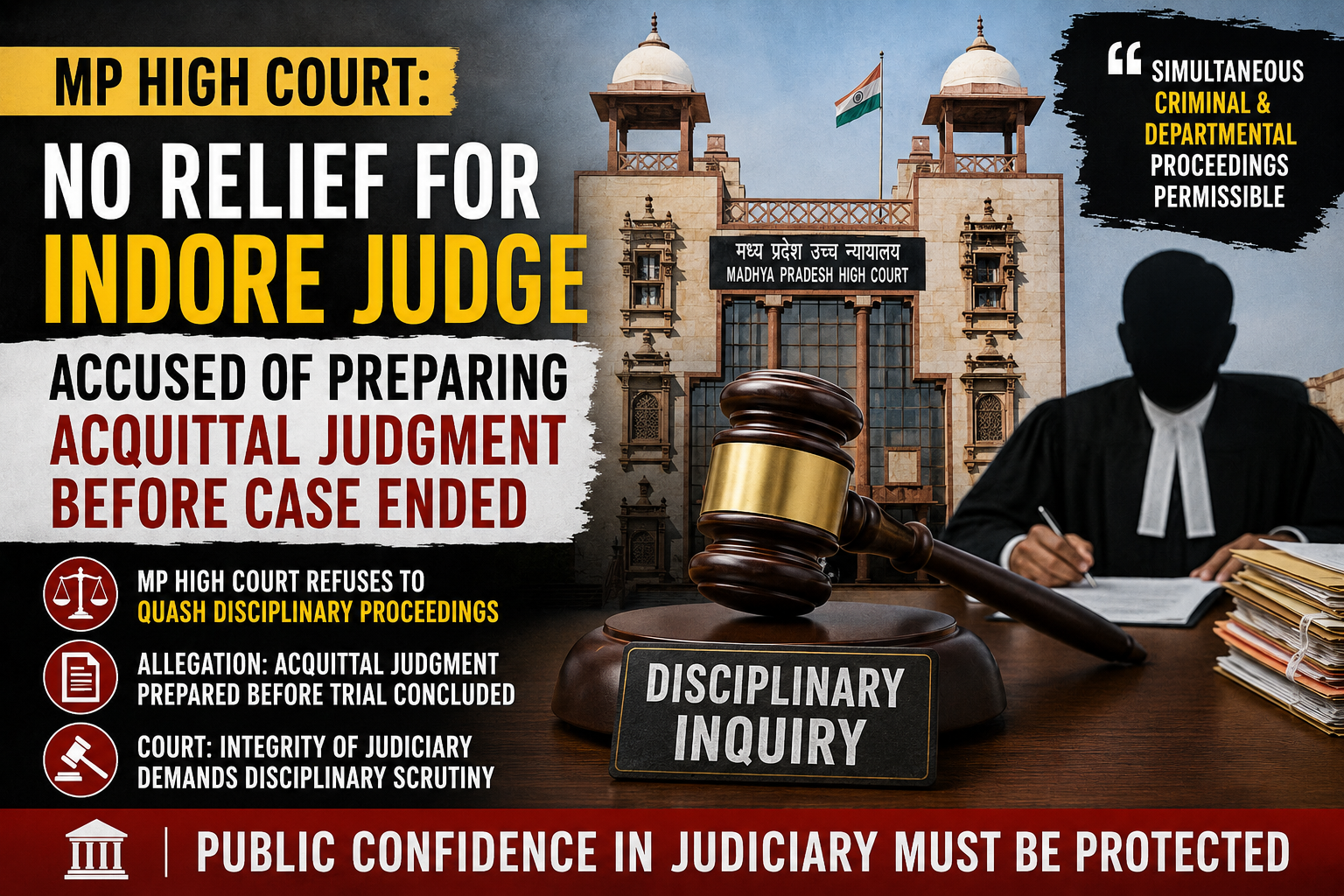
The Madhya Pradesh High Court has refused to quash departmental proceedings against a judicial officer who was accused of preparing an acquittal judgment in a criminal trial before the case had been legally concluded. The Court held that allegations touching the integrity of a judicial officer require careful disciplinary scrutiny and cannot be halted merely because a criminal prosecution on similar facts is pending. The writ petition was dismissed, leaving the disciplinary authority free to continue the inquiry in accordance with law.
Case Overview
In Vijendra Singh Rawat v. State of Madhya Pradesh and Others, Writ Petition No. 18568 of 2026, decided on 24 June 2026, a Division Bench of the Madhya Pradesh High Court at Jabalpur comprising Justice Anand Pathak and Justice B. P. Sharma considered a writ petition filed under Article 226 of the Constitution of India. The petitioner challenged a charge-sheet/show-cause notice dated 19.12.2025, issued by the High Court of Madhya Pradesh under Rule 14 of the Madhya Pradesh Civil Services (Classification, Control and Appeal) Rules, 1966.
The petitioner was a member of the Madhya Pradesh Judicial Service and, at the relevant time, was posted as V Civil Judge, Senior Division, Indore. The allegations arose from Criminal Trial No. 1621/2019, State v. Santosh Verma, where it was alleged that an acquittal judgment dated 06.10.2020 had been prepared and brought into existence despite the criminal case still being pending and not legally disposed of. The allegation further was that this was done to confer an undue advantage upon the accused, whose IAS award was allegedly affected by the pendency of the criminal case.
Following vigilance scrutiny on the administrative side of the High Court, the disciplinary authority placed the petitioner under suspension and issued the charge-sheet. The charge-sheet contained articles of charge, statement of imputations, list of documents and list of witnesses, and an Inquiry Officer and Presenting Officer were appointed.
Main Grounds Raised by the Judicial Officer
The petitioner challenged the disciplinary proceedings primarily on three grounds.
First, it was argued that there was a gross and unexplained delay because the alleged incident related to the year 2020, whereas the charge-sheet was issued only in December 2025. The petitioner contended that such delay caused prejudice to his defence.
Second, it was submitted that a criminal prosecution on the same set of facts was already pending and that continuation of the departmental inquiry would compel the petitioner to disclose his defence, thereby prejudicing his criminal trial. Reliance was placed on Capt. M. Paul Anthony v. Bharat Gold Mines Ltd., (1999) 3 SCC 679, where the Supreme Court had discussed circumstances in which departmental proceedings may be stayed pending criminal proceedings.
Third, the petitioner argued that the charge-sheet was vague and that the High Court could exercise judicial review to interfere where disciplinary proceedings were arbitrary or legally infirm.
High Court’s Reasoning
The High Court rejected the challenge. It reiterated the settled principle that interference with a charge-sheet at the threshold stage is exceptional. A writ court will ordinarily not quash a charge-sheet unless the authority lacks jurisdiction, the action is patently arbitrary, or the proceedings are contrary to law.
On the issue of delay, the Court held that the allegations were of a grave nature because they concerned the preparation of an acquittal judgment despite the criminal case not having been lawfully concluded. In matters concerning judicial officers, detailed vigilance scrutiny and careful examination may be necessary before disciplinary proceedings are initiated. The Court further held that the petitioner had not shown any specific prejudice arising from the delay; a mere assertion of prejudice was not enough.
On the plea that departmental proceedings should await the criminal trial, the Court held that Capt. M. Paul Anthony does not lay down an inflexible rule that disciplinary proceedings must be stayed in every case where a criminal prosecution is pending. The Court clarified that simultaneous continuation of criminal and departmental proceedings is not barred, and departmental proceedings cannot be indefinitely delayed where circumstances justify administrative action.
Most importantly, the Court emphasised that the matter involved a judicial officer and, therefore, public confidence in the judiciary was central. It held that the disciplinary authority was obligated to examine whether the conduct of the judicial officer met the standards of integrity and propriety expected from the office.
Why the High Court Refused to Quash the Charge-Sheet
The Court gave three clear reasons for refusing interference.
The first reason was that the case was at the charge-sheet stage. At this stage, the Court does not conduct a mini-trial on the correctness of allegations, sufficiency of evidence or probable defence.
The second reason was that the charge-sheet was not vague. It was supported by specific articles of charge, statement of imputations, witnesses and documentary material. Whether those charges are ultimately proved or disproved is a matter for the disciplinary inquiry.
The third reason was institutional. Allegations of misconduct against a judicial officer are not ordinary service disputes. They directly affect public confidence in the justice delivery system. The Court therefore held that such inquiry cannot be indefinitely postponed merely because a criminal case is pending.
Legal Position: Departmental Inquiry and Criminal Trial Can Proceed Together
The judgment reaffirms a settled position in service law: departmental proceedings and criminal proceedings operate in different fields.
A criminal trial determines whether an offence is proved beyond reasonable doubt. A departmental inquiry examines whether the employee’s conduct violates service discipline, integrity norms or institutional expectations. The standard of proof in a disciplinary inquiry is generally preponderance of probabilities, not proof beyond reasonable doubt.
Therefore, mere pendency of a criminal case does not automatically stay or invalidate departmental proceedings. A stay may be considered only in exceptional cases where both proceedings are based on identical facts, the criminal charge is grave, complicated questions of law and fact arise, and continuation of departmental proceedings would cause demonstrable prejudice.
In the present case, the High Court found no such ground for interference.
Why This Judgment Matters
This decision is important for three reasons.
First, it reinforces that judicial officers are held to a high standard of integrity, propriety and institutional responsibility. Any allegation that a judicial act was manipulated, prepared prematurely or used to confer an undue benefit must be examined with seriousness.
Second, it clarifies that disciplinary proceedings against judicial officers need not be frozen merely because a criminal prosecution is pending. The High Court’s administrative control over the subordinate judiciary includes the power and duty to inquire into conduct affecting the credibility of the institution.
Third, it confirms that delay in issuing a charge-sheet is not by itself fatal. A delinquent officer must show actual prejudice. Where the matter requires vigilance scrutiny and careful verification, some passage of time may not invalidate the proceedings.
Key Takeaways for Service Law and Judicial Discipline
- A charge-sheet is ordinarily not quashed at the threshold under Article 226.
- Delay in disciplinary proceedings must be tested on actual prejudice, not mere passage of time.
- Criminal prosecution and departmental inquiry can proceed simultaneously.
- Capt. M. Paul Anthony does not create an automatic bar against departmental proceedings.
- Judicial officers are subject to a higher standard of institutional integrity.
- Allegations affecting public confidence in courts require disciplinary scrutiny.
- Whether the allegations are true or false is for the inquiry authority to decide, not for the writ court at the initial stage.
Practical Legal Impact
For government servants, judicial officers and disciplinary authorities, this ruling is a reminder that a writ petition challenging a charge-sheet is a narrow remedy. Courts generally do not interfere unless the charge-sheet is without jurisdiction, mala fide, vague to the point of being indefensible, or issued in violation of statutory rules.
For disciplinary authorities, the judgment strengthens the position that serious allegations involving integrity, especially in judicial or public office, must be inquired into promptly but fairly.
For delinquent officers, the judgment shows that objections based on delay or parallel criminal proceedings must be supported by specific and demonstrable prejudice. General allegations of prejudice are unlikely to succeed.
Frequently Asked Questions
1. Can a departmental inquiry continue when a criminal case is pending?
Yes. There is no absolute legal bar on simultaneous departmental and criminal proceedings. A stay may be granted only in exceptional cases where continuation of the inquiry would cause serious prejudice.
2. Can a charge-sheet be quashed under Article 226?
Yes, but only in limited circumstances. A High Court may interfere if the charge-sheet is issued without jurisdiction, is patently arbitrary, violates statutory rules, or is so vague that no meaningful defence is possible.
3. Is delay enough to quash disciplinary proceedings?
No. Delay alone is not sufficient. The employee must show actual prejudice caused by the delay, such as loss of material evidence or inability to defend effectively.
4. What was the allegation against the Indore judicial officer?
The allegation was that an acquittal judgment in a criminal trial was prepared and brought into existence even though the criminal case had not been legally concluded. The allegation remains subject to proof in the disciplinary inquiry.
5. Did the High Court decide that the judicial officer was guilty?
No. The High Court did not decide guilt. It only refused to quash the charge-sheet and permitted the disciplinary authority to proceed with the inquiry in accordance with law.
Conclusion
The Madhya Pradesh High Court’s decision in Vijendra Singh Rawat v. State of Madhya Pradesh is a significant ruling on judicial discipline, departmental proceedings and the limited scope of writ interference at the charge-sheet stage. The Court made it clear that allegations affecting the integrity of the judicial institution cannot be shut down at the threshold merely on the grounds of delay or pendency of criminal proceedings.
The final finding of guilt or innocence will depend on the evidence led in the departmental inquiry. However, the ruling firmly establishes that where allegations concern the credibility of the justice system itself, disciplinary scrutiny is not only permissible but institutionally necessary.
Disclaimer
This article is for legal awareness and informational purposes only. It is based on publicly reported facts and the available judgment/order. It does not constitute legal advice, solicitation, or a legal opinion on the guilt or innocence of any person. Departmental proceedings, judicial service matters and criminal cases depend on their own facts, documents, service rules and procedural history.