
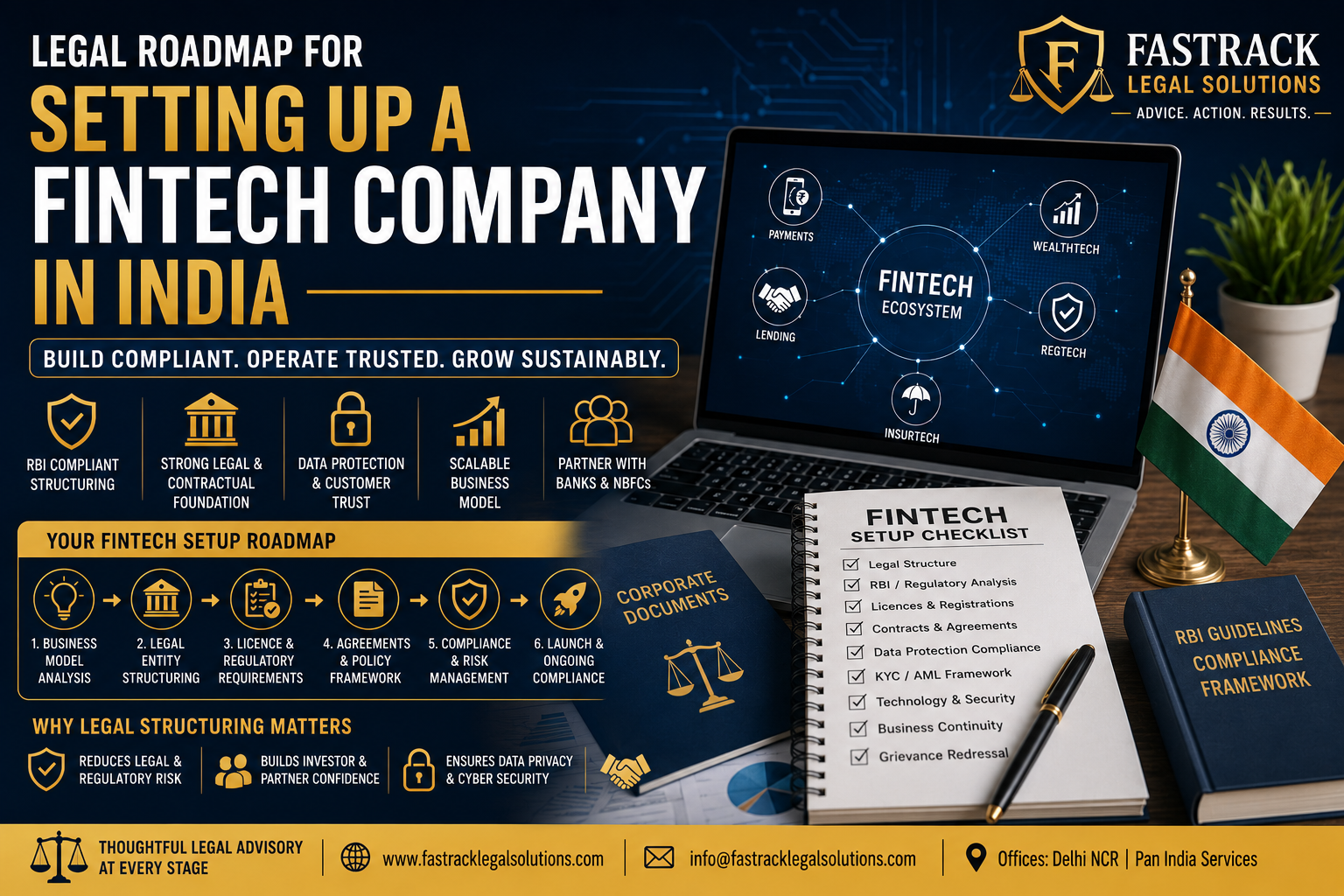
Setting up a fintech company in India requires first identifying the business model because fintech is not one single licence. A fintech may operate as a technology service provider, Lending Service Provider, digital lending platform, payment aggregator, payment gateway, prepaid instrument issuer, account aggregator, credit marketplace, wealth-tech platform, insurtech, regtech or embedded-finance platform. The legal requirements depend on whether the fintech merely provides technology support or performs regulated financial activities requiring RBI, SEBI, IRDAI, PFRDA or other regulatory approval. A legally sound fintech setup requires entity incorporation, business-model mapping, licence analysis, fund-flow and data-flow structuring, customer disclosures, data protection compliance, contracts with regulated entities, grievance redressal, KYC/AML alignment and ongoing compliance controls.
Non-Solicitation Note
This article is intended for general legal awareness and educational purposes only. It is not an advertisement, solicitation, invitation, or inducement for professional engagement. The purpose is to explain the legal and regulatory framework relevant to setting up a fintech company in India.
Introduction
India is one of the world’s most active fintech markets. Digital payments, lending platforms, credit marketplaces, wealth-tech tools, embedded finance, payment aggregators, neobanking interfaces, account aggregation, regtech, insurtech, digital onboarding, BNPL-style products and data-driven financial services are now part of mainstream financial activity.
However, fintech is not only a technology business. It is a regulated-risk business. The legal position depends on one core question:
Is the fintech only providing technology, or is it carrying on a regulated financial activity?
This distinction decides whether the entity needs RBI authorisation, NBFC registration, payment aggregator approval, PPI authorisation, account aggregator registration, SEBI registration, IRDAI registration, or only contractual compliance with a regulated partner.
A fintech founder should not begin by asking, “Which company should we incorporate?” The better first question is:
What exactly will the fintech do, who will hold customer money, who will lend, who will advise, who will collect data, who will bear risk, and who will face the customer?
This article provides a legal and compliance roadmap for setting up a fintech company in India.
What is a Fintech Company?
A fintech company is a business that uses technology to provide, enable, distribute, support or improve financial services.
A fintech may operate in areas such as:
- Digital payments.
- Online lending.
- Lending Service Provider activity.
- Payment aggregation.
- Payment gateway services.
- Prepaid payment instruments.
- Account aggregation.
- Personal finance management.
- Credit scoring and underwriting analytics.
- Wealth-tech and investment platforms.
- Insurance distribution technology.
- Embedded finance.
- Regtech and compliance automation.
- Financial data infrastructure.
- Merchant payment solutions.
- Cross-border payment facilitation.
- Collection and repayment solutions.
- Invoice financing support.
- Supply-chain finance support.
- Digital KYC and onboarding tools.
Each model has a different regulatory consequence.
Step 1: Identify the Fintech Business Model
Before incorporation or fundraising, the founders should prepare a clear business model note.
The note should answer:
- What product or service is being offered?
- Is the company lending from its own balance sheet?
- Is the company sourcing borrowers for an NBFC or bank?
- Is the company collecting money from customers or merchants?
- Is the company operating a payment system?
- Is the company issuing wallets or prepaid instruments?
- Is the company advising on investments?
- Is the company distributing insurance?
- Is the company handling personal financial data?
- Is the company using credit bureau data?
- Is the company using account aggregator data?
- Is the company charging customers directly?
- Will the company hold customer funds?
- Will the company provide any guarantee or default-loss support?
- Which regulator may have jurisdiction?
A vague model creates licensing risk. A precise model enables lawful structuring.
People Also Ask: Does Every Fintech Need RBI Licence?
No. Every fintech does not automatically need an RBI licence. A fintech that only provides software or technology support may not need RBI authorisation. However, if the fintech operates a payment system, payment aggregator, prepaid wallet, account aggregator, NBFC lending business or other regulated financial activity, licensing or authorisation may be required.
The legal analysis depends on the actual activity, not the label used by the company.
Step 2: Choose the Right Legal Entity
Most fintech businesses in India prefer a private limited company because it is generally better suited for fundraising, investor due diligence, ESOPs, board governance, regulated-entity partnerships, contracts and scalability.
Possible structures include:
- Private limited company.
- Public limited company, in larger cases.
- LLP, usually less preferred for venture-backed fintech.
- Wholly owned subsidiary of an existing company.
- Group company structure with technology and regulated activity separated.
- NBFC subsidiary, where lending is intended.
- Separate LSP entity for NBFC partnership.
Basic Incorporation Documents
- Certificate of incorporation.
- Memorandum of Association.
- Articles of Association.
- PAN and TAN.
- GST registration, where applicable.
- Shops and Establishments registration, where applicable.
- Udyam registration, where applicable.
- Board resolutions.
- Founder agreements.
- Shareholders agreement, where applicable.
- Employment and IP assignment agreements.
The object clause should be drafted carefully to cover fintech activities without misrepresenting regulated services.
Step 3: Decide Whether the Fintech Will Be Regulated or Unregulated
A fintech can broadly fall into three categories.
Category 1: Pure Technology Service Provider
The company builds software for banks, NBFCs, merchants, insurers or other financial institutions.
Examples:
- Loan management software.
- KYC workflow tool.
- Fraud monitoring tool.
- API integration.
- Credit analytics support.
- Merchant dashboard.
- Regtech platform.
This model may not require financial-sector licence if it does not handle regulated activity, customer money, lending decision, investment advice, insurance solicitation or payment-system operation.
Category 2: Regulated Financial Entity
The fintech itself performs regulated financial activity.
Examples:
- NBFC lending.
- Payment aggregator.
- PPI issuer.
- Account aggregator.
- Investment adviser.
- Stock broker.
- Insurance intermediary.
- Payment system operator.
This model may require regulator approval and ongoing compliance.
Category 3: Partner-Led Model
The fintech partners with a regulated entity and acts as service provider, platform, sourcing partner, LSP, technology vendor or digital interface.
Examples:
- LSP for NBFC.
- Co-branded loan marketplace.
- Merchant acquisition partner.
- Insurance web aggregator partner.
- Wealth-tech distributor model.
- Digital onboarding provider.
This model may not require direct licensing in every case, but it requires strong contracts, disclosures and compliance controls.
Step 4: RBI Licence Analysis
Fintech founders must check whether RBI authorisation is required.
A. NBFC Registration
If the company wants to lend from its own balance sheet as a financial business, it may require NBFC registration. NBFC registration involves minimum net owned fund, fit-and-proper criteria, business plan, management review, source of funds scrutiny and ongoing RBI compliance.
A company should not lend commercially and systematically without examining NBFC registration requirements.
B. Payment Aggregator
If the fintech aggregates payments from customers and settles them to merchants, it may fall within the payment aggregator framework. Payment aggregator activity is regulated by RBI and may require authorisation under the applicable RBI directions.
C. Payment System
If the fintech operates or commences a payment system, it must examine authorisation under the Payment and Settlement Systems Act, 2007.
D. Prepaid Payment Instruments
If the fintech issues wallets, stored-value instruments, prepaid cards or similar instruments, PPI regulations may apply.
E. Account Aggregator
If the fintech proposes to retrieve, consolidate or transfer financial information under the account aggregator framework, it may require NBFC-Account Aggregator registration.
F. Digital Lending / LSP
If the fintech supports a bank or NBFC in digital lending, it may be treated as a Lending Service Provider. The regulated lender remains responsible for borrower-facing compliance, but the LSP must operate within RBI’s digital lending and outsourcing framework.
People Also Ask: Can a Fintech Lend Without NBFC Licence?
A fintech should not conduct lending as a financial business without analysing NBFC registration requirements. If the fintech only sources borrowers or provides technology support for an RBI-regulated lender, the lender may be the bank or NBFC and the fintech may act as an LSP or service provider. But if the fintech lends from its own funds as its business, NBFC licensing issues may arise.
Step 5: SEBI, IRDAI and Other Regulator Analysis
Not all fintechs are regulated only by RBI.
SEBI May Apply If the Fintech Offers
- Investment advice.
- Research recommendations.
- Stock broking.
- Mutual fund distribution.
- Portfolio management support.
- Robo-advisory.
- Securities-related platforms.
- Alternative investment services.
IRDAI May Apply If the Fintech Offers
- Insurance distribution.
- Insurance comparison.
- Web aggregation.
- Corporate agency.
- Insurance broking.
- Claim assistance linked to insurance intermediation.
PFRDA May Apply If the Fintech Offers
- Pension product distribution.
- NPS-related intermediation.
- Pension advisory or onboarding services.
A fintech may require multiple regulatory reviews if it combines lending, payments, insurance and investments.
Step 6: Fund-Flow Structuring
Fund flow is one of the most critical legal issues in fintech.
A fintech must identify:
- Who receives customer money?
- Who holds settlement funds?
- Is there a nodal/escrow/current account?
- Is the fintech pooling funds?
- Is the fintech collecting repayments?
- Is the fintech settling merchants?
- Is the fintech deducting fees before settlement?
- Is the fintech holding loan disbursement money?
- Is the fintech routing money internationally?
- Are FEMA or cross-border payment rules involved?
Improper fund flow can convert a technology business into a regulated payment or lending activity.
Red-Flag Fund Flows
- Loan funds routed through fintech account.
- Repayments collected by fintech instead of lender.
- Customer funds pooled without authorisation.
- Merchant settlements controlled without PA authorisation.
- Hidden deductions from loan amount.
- Wallet-like stored value without PPI approval.
- Cross-border settlement without proper framework.
- Fintech holding money “temporarily” without legal basis.
People Also Ask: Can a Fintech Hold Customer Money?
A fintech should not hold customer money unless the business model is legally structured and authorised where required. Holding, pooling, settling or transferring customer funds may trigger payment aggregator, payment system, PPI, escrow, KYC, AML and RBI compliance issues.
Step 7: Data-Flow and Privacy Structuring
Fintech businesses process sensitive financial and personal data. Data-flow mapping is therefore essential.
The fintech should identify:
- What data is collected?
- Who collects it?
- Why is it collected?
- What consent is taken?
- Where is data stored?
- Who can access it?
- Is data shared with banks/NBFCs?
- Is data shared with vendors?
- Is credit bureau data used?
- Is account aggregator data used?
- How long is data retained?
- How is data deleted?
- How are breaches handled?
- Are children’s data or sensitive categories involved?
The Digital Personal Data Protection Act, 2023 and DPDP Rules framework require fintechs to build notice, consent, purpose limitation, security, grievance and breach response processes into their product journey.
Data Protection Documents for Fintech
A fintech should prepare:
- Privacy policy.
- Terms of use.
- Consent notice.
- Data processing agreement.
- Data retention policy.
- Data deletion policy.
- Information security policy.
- Breach response SOP.
- Vendor data-sharing clauses.
- Employee confidentiality undertakings.
- Grievance redressal process.
- Consent withdrawal mechanism.
- Data principal rights mechanism.
- Data inventory and processing register.
Data compliance should be product-integrated, not merely uploaded as a website policy.
Step 8: KYC and AML Compliance
Depending on the model, fintechs may have to support or comply with KYC/AML requirements.
For regulated models, KYC obligations may arise through:
- RBI KYC directions.
- Prevention of Money Laundering Act framework.
- Regulated entity policies.
- Payment aggregator merchant due diligence.
- NBFC borrower onboarding.
- PPI wallet KYC.
- Account aggregator consent framework.
- Fraud and suspicious transaction monitoring.
Even where the fintech is only a service provider, the bank/NBFC may impose KYC-support obligations contractually.
Step 9: Customer Journey and Disclosures
The fintech interface should not mislead customers.
A legally compliant customer journey should clearly disclose:
- Who is the lender/payment provider/service provider?
- Is the fintech only a platform?
- What fees are charged?
- Who receives the fees?
- What data is collected?
- What consent is being given?
- What are the product risks?
- What is the grievance mechanism?
- What are cancellation/refund terms?
- What documents are binding?
- Is the product regulated?
- Who is responsible for complaints?
Dark patterns, hidden charges, confusing lender identity, pre-ticked consent boxes and misleading promises create legal risk.
Step 10: Agreements Required for Fintech Setup
A fintech company may require several agreements depending on its model.
Founder and Governance Documents
- Founder agreement.
- Shareholders agreement.
- ESOP plan.
- Board policies.
- IP assignment documents.
- Confidentiality agreements.
Customer-Facing Documents
- Terms of use.
- Privacy policy.
- Consent notice.
- Refund/cancellation policy.
- Grievance policy.
- Product terms.
- User declarations.
B2B and Regulated Entity Documents
- Bank/NBFC partnership agreement.
- LSP agreement.
- Payment gateway agreement.
- Payment aggregator agreement.
- Data processing agreement.
- Vendor agreement.
- API integration agreement.
- Service-level agreement.
- Collection/recovery support agreement.
- Default-loss guarantee agreement, where legally permissible.
Internal Compliance Documents
- AML/KYC support SOP.
- Information security policy.
- Data breach SOP.
- Business continuity plan.
- Vendor risk management policy.
- Cybersecurity incident plan.
- Employee code of conduct.
- Outsourcing policy.
- Compliance calendar.
- Board reporting format.
People Also Ask: What Documents Are Required to Start a Fintech in India?
A fintech should prepare incorporation documents, founder agreement, business model note, licence applicability note, fund-flow note, data-flow note, privacy policy, terms of use, customer consent forms, partner agreements, information security policy, grievance SOP, vendor contracts, compliance calendar and regulator-specific documentation where required.
Step 11: Cybersecurity and Technology Controls
Fintech platforms are high-risk from a cybersecurity perspective because they handle financial information, identity data, bank details, transaction data and authentication flows.
A fintech should implement:
- Secure software development practices.
- Encryption.
- Access control.
- Logging and monitoring.
- Vulnerability assessment.
- Penetration testing.
- Secure API management.
- Incident response plan.
- Data backup.
- Business continuity planning.
- Vendor security review.
- Employee access control.
- Fraud monitoring.
- Customer authentication controls.
Security failures can lead to regulatory action, customer claims and reputational damage.
Step 12: Grievance Redressal
A fintech should have a clear grievance-redressal mechanism.
The grievance process should include:
- Complaint channels.
- Grievance officer details.
- Acknowledgment timeline.
- Resolution timeline.
- Escalation matrix.
- Regulated entity escalation, where applicable.
- Refund/reversal process.
- Fraud-reporting process.
- Data privacy complaint process.
- Record retention.
In partner-led models, the customer should not be confused between the fintech and the regulated entity.
Step 13: Revenue Model Structuring
Revenue model must be legally reviewed.
Common fintech revenue models include:
- SaaS fee.
- Platform fee.
- Lead-generation fee.
- Service fee from NBFC/bank.
- Merchant discount rate.
- Payment aggregation fee.
- Subscription fee.
- API usage fee.
- Commission.
- Distribution fee.
- Collection support fee.
- Default-loss guarantee-linked economics, where permissible.
Red Flags
- Hidden borrower fees.
- Deduction from loan amount without disclosure.
- Success fee that distorts suitability.
- Collection incentives encouraging harassment.
- Unclear GST treatment.
- Revenue share that resembles interest spread without licence.
- Fees collected from customer in unregulated manner.
Revenue should be commercially sensible and regulatorily defensible.
Step 14: Tax and GST Structuring
Fintech businesses should also review tax and GST implications.
Issues may include:
- GST on platform fees.
- GST on technology services.
- GST on payment facilitation services.
- TDS on vendor payments.
- Transfer pricing in group structures.
- Withholding tax on foreign software/API services.
- Equalisation levy issues, where relevant.
- Invoicing structure.
- Revenue recognition.
- Input tax credit eligibility.
- Cross-border service classification.
- GST registration across States, where applicable.
A fintech should not finalise commercial pricing without tax review.
Step 15: Fundraising Readiness
Investors reviewing fintech startups usually examine regulatory risk closely.
A fintech should be ready with:
- Cap table.
- Incorporation documents.
- Founder IP assignment.
- Employment agreements.
- Regulatory licence note.
- Data protection compliance note.
- Customer terms.
- Key contracts.
- Pending disputes.
- Tax compliance.
- Cybersecurity policies.
- Material vendor agreements.
- Regulated entity agreements.
- Compliance calendar.
- Board minutes and approvals.
Regulatory uncertainty can affect valuation, investment conditions and closing timelines.
Common Fintech Models and Legal Treatment
| Fintech Model | Legal Question | Possible Regulatory Area |
|---|---|---|
| Digital lending app | Who is lender? | RBI digital lending, LSP, NBFC |
| Payment aggregator | Who collects/settles funds? | RBI PA authorisation |
| Wallet/PPI | Is stored value issued? | PPI framework |
| Loan marketplace | Are lenders displayed transparently? | Digital lending, LSP |
| Wealth-tech | Is advice or execution provided? | SEBI |
| Insurtech | Is insurance solicited/distributed? | IRDAI |
| Account data platform | Is financial data shared through AA? | NBFC-AA |
| Regtech | Pure software or compliance outsourcing? | Contractual/outsourcing |
| Cross-border payments | Is forex/payment facilitation involved? | FEMA, RBI PA-CB |
| Embedded finance | Who owns regulated product? | Depends on product |
Common Mistakes While Setting Up a Fintech
- Starting operations before licence analysis.
- Calling technology product “unregulated” without checking fund flow.
- Holding customer money without authorisation.
- Lending without NBFC analysis.
- Hiding actual lender identity.
- Using copied terms and privacy policy.
- Collecting excessive customer data.
- No consent trail.
- No grievance mechanism.
- No partner agreement with regulated entity.
- No data processing agreement.
- No cybersecurity controls.
- No tax review.
- No founder IP assignment.
- No compliance calendar.
These mistakes are easier to prevent at the setup stage than to cure after launch.
People Also Ask: What Is the First Legal Step to Start a Fintech?
The first legal step is to prepare a business model and regulatory applicability note. This note should identify whether the fintech is a technology provider, LSP, lender, payment aggregator, PPI issuer, investment platform, insurance distributor or data platform. The licensing and compliance path depends on this classification.
Practical Setup Roadmap
Phase 1: Model Diagnosis
- Define product.
- Identify customer.
- Identify regulated activity.
- Identify regulator.
- Map fund flow.
- Map data flow.
- Identify licence requirement.
Phase 2: Entity and Governance
- Incorporate company.
- Draft object clause.
- Execute founder agreement.
- Assign IP.
- Create board approvals.
- Prepare compliance matrix.
Phase 3: Regulatory Structuring
- Prepare licence note.
- Prepare partner model.
- Draft regulated entity agreement.
- Review RBI/SEBI/IRDAI applicability.
- Prepare application documents if licence is required.
Phase 4: Product Compliance
- Terms of use.
- Privacy policy.
- Consent flow.
- Customer disclosures.
- Grievance process.
- Data protection controls.
- Security controls.
Phase 5: Launch Readiness
- Contract execution.
- Compliance testing.
- Customer journey review.
- Fund-flow verification.
- Data-flow verification.
- Staff training.
- Audit log setup.
- Go-live approval.
How to start a fintech company in India?
Start by identifying the fintech model, incorporating the entity, checking licence requirements, mapping fund flow and data flow, preparing customer terms, privacy policy, partner agreements, cybersecurity controls and compliance calendar.
Which licence is required for fintech in India?
There is no single fintech licence. Depending on the model, RBI, SEBI, IRDAI, PFRDA or no direct licence may apply. Payment aggregators, NBFC lenders, PPI issuers and account aggregators require specific regulatory analysis.
Can fintech operate without RBI approval?
Yes, if it only provides technology or support services and does not perform regulated financial activity. RBI approval may be required if it operates payment systems, payment aggregation, lending as NBFC, PPI or account aggregation.
Is private limited company suitable for fintech?
Yes, most fintech startups prefer private limited company structure because it supports fundraising, ESOPs, investor rights, regulated partnerships and governance.
What is the biggest legal risk for fintech startups?
The biggest legal risk is launching a financial product without correctly identifying licensing, fund-flow, data protection, customer disclosure and regulated-entity responsibility.
Frequently Asked Questions
1. How do I set up a fintech company in India?
To set up a fintech company in India, identify the business model, incorporate a suitable entity, examine RBI/SEBI/IRDAI licence requirements, prepare fund-flow and data-flow notes, draft customer and partner contracts, create data protection documents and implement compliance controls.
2. Does fintech require RBI licence?
Not every fintech requires RBI licence. RBI approval may be required if the fintech carries on regulated activities such as NBFC lending, payment aggregation, prepaid payment instruments, account aggregation or payment system operation.
3. Can a fintech provide loans without becoming NBFC?
A fintech can act as an LSP or technology partner for a bank/NBFC, but if it lends from its own balance sheet as a business, NBFC registration requirements must be examined.
4. Can a fintech collect payments from customers?
It depends on the model. If the fintech aggregates payments and settles to merchants, payment aggregator regulations may apply. Customer fund-flow must be legally structured.
5. What documents are needed for fintech startup?
Key documents include incorporation papers, founder agreement, licence note, business model note, fund-flow note, data-flow note, terms of use, privacy policy, partner agreements, vendor contracts, information security policy and grievance SOP.
6. What is LSP in fintech?
An LSP, or Lending Service Provider, assists a regulated lender in digital lending functions such as customer acquisition, onboarding, servicing, monitoring or recovery support.
7. Can fintech operate as payment aggregator?
Yes, but payment aggregator activity is regulated and may require RBI authorisation and compliance with net worth, governance, merchant due diligence, escrow and settlement requirements.
8. Is DPDP compliance required for fintech?
Yes. Fintechs process personal and financial data and should implement privacy notice, consent, data minimisation, security safeguards, grievance mechanism, breach response and data retention controls.
9. Can foreign investors invest in Indian fintech?
Foreign investment may be possible subject to FDI policy, sectoral caps, beneficial ownership checks, FEMA pricing, reporting and regulatory approvals depending on the fintech activity.
10. What should fintech founders do before launch?
Before launch, founders should complete licence analysis, fund-flow review, data-flow review, customer terms, privacy policy, regulated partner agreements, cybersecurity checks, grievance mechanism and compliance calendar.
Conclusion
Setting up a fintech company in India requires more than incorporation and app development. The legal structure must match the actual financial activity. A fintech that only provides software may have a very different compliance path from a fintech that lends, aggregates payments, issues wallets, distributes financial products, processes financial data or works as an LSP.
The safest approach is to classify the business model first, then build the entity, contracts, data controls, fund-flow structure, customer disclosures and regulatory compliance around that classification.
A fintech should be built regulator-ready from day one. Once customer money, credit, payments or personal financial data enter the model, legal structuring becomes core infrastructure, not a post-launch formality.
Disclaimer
This article is intended for general legal awareness and educational purposes only. It is not an advertisement, solicitation, invitation, or professional inducement. Fintech structuring depends on the exact business model, regulator, product, fund flow, data flow, foreign investment, customer interface, partner contracts and applicable law. Specific legal advice should be taken before launching any regulated fintech activity.