
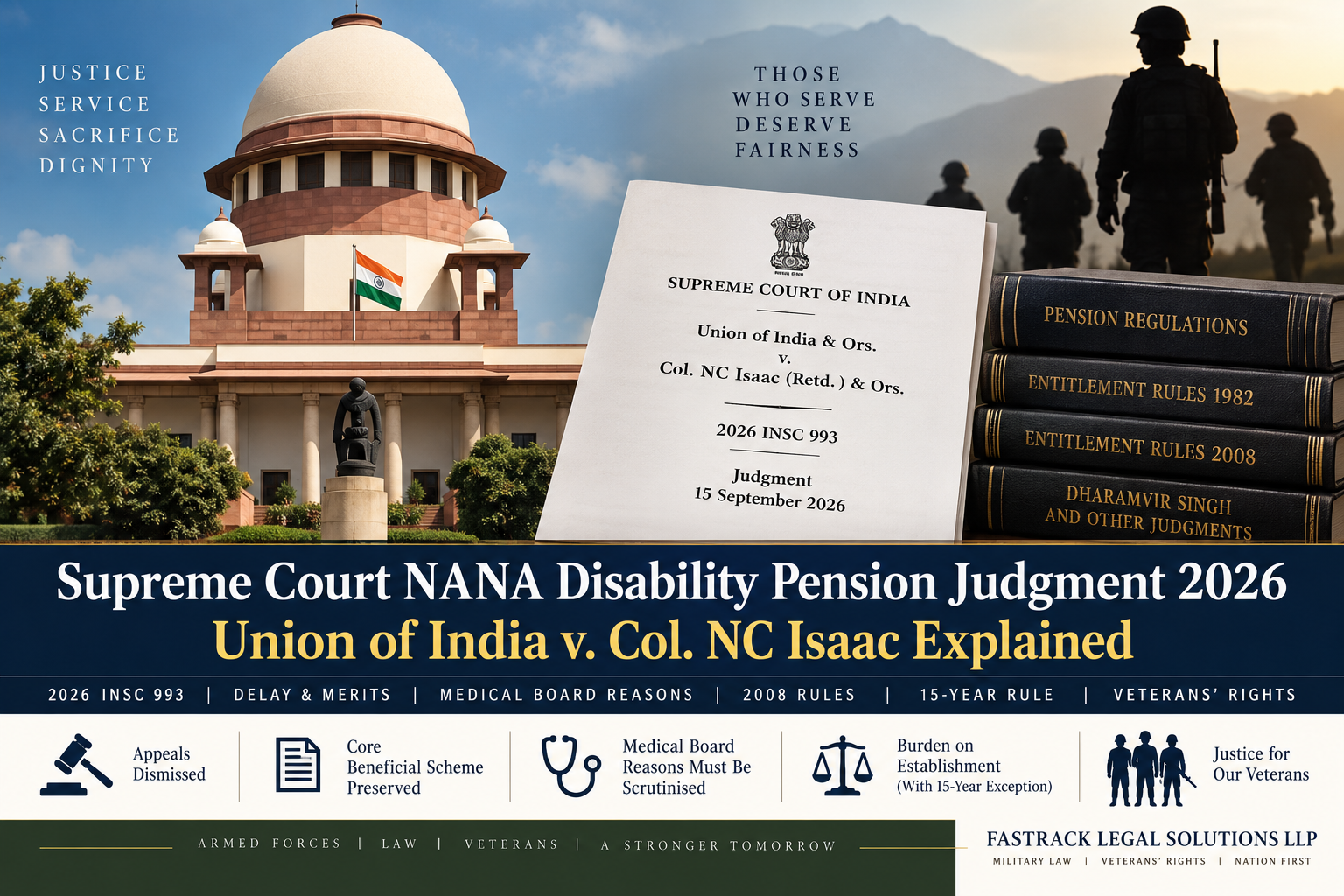
SUPREME COURT · NANA DISABILITY PENSION · AFT · 2026 INSC 993
Supreme Court NANA Disability Pension Judgment 2026: Union of India v. Col. NC Isaac Explained
By Adv. Govind Bali · Fastrack Legal Solutions LLP
A detailed practitioner analysis of Union of India & Ors. v. Col. NC Isaac (Retd.) & connected matters, 2026 INSC 993, decided on 15 September 2026 by Justices Pamidighantam Sri Narasimha and Alok Aradhe, and its implications for NANA disability pension, Medical Board reasoning, Entitlement Rules, burden of proof, delayed claims and Armed Forces Tribunal litigation.
The Supreme Court’s judgment in Union of India & Ors. v. Col. NC Isaac (Retd.) & connected matters, 2026 INSC 993 is one of the most important recent decisions on Armed Forces disability pension. The Court did not merely dismiss a Special Leave Petition at the threshold. Leave was granted, the legal controversy was examined through a detailed reportable judgment, and the present batch was dismissed on the grounds of delay as well as on merits.
The judgment is especially important for cases in which a Release Medical Board or other competent Medical Board classified a disease or disability as NANA, meaning Neither Attributable to Nor Aggravated by Military Service, but the Armed Forces Tribunal or a High Court later granted the disability element. It also clarifies how the 1982 and 2008 Entitlement Rules should be read together, how much weight should be given to Medical Board opinions, and when the burden of proof shifts in old claims.
For the wider forum and procedure framework, readers may first see our AFT Lawyer in Delhi: Armed Forces Tribunal, Service and Military Pension Matters. For the commercial disability-pension pathway, see Disability Pension Lawyer in Delhi: Medical Board, NANA, Attributability and AFT Claims.
1. What the Supreme Court was deciding
The Court explained that the present appeals shared a common factual pattern. A Release Medical Board had initially classified the disability of an ex-serviceman as NANA. Departmental appeals were also rejected on the basis of that medical opinion. The ex-servicemen then approached the Armed Forces Tribunal or High Courts, and those forums interfered and granted the disability element on the basis that the disability was attributable to or aggravated by military service. The Union challenged those favourable orders before the Supreme Court.
The Court expressly confined the controversy before it to entitlement to the disability element of service pension upon retirement or completion of service or engagement. This qualification is important. The judgment contains principles that are useful across disability-pension litigation, but the factual controversy before the Court principally concerned personnel who had completed service rather than every category of medical invalidment.
2. Disability pension, disability element and invalid pension are not identical
One useful feature of the judgment is the Court’s care in distinguishing different pension concepts. A person medically invalided before completing normal service can fall within provisions dealing with invalidment. By contrast, a person who completes tenure or retires in the normal course may already receive a service pension and additionally claim the disability element if the disability is attributable to or aggravated by military service and satisfies the applicable percentage requirement.
The Court observed that pleadings often use the expression “disability pension” loosely. In practice, the distinction can affect the applicable regulation, the mode of cessation and the relief that should be sought before the AFT. Our broader Army Disability Pension 2026 guide should be read together with this judgment for the wider benefit structure.
3. The 1982 Entitlement Rules and why Dharamvir Singh became so important
The Supreme Court revisited the Entitlement Rules for Casualty Pensionary Awards, 1982 in detail. Under the earlier regime, Rule 5 created a presumption that a service member was in sound physical and mental condition at entry except for disabilities noted or recorded at that time. Rule 9 provided that the claimant should not ordinarily be called upon to prove the conditions of entitlement and should receive the benefit of reasonable doubt.
Those provisions formed the legal setting for Dharamvir Singh v. Union of India, (2013) 7 SCC 316. In Dharamvir, the Court held that where no disease was recorded at entry and the serviceman later developed the disabling condition, the applicable presumption and burden framework had to be respected. It also emphasised that a Medical Board should give reasons where it sought to conclude that a disease was not related to service.
In NC Isaac, the Supreme Court expressly revisited Dharamvir, reproduced its core principles and treated it as an important authority on presumption, causality and burden of proof. But the Court also cautioned against mechanical application of Dharamvir without considering the governing rules and the medical facts of the individual case.
4. The Union’s central argument: the 2008 Rules changed the legal position
The Attorney General argued that the Entitlement Rules 2008 materially changed the earlier framework. Rule 5 of the 2008 regime recognises that the medical examination at entry is not exhaustive and may not detect dormant, hereditary, constitutional or congenital disease. It further states that the mere manifestation of a disease during military service does not, by itself, establish attributability or aggravation.
That argument was legally serious. Under the 2008 framework, healthy entry is still relevant, but it is no longer an automatic answer to causation. A disease can manifest during military service and still be unrelated to military conditions if the medical evidence and applicable rules support that conclusion.
5. The Supreme Court’s key answer: no significant change in the core scheme
The Court compared the 1982 and 2008 regimes issue by issue. Its conclusion is one of the most important holdings in the judgment: although the 2008 Rules removed the old automatic presumption at entry and expressly strengthened the need for causal connection, they did not dismantle the broader beneficial structure of the entitlement framework.
| Issue | 1982 Rules | 2008 Rules after NC Isaac |
|---|---|---|
| Healthy entry | Strong express presumption | Automatic presumption removed; entry examination recognised as limited |
| Causal connection | Required through appropriate medical authority | Continues to be required |
| Onus of proof | Claimant ordinarily not called upon to prove entitlement | Broadly retained, subject to 15-year exception |
| Aggravation | Protective aggravation rule | Substantially preserved and clarified |
| Unknown cause | Attributability can be conceded if presumption not rebutted | Similar protection retained through Rule 10(b)(iii) |
| Old claims | No equivalent 15-year proviso | After 15 years, burden shifts to claimant |
The Court therefore rejected the proposition that the 2008 Rules completely reversed the earlier claimant-protective philosophy. In substance, the core principles concerning causation, onus, aggravation and reasonable doubt continue, subject to limited but important qualifications.
6. Healthy at entry no longer automatically proves service attributability
This is one of the most important nuances in NC Isaac. A claimant cannot simply say, “I was fit when I joined, therefore every disease that appeared later must be attributable to military service.” Under Rule 5 of the 2008 framework, the entry medical examination is acknowledged to be limited. Dormant, hereditary, constitutional or congenital conditions may not necessarily be detected at entry.
Accordingly, the Court requires an actual causal analysis. The medical history, nature of disease, conditions of service and reasons recorded by the competent Medical Board remain important.
But the removal of the automatic presumption does not mean the claimant now carries the entire burden in every case. That leads directly to Rule 7.
7. Rule 7: ordinarily the primary burden remains on the establishment
The Supreme Court held that Rule 7 of the 2008 Entitlement Rules broadly carries forward the earlier onus principle. Ordinarily the claimant is not required to prove entitlement from a blank slate. The broader burden structure continues to operate in the claimant’s favour in ordinary cases.
The Court approved the broad approach that where a negative Medical Board opinion is relied upon, it must be a sound, reasoned opinion. A claimant can place the opinion under scrutiny by showing infirmity, omission of relevant material, failure to apply the correct rule or inadequate reasons. Once such a prima facie problem is demonstrated, the Department may have to justify the Medical Board’s conclusion.
8. The 15-year exception: one of the biggest practical changes
The most important qualification is the proviso to Rule 7. Where a claim is preferred after 15 years from discharge, retirement, invalidment or release, the burden shifts to the claimant.
The rationale is practical. By that time, relevant service documents may have been destroyed after the prescribed retention period. The administration cannot fairly be expected to disprove a claim when the records necessary to meet that burden may no longer exist.
This aspect should now be read together with our Armed Forces Tribunal Limitation 2026 guide. Limitation, recurring pension rights and the 15-year Rule 7 burden are related but distinct questions.
9. Medical Boards deserve due weight, but that is not the end of the enquiry
Paragraph 39 of the judgment contains a carefully balanced formulation. The Supreme Court accepted that the opinion of the Medical Board deserves due weight and should not be substituted merely because a court can imagine another possible medical view.
That principle protects specialist expertise. Courts and Tribunals are not medical boards and should not casually replace expert medical conclusions with judicial intuition.
But the Court immediately added the other half of the rule: in pending matters, the Tribunal must scrutinise in detail the opinion and reasons expressed by the Medical Board.
That is why this judgment should become the lead authority in our cornerstone analysis, Why Medical Board Reasons Matter in Armed Forces Disability Pension Cases.
10. Deference is strongest when the Medical Board is actually reasoned
NC Isaac should not be read as creating blind deference. The Court’s framework is better understood as reasoned medical deference.
A Medical Board opinion will generally be more persuasive where it identifies the relevant medical history, risk factors, service conditions, disease-specific guidance, causation analysis and aggravation analysis. A conclusion that simply records “NANA” without explaining why may be much more vulnerable to scrutiny.
This approach is consistent with the Court’s discussion of Rajumon T.M. v. Union of India, where an unreasoned Medical Board report denying disability pension was treated as legally unsustainable.
11. NANA is a conclusion, not a complete reasoning process
NANA means Neither Attributable to Nor Aggravated by Military Service. It is the end result of the Medical Board’s service-connection analysis. The acronym itself does not explain how the Board got there.
After NC Isaac, the AFT should examine questions such as:
- What was the claimant’s medical condition at entry?
- When did the disease first manifest?
- What was the relevant posting and duty history?
- What independent risk factors were identified?
- What disease-specific criteria or medical guidance were applied?
- Were attributability and aggravation analysed separately?
- Does the conclusion logically follow from the medical and service record?
12. Peace station is not the legal opposite of military service
The judgment revisits Regulation 423(a), which recognises that for deciding whether disease is attributable to service, it is not decisive whether the causative circumstances arose in a field or active-service area or under normal peace conditions. What matters is the causal connection with service conditions.
This point is particularly important in hypertension cases. Our detailed Primary Hypertension Disability Pension in Armed Forces guide should now be read through the NC Isaac framework.
The correct post-NC Isaac position is balanced: onset at a peace station does not automatically prove NANA, but prior field service does not automatically prove attributability either. The actual Medical Board reasoning and causal evidence matter.
13. Col. Balbir Singh and the peace-station reasoning
The Supreme Court discusses the Delhi High Court’s reasoning in Col. Balbir Singh v. Union of India, including the High Court’s treatment of peace-station service and cumulative military stress. The Supreme Court does not convert every peace-station case into automatic entitlement. Instead, it places those decisions within the broader structure of detailed Medical Board scrutiny and causal connection.
For advocates, that means the stronger argument is not simply “peace station is irrelevant.” The stronger argument is: the Board must explain why the claimant’s actual service conditions, risk factors and medical history do or do not establish causation or aggravation.
14. Diabetes Mellitus after NC Isaac
The Attorney General specifically relied on diseases such as hypertension, diabetes mellitus and ischaemic heart disease as examples of conditions requiring individualised and disease-specific assessment. That submission is important because these cases frequently involve generic phrases such as “lifestyle disease” or “constitutional disease.”
After NC Isaac, a Type-II Diabetes claim should be prepared by examining the claimant’s actual risk profile and service history rather than assuming that either side wins merely from the label. Relevant material can include age at onset, BMI, family history, metabolic risk factors, treatment history, field service and whether aggravation was independently considered.
See our Type-II Diabetes Mellitus Disability Pension in Armed Forces guide.
15. Psychiatric disability after NC Isaac
Psychiatric cases require even greater care. The Supreme Court discusses earlier jurisprudence including Narsingh Yadav, which rejected mechanical assumptions and required attention to the duties, stressors, nature of psychiatric illness and individual facts.
A psychiatric disability case should therefore address entry status, date of onset, service stressors where documented, specialist psychiatric findings, constitutional or family factors if identified, recurrence and the precise reasons given by the Medical Board.
See our Psychiatric Disability Pension in Armed Forces guide.
16. Hearing loss and occupational exposure
Hearing-loss cases present a different causation model. Instead of generic stress, the relevant issue may be prolonged exposure to weapon firing, artillery, aircraft, machinery or engine noise. Serial audiograms, trade, unit history and occupational exposure can become central.
NC Isaac reinforces the need for condition-specific reasoning. See our Sensorineural Hearing Loss Disability Pension in Armed Forces guide.
17. PIVD, lumbar spondylosis and spinal disability
Spinal cases may involve degenerative factors, prior injury, cumulative load carriage, repetitive movement, military transport, field duties and age. An AFT should not replace medical science with assumption, but the Medical Board should still explain how it evaluated these factors when reaching its NANA conclusion.
See our PIVD and Lumbar Spondylosis Disability Pension guide.
18. Unknown cause of disease: an important beneficial principle survives
The Supreme Court compared Rule 20(a) of the 1982 Rules with Rule 10(b)(iii) of the 2008 Rules. Where nothing at all is known about the cause of disease and the presumption in favour of entitlement has not been rebutted, attributability can still be conceded on the basis of the clinical picture and current scientific medical application.
This is significant for diseases whose precise aetiology is medically uncertain. The absence of a known cause does not automatically become evidence against the veteran.
19. Aggravation must be analysed separately from attributability
Another important part of the judgment is its treatment of aggravation. Rule 11 of the 2008 framework recognises that a disability can be aggravated where its onset is hastened or its subsequent course is worsened by specific military-service conditions.
That means a Board’s conclusion that service did not originally cause the disease does not necessarily answer whether service aggravated it. In an effective disability-pension OA, attributability and aggravation should be pleaded and analysed separately.
20. The Supreme Court questioned the legal pedigree of the 2008 Rules
One of the most remarkable parts of NC Isaac concerns the very status and promulgation of the Entitlement Rules 2008. The Court records significant uncertainty regarding how the 2008 rules were brought into force and whether the Union had fully demonstrated the source, timing and legal process by which they replaced or superseded the earlier regime.
The Court also discusses earlier difficulty experienced by courts and the AFT in obtaining authentic versions of pension regulations. It emphasises that transparency, clarity and certainty are important where pensionary rights are concerned.
21. The Raksha Mantri Committee Report becomes highly relevant
The judgment devotes substantial attention to the 2015 Raksha Mantri Committee of Experts Report. The Report had criticised rigid and unscientific declaration of disabilities as NANA and had also questioned the legal foundation of the 2008 pension documents.
More importantly for institutional policy, the Committee had recommended withdrawal of appeals of this nature against disabled soldiers. The Supreme Court records that this recommendation was not faithfully implemented and that similar litigation continued even after the Ministry of Defence accepted the recommendation for withdrawal of this class of cases.
22. The Supreme Court’s institutional concern about repeated litigation
The judgment opens with a significant observation. The Court says that the present matters were only a small fraction of the many similar appeals already taken up and dismissed. The Bench had asked the Attorney General why the Union continued filing so many disability-pension appeals despite earlier Supreme Court decisions.
This is not merely commentary about one case. It indicates institutional concern over repetitive pension litigation involving ex-servicemen and disabled soldiers.
23. The litigation statistics recorded by the Court
The judgment records striking figures concerning departmental disability-pension appeals. According to information placed before the Court, before the First Appellate Authority there were 2,997 appeals, of which 2,855 were rejected and only 142 accepted. Before the Second Appellate Authority, out of 456 appeals, 439 were rejected and only 17 were accepted.
| Forum | Total Appeals | Rejected | Accepted |
|---|---|---|---|
| First Appellate Authority | 2,997 | 2,855 | 142 |
| Second Appellate Authority | 456 | 439 | 17 |
The Court also noted that around 271 Civil Appeals and Special Leave Petitions formed part of this stream of litigation, with many barred by limitation. These figures provide important context for why so many ex-servicemen ultimately reached the AFT, High Courts and Supreme Court.
24. The final operative holdings
The Supreme Court’s conclusion can be reduced to three controlling propositions:
- No interference: the present Special Leave Petitions and Civil Appeals were dismissed on delay as well as on merits.
- Medical Board deference plus scrutiny: Medical Board opinions deserve due weight and should not be substituted merely because another view is possible, but in pending matters the Tribunal must scrutinise the Board’s opinion and reasons in detail.
- 15-year burden shift: where the claimant approaches the relevant forum after 15 years, Rule 7 applies and the burden is on the applicant to prove the conditions of entitlement.
25. Why the dismissal on merits matters
The present judgment is not simply a procedural rejection of the Union’s cases. The Supreme Court expressly held that no case for interference was made out and dismissed the matters on merits as well as delay. The favourable orders challenged by the Union therefore survive.
The subsequent Record of Proceedings also recorded that the Union sought time to comply with the directions in the impugned orders that had been upheld, and the Court granted four months for compliance.
26. What NC Isaac changes for pending AFT pleadings
After this judgment, a strong NANA disability-pension OA should be built around the record rather than around slogans. Counsel should structure the case through distinct matrices:
Entry status, onset, treatment, category, specialist review, RMB or IMB.
Field, peace, high-altitude, occupational and operational postings relevant to the disease.
Exact reason for NANA, risk factors, medical criteria and aggravation analysis.
Applicable Pension Regulations, Entitlement Rules and Supreme Court authorities.
The OA should then answer the new NC Isaac questions: what rule applies, who carries the burden, whether the claim is older than 15 years, whether the Medical Board opinion is reasoned, and whether the Tribunal is being asked to review legality rather than simply substitute a different medical opinion.
27. Claims filed within 15 years
For a claim raised within 15 years, the judgment is favourable to the continued claimant-protective burden structure. The claimant should still produce the best available medical and service evidence, but the administration cannot simply invoke the 2008 Rules as if they completely reversed Dharamvir-era principles.
The practical pleading focus should be on exposing flaws in the Medical Board’s reasoning and demonstrating the service and medical facts relevant to causal connection or aggravation.
28. Claims filed after 15 years
For claims raised after 15 years, strategy must change. The applicant should proceed on the assumption that the evidentiary burden now rests squarely upon him or her.
Useful material can include:
- entry medical documents;
- service medical records;
- posting history;
- old specialist reports;
- RMB or IMB proceedings;
- departmental appeal orders;
- PPO and pension correspondence;
- medical-category history;
- contemporaneous records establishing onset or aggravation.
The case should not be drafted as though the old burden framework automatically remains unchanged despite the delay.
29. NC Isaac and disability reassessment cases
NC Isaac principally addresses service connection and NANA in the context before the Court. Percentage disputes, reassessment and broad-banding remain separate questions. A veteran can succeed on attributability yet still dispute the percentage or duration of assessment.
For those issues, see our Disability Pension Reassessment in Armed Forces guide.
30. What the judgment does not hold
- It does not hold that every disease appearing in service is attributable to military service.
- It does not make every NANA opinion invalid.
- It does not make Medical Board expertise irrelevant.
- It does not hold that healthy entry automatically proves entitlement under the 2008 Rules.
- It does not strike down the Entitlement Rules 2008.
- It does not say that every claim filed after 15 years must fail.
- It does not authorise an AFT to replace a reasoned expert medical opinion merely because another medical view is possible.
31. The post-NC Isaac litigation test
For practical purposes, disability-pension litigation after 15 September 2026 can be approached through the following sequence:
- Identify the pension category and mode of cessation from service.
- Identify the applicable Pension Regulations and Entitlement Rules.
- Identify the exact Medical Board opinion and the Board that made it.
- Separate diagnosis from service connection.
- Separate attributability from aggravation.
- Identify the reasons supporting NANA.
- Examine the individual service and medical evidence relevant to causation.
- Determine which party carries the burden under the applicable rule.
- Ask whether the claim was raised more than 15 years later.
- Give due weight to medical expertise, while testing the legality and adequacy of its reasoning.
32. Adv. Govind Bali’s analysis: the judgment rejects both extremes
In my view, the importance of NC Isaac lies in the fact that the Supreme Court rejected two oversimplified approaches.
The first is the proposition that if a serviceman was healthy at entry and developed a disease during service, entitlement follows automatically. Under the 2008 framework, the Supreme Court has made clear that an actual causal enquiry remains necessary.
The second is the proposition that once a specialist Medical Board writes NANA, the adjudicatory process is effectively over. The Supreme Court has equally rejected that approach by directing the Tribunal to scrutinise the Medical Board’s opinion and reasons in detail.
The correct framework lies between these two positions: medical expertise deserves respect, but expert conclusions affecting pensionary rights must remain reasoned, intelligible and legally sustainable.
33. Adv. Govind Bali’s analysis: reasons are now even more important
NC Isaac strengthens the proposition that the quality of the Medical Board’s reasons may determine the quality of the Government’s defence. A detailed opinion that identifies disease-specific risk factors, service conditions, medical guidance and reasons for excluding service connection deserves substantial deference.
A bare statement such as “NANA, onset in peace station” is much easier to question because it leaves unanswered whether the Board considered the cumulative service history, aggravation, independent risk factors and applicable medical criteria.
This is why the cornerstone article Why Medical Board Reasons Matter should now be treated as a companion analysis to NC Isaac.
This judgment should be read as the central Supreme Court authority within the existing Fastrack Legal Solutions disability-pension cluster:
- AFT Lawyer in Delhi
- Disability Pension Lawyer in Delhi
- Why Medical Board Reasons Matter in Armed Forces Disability Pension Cases
- AFT Limitation 2026
- Primary Hypertension Disability Pension
- Type-II Diabetes Mellitus Disability Pension
- Psychiatric Disability Pension
- Sensorineural Hearing Loss Disability Pension
- PIVD and Lumbar Spondylosis Disability Pension
- Disability Pension Reassessment
This internal structure is intentional. NC Isaac supplies the fresh Supreme Court authority, while the older pages answer the forum, procedure, disease-specific and percentage-specific searches that arise from the judgment.
34. Practical checklist for a veteran after NC Isaac
- Obtain the complete Medical Board proceedings, not only the pension rejection letter.
- Check what was recorded at enrolment or commissioning.
- Identify the exact date of onset and diagnosis.
- Prepare a posting chronology only for postings relevant to the claimed causal or aggravating factor.
- Identify what reason was actually recorded for NANA.
- Check whether aggravation was analysed separately.
- Preserve First and Second Appeal decisions.
- Check whether the claim is older than 15 years and prepare evidence accordingly.
- Separate service connection from percentage and broad-banding.
- Do not rely only on the fact that the disease developed during service.
35. Practical checklist for counsel
- Plead the correct pension category and mode of retirement or discharge.
- Identify the applicable 1982 or 2008 entitlement framework.
- Quote the Medical Board’s exact reasoning rather than paraphrasing it.
- Separate causation, aggravation, percentage and reassessment.
- Use disease-specific evidence instead of generic “military stress” arguments.
- Address NC Isaac directly on Medical Board deference.
- Show why the Board’s reasoning is legally sustainable or unsustainable.
- For claims beyond 15 years, plead and prove entitlement on the assumption that the burden has shifted.
- Address limitation under the AFT Act separately from the Rule 7 burden issue.
- Frame relief in precise pensionary terms.
36. Frequently Asked Questions
What does NANA mean?
NANA means Neither Attributable to Nor Aggravated by Military Service. It is a service-connection conclusion by the competent Medical Board.
Did the Supreme Court hold that all NANA findings are wrong?
No. The Court expressly held that Medical Board opinions deserve due weight. It also directed Tribunals to scrutinise the Board’s opinion and reasons in detail.
Does healthy entry automatically prove disability pension after NC Isaac?
No. The Court recognised that the 2008 Rules removed the old automatic presumption and require causal connection. However, the broader claimant-protective burden framework substantially survives.
Who carries the burden of proof?
Ordinarily, the 2008 Rule 7 structure continues to place the primary burden on the establishment. Where the claim is preferred after 15 years, the burden shifts to the claimant.
Does a claim after 15 years automatically fail?
No. The claimant can still prove entitlement, but the evidentiary burden is on the claimant.
Can the AFT disagree with the Medical Board?
The AFT should not simply substitute another medical view. It must, however, scrutinise the Medical Board’s opinion and reasons in detail and can interfere where the decision is legally unsustainable within the applicable framework.
Is onset at a peace station enough to reject disability pension?
Not by itself. The applicable rules focus on causal connection. The Board should consider the relevant medical and service history.
Does NC Isaac strike down the 2008 Entitlement Rules?
No. The Court raised serious questions concerning their promulgation and legal pedigree, but did not strike them down. It analysed their substantive effect and held that the core scheme broadly continues.
Does the judgment apply to percentage disputes?
Its central focus is NANA and service connection. Percentage, reassessment and broad-banding remain separate issues governed by their own rules and precedents.
Why is this judgment important for AFT cases?
Because it gives a current Supreme Court framework for how AFTs should treat Medical Board expertise, reasons, burden of proof, the 2008 Rules and delayed claims.
37. Conclusion
Union of India v. Col. NC Isaac (Retd.), 2026 INSC 993 now stands as a major Supreme Court authority on modern Armed Forces disability-pension litigation.
The Court dismissed the Union’s batch of appeals on delay as well as on merits. But the decision is not a simple declaration that every veteran with a NANA disability must receive pension.
Instead, the Supreme Court has produced a disciplined legal framework. Medical Boards deserve due weight. Their reasons must still be scrutinised. The 2008 Rules removed the old automatic healthy-at-entry presumption, but did not substantially dismantle the claimant-protective core of the earlier entitlement scheme. Attributability requires causal analysis. Aggravation remains independently relevant. Unknown disease causation can still attract beneficial treatment. Ordinary burden remains substantially with the establishment, except where the claim is raised after 15 years, when the onus shifts to the claimant.
For veterans and practitioners, the central question after 15 September 2026 is therefore not merely whether the Medical Board wrote NANA. The real questions are: what reasons did it give, what rule applies, what does the individual medical and service record show, who carries the burden, and how old is the claim?