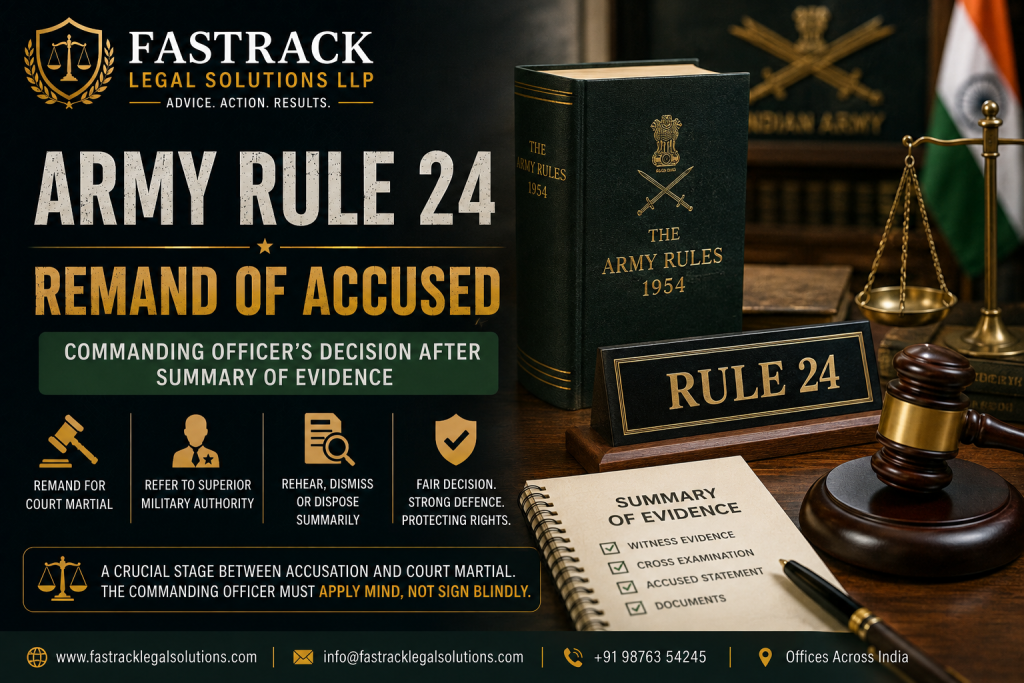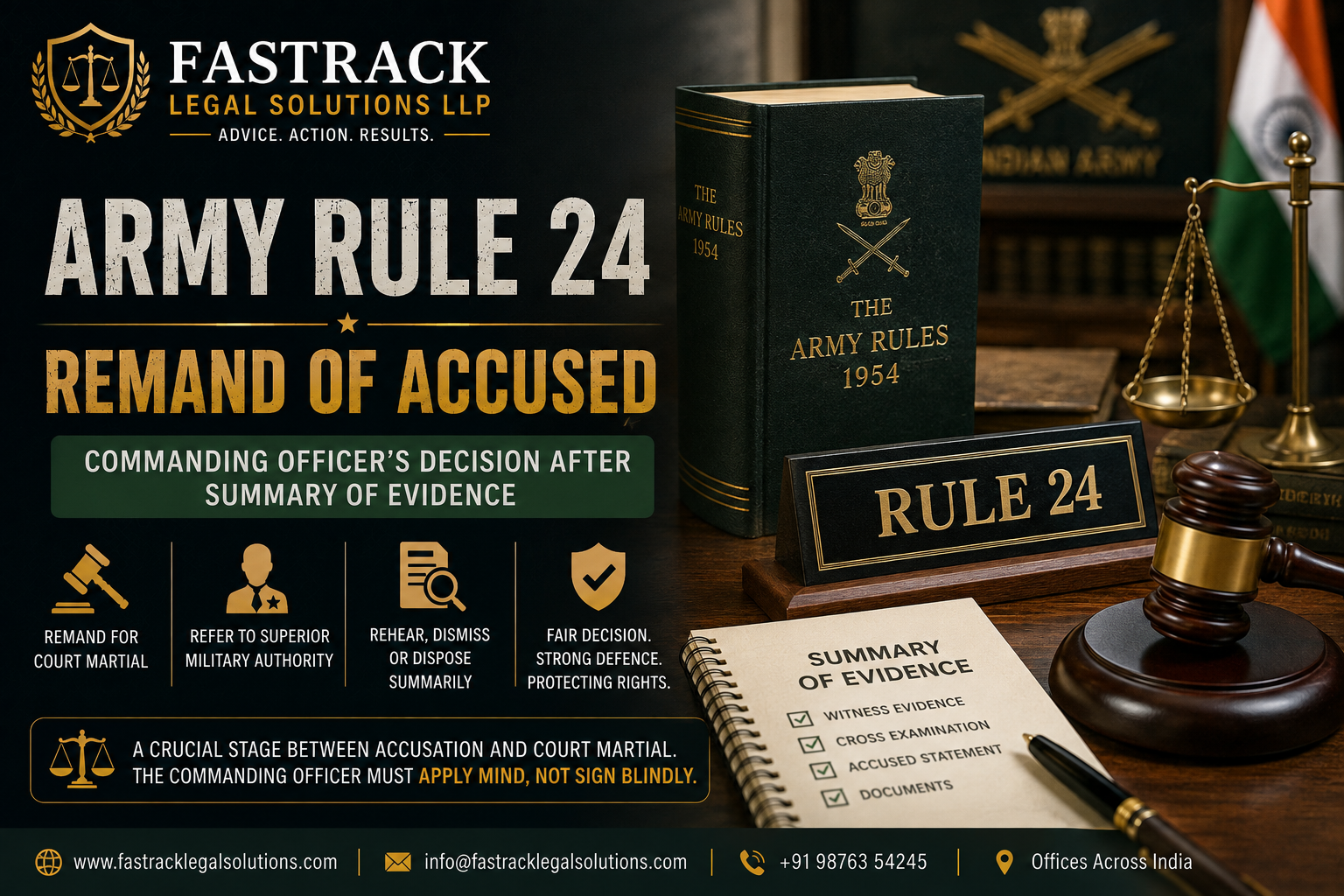
Army Rule 24 deals with the remand of accused after the Summary of Evidence is recorded under Army Rule 23. The Summary of Evidence must be considered by the Commanding Officer, who then has three broad options: remand the accused for trial by court martial, refer the case to the proper superior military authority, or, if desirable, rehear the case and either dismiss the charge or dispose of it summarily. Therefore, Rule 24 is the decision-making bridge between Summary of Evidence and possible court martial. It requires application of mind by the Commanding Officer and should not be treated as a mechanical forwarding step.
Non-Solicitation Note
This article is for general legal awareness and educational purposes only and may be published by Fastrack Legal Solutions LLP. It is not an advertisement, solicitation, invitation or inducement for professional engagement. It does not create an advocate-client relationship. Army Rule 24 disputes depend on the charge, Rule 22 hearing, Rule 23 Summary of Evidence, Court of Inquiry, Rule 180 compliance, witness statements, defence objections, Commanding Officer’s order, superior authority decision, convening order and case-specific facts.
Introduction
Army Rule 24 is a critical stage in military disciplinary proceedings. It comes after the charge has been heard under Army Rule 22 and after evidence has been reduced into writing under Army Rule 23 as Summary of Evidence.
At this stage, the Commanding Officer must consider whether the material justifies further proceedings. This is not a rubber-stamp formality. The Commanding Officer is required to look at the Summary of Evidence and decide whether the accused should be sent towards court martial, whether the matter should be referred to superior military authority, or whether the matter should be reheard, dismissed or disposed of summarily.
In practical court martial defence, Rule 24 is extremely important because it is the stage where a defective or weak case should be stopped before it escalates into court martial. If the Commanding Officer mechanically remands the accused for trial without proper consideration of the Summary of Evidence, procedural objections may arise.
What Is Army Rule 24?
Army Rule 24 is titled “Remand of accused.” It provides that the evidence and statement, if any, taken down in writing under Rule 23 — called the Summary of Evidence — shall be considered by the Commanding Officer. After considering it, the Commanding Officer shall either:
- Remand the accused for trial by court martial;
- Refer the case to the proper superior military authority; or
- If he thinks it desirable, rehear the case and either dismiss the charge or dispose of it summarily.
This means Rule 24 is not merely about “remand” in the ordinary criminal-law sense. It is a structured decision point after Summary of Evidence.
Why Army Rule 24 Matters
Army Rule 24 matters because it determines whether a case moves closer to court martial.
The Commanding Officer must decide:
- Whether the Summary of Evidence discloses a case for trial.
- Whether the charge is supported by evidence.
- Whether the matter should go to superior military authority.
- Whether the case can be disposed of summarily.
- Whether the charge should be dismissed.
- Whether the case requires rehearing.
- Whether the evidence is too weak, contradictory or procedurally defective.
- Whether Rule 22 and Rule 23 have been complied with.
- Whether the accused received procedural fairness.
- Whether court martial is justified on the material available.
A properly exercised Rule 24 decision can prevent unnecessary court martial.
Army Rule 24 Comes After Rule 23: Summary of Evidence
The Rule 24 decision is based on the Summary of Evidence recorded under Rule 23. Therefore, any defect in Rule 23 can affect the legality and fairness of the Rule 24 decision.
For example, Rule 24 scrutiny becomes important where:
- Witnesses were not examined in the presence of the accused.
- Cross-examination was denied.
- Questions and answers were not recorded.
- Written statements of absent witnesses were included without proper certification.
- The accused’s statement was not properly recorded.
- Material defence documents were ignored.
- Defence witnesses were not considered.
- Summary of Evidence does not support the charge.
- The Commanding Officer did not apply mind to contradictions.
- The accused was remanded for trial mechanically.
Rule 24 therefore cannot be separated from Rule 23.
Link Between Rule 22, Rule 23 and Rule 24
The military disciplinary chain usually moves in this sequence:
| Stage | Rule | Purpose |
|---|---|---|
| Hearing of charge | Army Rule 22 | Commanding Officer hears the charge in presence of accused |
| Summary of Evidence | Army Rule 23 | Evidence is reduced into writing |
| Remand / further decision | Army Rule 24 | Commanding Officer decides next step after considering Summary of Evidence |
| Preparation for trial | Later rules | Accused is warned, charge is finalised, court martial may be convened |
Courts have recognised that Rules 22, 23 and 24 form part of the pre-trial military disciplinary process. In Chandra Mohan Shukla v. State of Assam, the Court observed that Rule 24 requires the Commanding Officer to consider the Summary of Evidence and then remand the accused for court martial, refer the case to proper superior military authority, or rehear and dismiss/dispose of the charge.
People Also Ask: Is Army Rule 24 a court-martial trial?
No. Army Rule 24 is not the court martial trial. It is a pre-trial decision stage. The Commanding Officer considers the Summary of Evidence and decides whether the case should proceed further, be referred, reheard, dismissed or summarily disposed of. The actual trial, if ordered, occurs before a competent court martial.
Commanding Officer’s Three Options Under Army Rule 24
Army Rule 24 gives the Commanding Officer three broad options after considering the Summary of Evidence.
Option 1: Remand the Accused for Trial by Court Martial
The first option is to remand the accused for trial by court martial.
This means the Commanding Officer considers that the matter should proceed towards trial. However, this should not be automatic. The Summary of Evidence must disclose sufficient material to justify trial.
Before remanding the accused for trial, the Commanding Officer should consider:
- Whether evidence supports each ingredient of the charge.
- Whether witnesses are credible.
- Whether material contradictions exist.
- Whether Rule 22 and Rule 23 were complied with.
- Whether procedural prejudice exists.
- Whether the case is suitable for court martial.
- Whether summary disposal is legally or practically appropriate.
- Whether higher authority’s decision is needed.
- Whether the accused’s statement explains the allegation.
- Whether further investigation or rehearing is required.
Option 2: Refer the Case to Proper Superior Military Authority
The second option is to refer the case to the proper superior military authority.
This may be appropriate where:
- The Commanding Officer lacks power to dispose of the matter.
- The matter is serious.
- The case involves an officer or higher disciplinary authority.
- The nature of charge requires superior decision.
- Policy, command or legal advice is required.
- The matter may require convening authority action.
- The punishment likely exceeds summary powers.
- The offence requires formal court martial consideration.
- The case involves wider command implications.
- The Commanding Officer considers superior scrutiny necessary.
Referral is not the same as conviction. It is a decision to place the matter before appropriate superior military authority for further action.
Option 3: Rehear the Case and Dismiss or Dispose of It Summarily
The third option is highly important from a defence perspective. Rule 24 allows the Commanding Officer, if he thinks it desirable, to rehear the case and either:
- Dismiss the charge; or
- Dispose of it summarily.
This means that after Summary of Evidence, the Commanding Officer is not bound to send every case to trial. If the evidence is weak, contradictory, minor, exaggerated or capable of summary disposal, the Commanding Officer can prevent unnecessary escalation.
This option is important where:
- Evidence does not support the charge.
- Witnesses have contradicted earlier statements.
- The accused has a strong explanation.
- The matter is minor.
- The charge is defective.
- Procedural irregularities exist.
- Summary disposal is sufficient.
- No useful purpose will be served by court martial.
- The charge should be dismissed.
- Rehearing is necessary for fairness.
Is Remand for Court Martial Automatic After Summary of Evidence?
No. Remand for court martial should not be automatic.
The wording of Rule 24 requires the Commanding Officer to consider the Summary of Evidence. The presence of multiple options under Rule 24 shows that the Commanding Officer must apply discretion.
A mechanical order such as “remanded for trial” without meaningful consideration may be challenged if facts show non-application of mind, especially where the Summary of Evidence does not support the charge or where procedural safeguards were denied.
What Does “Consider the Summary of Evidence” Mean?
“Consideration” means active application of mind.
It should include examination of:
- The charge.
- Witness evidence.
- Cross-examination.
- Documents relied upon.
- Accused’s statement.
- Procedural objections.
- Relevance and reliability of evidence.
- Whether the evidence supports trial.
- Whether the case should be referred.
- Whether rehearing, dismissal or summary disposal is appropriate.
It should not be a predetermined or command-influenced decision.
Can the Commanding Officer Dismiss the Charge Under Rule 24?
Yes. Rule 24 expressly permits the Commanding Officer, if he thinks it desirable, to rehear the case and either dismiss the charge or dispose of it summarily.
This is significant because the defence can request the Commanding Officer to exercise this option where the Summary of Evidence does not justify court martial.
Can the Case Be Disposed of Summarily Under Rule 24?
Yes, where legally permissible and appropriate. Rule 24 allows rehearing and summary disposal. However, summary disposal depends on the nature of offence, rank of accused, powers of the Commanding Officer, seriousness of charge and limitations under the Army Act and Rules.
In Union of India v. Maj. Virendrarai J. Kharod, the Court noted that there is no offence which a Commanding Officer is compelled by law or rules to send before court martial; each case should be considered on its merits. However, a Commanding Officer should not summarily dispose of cases where he is legally barred or where the matter obviously deserves more severe punishment than he can award summarily.
Defence Strategy Before Rule 24 Decision
The defence should not wait passively for remand to court martial. After Summary of Evidence, a focused representation may be submitted requesting dismissal, rehearing, or non-remand.
A good representation should highlight:
- Defects in Rule 22 hearing.
- Defects in Rule 23 Summary of Evidence.
- Witness contradictions.
- Absence of essential ingredients of offence.
- Documentary gaps.
- Unreliable or hearsay evidence.
- Exculpatory material.
- Accused’s clean service record.
- Minor nature of allegation.
- Lack of proportionality in court martial.
- Request for dismissal or summary disposal.
- Request against mechanical remand for trial.
This representation should be precise and record-based.
Draft Representation After Summary of Evidence Before Rule 24 Decision
A practical representation may state:
“Without prejudice to my rights and defence, I respectfully submit that the Summary of Evidence does not disclose a prima facie case warranting remand for trial by court martial. The prosecution witnesses have materially contradicted the charge, essential ingredients remain unproved, and serious procedural irregularities occurred during Rule 22/Rule 23 proceedings. I therefore request that the Summary of Evidence be considered objectively under Army Rule 24 and that the charge be dismissed, or in the alternative, the case be reheard or disposed of summarily as deemed appropriate.”
This should be customised according to facts.
Common Violations at Rule 24 Stage
1. Mechanical Remand for Court Martial
The accused is remanded for trial without any real consideration of Summary of Evidence.
2. Ignoring Rule 23 Defects
Cross-examination denial, missing documents or defective recording are ignored.
3. Ignoring Accused’s Statement
The accused’s explanation is not considered.
4. Ignoring Defence Representation
A reasoned representation against remand is not considered.
5. Predetermined Decision
The matter is treated as already fit for trial before Summary of Evidence is objectively examined.
6. Improper Referral
The case is referred to superior authority without proper analysis or in violation of required procedure.
7. Failure to Rehear
Where the evidence is weak or defective, rehearing is not considered.
8. Failure to Dismiss Weak Charge
Even where the charge is unsupported, the accused is still sent toward court martial.
9. Command Influence
Decision appears driven by command pressure rather than evidence.
10. Non-Consideration of Proportionality
A minor or doubtful case is escalated to court martial without considering summary disposal.
How Rule 24 Defects Affect Court Martial
A defective Rule 24 decision may affect later proceedings where it shows:
- No application of mind.
- Summary of Evidence was not considered.
- Mandatory options were ignored.
- Rule 22/23 violations were carried forward.
- Court martial was convened on defective foundation.
- Prejudice was caused to the accused.
- Procedural fairness was compromised.
- The case should have been dismissed or reheard.
- Superior authority acted on an incomplete or defective record.
- The accused was denied an effective pre-trial safeguard.
However, the effect depends on facts, prejudice, stage of challenge and whether subsequent proceedings cured or aggravated the defect.
Rule 24 and Superior Military Authority
Where the Commanding Officer refers the case to proper superior military authority, the superior authority may consider further action according to the Army Act and Rules.
The defence should examine:
- What exactly was referred?
- Was the Summary of Evidence complete?
- Were defence objections forwarded?
- Were procedural defects disclosed?
- Did the superior authority receive the accused’s statement?
- Was legal advice obtained?
- Was a fresh charge framed?
- Was court martial convened thereafter?
- Was the convening order valid?
- Was the accused warned properly for trial?
The referral chain must be checked carefully.
Rule 24 and Rehearing of the Case
Rehearing under Rule 24 may be useful where:
- Evidence is incomplete.
- Witnesses contradicted each other.
- Charge requires reconsideration.
- Documents were not properly examined.
- Accused was not given fair opportunity.
- Rule 22 defects need correction.
- Summary of Evidence reveals a different factual position.
- Charge may deserve dismissal or summary disposal.
A rehearing is not a trial. It is a procedural opportunity to reconsider the charge before escalation.
Rule 24 and Dismissal of Charge
Dismissal of charge may be justified where:
- No offence is made out.
- Essential ingredients are absent.
- Evidence is hearsay.
- Witnesses are unreliable.
- Material contradictions exist.
- Accused’s explanation is supported by documents.
- Complaint is motivated.
- Proceedings are procedurally defective.
- Charge is legally unsustainable.
- Further proceedings would be oppressive.
A defence representation should specifically ask for dismissal where facts support it.
Rule 24 and Summary Disposal
Summary disposal may be considered where:
- The matter is minor.
- Court martial is disproportionate.
- The offence is within summary powers.
- The accused’s rank/category permits such disposal.
- The expected punishment is within Commanding Officer’s powers.
- The case does not require formal trial.
- Service discipline can be maintained without court martial.
However, summary disposal must also comply with law and cannot be used where the Commanding Officer is barred or where the matter clearly requires higher trial.
People Also Ask: Can the Accused Challenge Remand for Court Martial?
Yes. The accused may challenge remand for court martial where the decision is mechanical, based on defective Summary of Evidence, suffers from non-application of mind, ignores mandatory procedure, or causes serious prejudice. The appropriate remedy and timing depend on whether proceedings are at pre-trial, trial, post-confirmation or AFT stage.
AFT Remedy for Rule 24 Violation
Rule 24 violations may be raised before the Armed Forces Tribunal where they affect service rights, court martial proceedings, punishment or disciplinary action.
Possible reliefs may include:
- Direction to reconsider Summary of Evidence.
- Setting aside defective remand decision.
- Direction for rehearing.
- Interference with court martial proceedings in exceptional cases.
- Relief in post-confirmation challenge.
- Direction to consider statutory complaint.
- Relief where Rule 22/23/24 defects cumulatively vitiate proceedings.
Tribunals may be cautious in interfering at interlocutory stages, but serious jurisdictional or procedural defects can still be relevant.
Practical Checklist for Defence
Before Rule 24 Decision
- Obtain Summary of Evidence.
- Compare it with Rule 22 record.
- Identify contradictions.
- Identify missing evidence.
- Check cross-examination recording.
- Check accused statement.
- Check written witness statements.
- Prepare representation.
- Ask for dismissal/rehearing/summary disposal if justified.
- Preserve proof of submission.
After Rule 24 Decision
- Obtain or inspect the order, where permissible.
- Check whether accused was remanded for trial.
- Check whether case was referred to superior authority.
- Check whether rehearing was ordered.
- Check whether charge was modified.
- Check whether court martial is being convened.
- Check compliance with warning for trial.
- Prepare challenge or defence strategy.
Common Client Questions
What happens after Summary of Evidence in Army proceedings?
After Summary of Evidence, the Commanding Officer considers it under Army Rule 24 and decides whether to remand the accused for trial by court martial, refer the matter to superior authority, rehear the case, dismiss the charge or dispose of it summarily.
Can the Commanding Officer dismiss the charge after Summary of Evidence?
Yes. Rule 24 allows rehearing and dismissal of the charge if the Commanding Officer considers it desirable.
Is court martial compulsory after Summary of Evidence?
No. The Commanding Officer has multiple options and must consider the Summary of Evidence before deciding.
Can Rule 24 remand be challenged?
Yes, if the remand is mechanical, procedurally defective, unsupported by Summary of Evidence or causes prejudice.
What is the best defence step after Summary of Evidence?
A precise written representation should be submitted pointing out contradictions, procedural violations and reasons why the accused should not be remanded for court martial.
Frequently Asked Questions
1. What is Army Rule 24?
Army Rule 24 deals with remand of accused after Summary of Evidence. The Commanding Officer considers the Summary of Evidence and decides the next step.
2. What are the options under Rule 24?
The Commanding Officer may remand the accused for trial by court martial, refer the case to superior military authority, or rehear the case and dismiss or summarily dispose of the charge.
3. Does Rule 24 come after Rule 23?
Yes. Rule 24 comes after evidence and statement are recorded under Rule 23 as Summary of Evidence.
4. Is Rule 24 a trial?
No. Rule 24 is a pre-trial decision-making stage, not the court martial trial itself.
5. Can the Commanding Officer dismiss the charge under Rule 24?
Yes. If he thinks it desirable, he may rehear the case and dismiss the charge.
6. Can every case be sent to court martial after Summary of Evidence?
No. The Commanding Officer must consider the Summary of Evidence and choose the legally appropriate course.
7. Can the accused file a representation before Rule 24 decision?
Yes. A representation pointing out defects, contradictions and reasons against remand for trial may be submitted.
8. Can Rule 24 defects affect court martial?
Yes. Serious defects at Rule 24 stage may affect later proceedings if they cause prejudice or show non-application of mind.
9. Can Rule 24 violation be raised before AFT?
Yes. Depending on stage and prejudice, Rule 24 violation may be raised before the Armed Forces Tribunal.
10. What is the defence strategy at Rule 24 stage?
The defence should analyse Summary of Evidence, identify contradictions, challenge procedural defects, and request dismissal, rehearing or summary disposal where justified.
Conclusion
Army Rule 24 is the key decision-making stage after Summary of Evidence. It requires the Commanding Officer to consider the written evidence and decide whether the accused should face court martial, whether the case should go to superior military authority, or whether it should be reheard, dismissed or disposed of summarily.
The rule is important because it prevents automatic escalation of every charge into court martial. The Commanding Officer must apply mind. If the Summary of Evidence is weak, contradictory, incomplete or procedurally defective, the accused can request dismissal, rehearing or summary disposal.
From a defence perspective, Rule 24 is a strategic opportunity. A well-drafted representation after Summary of Evidence can preserve objections, expose weaknesses and prevent unnecessary trial. If the accused is mechanically remanded for court martial despite serious defects, the issue may become a ground before superior military authorities, the Armed Forces Tribunal or higher courts.
Army Rule 24 should therefore be treated not as a clerical forwarding step, but as a statutory checkpoint between accusation and court martial.
Disclaimer
This article is for general legal awareness and educational purposes only and may be published by Fastrack Legal Solutions LLP. It is not an advertisement, solicitation, invitation or inducement for professional engagement. It does not create an advocate-client relationship. Army Rule 24 issues depend on Rule 22 hearing, Rule 23 Summary of Evidence, charge-sheet, witness record, accused statement, Commanding Officer’s order, superior authority action, convening order and case-specific facts.