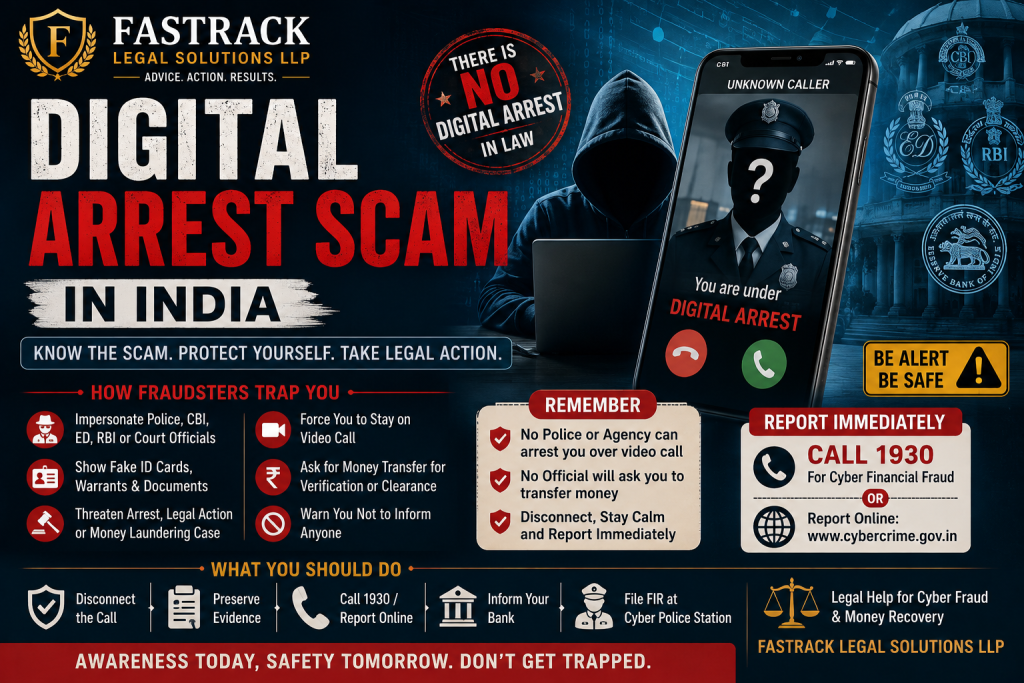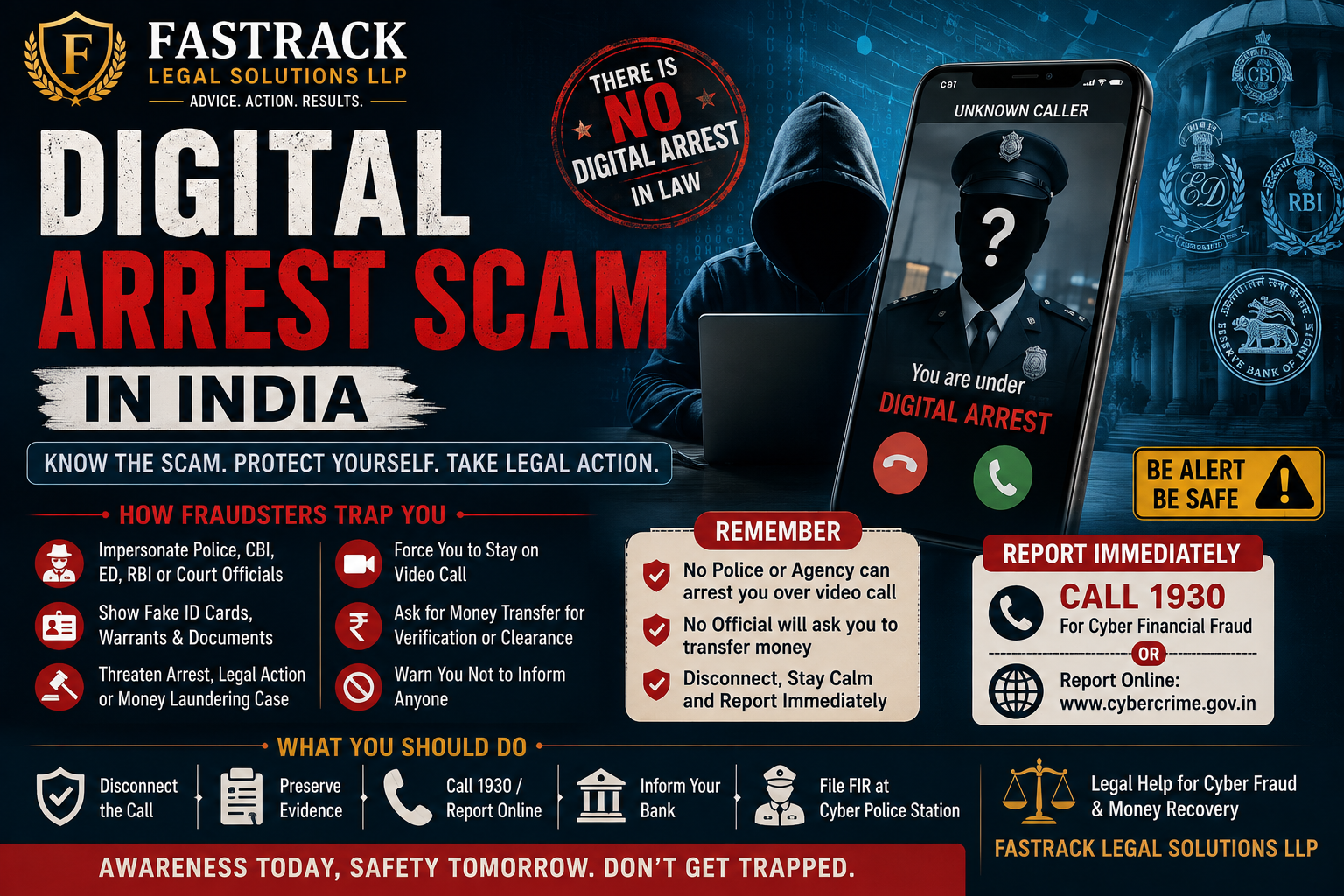
A “digital arrest” scam is a cyber-fraud method where criminals impersonate police, CBI, ED, Narcotics Department, RBI, courier officials or court officers and falsely tell the victim that he or she is under investigation or “digitally arrested”. They usually use WhatsApp, Skype, video calls, fake ID cards, forged notices, fake court orders and intimidation to force the victim to transfer money. There is no legal concept of arrest over video call or WhatsApp. A real arrest cannot be conducted through a video call. Victims should immediately disconnect, preserve screenshots and call 1930 or report on the National Cyber Crime Reporting Portal. The Ministry of Home Affairs has specifically warned citizens about “digital arrest” scams and has asked victims to report such incidents on 1930 or the cybercrime portal.
Non-Solicitation Note
This article is for general legal awareness and educational purposes only and may be published by Fastrack Legal Solutions LLP. It is not an advertisement, solicitation, invitation or inducement for professional engagement. It does not create an advocate-client relationship. Cyber-fraud and digital-arrest cases depend on the complaint, transaction trail, bank accounts used, screenshots, video-call record, FIR, cyber-cell response, bank-freeze status, recovery stage and case-specific facts.
Introduction
Digital arrest scams are among the fastest-growing forms of cybercrime in India. The scam is psychologically powerful because the fraudster does not merely ask for money. He creates fear of criminal prosecution, arrest, ED inquiry, CBI case, narcotics case, money-laundering case, parcel seizure, bank-account misuse or Supreme Court proceedings.
The victim is told not to disconnect the call. The fraudster may say that the victim is under “digital surveillance” or “digital arrest”. Fake documents are shown on video call. The victim may be made to sit in front of a camera for hours. In many cases, victims are forced to transfer money under the false promise that the funds are being “verified” and will be returned.
The Ministry of Home Affairs has warned that fraudsters are impersonating police authorities, CBI, Narcotics Department, RBI, ED and other law-enforcement agencies, and that many complaints regarding intimidation, blackmail, extortion and “digital arrests” have been reported on the National Cyber Crime Reporting Portal.
Also Read Cyber law and IT
What Is a Digital Arrest Scam?
A digital arrest scam is not a legal process. It is a cyber-fraud technique.
The fraudster falsely claims that:
- A parcel in the victim’s name contains drugs.
- The victim’s Aadhaar or bank account has been misused.
- The victim is linked to money laundering.
- The victim is wanted by CBI, ED, police, customs or narcotics department.
- A fake Supreme Court, High Court or police order has been issued.
- The victim must remain on video call for “investigation”.
- The victim must transfer money for “verification”.
- The money will be returned after clearance.
- The victim must not inform family, bank or lawyer.
- The victim will be arrested if he disconnects the call.
This entire process is illegal and fraudulent.
Is Digital Arrest Legal in India?
No. There is no such lawful procedure as “digital arrest” over video call.
An arrest in India must follow criminal procedure. Police cannot arrest a person by WhatsApp call, Skype call, Zoom call or video call. A genuine investigating agency does not ask a citizen to remain on video call for hours and transfer money for “verification”.
If someone says “you are under digital arrest”, it is a scam.
Common Modus Operandi of Digital Arrest Scams
1. Courier Parcel Scam
The victim receives a call claiming that a parcel in his name contains drugs, passports, Aadhaar cards, ATM cards or illegal articles. The call is transferred to a fake police/CBI/NCB officer.
2. Aadhaar Misuse Scam
The fraudster claims that the victim’s Aadhaar has been used for illegal bank accounts or SIM cards.
3. Money-Laundering Scam
The victim is told that his bank account is linked with money laundering or terror funding.
4. Fake CBI / ED / Police Video Call
The fraudster appears on video call wearing a police-style uniform or sitting before a fake official background.
5. Fake Court Order or Arrest Warrant
Forged documents are shown with logos of police, CBI, ED, RBI or courts.
6. Bank Verification Scam
The victim is told to transfer money to a “safe account” or “RBI verification account”.
7. Isolation and Threat
The victim is warned not to call family, bank, lawyer or local police.
8. Multiple Transfers
The victim is made to transfer money in instalments to different accounts.
People Also Ask: What Should I Do If I Am Under Digital Arrest?
Disconnect the call immediately. Do not transfer money. Do not share OTP, Aadhaar, PAN, bank details or screen access. Take screenshots, save numbers, preserve call logs and immediately call 1930 or report on the National Cyber Crime Reporting Portal. If money has already been transferred, report within the golden hour so that bank accounts can be blocked quickly. The official cybercrime portal specifically displays 1930 for immediate reporting of cyber financial fraud.
Immediate Steps for Victims
Step 1: Disconnect the Call
Do not continue the video call. Fraudsters use fear and isolation to control the victim.
Step 2: Do Not Transfer Money
No genuine agency asks for money transfer for verification of innocence.
Step 3: Call 1930 Immediately
For cyber financial fraud, call 1930 immediately. Fast reporting improves chances of freezing the fraud trail.
Step 4: File Complaint on Cybercrime Portal
Report the incident on the National Cyber Crime Reporting Portal.
Step 5: Inform Your Bank
Call the bank’s fraud helpline and request immediate blocking/recall of transferred amount.
Step 6: Preserve Evidence
Save screenshots, numbers, bank details, UTRs, WhatsApp chats, video-call screenshots, fake notices and transaction receipts.
Step 7: File Police Complaint / FIR
Approach the local cyber police station or police station with all documents.
Documents Required for Digital Arrest Scam Complaint
Prepare the following:
- Written complaint.
- Victim’s ID proof.
- Bank statement.
- Transaction receipts.
- UTR numbers.
- Fraudster phone numbers.
- WhatsApp chat screenshots.
- Telegram/Skype/Zoom IDs, if any.
- Fake notices or warrants.
- Video-call screenshots.
- Call recordings, if available.
- Details of receiving accounts.
- Complaint acknowledgment from 1930/cyber portal.
- Bank complaint acknowledgment.
- Timeline of events.
Legal Offences Involved
Depending on facts, a digital arrest scam may involve offences relating to:
- Cheating.
- Criminal intimidation.
- Extortion.
- Personation.
- Forgery of documents.
- Use of forged electronic records.
- Identity theft.
- Cyber fraud.
- Criminal conspiracy.
- Money laundering, where proceeds are layered through mule accounts.
The precise provisions depend on the FIR, facts and applicable BNS/IT Act/PMLA framework.
Digital Arrest and Bank Account Freeze
After a digital arrest scam, money usually moves quickly through multiple mule accounts. The victim’s immediate goal is to freeze the trail.
The process may involve:
- 1930 complaint.
- Cyber portal complaint.
- Bank fraud complaint.
- Debit freeze/lien on beneficiary accounts.
- Police communication to banks.
- Freezing of mule accounts.
- Court application for release of recovered money.
- Investigation into account holders and handlers.
The Supreme Court has recently directed coordinated action involving banks, regulators and law-enforcement agencies to address digital arrest scams and improve recovery of money lost to cyber fraud. It also directed RBI to prepare a standard operating procedure concerning mule accounts.
People Also Ask: Can Money Lost in Digital Arrest Scam Be Recovered?
Recovery depends on how quickly the complaint is filed, whether the money trail is frozen, whether funds remain in mule accounts, bank response, police action and court orders. The best chance is immediate reporting through 1930 and the cybercrime portal, followed by written complaints to the bank and police.
Role of 1930 Cyber Helpline
The 1930 helpline is intended for immediate assistance in lodging cyber financial fraud complaints. The Ministry of Home Affairs has repeatedly referred citizens to 1930 and the cybercrime portal for reporting cyber crimes including digital arrest scams.
Victims should provide:
- Name and mobile number.
- Bank name.
- Account number.
- Amount transferred.
- Date and time of transfer.
- UTR/reference number.
- Beneficiary account details, if known.
- Fraudster phone number.
- Short description of scam.
Complaint Format: Key Points to Include
A digital arrest scam complaint should include:
- Date and time of first call.
- Number from which call was received.
- Name/designation used by fraudster.
- Agency impersonated.
- Threats made.
- Fake documents shown.
- Video-call platform used.
- Amount demanded.
- Amount transferred.
- Bank account details of transfer.
- UTR numbers.
- Immediate request for freezing beneficiary accounts.
- Request for FIR.
- Request for investigation of mule accounts and handlers.
- Request for recovery and release of frozen money.
Court Procedure for Release of Frozen Money
If the police freeze money in beneficiary or mule accounts, the victim may need a court order for release.
The broad process may be:
- File complaint/FIR.
- Police trace bank accounts.
- Banks freeze/lien amounts.
- Police submit report to court/Magistrate.
- Victim files application for release of money.
- Court examines transaction trail and objections.
- Court may order release on bond/undertaking.
- Bank releases amount as per court order.
The exact procedure depends on the State, police station, court and status of investigation.
What If the Victim’s Own Account Gets Frozen?
Sometimes the victim or an innocent recipient’s account may also be frozen due to chain transactions. In such cases, the person should:
- Get written freeze details from bank.
- Identify the complaint/FIR number.
- Collect source-of-funds proof.
- File representation to cyber police.
- Seek lien only over disputed amount.
- Approach Magistrate or High Court if full freeze is excessive.
This connects directly with bank-account freeze and lien litigation.
How Families Should Respond
Digital arrest scammers often target elderly persons, professionals, retired officers, business owners and people living alone.
Family members should:
- Tell elders that digital arrest is fake.
- Keep bank emergency numbers accessible.
- Enable transaction alerts.
- Set daily transfer limits.
- Discuss cyber fraud openly.
- Encourage immediate reporting.
- Never shame the victim; delay helps fraudsters.
- Help preserve evidence.
- Accompany the victim to cyber police.
- Follow up with bank and court remedies.
Red Flags of Digital Arrest Scam
| Red Flag | Why It Is Suspicious |
|---|---|
| “You are under digital arrest” | No such legal process exists |
| Demand to stay on video call | Psychological control tactic |
| Fake CBI/ED/police ID | Impersonation |
| Demand for secrecy | Prevents victim from verifying |
| Money transfer for verification | No lawful agency asks this |
| Fake court order on WhatsApp | Courts do not conduct arrest this way |
| Threat of immediate arrest | Intimidation/extortion |
| Multiple account transfers | Money-laundering trail |
Practical Legal Strategy for Victims
The legal strategy should be fast and document-backed.
Within First Hour
Call 1930, contact bank, freeze beneficiary account trail.
Within Same Day
File cyber portal complaint and written bank complaint.
Within 24–48 Hours
Visit cyber police station with documents and seek FIR/freezing action.
Within 7 Days
Follow up on frozen amount, mule accounts and transaction trail.
If Money Is Frozen
Move court for release of funds.
If Police Do Not Act
Consider representation to senior police officers or appropriate legal remedy.
Mistakes Victims Should Avoid
- Continuing the call.
- Transferring more money.
- Deleting chats.
- Blocking numbers without screenshots.
- Not saving UTRs.
- Waiting due to embarrassment.
- Not calling 1930 immediately.
- Relying only on bank customer care.
- Not filing written complaint.
- Not following up for court release.
People Also Ask: Is Digital Arrest a Separate Offence?
As of now, “digital arrest” describes a scam method, not necessarily a standalone codified offence. However, the acts involved may constitute cheating, extortion, impersonation, forgery, cyber offences and other offences. Recent reports indicate that the government has considered making digital arrest a separate offence after concerns were raised about gaps in existing penal definitions.
Search-Optimised Quick Answers
What is digital arrest scam?
Digital arrest scam is a cyber fraud where criminals impersonate police, CBI, ED, RBI or court officials and falsely claim that the victim is under investigation or arrest through video call.
Is digital arrest real?
No. Arrest cannot be conducted through WhatsApp, Skype or video call.
What number should I call for digital arrest scam?
Call 1930 immediately for cyber financial fraud and report on the National Cyber Crime Reporting Portal.
Can transferred money be recovered?
Recovery is possible if the complaint is filed quickly and beneficiary accounts are frozen before funds move further.
What documents are required?
Bank statement, transaction receipts, UTRs, screenshots, phone numbers, fake notices, video-call screenshots, complaint acknowledgment and bank complaint are important.
Frequently Asked Questions
1. What is digital arrest scam in India?
It is a cyber-fraud method where criminals impersonate police, CBI, ED, RBI, narcotics, courier or court officials and threaten the victim with arrest or investigation over video call.
2. Can police digitally arrest someone?
No. There is no lawful procedure of digital arrest through video call or WhatsApp.
3. What should I do if someone says I am under digital arrest?
Disconnect the call, do not transfer money, preserve evidence and immediately call 1930 or report on the National Cyber Crime Reporting Portal.
4. Can money be recovered after digital arrest scam?
Recovery depends on speed of reporting, bank-freezing action, police investigation and whether funds remain traceable in beneficiary accounts.
5. Should I inform my bank?
Yes. Immediately inform your bank’s fraud department and ask for recall/hold/freezing of beneficiary account trail.
6. Should I file FIR?
Yes, a formal police/cyber complaint or FIR should be pursued with complete transaction and evidence details.
7. What if fake CBI or ED documents are shown?
Preserve them. Fake official documents may support offences of forgery, personation and cyber fraud.
8. Can scammers use real-looking video call backgrounds?
Yes. Fraudsters often use fake police-station, court, CBI or ED-style backgrounds to intimidate victims.
9. What if I already transferred money?
Call 1930 immediately, file cybercrime portal complaint, contact your bank, preserve all evidence and pursue police/court remedy for freezing and release of funds.
10. Is digital arrest now being taken seriously by courts?
Yes. Recent Supreme Court proceedings show serious concern over digital arrest scams, mule accounts and coordinated action between banks, regulators and law-enforcement agencies.
Conclusion
Digital arrest is not law. It is fear-based cyber fraud.
No genuine police officer, CBI officer, ED officer, RBI official or court officer can arrest a person through WhatsApp or video call. No lawful authority asks a citizen to transfer money for “verification”. No court order is served through a threatening video call demanding secrecy.
The strongest protection is awareness and speed. Disconnect, preserve evidence, call 1930, file a cyber complaint, inform the bank and pursue recovery through police and court procedure.
For victims, the first few hours are critical. The faster the fraud is reported, the better the chance of freezing the money trail and recovering funds.
Disclaimer
This article is for general legal awareness and educational purposes only and may be published by Fastrack Legal Solutions LLP. It is not an advertisement, solicitation, invitation or inducement for professional engagement. It does not create an advocate-client relationship. Digital arrest and cyber-fraud matters depend on the complaint, transaction trail, FIR, bank-freeze status, police action, court orders and case-specific facts.