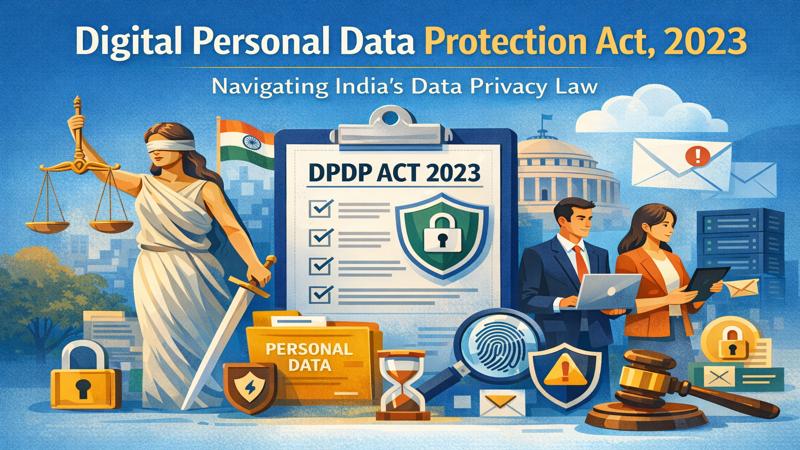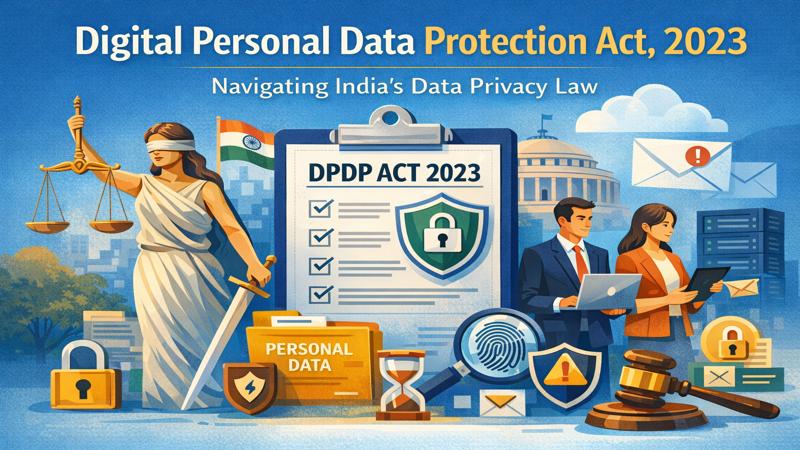
Digital Personal Data Protection Act, 2023: A Complete Guide to DPDP Compliance in India
The Digital Personal Data Protection Act, 2023 has fundamentally changed how businesses in India must think about personal data.
For years, many organisations collected customer data, employee data, behavioural data, and digital records with loose internal controls,
vague privacy notices, and almost no real discipline in retention or accountability. That era is over.
India now has a central legal framework for digital personal data. The Act was enacted on
11 August 2023,
and the Digital Personal Data Protection Rules, 2025
were notified on 14 November 2025. The Government also issued public explanations through the
Press Information Bureau
and a related
official press release.
This law is not limited to social media companies or giant technology platforms. It affects employers, startups, HR teams, hospitals,
educational institutions, logistics companies, e-commerce businesses, consultants, SaaS platforms, vendors, and any organisation handling digital personal data.
If you collect, store, use, share, transfer, analyse, or retain digital personal data in India, the DPDP framework is already relevant to your business.
What is the Digital Personal Data Protection Act, 2023?
The Digital Personal Data Protection Act, 2023 is India’s principal legislation governing the processing of digital personal data.
Its objective is simple in theory and serious in practice: to create a legal framework that recognises both the right of individuals to protect their personal data
and the need to process such data for lawful purposes.
You can read the official text of the Act on
India Code.
The law uses specific defined terms that matter in real compliance work. The individual whose data is involved is called the Data Principal.
The entity deciding why and how that data is processed is the Data Fiduciary. Any person or entity processing data on behalf of the fiduciary
is a Data Processor.
Those labels are not cosmetic. They determine responsibility, compliance obligations, and legal exposure.
Why the DPDP Act Matters for Businesses
Many organisations still treat privacy compliance as a policy problem rather than an operational problem. That is a mistake.
Personal data today lives inside websites, apps, ERP systems, HRMS software, payroll tools, lead forms, CRM databases, CCTV-backed systems,
customer care workflows, and outsourced vendor networks.
The DPDP Act matters because it changes the legal default. A business can no longer assume that data may be casually collected first and justified later.
The law now requires a lawful framework for processing, proper notice, valid consent where necessary, grievance mechanisms, safeguards, and internal accountability.
Put bluntly: it is no longer enough to say “we respect privacy.” A business now needs to show what data it collects, why it collects it,
how it uses it, where it stores it, who gets access to it, how long it keeps it, and what happens when something goes wrong.
Scope of the DPDP Act (Digital Personal Data Protection Act 2023)
The Act applies to digital personal data. This includes personal data collected in digital form and also personal data that may have been collected offline
but is later digitised. So if a company first takes paper forms and later scans or uploads them into software, that data does not escape the law merely because its first breath was analog.
The Act also has an extra-territorial element. It can apply to processing outside India where such processing is connected with offering goods or services to individuals in India.
That is particularly relevant for foreign businesses, offshore vendors, multinational technology stacks, and cloud-based service providers handling Indian data.
the safer assumption is that the DPDP framework is relevant unless a close legal review says otherwise.
Key Concepts Under the DPDP Act (Digital Personal Data Protection Act 2023)
Data Principal
A Data Principal is the individual to whom the personal data relates. In cases involving a child or a person with disability having a lawful guardian,
the relevant representative may act on their behalf.
Data Fiduciary
A Data Fiduciary is the person or entity determining the purpose and means of processing personal data. In ordinary business reality,
this is usually the employer, platform owner, institution, company, service provider, or app operator controlling the processing activity.
Data Processor
A Data Processor handles data on behalf of the Data Fiduciary. Typical examples include payroll vendors, cloud providers, HR outsourcing partners,
analytics tools, CRM systems, IT service vendors, and background verification agencies.
Consent
Consent under the Act must be free, specific, informed, unconditional, and unambiguous, and it must be given through
a clear affirmative action. That requirement alone forces many businesses to rethink their website forms, employee notices, onboarding flows,
and marketing practices.
Consent Under the DPDP Act: Where Many Businesses Will Slip
Consent is one of the most important compliance themes under the law. Most organisations are not short of privacy slogans. They are short of legal precision.
The Act requires that a request for consent be accompanied or preceded by a notice informing the Data Principal about the personal data proposed to be processed,
the purpose of processing, and the manner in which rights and complaints may be exercised.
In practical terms, a proper notice should tell the individual:
- what data is being collected,
- why that data is being collected,
- how it will be used,
- whether it may be shared,
- how consent may be withdrawn,
- how a grievance may be raised, and
- who within the organisation can be contacted.
Pre-ticked boxes, bundled consents, and vague catch-all wording are exactly the sort of bad habits that create exposure.
A consent clause that tries to cover everything often proves very little when tested closely.
Rights of the Data Principal
The DPDP framework gives enforceable rights to individuals. These include rights relating to access to information about personal data and its processing,
correction and erasure in specified circumstances, grievance redressal, and nomination of another person in the event of death or incapacity.
For businesses, this means there must be a system for actually handling such requests. Publishing a generic support email is not enough.
A functioning rights-response mechanism requires internal workflows, identity verification, escalation rules, documented decisions, and timely handling.
A legal right without an internal process becomes a litigation opportunity.
Obligations of Data Fiduciaries
A Data Fiduciary carries the primary burden of compliance. The law expects the fiduciary to ensure that personal data is processed for lawful purposes,
that reasonable safeguards are maintained, that personal data breaches are dealt with properly, that unnecessary retention is avoided,
and that grievance mechanisms exist.
In practice, a business serious about DPDP compliance should review:
- privacy notices and consent language,
- employee data collection forms,
- retention and deletion practices,
- processor and vendor contracts,
- access controls and security safeguards,
- grievance handling mechanisms, and
- internal ownership of privacy-related decisions.
The compliance burden cannot be outsourced away merely because a third-party vendor touches the data.
If anything, vendor use increases the importance of contractual discipline.
Significant Data Fiduciaries
The Act allows the Central Government to notify certain entities or classes of entities as Significant Data Fiduciaries,
based on factors such as the volume and sensitivity of data, risk to the rights of Data Principals, and implications for sovereignty,
integrity, security of the State, electoral democracy, or public order.
These entities may face enhanced obligations such as appointment of a Data Protection Officer and data audits.
Even businesses not formally designated in this category should not become complacent. Waiting until the law points a finger at you is an expensive compliance strategy.
Children’s Data Under the DPDP Act
Children’s data receives special treatment under the Act. The law requires verifiable consent of a parent or lawful guardian for processing the personal data of a child.
It also places restrictions on certain kinds of processing concerning children.
This becomes particularly important for schools, ed-tech companies, gaming platforms, healthcare services, family apps,
and any product or service likely to interact with minors.
If a business handles children’s data, it should examine age verification, parental consent workflows, behavioural tracking,
profiling practices, advertising logic, and retention discipline with much greater care.
Data Breach Reporting and Security Safeguards
One of the most commercially serious aspects of the framework is the obligation to maintain reasonable security safeguards and comply with breach-related obligations.
The
DPDP Rules, 2025
set out phased commencement provisions, and the Government publicly described the notification as a major operational step in India’s privacy framework.
A breach is not always a dramatic hack. It may arise from:
- weak access controls,
- misconfigured systems,
- poor vendor supervision,
- lost devices,
- rogue employees,
- phishing incidents, or
- casual sharing of sensitive records.
Every organisation handling digital personal data should have an internal incident response framework.
A breach handled without documentation is often worse than a breach handled with discipline.
Penalties Under the DPDP Act
Yes, this is the part that gets management’s attention. The Act provides for significant monetary penalties for specified contraventions.
The Schedule to the Act deals with penalty-linked violations, including failures relating to reasonable security safeguards and other statutory obligations.
The exact financial exposure depends on the nature of the contravention, but the broad message is obvious:
privacy failure in India is no longer only a reputational issue. It is a legal and financial risk issue.
Are the DPDP Rules Fully in Force?
This point requires precision, because sloppy summaries online often get it wrong.
The Government notified the
Digital Personal Data Protection Rules, 2025
on 14 November 2025. However, the Rules themselves provide for phased commencement.
The notification states that Rules 1, 2 and 17 to 21 came into force on publication,
Rule 4 comes into force one year later, and Rules 3, 5 to 16, 22 and 23 come into force eighteen months after publication.
That means the framework is not a one-day switch-on. It is a staged operational rollout.
DPDP Compliance Checklist for Businesses
Businesses looking at the DPDP Act should not begin with panic. They should begin with mapping and control.
- Identify what personal data is collected and for what purpose.
- Review website notices, app notices, employee notices, and onboarding forms.
- Examine whether consent language is actually valid and specific.
- Review vendor and processor contracts.
- Create a rights-handling and grievance-response workflow.
- Review retention and deletion practices.
- Assess employee-data governance separately.
- Prepare an incident response and breach review protocol.
- Review children’s-data exposure, if relevant.
- Train legal, HR, technology, operations, and management teams.
Compliance under the DPDP Act is not merely about drafting better documents. It is about building processes that can survive scrutiny.
DPDP Act and Employers
Employers are often sitting on some of the most poorly governed categories of personal data.
Employee records may include Aadhaar details, PAN, bank information, health disclosures, biometric attendance,
background checks, disciplinary records, grievance files, and exit documentation.
Every employer should therefore review:
- employee privacy notices,
- recruitment and onboarding forms,
- background verification authorisations,
- payroll vendor arrangements,
- HRMS access controls,
- biometric attendance systems, and
- retention rules for current and former employee records.
In many organisations, employee-data handling has historically been held together by convenience rather than structure.
That will not hold up comfortably under a mature privacy regime.
Conclusion
The Digital Personal Data Protection Act, 2023 is now the central legal framework governing digital personal data in India,
and the notification of the
DPDP Rules, 2025
has pushed the system from abstract promise toward operational compliance.
Businesses should not treat this as a checkbox law. It is a governance law, a contract law issue, an HR issue, a technology issue,
and, when ignored badly enough, a penalty issue.
The organisations that will handle this framework well are not merely the ones with the longest privacy policies.
They are the ones with cleaner processes, sharper records, better contracts, stronger safeguards, and evidence of defensible decision-making.
In law, that is the difference between looking compliant and being able to prove compliance.
Frequently Asked Questions
What is the Digital Personal Data Protection Act, 2023?
It is India’s principal law regulating the processing of digital personal data and creating rights for individuals alongside obligations for organisations.
Where can I read the official DPDP Act?
The official text is available on
India Code.
Where can I read the DPDP Rules, 2025?
The official rules are available through
MeitY’s notification PDF.
When were the DPDP Rules, 2025 notified?
They were notified on 14 November 2025, as reflected in the official notification and related
PIB release.
Does the DPDP Act apply to employee data?
Yes. Employee data in digital form can fall within the scope of the Act, depending on the processing activity and context.
Does the DPDP Act impose penalties?
Yes. The Act provides for significant monetary penalties for specified contraventions.