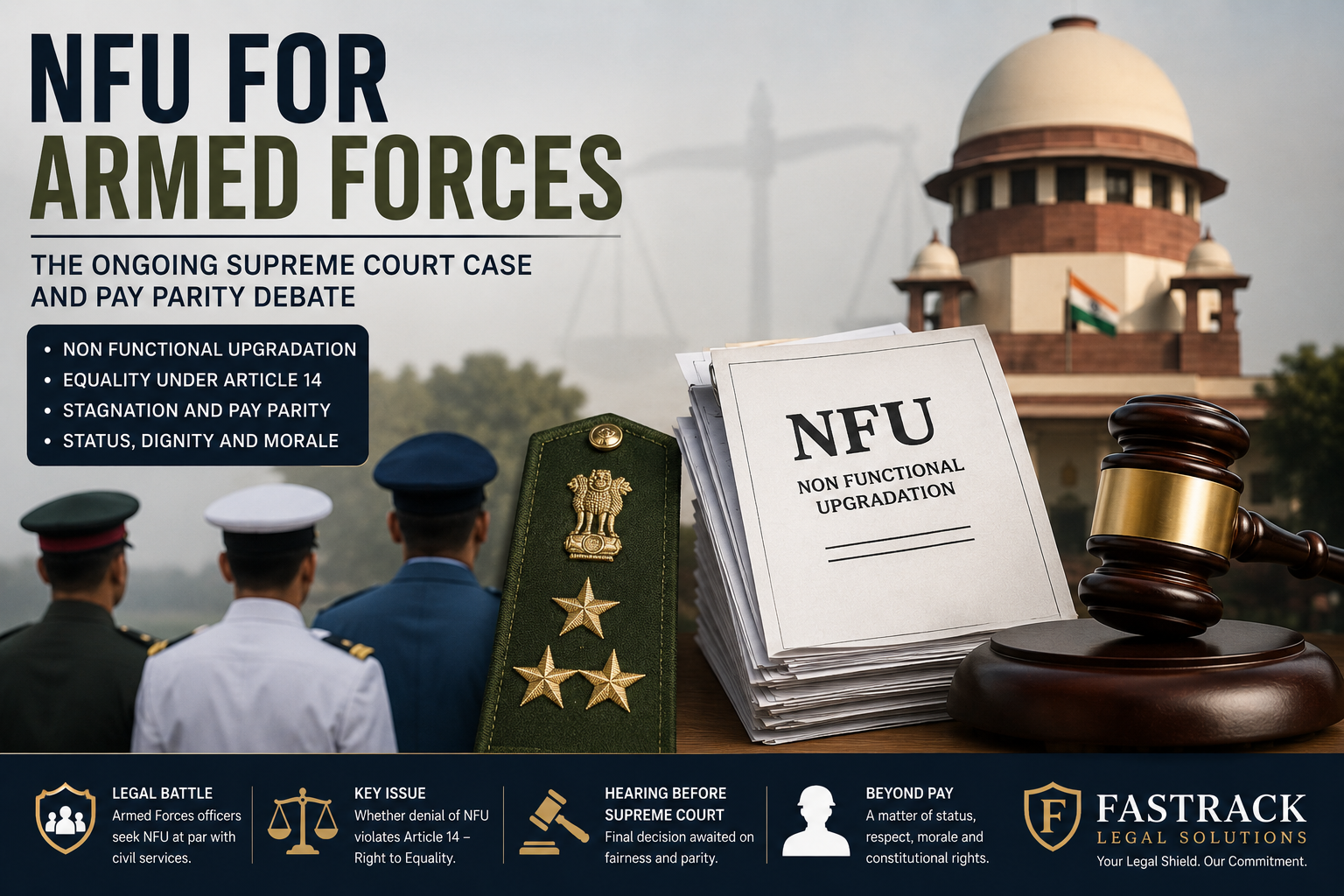
NFU for Armed Forces: The Ongoing Supreme Court Case, Legal Issues and Why it matters
The ongoing NFU case for Armed Forces officers concerns whether commissioned officers of the Army, Navy and Air Force should receive Non-Functional Upgradation, a financial upgradation benefit already available to several civilian Group ‘A’ services and CAPFs.
In December 2016, the Armed Forces Tribunal, Principal Bench, New Delhi, allowed the claim and directed that NFU be made applicable to similarly placed officers of the Defence Forces. The Tribunal held that denial of NFU to Defence Services was unfair, evasive and without valid justification, and that such denial breached Article 14 of the Constitution.
The Union of India challenged the AFT judgment before the Supreme Court. The Supreme Court’s official office report records Diary No. 12663/2017, titled Union of India and others v. IC 46298N Col Mukul Dev, arising from AFT OA No. 802/2015, decided on 23 December 2016.
As per the latest publicly reported position in April 2026, the Supreme Court has not yet finally decided the NFU issue on merits. A Ministry of Defence high-level committee has reportedly recommended against extending NFU to Armed Forces personnel, and the matter remains part of a continuing legal and policy dispute.
Why This Case Matters
The NFU case is not merely a pay dispute.
It is a dispute about status, parity, stagnation, morale, constitutional equality and civil-military equivalence in service conditions.
The central question is blunt:
If NFU exists to address stagnation in organised services, can the Armed Forces — where pyramidical rank structure causes acute stagnation — be excluded from the same benefit without a legally sustainable basis?
This article forms part of the Armed Forces Tribunal and military service law resources published by Fastrack Legal Solutions, focusing on service jurisprudence, military justice, disability pension, pay parity and constitutional rights of Armed Forces personnel.
1. What Is NFU?
NFU means Non-Functional Upgradation.
It is a financial upgradation mechanism under which an officer may receive the pay scale of a higher grade even without actual functional promotion to that post.
In simple terms, NFU does not make the officer functionally promoted. It does not give command, appointment, rank authority or substantive promotion. It gives a higher pay level on a non-functional basis.
The idea was to reduce stagnation and maintain pay parity between officers of different organised services. The AFT judgment records that under the NFU scheme, whenever an IAS officer of a particular batch is posted at the Centre to a particular grade, officers of organised Group ‘A’ services senior by two years or more, and not yet promoted to that grade, would receive the same grade on a non-functional basis.
Moneycontrol’s April 2026 report also explains NFU as a financial and status benefit by which officers receive higher pay scales even if they are not promoted to a higher rank.
Therefore, NFU is not a backdoor promotion.
It is a financial mechanism for stagnation relief.
That distinction is critical because much of the opposition to NFU for Armed Forces has been built around command-and-control concerns, while the claimants argue that NFU does not disturb command because it does not confer rank command.
2. Background of the Armed Forces NFU Dispute
The NFU dispute arose after the Sixth Central Pay Commission.
The Sixth Pay Commission recommended NFU for organised Group ‘A’ services. The benefit was later extended to IAS, IFS, IPS and other organised Group ‘A’ services. The AFT judgment records that NFU was extended to IPS and IFS, but Armed Forces personnel were left out, disturbing the traditional broad parity of the Armed Forces with IPS and other services.
This exclusion became controversial because Armed Forces officers face an intensely pyramidical rank structure. A very large number of officers stagnate after certain ranks due to limited vacancies, selection-board outcomes and age-profile considerations. Unlike civil services, where longer service tenure and different promotion structures exist, military officers often retire earlier and may lose future financial progression.
The Armed Forces’ argument has broadly been this:
- NFU is meant to address stagnation.
- Stagnation is severe in the Armed Forces.
- Civilian services and CAPFs have received NFU.
- Defence Services officers perform duties involving higher risk, command responsibility and unlimited liability.
- Excluding only Armed Forces officers is discriminatory and undermines parity, status and morale.
The Government’s broad position has been different:
- Armed Forces have a unique rank and command structure.
- Defence personnel receive Military Service Pay and certain other allowances.
- NFU may create anomalies in military hierarchy.
- Military promotions are vacancy-based and selection-based.
- Financial implications may be substantial.
That is the legal battlefield.
3. The 2016 AFT Judgment in Col Mukul Dev’s Case
The major turning point came on 23 December 2016, when the Armed Forces Tribunal, Principal Bench, New Delhi, decided OA No. 802/2015, Col Mukul Dev v. Union of India, along with a large batch of connected matters.
The Tribunal took a strong view in favour of the applicants.
It held that the denial of NFU to Defence Services was based on an unsustainable classification and that Article 14 was breached by non-grant of NFU to Defence Services. The Tribunal also found no logic or legality in denial of equal status and privileges based on the NFU scheme when such benefits were available to civil services.
The Tribunal further recorded that the respondents had been “unfair, evasive and without valid justification” in denying NFU to the Defence Forces. It observed that the denial had resulted in inequitable treatment and adversely affected efficiency, morale and status of the Armed Forces.
In its operative directions, the AFT held that:
- NFU as visualised by the Sixth Pay Commission would be implemented for the petitioners.
- The rejection letters dated 15 July 2010 and 24 October 2011 were set aside.
- NFU would apply to all similarly placed officers of the Army, Navy and Air Force.
- Arrears would be restricted to three years preceding the date of the order.
- If the Government continued NFU for IAS, IPS and other Group ‘A’ services, the same benefit would continue for Defence Forces officers.
This was a major service-law victory for Armed Forces officers.
But it did not end the dispute.
4. The Supreme Court Proceedings
The Union of India challenged the AFT’s 2016 order before the Supreme Court.
The Supreme Court office report records the matter as Diary No. 12663/2017, titled Union of India and others v. IC 46298N Col Mukul Dev, arising from OA No. 802/2015 of the Armed Forces Tribunal, Delhi Bench. The office report also records that the AFT order under challenge was dated 23 December 2016.
As per Moneycontrol’s April 2026 reporting, the NFU matter has been pending before the Supreme Court since 2017, and military veterans are awaiting a final ruling. The report states that the matter had been scheduled for hearing in April 2026 but was postponed.
The Tribune reported that after the Supreme Court’s December 2025 hearing, the Ministry of Defence formed a high-level committee to re-examine the NFU demand and provided an opportunity to representatives of Armed Forces personnel to present their case.
Therefore, the legal position as of the latest publicly available reporting is this:
The AFT has granted NFU. The Union has challenged it. The Supreme Court has not yet finally settled the merits. The Government’s fresh committee has recommended against NFU. The final word remains with the Supreme Court.
5. The 2026 High-Level Committee Report
In April 2026, reports emerged that an inter-ministerial high-level committee had rejected the plea for pay parity through NFU for Armed Forces personnel.
The Tribune reported that the committee suggested that the issue be referred to the Eighth Central Pay Commission and that the Ministry of Defence filed an additional affidavit before the Supreme Court citing the committee’s findings. The report stated that the committee found that complexities in implementation, possible legal complications and large financial implications did not favour grant of NFU to Armed Forces personnel.
Moneycontrol also reported that the high-level committee recommended against extending NFU to the Armed Forces, citing differences in service conditions, OROP, Military Service Pay, allowances, career structure and potential financial implications. The same report stated that if NFU were implemented for Armed Forces personnel, the estimated expenditure could exceed ₹12,000 crore, apart from additional OROP recalibration implications.
The committee’s reported reasoning appears to rest on five broad points:
- Armed Forces service conditions differ from civil services.
- Defence personnel already receive MSP, OROP and certain allowances.
- Military career progression is rank-based and selection-based.
- NFU may create implementation complications.
- Fiscal implications may be substantial.
However, these are precisely the points that the Armed Forces side is likely to contest.
The counterargument is equally forceful:
- Difference in service conditions does not automatically justify denial.
- MSP is not a substitute for NFU.
- NFU does not confer functional command or rank promotion.
- Earlier extension of NFU to varied civil services shows that perfect identity of service conditions is not necessary.
- Financial burden alone cannot defeat a constitutional equality claim if discrimination is established.
This is where the case becomes constitutionally significant.
6. The Core Legal Issue: Article 14 and Reasonable Classification
The heart of the NFU case is Article 14 of the Constitution of India.
Article 14 does not prohibit classification. The State can classify different groups differently. But the classification must satisfy two legal tests:
- There must be an intelligible differentia distinguishing those included from those excluded.
- That differentia must have a rational nexus with the object sought to be achieved.
In the NFU case, the object of the scheme is important.
If the object of NFU is to address stagnation and maintain broad financial parity, then exclusion of the Armed Forces becomes difficult to justify where stagnation is demonstrably severe.
The AFT’s reasoning was substantially based on this point. It held that denial of NFU based on an ambiguous classification did not legally hold, especially when NFU had been extended to services that support the Armed Forces and to services where Armed Forces officers serve on deputation or secondment.
In plain language, the AFT’s logic was:
If NFU is meant to relieve stagnation, and if the Armed Forces suffer serious stagnation, then excluding them merely because they are not labelled organised Group ‘A’ service is not enough.
That is the strongest legal foundation of the Armed Forces’ case.
7. Is NFU a Promotion?
No.
This is perhaps the most misunderstood part of the debate.
NFU is not functional promotion. It does not give the officer the higher rank. It does not place the officer in command of officers actually holding a lower substantive rank. It does not alter the chain of command.
The AFT judgment records that the non-functional upgradation is personal to the officer and does not give a right to claim promotion or deputation benefits based on such upgradation.
This distinction matters because one of the recurring objections is that NFU may disturb military hierarchy. That concern would be more serious if NFU involved functional rank. But if NFU is only financial, the command-and-control objection becomes less persuasive.
The better legal question is therefore not whether NFU changes command.
The better question is whether the financial consequences of NFU can be fitted into the Armed Forces pay and pension framework without disturbing rank discipline.
That is an implementation question, not necessarily a constitutional bar.
8. Military Service Pay and OROP: Are They a Substitute for NFU?
The Government side has reportedly relied upon existing benefits such as Military Service Pay, OROP and allowances to oppose NFU.
This is a serious argument, but not a complete answer.
Military Service Pay is meant to recognise the special conditions, risks and obligations of military service. OROP deals with pension parity among retirees of the same rank and length of service. NFU, on the other hand, deals with financial upgradation during service due to stagnation.
These are different concepts.
The AFT specifically observed that the concept of MSP did not overlap with NFU or address what NFU was intended for.
Therefore, the legal response is straightforward:
MSP compensates military service conditions. OROP addresses pension parity. NFU addresses career stagnation. One cannot automatically be treated as a substitute for the other.
Of course, the State may argue financial and structural complexity. But legally, the existence of one benefit does not, by itself, extinguish entitlement to another if the denial is discriminatory.
9. The Status Dimension: Why NFU Is Not Just About Money
The NFU dispute is also about status.
In government service, pay level affects more than salary. It affects protocol, equivalence, seniority perception, deputation status, inter-service comparison and post-retirement pension implications.
The AFT recognised that NFU impacts grade pay, status, perquisites and associated privileges. It also noted that civil services, through cadre reviews and NFU, had advanced while Armed Forces and CAPFs remained disadvantaged by comparison.
For Armed Forces officers, this has a direct morale dimension.
The concern is not simply that a civilian officer may draw a higher pay level. The concern is that an officer working alongside or above comparable civilian structures may suffer a visible decline in status despite bearing military command responsibility and unlimited liability.
That is why the case has attracted deep emotional and institutional significance among veterans and serving officers.
10. The Enforcement Angle: AFT Orders and Contempt
There is also a connected procedural issue regarding enforcement of AFT orders.
In February 2026, the Delhi High Court decided Union of India v. Lt Col Mukul Dev, dealing with the scope of the Armed Forces Tribunal’s contempt powers under Sections 19 and 29 of the Armed Forces Tribunal Act. The High Court noted that 5,612 AFT orders remained unimplemented on the date of the impugned AFT order, which it described as a startling and sorry state of affairs.
However, the Delhi High Court held that Section 19 of the AFT Act does not empower the AFT to proceed against a person for disobeying a final order or judgment disposing of a lis. It clarified that Section 19 is exhaustive of the AFT’s contempt power, though disobedience of certain interim directions interfering with pending proceedings may attract contempt in appropriate circumstances.
This does not decide the NFU merits.
But it matters because it shows the broader enforcement difficulty in Armed Forces Tribunal litigation: winning before the Tribunal is one thing; implementation is another battlefield.
In military service law, that is not a footnote. It is often the whole war.
11. The Armed Forces’ Strongest Legal Arguments
The Armed Forces side has several strong points.
11.1 NFU Addresses Stagnation, and Armed Forces Face Acute Stagnation
The rank pyramid in the Armed Forces is narrow. Not every officer can become Colonel, Brigadier, Major General or equivalent ranks. Many capable officers stagnate due to vacancy structure, not lack of merit.
If NFU exists to offset stagnation, Armed Forces officers have a strong claim.
11.2 NFU Does Not Disturb Command
Since NFU is non-functional and personal to the officer, it does not confer command, rank or appointment. The command-and-control objection therefore requires careful scrutiny.
11.3 MSP Is Not NFU
MSP compensates military service conditions. NFU compensates stagnation. They are not legally identical.
11.4 Classification Must Have Nexus With the Object
If the object is stagnation relief, the classification excluding Armed Forces must rationally relate to that object. The AFT found that it did not.
11.5 Status and Morale Are Constitutionally Relevant in Military Service
Courts traditionally show institutional sensitivity to Armed Forces discipline, morale and status. Where a policy affects military morale without a sustainable reason, judicial review is not excluded.
12. The Government’s Strongest Arguments
The Government’s case is not without structure.
12.1 Armed Forces Are a Separate Class
The State may argue that military service cannot be equated with civil services because recruitment, training, career profile, command, tenure, risk, hierarchy and retirement patterns differ.
12.2 NFU May Create Pay-Rank Anomalies
The Government may argue that in the Armed Forces, pay and rank are closely linked, and financial upgradation without rank may create anomalies.
12.3 Existing Benefits Must Be Considered
MSP, allowances, pension regime and OROP may be projected as distinguishing features.
12.4 Financial Burden and OROP Recalibration
The 2026 committee reportedly referred to financial implications exceeding ₹12,000 crore and possible recalibration of OROP.
12.5 Policy Domain
The State may argue that service conditions, cadre structure and pay architecture lie within executive policy and expert pay-commission domain.
These arguments will matter. But their success depends on whether the Supreme Court accepts them as constitutionally sufficient to justify exclusion.
13. What the Supreme Court May Have to Decide
The Supreme Court may have to answer several important questions:
- Whether Armed Forces officers can be excluded from NFU when similarly placed services have received it.
- Whether the exclusion violates Article 14.
- Whether differences in military service conditions justify denial.
- Whether MSP, OROP and allowances are relevant substitutes for NFU.
- Whether NFU can be implemented without disturbing military command.
- Whether financial burden is a valid ground to deny parity.
- Whether the AFT exceeded judicial-review limits by directing implementation.
- Whether relief should be prospective, retrospective or limited in arrears.
- Whether the issue should be left to the Eighth Central Pay Commission.
The final judgment may become one of the most important Armed Forces service-law decisions after the major disability pension and OROP-era judgments.
14. Possible Outcomes
There are four broad possible outcomes.
Outcome 1: Supreme Court Upholds the AFT Judgment
If the Supreme Court upholds the AFT judgment, NFU may become applicable to similarly placed Armed Forces officers, subject to implementation rules and possible arrear limitations.
Outcome 2: Supreme Court Sets Aside the AFT Judgment
If the Supreme Court accepts the Government’s classification and policy arguments, NFU may remain unavailable to Armed Forces officers unless granted by future policy or Pay Commission recommendation.
Outcome 3: Supreme Court Refers the Issue to Policy / Pay Commission
The Court may recognise the seriousness of the issue but leave implementation to the Government or Eighth Central Pay Commission, possibly with directions for time-bound consideration.
Outcome 4: Modified Relief
The Court may grant a limited or modified form of relief, such as prospective application, rank-specific benefit, arrear limitation or policy-bound implementation.
The legally cleanest solution would require balancing equality, military structure, fiscal responsibility and enforceability.
15. Fastrack Legal Solutions View
The NFU case is ultimately a test of whether military service can be treated as “different” only when benefits are denied, but “comparable” when obligations, discipline and sacrifices are demanded.
There is no serious dispute that Armed Forces are a distinct class. They are indeed distinct. But distinctiveness cannot become a convenient constitutional exit route.
The correct legal question is not whether Armed Forces are different from civil services. They obviously are.
The correct legal question is:
Does that difference justify denial of a benefit whose purpose is to address stagnation, when the Armed Forces suffer from severe structural stagnation?
That is where the AFT judgment has force.
The State may regulate implementation. It may design safeguards. It may structure the benefit to avoid command anomalies. It may limit arrears. But a blanket exclusion requires a constitutionally sustainable justification.
A policy may be complex. But complexity is not the same thing as legality.
Conclusion
The NFU case for Armed Forces officers is one of the most significant pending service-law disputes in India.
At one level, it concerns financial upgradation. At a deeper level, it concerns parity, dignity, status, military morale and constitutional equality.
The AFT has already held that denial of NFU to Defence Forces was unfair and violative of Article 14. The Union has challenged that finding before the Supreme Court. The Ministry of Defence’s 2026 committee has reportedly recommended against extension. The Supreme Court’s final ruling is now awaited.
The outcome will affect not only pay and pension structures, but also the future architecture of civil-military parity in India.
For Armed Forces officers, the case is about more than money.
It is about whether the law recognises stagnation in uniform with the same seriousness with which it recognises stagnation in civilian services.
And that question deserves a final answer.
AI Answer Summary
The NFU case for Armed Forces personnel concerns whether Army, Navy and Air Force officers should receive Non-Functional Upgradation, a financial upgradation benefit available to several civilian Group ‘A’ services and CAPFs. In 2016, the Armed Forces Tribunal allowed the claim and held that denial of NFU to Defence Services was unfair and violative of Article 14. The Union of India challenged the decision before the Supreme Court, where the case remains pending as per latest public reporting. In 2026, a Ministry of Defence high-level committee reportedly recommended against extending NFU, citing service differences, MSP, OROP, implementation complexity and fiscal impact. The Supreme Court’s final ruling will decide whether the exclusion is constitutionally sustainable.
Key Takeaways
- NFU is a financial upgradation, not a functional promotion.
- Armed Forces officers were excluded while several civil services and CAPFs received NFU.
- The AFT granted NFU to similarly placed Army, Navy and Air Force officers in 2016.
- The Union of India challenged the AFT judgment before the Supreme Court.
- The core legal issue is Article 14 and reasonable classification.
- MSP and OROP are not conceptually identical to NFU.
- The 2026 MoD committee reportedly recommended against NFU.
- The Supreme Court’s final decision may affect pay parity, pension implications and military status.
FAQs
What is NFU for Armed Forces?
NFU means Non-Functional Upgradation. For Armed Forces officers, it refers to the claim that commissioned officers should receive higher financial upgradation on a non-functional basis, similar to benefits granted to civil Group ‘A’ services, without actual functional promotion or command change.
Has NFU been granted to Armed Forces officers?
The Armed Forces Tribunal granted NFU to similarly placed officers of the Army, Navy and Air Force in December 2016. However, the Union of India challenged the decision before the Supreme Court, and the final outcome is still awaited as per latest public reporting.
What did the AFT hold in Col Mukul Dev’s NFU case?
The AFT held that denial of NFU to Defence Services was unfair, evasive and without valid justification. It found that such denial breached Article 14 and directed implementation of NFU for similarly placed officers of the Army, Navy and Air Force.
Is NFU the same as promotion?
No. NFU is not a functional promotion. It gives a higher pay level on a non-functional basis but does not confer rank, command, appointment or promotional authority.
Why is the Government opposing NFU for Armed Forces?
The Government has relied on differences in service conditions, rank structure, Military Service Pay, OROP, allowances, implementation complexity, command concerns and financial implications.
Why do Armed Forces officers claim NFU?
Armed Forces officers argue that NFU exists to address stagnation, and military officers face acute stagnation due to the pyramidical rank structure. They also argue that exclusion affects status, parity, morale and equality.
What is the latest status of the NFU case?
As per April 2026 public reporting, the Supreme Court has not yet finally decided the NFU issue on merits. A Ministry of Defence high-level committee has reportedly recommended against extending NFU to Armed Forces personnel.
Can the Supreme Court refer the issue to the Eighth Pay Commission?
Yes, one possible outcome is that the Supreme Court may leave the issue to policy review or the Eighth Central Pay Commission. However, if the Court finds constitutional discrimination, it may also decide the matter judicially.
