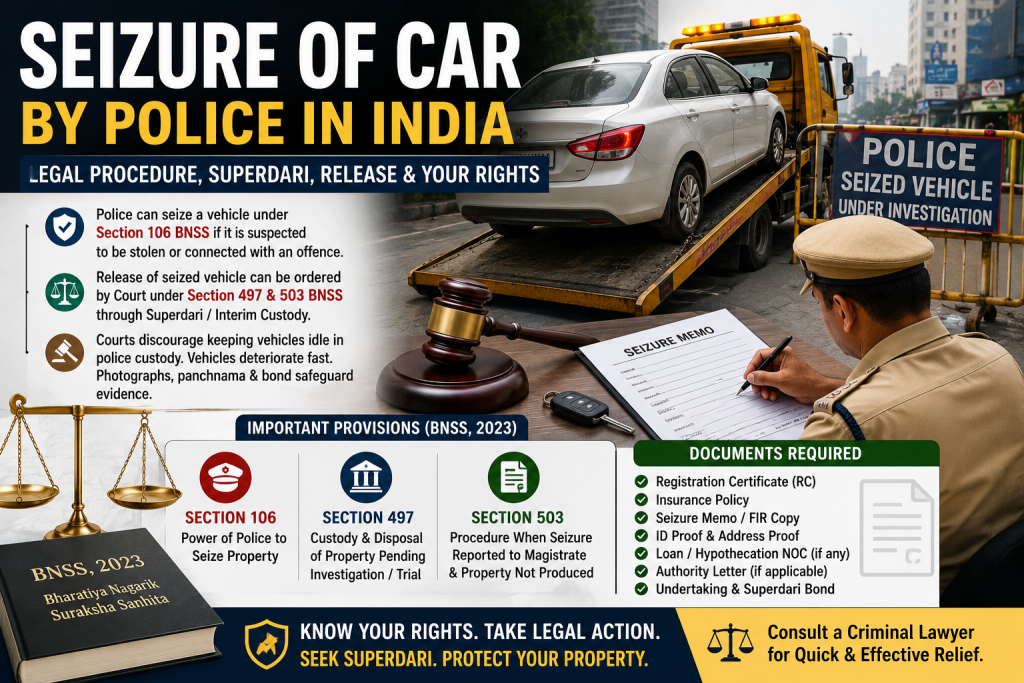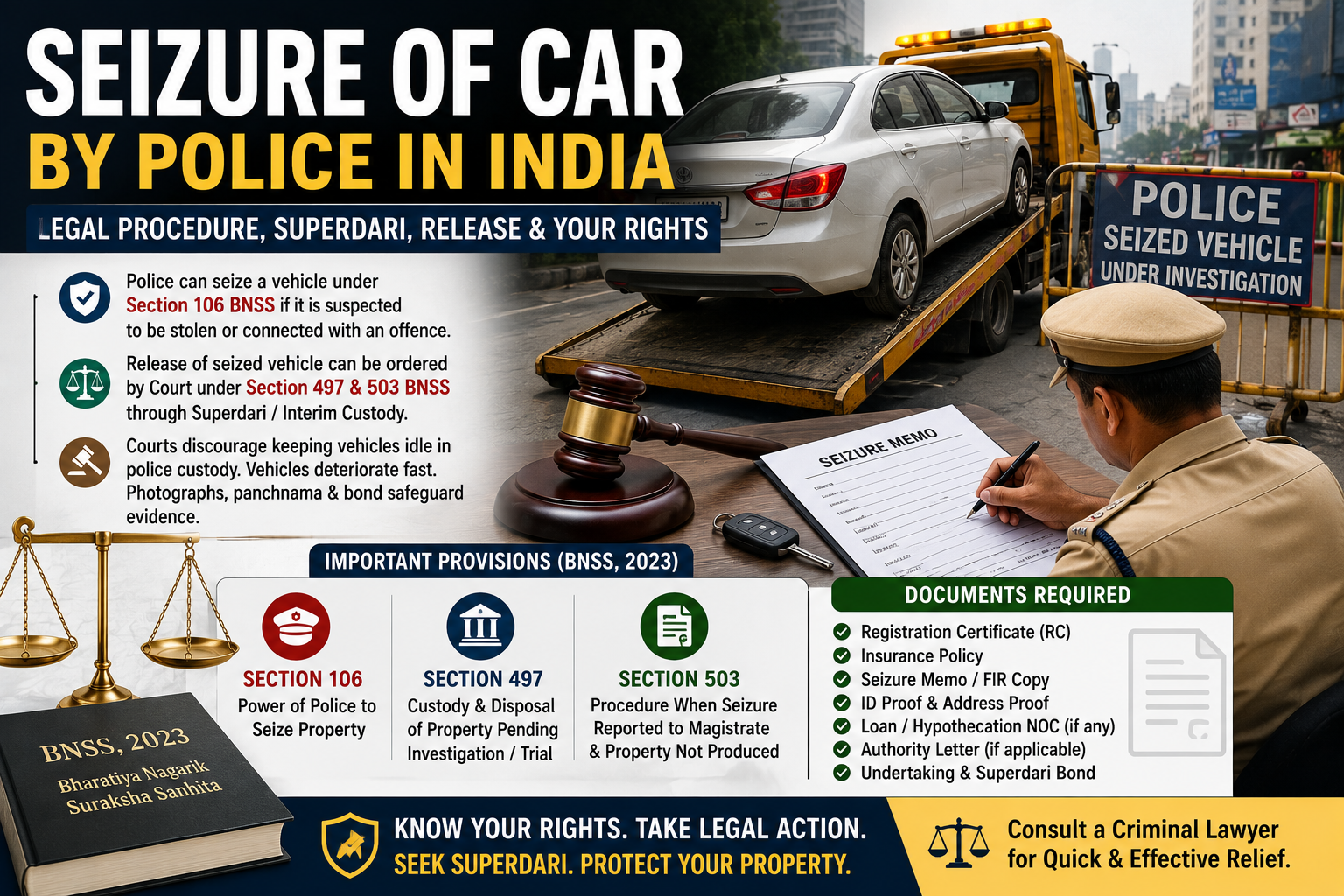
ISeizure of Car by Police in India . If a car is seized by police in India, the owner or lawful claimant can seek release of the vehicle by filing a superdari / interim custody application before the concerned Magistrate or criminal court. Under the Bharatiya Nagarik Suraksha Sanhita, 2023, police may seize property suspected to be stolen or connected with an offence under Section 106 BNSS, while the court may grant custody or release of seized property under Section 497 BNSS where the property is produced before court, and under Section 503 BNSS where seizure is reported to the Magistrate but the property is not produced during inquiry or trial. The Supreme Court has repeatedly discouraged keeping vehicles idle in police stations because vehicles deteriorate rapidly, and courts should ordinarily pass suitable custody/release orders with photographs, panchnama, bond and production conditions
Introduction
Car seizure is one of the most common legal problems faced by vehicle owners in criminal investigations, road-traffic enforcement, accident cases, theft cases, excise cases, NDPS matters, mining cases, financial disputes and allegations of use of vehicle in commission of an offence.
The immediate concern of the owner is simple: how do I get my car released?
The legal answer depends on the reason for seizure. If the car is seized as case property in a criminal case, the remedy is usually a superdari application before the Magistrate or competent criminal court. If the car is detained under the Motor Vehicles Act for lack of registration, licence, permit or similar transport-law violation, the release route may lie before the transport authority or authorised officer. If the vehicle is seized under a special statute such as the NDPS Act, Excise law, Forest law, Mining law or GST-related proceedings, the release process may be governed by special confiscation provisions.
This article explains the law, procedure, documents, do’s and don’ts for release of a seized car in India.
What is Seizure of Car by Police?
Car seizure means taking custody of a vehicle by police or another authorised authority because the vehicle is suspected to be:
- Stolen property.
- Used in commission of an offence.
- Connected with an accident.
- Used for transporting contraband.
- Used for illegal mining or transportation.
- Used without valid registration, permit or licence.
- Involved in a cheating, theft, robbery, excise, NDPS, GST or other criminal case.
- Required as evidence during investigation or trial.
- Subject to confiscation under a special law.
A seized car is usually kept at the police station, police malkhana, traffic yard, court compound, authorised parking yard or government custody facility. The problem is that prolonged custody damages the vehicle and reduces its value.
Legal Basis for Car Seizure Under BNSS
Section 106 BNSS: Police Power to Seize Property
Section 106 BNSS permits a police officer to seize any property which is alleged or suspected to have been stolen, or which is found in circumstances creating suspicion of commission of an offence. The police officer must report the seizure to the Magistrate having jurisdiction.
This is the present BNSS equivalent of the old Section 102 CrPC.
In car cases, Section 106 BNSS may apply where the vehicle is:
- Suspected to be stolen.
- Used in an offence.
- Found in suspicious circumstances.
- Required for investigation.
- Connected with property offence or criminal proceeds.
- Connected with a criminal complaint or FIR.
Section 497 BNSS: Custody and Disposal of Property Pending Trial
Section 497 BNSS applies when property is produced before a criminal court or Magistrate during investigation, inquiry or trial. The court may make an order for proper custody of such property pending conclusion of the case. The section expressly includes property regarding which an offence appears to have been committed or which appears to have been used for commission of an offence.
This is the present BNSS equivalent of old Section 451 CrPC.
For seized vehicles, this provision is central because the court can give interim custody to the owner on conditions.
Section 503 BNSS: Procedure When Police Report Seizure to Magistrate
Section 503 BNSS applies where seizure by police is reported to the Magistrate and the property is not produced before a criminal court during inquiry or trial. The Magistrate may order disposal of the property or delivery to the person entitled to possession.
This is the present BNSS equivalent of old Section 457 CrPC.
This provision is useful where the police have seized the car and reported seizure, but the vehicle is lying in police custody and not formally produced in court.
Section 498 BNSS: Disposal at Conclusion of Trial
Section 498 BNSS applies after investigation, inquiry or trial concludes. The court may pass final orders for disposal, destruction, confiscation or delivery of property to the person entitled to possession.
This is the present BNSS equivalent of old Section 452 CrPC.
For car owners, this matters because interim release on superdari is not always the final ownership decision. Final disposal may be decided at the end of the case.
What is Superdari?
Superdari means interim custody of property released by the court to a person, usually the owner or lawful claimant, subject to conditions. The person receiving the vehicle executes a bond undertaking to produce the vehicle before the court or investigating agency whenever required.
In car seizure cases, superdari usually means:
- Court allows release of the car to the registered owner or lawful claimant.
- Owner executes a superdari bond.
- Owner gives undertaking not to sell, alter or dispose of the vehicle without permission.
- Owner undertakes to produce the vehicle whenever required.
- Photographs, panchnama, chassis number and engine number are recorded.
- Court may require security or surety.
- Court may impose conditions depending on facts.
Superdari is not acquittal. It is only interim custody pending investigation or trial.
Why Courts Release Seized Cars on Superdari
Cars are movable assets that deteriorate quickly when kept unused. Exposure to sun, rain, dust, mechanical stagnation, tyre damage, battery discharge and missing parts can destroy value. The Supreme Court in Sunderbhai Ambalal Desai v. State of Gujarat discouraged keeping seized vehicles and articles in police custody for long periods and emphasised that proper panchnama, photographs and bonds can preserve evidence without keeping the vehicle idle.
The principle is practical: a vehicle should not rot in a police station if evidence can be preserved through documentation and the owner can be made responsible for production.
Leading Supreme Court Judgments on Release of Seized Vehicles
1. Sunderbhai Ambalal Desai v. State of Gujarat
This is the leading judgment on release and disposal of seized property, including vehicles. The Supreme Court emphasised that courts should pass appropriate orders for custody/disposal of seized property and that vehicles should not remain in police stations for long periods. The Court recognised that photographs, panchnama and appropriate bonds may be used to preserve evidentiary value.
Practical Use
Use this judgment in every superdari application for release of car, especially where the vehicle is lying unused and deteriorating.
2. General Insurance Council v. State of Andhra Pradesh
In General Insurance Council & Ors. v. State of A.P., the Supreme Court dealt with the problem of seized vehicles lying unattended and gave directions regarding release and disposal. The Court recognised that applications for release should ordinarily be handled expeditiously, with photographs and panchnama before release.
Practical Use
Use this judgment when arguing that continued retention of a seized vehicle serves no useful purpose once photographs, inventory and panchnama are prepared.
3. Denash v. State of Tamil Nadu, 2025 INSC 1258
In Denash v. State of Tamil Nadu, the Supreme Court dealt with release of a vehicle seized under the NDPS Act. The Court held that the NDPS Rules of 2022 cannot divest the Special Court of jurisdiction to consider interim custody/release of a seized conveyance under old Sections 451/457 CrPC, now corresponding to Sections 497/503 BNSS. The Court also clarified that mere liability to confiscation under NDPS law does not automatically bar interim custody to a bona fide owner.
Practical Use
Use this judgment where the vehicle is seized in an NDPS case and the owner is not an accused or claims bona fide ownership without knowledge or connivance.
People Also Ask: Can Police Seize My Car Without a Court Order?
Yes, police may seize a car without a prior court order if the statutory conditions for seizure are satisfied. Under Section 106 BNSS, police may seize property suspected to be stolen or found under circumstances creating suspicion of commission of an offence. However, the seizure must be reported to the Magistrate having jurisdiction.
A vehicle owner should immediately obtain:
- Seizure memo.
- FIR number or DD entry.
- Police station details.
- Name of Investigating Officer.
- Reason for seizure.
- Case sections invoked.
- Location where vehicle is kept.
People Also Ask: How Can I Get My Seized Car Released?
To get a seized car released, the owner should file a superdari / interim custody application before the concerned Magistrate or competent court.
The usual steps are:
- Obtain copy of FIR / seizure memo.
- Collect vehicle documents.
- Prepare superdari application.
- Attach RC, insurance, ID proof and ownership proof.
- File before the concerned Magistrate or court.
- Serve prosecution / IO, where required.
- Seek court direction for release.
- Execute superdari bond.
- Complete photographs, panchnama and vehicle identification.
- Take delivery of vehicle from police custody.
If the seizure is under a special statute, the application must be filed before the correct forum, such as Special Court or authorised authority.
Documents Required for Release of Seized Car
A strong superdari application should attach:
- Copy of FIR.
- Copy of seizure memo.
- Registration certificate.
- Insurance policy.
- Pollution certificate, where available.
- Driving licence of owner/driver, where relevant.
- Invoice or purchase documents, where required.
- Loan/hypothecation NOC, if vehicle is financed.
- Aadhaar/PAN/address proof of owner.
- Authority letter, if applicant is not owner.
- Company board resolution, if vehicle belongs to company.
- Lease/hire agreement, if commercial vehicle.
- Photographs of vehicle.
- Undertaking not to sell/alter vehicle.
- Superdari bond.
- Any proof showing owner is not connected with offence.
For NDPS or serious criminal cases, the owner should also attach evidence showing lack of knowledge, lack of connivance and reasonable precautions.
People Also Ask: Can Police Refuse to Release a Car?
The police cannot finally decide ownership or permanently refuse release where the matter requires judicial order. If the vehicle is case property in a criminal case, the owner should approach the Magistrate or competent court for superdari. Under Section 503 BNSS, once seizure is reported to the Magistrate, the Magistrate may order delivery of the property to the person entitled to possession.
However, the police or prosecution may oppose release if:
- Vehicle is required for investigation.
- Vehicle identity is disputed.
- Vehicle is stolen property.
- Ownership is contested.
- Vehicle was used in serious offence.
- Vehicle is liable to confiscation under special law.
- Applicant is accused and release may prejudice trial.
- Chassis/engine number is tampered.
- Vehicle is required for mechanical inspection.
- Vehicle is required for forensic examination.
Even then, the court may release the vehicle with strict conditions if evidence is preserved.
Seizure of Car in Accident Cases
In accident cases, the car may be seized for:
- Mechanical inspection.
- Proof of accident involvement.
- Damage assessment.
- Forensic examination.
- Identification of vehicle.
- Investigation under penal and motor vehicle laws.
Once inspection, photographs and panchnama are complete, the owner can seek release on superdari. The application should mention that the vehicle is deteriorating and that the owner undertakes to produce it whenever required.
Seizure of Car in Theft or Stolen Vehicle Cases
Where the car itself is stolen property, release becomes more sensitive. The person seeking release must prove entitlement.
Documents may include:
- RC.
- Insurance.
- Purchase invoice.
- Police complaint of theft.
- Insurance claim documents.
- Identity proof.
- Loan documents.
- Possession history.
If there is a dispute between claimant, insurer and financier, the court may impose stricter conditions or defer release until entitlement is clear.
Seizure of Car under Motor Vehicles Act
A vehicle may be detained under Section 207 of the Motor Vehicles Act, 1988 where it is used without valid registration, driving licence, permit, or in contravention of permit conditions. Section 207 also provides that the owner or person in charge may apply to the transport authority or authorised officer with relevant documents for release of the vehicle.
This is different from a criminal case superdari application.
Practical Examples
A car may be detained under the Motor Vehicles Act for:
- No registration certificate.
- Invalid or absent driving licence.
- No permit for commercial vehicle.
- Use contrary to permit condition.
- Use without required authorisation.
- Suspicious or false vehicle documents.
In such cases, first check whether the vehicle is detained under transport law or seized as case property in an FIR.
Seizure of Car in NDPS Cases
If a car is allegedly used for transporting narcotic drugs or psychotropic substances, special caution is required. Under Section 60 of the NDPS Act, conveyances used in commission of NDPS offences may be liable to confiscation. However, Section 60(3) protects an owner who proves that the vehicle was used without his knowledge or connivance and that he, his agent and the person in charge took reasonable precautions.
In Denash v. State of Tamil Nadu, the Supreme Court held that Special Courts retain jurisdiction to consider interim release of seized vehicles under Sections 497/503 BNSS, and mere possible confiscation under NDPS law does not by itself deny interim custody to a bona fide owner.
What Owner Must Prove in NDPS Vehicle Release
The owner should show:
- He is the true registered owner.
- He was not present at seizure.
- He is not chargesheeted, where applicable.
- Vehicle was hired/used without knowledge of contraband.
- Driver acted beyond authority.
- Owner exercised reasonable precautions.
- Owner has valid documents.
- Vehicle is livelihood/business asset.
- Vehicle is deteriorating in custody.
- Owner undertakes to produce vehicle when required.
Seizure of Car in Excise, Mining, Forest and GST Cases
Vehicles may also be seized under special statutes for transporting liquor, minerals, forest produce, goods without documents, or alleged contraband. In these cases, release depends on the relevant statute and confiscation procedure.
The court or authority will examine:
- Whether seizure was lawful.
- Whether vehicle was used in offence.
- Whether owner knew or connived.
- Whether special confiscation proceedings are pending.
- Whether criminal court has jurisdiction.
- Whether authority under special law must be approached.
- Whether penalty/compounding is available.
- Whether interim custody can be granted.
Do not file a generic superdari application blindly in special-law cases. First identify the governing statute and correct forum.
Conditions Usually Imposed While Releasing a Seized Car
Courts may impose conditions such as:
- Execution of superdari bond.
- Surety bond.
- Undertaking to produce vehicle when required.
- Undertaking not to sell, transfer or alter vehicle.
- Undertaking not to change colour, engine, chassis or registration.
- Photographs of vehicle before release.
- Panchnama/inventory.
- Verification of engine and chassis numbers.
- Deposit of RC copy.
- Production before IO/court whenever directed.
- Security amount, depending on facts.
- Compliance with investigation.
The purpose is to preserve evidence while preventing unnecessary deterioration of the vehicle.
Drafting Grounds for Superdari Application
A strong application should plead:
- Applicant is registered owner/lawful claimant.
- Vehicle is in police custody and deteriorating.
- Continued detention serves no useful purpose.
- Photographs, panchnama and mechanical inspection can preserve evidence.
- Applicant undertakes to produce vehicle whenever required.
- Applicant undertakes not to sell or alter vehicle.
- Vehicle is required for livelihood/business/personal use.
- No prejudice will be caused to investigation.
- Supreme Court discourages keeping vehicles idle in police station custody.
- Applicant has no connection with offence, where applicable.
For NDPS cases, add:
- Applicant was not in conscious possession.
- Applicant had no knowledge or connivance.
- Applicant took reasonable precautions.
- Applicant is a bona fide owner.
- Special Court has jurisdiction to release vehicle on interim custody.
Do’s After Car is Seized
1. Do Obtain Seizure Memo
Immediately ask for a copy of seizure memo. It should mention vehicle number, make, model, colour, engine number, chassis number, place of seizure, date, time and reason.
2. Do Find Out FIR Number
Without FIR/DD details, release becomes difficult. Get FIR number, police station and sections invoked.
3. Do Collect Vehicle Documents
Keep RC, insurance, PUC, invoice, finance documents and ID proof ready.
4. Do File Superdari Application Quickly
Delay causes vehicle deterioration. File promptly before the correct Magistrate or court.
5. Do Preserve Proof of Ownership
If the vehicle is company-owned, attach board authorisation. If financed, attach hypothecation/loan records.
6. Do Seek Photographs and Panchnama
Request court to direct photographs, videography and panchnama before release.
7. Do Comply with Court Conditions
After release, do not sell, alter or hide the car. Produce it whenever directed.
Don’ts After Car is Seized
1. Don’t Try to Remove Vehicle Without Court Order
Taking vehicle without lawful release order can create additional criminal exposure.
2. Don’t Pay Informal Money
Vehicle release should be through legal process, not informal payments.
3. Don’t Delay Application
Cars deteriorate quickly in police yards. Delay weakens practical relief.
4. Don’t File Before Wrong Forum
MV Act detention, BNSS seizure, NDPS seizure and special-law confiscation may require different forums.
5. Don’t Conceal Ownership Dispute
If financier, insurer, company or co-owner is involved, disclose properly.
6. Don’t Sell Vehicle After Superdari
Most release orders prohibit sale or transfer pending trial.
7. Don’t Modify Vehicle
Changing colour, parts, number plate, chassis, engine or body may violate court conditions.
People Also Ask: Can a Seized Car Be Sold After Release on Superdari?
Ordinarily, no. Most courts impose a condition that the vehicle shall not be sold, transferred, altered or disposed of without court permission. Since the vehicle may still be required during trial, selling it without permission can violate the superdari bond and invite legal consequences.
People Also Ask: How Long Does It Take to Release a Seized Car?
There is no single fixed timeline. In simple cases, release may be ordered within days or a few weeks. In serious cases, NDPS cases, ownership disputes or special-law confiscation cases, it may take longer. The Supreme Court has repeatedly emphasised that vehicles should not remain idle for long periods and that courts should use photographs, panchnama and bond conditions to preserve evidence.
People Also Ask: Can a Financed Car Be Released on Superdari?
Yes, but the applicant should disclose the hypothecation/finance status. Depending on the facts, the court may require:
- RC copy showing hypothecation.
- NOC from financier.
- Loan statement.
- Undertaking from owner.
- Authority from company/financier, where required.
Where EMI default, repossession or insurer claim exists, the court may hear competing claimants.
People Also Ask: Can Insurance Company Claim a Seized Vehicle?
Yes, in appropriate cases. If the insurer has settled a theft claim and ownership/subrogation issues arise, the insurer may claim release. In General Insurance Council, the Supreme Court considered issues around recovered vehicles and insurer applications for release.
People Also Ask: Can Police Keep My Car Till Trial Ends?
Not necessarily. Courts have repeatedly held that keeping vehicles idle in police custody until trial concludes is usually undesirable. If evidence can be preserved by photographs, inventory, panchnama and bond, the vehicle may be released on superdari. However, release depends on facts, ownership, offence, special statute and investigation requirements.
Superdari Application Checklist
Before filing, prepare:
- Court name and case title.
- FIR number and police station.
- Vehicle registration number.
- Engine and chassis number.
- Name of registered owner.
- Seizure memo.
- RC copy.
- Insurance copy.
- ID proof.
- Proof of address.
- Loan/hypothecation documents.
- Authority letter, if needed.
- Reason for release.
- Undertaking to produce vehicle.
- Undertaking not to sell/alter.
- Prayer for photographs/panchnama.
- Prayer for release on superdari.
Practical Legal Strategy for Vehicle Owners
A vehicle owner should act in three stages.
Stage 1: Identify the Nature of Seizure
Ask whether the car was seized under:
- BNSS/criminal case.
- Motor Vehicles Act.
- NDPS Act.
- Excise law.
- Mining law.
- Forest law.
- GST/customs law.
- Court attachment/confiscation order.
The remedy depends on this classification.
Stage 2: Establish Ownership and No Prejudice
Show that:
- You are the registered owner.
- Vehicle identity is clear.
- Investigation can proceed without custody.
- Evidence can be preserved.
- You will produce vehicle when required.
Stage 3: Seek Conditional Release
Ask for release subject to:
- Bond.
- Surety, if required.
- Photographs and panchnama.
- Undertaking.
- Production whenever required.
This is usually the most practical route.
Sample Prayer for Superdari Application
A typical prayer may read:
“Pass an order directing release of vehicle bearing registration no. ________, make/model ________, engine no. ________, chassis no. ________, seized in FIR No. ________ registered at P.S. ________, on superdari/interim custody to the applicant, subject to such terms and conditions as this Hon’ble Court may deem fit, including execution of superdari bond and undertaking to produce the vehicle as and when directed.”
This should be modified according to facts and forum.
What is car seizure by police?
Car seizure means police take custody of a vehicle because it is suspected to be stolen, used in an offence, connected with an FIR, involved in accident, or liable to confiscation under law.
What is superdari of car?
Superdari is interim custody of a seized vehicle granted by court to the owner or lawful claimant on bond and undertaking to produce the vehicle whenever required.
Which BNSS section applies to seized car release?
Sections 497 BNSS and 503 BNSS are commonly relevant for custody and release of seized property, depending on whether the vehicle is produced before court or seizure is reported to Magistrate.
Which BNSS section gives police power to seize property?
Section 106 BNSS gives police power to seize property suspected to be stolen or connected with commission of an offence.
Can seized car be released in NDPS case?
Yes, in appropriate cases. The Supreme Court in Denash v. State of Tamil Nadu recognised the Special Court’s jurisdiction to consider interim release of seized conveyance under Sections 497/503 BNSS, even in NDPS matters, where circumstances justify release.
Frequently Asked Questions
1. What should I do if police seize my car?
Obtain seizure memo, FIR/DD details, police station information, IO name and reason for seizure. Then prepare ownership documents and file a superdari application before the concerned Magistrate or competent court.
2. Can police seize my car under BNSS?
Yes. Under Section 106 BNSS, police may seize property suspected to be stolen or found in circumstances creating suspicion of commission of an offence. The seizure must be reported to the Magistrate having jurisdiction.
3. Which court releases a seized car?
Usually, the Magistrate having jurisdiction over the police station or criminal case releases the car on superdari. In special statutes such as NDPS, the Special Court may be the proper forum.
4. What is the difference between Section 497 and Section 503 BNSS?
Section 497 BNSS applies where property is produced before a criminal court or Magistrate during investigation, inquiry or trial. Section 503 BNSS applies where seizure by police is reported to the Magistrate and property is not produced before a criminal court during inquiry or trial.
5. Can a car seized in an accident case be released?
Yes. After mechanical inspection, photographs, panchnama and necessary investigation steps, the owner may seek release on superdari.
6. Can a car seized in NDPS case be released?
Yes, depending on facts. In Denash v. State of Tamil Nadu, the Supreme Court held that the Special Court is not divested of jurisdiction to consider interim custody/release of seized conveyance under Sections 497/503 BNSS.
7. Can I sell the car after superdari release?
Usually no. Courts generally prohibit sale, transfer, alteration or disposal of the vehicle without permission until the case is concluded.
8. Is RC enough for release of seized car?
RC is important but not always sufficient. The court may also require insurance, ID proof, seizure memo, undertaking, bond, loan/NOC documents and proof that release will not prejudice investigation.
9. Can police keep the car until trial ends?
The court may release the car earlier if evidence can be preserved through photographs, panchnama and bond. The Supreme Court has discouraged unnecessary long retention of vehicles in police custody.
10. What if the car is detained under Motor Vehicles Act?
If the car is detained under Section 207 of the Motor Vehicles Act for registration, licence, permit or permit-condition violations, the owner/person in charge may apply to the transport authority or authorised officer with documents for release.
Conclusion
Seizure of a car by police does not mean the owner must wait until the criminal trial ends. Indian law provides a practical remedy through superdari / interim custody so that vehicles do not deteriorate in police custody. Under the BNSS framework, Sections 106, 497, 498 and 503 are central to seizure, custody and release of seized vehicles.
The correct legal route depends on the reason for seizure. A criminal-case seizure usually requires a court application. A Motor Vehicles Act detention may require an application before the authorised transport authority. NDPS and other special-statute seizures require special care because confiscation provisions may apply.
The strongest approach is immediate document collection, prompt superdari application, reliance on Supreme Court precedents, and a clear undertaking that the vehicle will be produced whenever required. A vehicle is evidence, but it is also property. The law does not favour letting it rot in police custody when evidence can be preserved by lawful safeguards.
Also Read Understanding the Chargesheet under Indian Law: An In-Depth Analysis
Disclaimer
This article is intended for general legal awareness and educational purposes only. It does not constitute legal advice, solicitation, advertisement or creation of an advocate-client relationship. Release of a seized car depends on the FIR, sections invoked, ownership documents, forum, nature of offence, investigation status, special law involved, confiscation risk, court practice and facts of each case.