
By Adv. Govind Bali
Fastrack Legal Solutions LLP
Website: www.fastracklegalsolutions.com
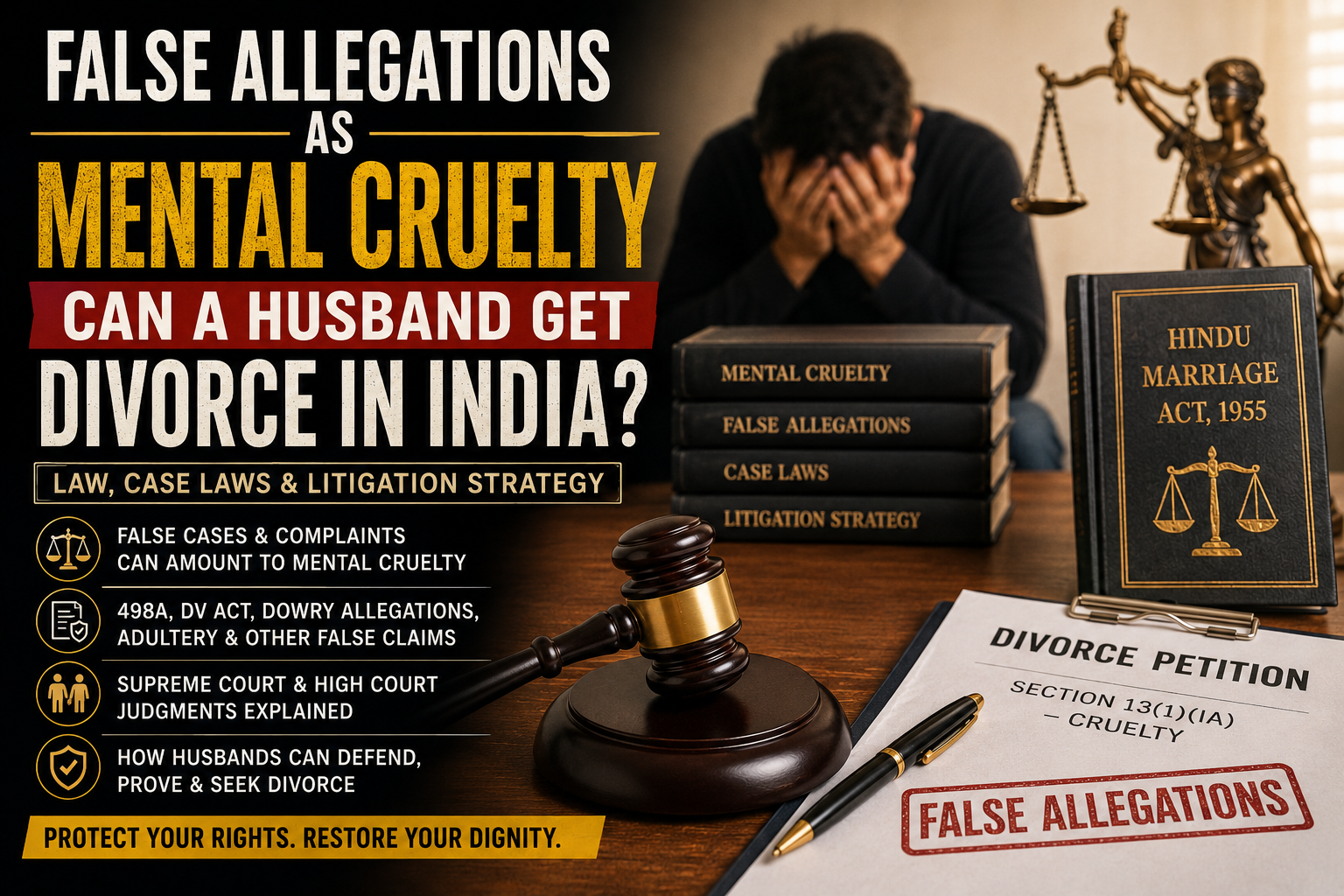
Can A husband can seek divorce in India on the ground of mental cruelty?
Yes. A husband can seek divorce in India on the ground of mental cruelty if false, reckless, scandalous or malicious allegations by the wife make it unreasonable for him to continue the matrimonial relationship. False allegations of adultery, dowry demand, domestic violence, illegitimacy, immoral conduct, criminal behaviour, or abusive complaints to employers, police authorities and relatives may amount to mental cruelty if proved through pleadings, evidence, contradictions, acquittal, closure report, quashing order, or other reliable material. Under Section 13(1)(ia) of the Hindu Marriage Act, 1955, divorce may be granted where one spouse has treated the other with cruelty. The provision applies equally to husbands and wives.
1. Introduction: False Allegations Are Not Mere Words When They Destroy Matrimonial Trust
In matrimonial litigation, allegations are not harmless. A single reckless allegation can damage reputation, employment, family relations, social standing and mental peace. When such allegations are made in pleadings, police complaints, domestic violence proceedings, complaints to employers or public communications, the damage is not confined to the courtroom. It travels into the husband’s family, workplace and social identity.
A husband seeking divorce on the ground of mental cruelty must therefore understand one basic legal truth: the court will not dissolve a marriage merely because allegations were made. The husband must show that the allegations were false, reckless, serious, humiliating, malicious, or of such nature that matrimonial cohabitation became impossible.
Every complaint by a wife is not false. Every criminal case is not cruelty. Every matrimonial allegation does not automatically entitle the husband to divorce.
But where allegations are scandalous, unsupported, repeatedly made, and aimed at destroying the husband’s dignity or family reputation, courts have treated such conduct as mental cruelty.
The law does not expect a spouse to live under permanent character assassination.
2. Legal Basis: Section 13(1)(ia) of the Hindu Marriage Act
Section 13(1)(ia) of the Hindu Marriage Act, 1955 provides that a marriage may be dissolved by a decree of divorce if, after solemnisation of marriage, the other party has treated the petitioner with cruelty.
Cruelty under matrimonial law is not limited to physical violence. It includes mental cruelty. Mental cruelty is assessed from the conduct of the parties, the nature of allegations, social background, intensity of humiliation, continuation of conduct, impact on the spouse, and whether it is reasonable to expect the parties to continue living together.
Therefore, in a husband’s divorce petition, false allegations must not be pleaded vaguely. They must be converted into a structured legal ground:
- What allegation was made?
- Where was it made?
- When was it made?
- Against whom was it made?
- Why is it false?
- What material disproves it?
- How did it affect the husband’s mental peace, reputation and matrimonial life?
- Why does it make continuation of marriage unreasonable?
A cruelty case is won by particulars, not adjectives.
3. What Is Mental Cruelty? The Supreme Court’s Broad Test
The leading authority on mental cruelty is Samar Ghosh v. Jaya Ghosh, (2007) 4 SCC 511. The Supreme Court held that mental cruelty cannot be put into a rigid formula and must be assessed from the entire matrimonial relationship, conduct of parties, social background and circumstances of the case. The Court gave broad illustrative categories and clarified that normal wear and tear of marriage does not amount to cruelty.
This judgment is important because it prevents two extremes.
On one side, it prevents husbands from treating every quarrel or disagreement as cruelty. On the other side, it recognises that cruelty need not always be physical. A person can be broken by words, accusations, threats, humiliation and sustained hostile conduct.
The test is not whether the husband felt hurt. The test is whether the wife’s conduct was such that the husband could not reasonably be expected to live with her.
That distinction matters. Hurt feelings are human. Legal cruelty requires a higher threshold.
4. False Criminal Complaints as Mental Cruelty
False criminal complaints are one of the strongest categories of husband-side mental cruelty, provided the husband can demonstrate falsity or mala fides.
In K. Srinivas Rao v. D.A. Deepa, (2013) 5 SCC 226, the Supreme Court considered whether false complaints and litigation conduct by the wife could amount to mental cruelty. The Court disagreed with the High Court’s view that mental cruelty could not arise merely because the parties had not lived together for long. The Supreme Court accepted that false complaints and conduct causing mental agony may constitute cruelty.
This judgment is extremely useful for husbands facing false or exaggerated criminal proceedings. It supports the proposition that cruelty can arise even outside physical cohabitation. A wife may cause mental cruelty through complaints, pleadings, communications and litigation conduct.
However, the husband must be careful. The mere fact that a wife filed a complaint is not enough. The husband must show that the complaint was false, reckless, malicious or unsupported.
Useful supporting material may include:
- Acquittal judgment;
- Quashing order;
- Closure report;
- Contradictory statements;
- Police cancellation report;
- Admissions in cross-examination;
- Absence of specific allegations;
- Documentary impossibility;
- Timing showing retaliatory motive;
- Independent witnesses disproving allegations.
A husband who says “false case” without proof has only a grievance. A husband who shows why it is false has a legal ground.
5. False Allegations of Extra-Marital Affair or Immorality
Allegations of adultery, illicit relationship or immoral conduct strike at the core of personal dignity. Courts have consistently treated reckless and unproved allegations of extra-marital relationship as capable of causing mental cruelty.
In Narendra v. K. Meena, (2016) 9 SCC 455, the Supreme Court dealt with a case where the wife made frivolous but serious allegations regarding the husband’s character and alleged extra-marital relationship. The Court recognised that such conduct, along with other circumstances, could make it impossible for the husband to continue the relationship.
In Vishwanath Agrawal v. Sarla Vishwanath Agrawal, (2012) 7 SCC 288, the Supreme Court examined allegations of illicit relationship made by the wife against the husband. The Court’s discussion is relevant because it treats the making of serious allegations in matrimonial pleadings as a matter requiring strict scrutiny and proof.
The legal principle is simple: if a wife alleges adultery or immoral conduct, she must have material. If she makes such allegations recklessly and fails to prove them, the allegation itself may become cruelty.
A husband should plead:
- Exact allegation of adultery or immoral conduct;
- Place where the allegation was made;
- Whether it was made in pleadings, complaint, email, social media, or before relatives;
- Whether the wife repeated it;
- Why it is false;
- How it damaged his reputation, employment, family standing or mental peace.
False accusations of adultery are not small domestic insults. They are reputational grenades.
6. False Allegations Against Husband’s Parents and Family Members
False allegations are often not limited to the husband. Parents, siblings, married sisters, elderly relatives and distant family members may be named in matrimonial complaints. Where allegations are general, omnibus and unsupported, they may become relevant in divorce proceedings as part of cruelty.
The Supreme Court and High Courts have repeatedly cautioned against roping in relatives without specific allegations in matrimonial criminal cases. In divorce proceedings, such conduct may be pleaded to show that the wife attempted to criminalise the entire family and destroy matrimonial trust.
The husband’s pleading should not simply say: “She filed false cases against my family.”
It should say:
- Which relatives were named?
- Did they live with the couple?
- Was any specific role assigned?
- Were they elderly, separately residing, or married sisters living elsewhere?
- What was the outcome of the complaint?
- Did the wife later withdraw or contradict the allegations?
- How did this affect the husband’s family life?
Courts understand family reputation. But they need evidence, not melodrama.
7. Threats of False Cases and Suicide Threats
Threats of false criminal prosecution or suicide may also amount to mental cruelty, depending on the facts.
In husband-side litigation, allegations often include threats such as:
- “I will implicate you in dowry case”;
- “I will send your parents to jail”;
- “I will destroy your job”;
- “I will commit suicide and blame you”;
- “I will file cases unless you separate from your parents”;
- “I will ruin your social reputation.”
Such conduct must be pleaded carefully. Courts do not act on bald assertions. The husband should preserve WhatsApp chats, emails, audio recordings where legally usable, witness statements, prior complaints, police diary entries and contemporaneous communications.
The Supreme Court in Narendra v. K. Meena also considered the wife’s threat to commit suicide as a relevant circumstance while assessing cruelty.
A suicide threat is not a small domestic quarrel. It creates fear of criminal implication, social ruin and psychological pressure. If proved, it can become a powerful cruelty ground.
8. False Allegations in Written Statement and Court Pleadings
A common question is whether allegations made in court pleadings can themselves constitute mental cruelty.
The answer is yes, depending on the nature of allegations and whether they are proved.
If the wife makes scandalous allegations in her written statement, domestic violence petition, maintenance application or criminal complaint, and those allegations are false or unsupported, the husband can rely on them in divorce proceedings.
This is strategically important because many husbands file divorce petitions before the wife files her reply. Later, the wife’s written statement may contain additional defamatory allegations. The husband should then amend the petition or file appropriate pleadings to bring subsequent cruelty on record.
Subsequent conduct can be relevant. A marriage can be made impossible not only before filing the petition but also during the litigation.
Litigation conduct is still conduct. A courtroom is not a free fire zone.
9. When False Allegations Become Strong Grounds for Divorce
False allegations are more likely to support divorce where they are:
- Serious and scandalous;
- Repeated;
- Made before police, employer, relatives, society or court;
- Unsupported by evidence;
- Contradicted by record;
- Made after the husband initiated divorce or other proceedings;
- Directed not only at husband but also elderly parents/family;
- Capable of causing arrest, job loss or social humiliation;
- Made with knowledge of falsity;
- Followed by acquittal, closure, quashing or adverse judicial findings.
For example, an unproved allegation that the husband is in an illicit relationship, is impotent, is illegitimate, is a criminal, demanded dowry, sexually abused someone, or assaulted the wife may have grave consequences.
The law recognises that reputation is part of dignity. A marriage cannot survive where dignity is systematically attacked.
10. What Does Not Amount to Mental Cruelty
A husband-side article must be legally honest. Not every allegation by the wife amounts to cruelty.
The following may not automatically amount to mental cruelty:
- Filing a genuine police complaint;
- Filing a maintenance case;
- Filing a domestic violence case with specific allegations;
- Ordinary matrimonial quarrels;
- Refusal to live in a joint family where there is reasonable cause;
- Career choices of the wife;
- Assertion of legal rights;
- Complaints supported by medical or documentary evidence;
- Emotional outbursts during marital conflict;
- Allegations which are substantially proved.
The husband’s case becomes weak if it looks like he is punishing the wife for using legal remedies. Courts will not treat legitimate legal action as cruelty merely because it inconveniences the husband.
The difference is this:
A genuine complaint is legal recourse.
A false and malicious complaint may become cruelty.
That line must be respected.
11. Recent High Court Trends: Courts Are Looking at Reputation and Dignity
Recent High Court decisions show that courts continue to recognise mental cruelty where the wife’s conduct attacks the husband’s reputation, dignity, family identity or self-respect. For example, recent reporting from Delhi High Court noted divorce being upheld where the wife’s conduct included questioning the husband’s legitimacy, making serious allegations against his mother, abusive language, physical violence and social isolation.
Other recent decisions have treated repeated derogatory remarks, threats, denial of cohabitation or reckless allegations of extra-marital affairs as relevant to mental cruelty depending on facts.
These cases reinforce one point: courts do not dissolve marriages on small irritations. But where conduct becomes sustained, humiliating and destructive of dignity, divorce may be granted.
12. How a Husband Should Build Evidence
A husband seeking divorce on the basis of false allegations must prepare a clean evidentiary record.
12.1 Police and Criminal Case Records
- FIR copy;
- Complaint copy;
- Notice under criminal procedure;
- Bail order;
- Charge-sheet or closure report;
- Protest petition, if any;
- Quashing petition and order;
- Acquittal judgment;
- Cross-examination admissions;
- Certified copies of pleadings.
12.2 Matrimonial Litigation Records
- Wife’s written statement;
- Domestic violence complaint;
- Maintenance application;
- Affidavit of income and assets;
- Mediation proceedings, where usable;
- Court orders;
- Pleadings where defamatory allegations are made.
12.3 Digital Evidence
- WhatsApp chats;
- Emails;
- SMS;
- Social media posts;
- Call recordings, subject to admissibility;
- Screenshots with metadata where possible;
- Cloud backups;
- Device preservation.
12.4 Reputation and Employment Impact
- Employer complaint;
- Internal inquiry records;
- Suspension or disciplinary notice;
- Letters from workplace;
- Witnesses from family or society;
- Medical or psychological impact record.
The husband should not rely on memory. Memory is cross-examination’s favourite breakfast.
13. Drafting Strategy: How to Plead False Allegations as Cruelty
A divorce petition based on false allegations should not be written like an emotional complaint. It must be structured.
Recommended pleading structure
A. Marriage and background
State date of marriage, place, cohabitation, children, and initial matrimonial facts.
B. Pattern of conduct
Set out the wife’s conduct chronologically.
C. Specific false allegations
Quote the exact allegations where possible.
D. Why the allegations are false
Refer to documents, contradictions, acquittal, quashing or other material.
E. Impact on husband
Explain mental agony, social humiliation, employment risk, family trauma and breakdown of trust.
F. Legal ground
Connect facts to Section 13(1)(ia) HMA.
G. Prayer
Seek decree of divorce and appropriate consequential reliefs.
The petition must avoid unnecessary abuse. Judges do not need volume. They need precision.
14. Sample Husband-Side Pleading Paragraph
The following style may be used as a drafting model:
“That the Respondent, with the deliberate object of causing mental agony, social humiliation and reputational injury to the Petitioner, levelled false, reckless and scandalous allegations against the Petitioner and his family members, including allegations of dowry demand, physical cruelty and immoral conduct, despite there being no contemporaneous complaint, medical record, independent witness or documentary support. The said allegations were made not only in private matrimonial exchanges but also before police authorities and in judicial pleadings, thereby exposing the Petitioner and his elderly family members to criminal prosecution, social embarrassment and severe mental trauma. The falsity of the allegations is evident from the contradictions in the Respondent’s own pleadings, absence of particulars, subsequent admissions and the judicial record. Such conduct has destroyed the very foundation of matrimonial trust and has rendered it impossible for the Petitioner to reasonably continue the marital relationship.”
This is the correct tone. Controlled, legal, document-focused.
15. Defence Against Wife’s Likely Argument
A wife may argue that she merely exercised her legal rights by filing complaints. The husband must then distinguish between lawful complaint and malicious accusation.
The husband’s reply should be:
- The petitioner does not object to lawful remedies;
- The cruelty lies in false and malicious allegations;
- The allegations were reckless and unsupported;
- The wife attempted to criminalise innocent relatives;
- The allegations caused social and mental injury;
- The allegations were contradicted by record;
- The conduct destroyed matrimonial trust.
This prevents the husband from appearing anti-woman or anti-remedy. The argument is not that the wife had no right to complain. The argument is that she had no right to falsely destroy.
16. Relationship with 498A / BNS Section 85 Proceedings
After the new criminal laws came into force, matrimonial cruelty by husband or relatives is substantially dealt with under Sections 85 and 86 of the Bharatiya Nyaya Sanhita, 2023 for offences committed after commencement of the new regime, while older cases may still involve Section 498A IPC depending on date and transition. The distinction matters because divorce pleadings should correctly refer to the pending criminal provision.
Where a wife has filed a criminal cruelty case, the husband should avoid making overbroad claims in divorce until the criminal record is studied. If the criminal case is at an early stage, plead falsity on available contradictions and lack of particulars. If there is acquittal, quashing or closure, plead that strongly.
The divorce case and criminal defence must speak the same language. Contradictions between the two can be fatal.
17. Can Acquittal Automatically Prove Mental Cruelty?
Not always.
An acquittal may strongly support the husband’s case, but every acquittal does not automatically mean the complaint was false. Sometimes acquittal may be due to benefit of doubt, settlement, hostile witnesses, delay or insufficient proof.
For divorce, the husband should show more than technical acquittal. He should show that the allegations were false, reckless, exaggerated or malicious.
The best cases are those where the criminal court, High Court or police record specifically records lack of substance, falsity, contradiction, abuse of process or absence of specific allegations.
So, an acquittal is powerful. But a reasoned acquittal is stronger.
18. False Allegations and Irretrievable Breakdown
Indian family courts ordinarily require a statutory ground such as cruelty or desertion. Irretrievable breakdown by itself is not a general statutory ground under the Hindu Marriage Act before ordinary courts. However, long separation, repeated litigation and false allegations may support the cruelty ground and show that the marriage has practically ended.
Therefore, in husband-side drafting, irretrievable breakdown should not replace cruelty. It should support it.
The better pleading is:
“The false allegations constitute mental cruelty under Section 13(1)(ia), and the prolonged litigation and complete breakdown of trust further show that the matrimonial bond has been destroyed beyond repair.”
That is legally safer.
19. Practical Court Strategy for Husbands
A husband relying on false allegations as cruelty should follow these principles:
- Do not exaggerate;
- Do not call every complaint false without record;
- File certified copies of pleadings and orders;
- Prove exact allegations;
- Show contradiction and falsity;
- Show impact on reputation and mental peace;
- Avoid abusive language against wife;
- Align divorce pleadings with criminal defence;
- Seek amendment if false allegations arise later;
- Preserve digital evidence properly.
A divorce petition is not a revenge note. It is a legal instrument.
20. Case Law Summary
| Case | Principle |
|---|---|
| Samar Ghosh v. Jaya Ghosh | Mental cruelty is fact-sensitive; normal wear and tear of marriage is not enough; the entire matrimonial relationship must be assessed. |
| K. Srinivas Rao v. D.A. Deepa | False complaints and litigation conduct may constitute mental cruelty; mental cruelty can occur even without long cohabitation. |
| Narendra v. K. Meena | Frivolous and serious allegations about character and extra-marital relationship may amount to cruelty, along with other facts. |
| Vishwanath Agrawal v. Sarla Vishwanath Agrawal | Serious allegations of illicit relationship in matrimonial proceedings require proof and may be relevant to cruelty. |
| Recent High Court trend | Courts continue to treat sustained humiliation, reckless allegations, abusive conduct and reputational attacks as mental cruelty where proved. |
21. Frequently Asked Questions
Can a husband get divorce if the wife files a false 498A case?
Yes, if the husband proves that the complaint was false, malicious, reckless or unsupported and that it caused mental cruelty. Mere filing of a complaint is not automatically cruelty, but false criminal prosecution may become a strong ground for divorce.
Are false allegations of extra-marital affair mental cruelty?
Yes. Reckless and unproved allegations of adultery, illicit relationship or immoral conduct may amount to mental cruelty because they attack personal dignity and reputation. The Supreme Court has treated such allegations seriously in matrimonial disputes.
Can allegations made in written statement amount to cruelty?
Yes. False and scandalous allegations made in pleadings may be considered as subsequent conduct and may support divorce on the ground of mental cruelty.
Is acquittal in criminal case necessary before filing divorce?
No. A husband can file divorce even while criminal proceedings are pending. However, acquittal, quashing or closure report strengthens the husband’s cruelty case.
Can a genuine complaint by wife be treated as cruelty?
No. A genuine complaint supported by facts and evidence is legal recourse. Cruelty arises where the complaint is false, malicious, reckless or made to harass and humiliate.
What evidence should a husband collect?
The husband should collect FIRs, complaints, court pleadings, bail orders, quashing orders, acquittal judgments, WhatsApp chats, emails, employer complaints, witness details, medical records and certified copies of all litigation documents.
Conclusion
False allegations in matrimonial disputes are not merely unpleasant words. They can become legal cruelty when they are reckless, malicious, scandalous and destructive of dignity, reputation and matrimonial trust.
A husband can seek divorce where such allegations make it impossible to reasonably continue the marriage. But the case must be built carefully. The husband must prove the exact allegations, their falsity, their impact and their connection with the breakdown of marital life.
The best husband-side cruelty petition is not loud. It is precise.
It does not say: “She ruined my life.”
It says: “She made false allegations of a grave nature, failed to prove them, caused reputational and mental injury, and destroyed the foundation of matrimonial trust.”
That is the difference between anger and advocacy.
Disclaimer
This article is for legal awareness and academic discussion only. It does not constitute legal advice, advertisement, solicitation or creation of an advocate-client relationship. Matrimonial disputes are fact-sensitive and must be assessed on pleadings, evidence, conduct of parties, pending proceedings, applicable personal law and judicial discretion.