
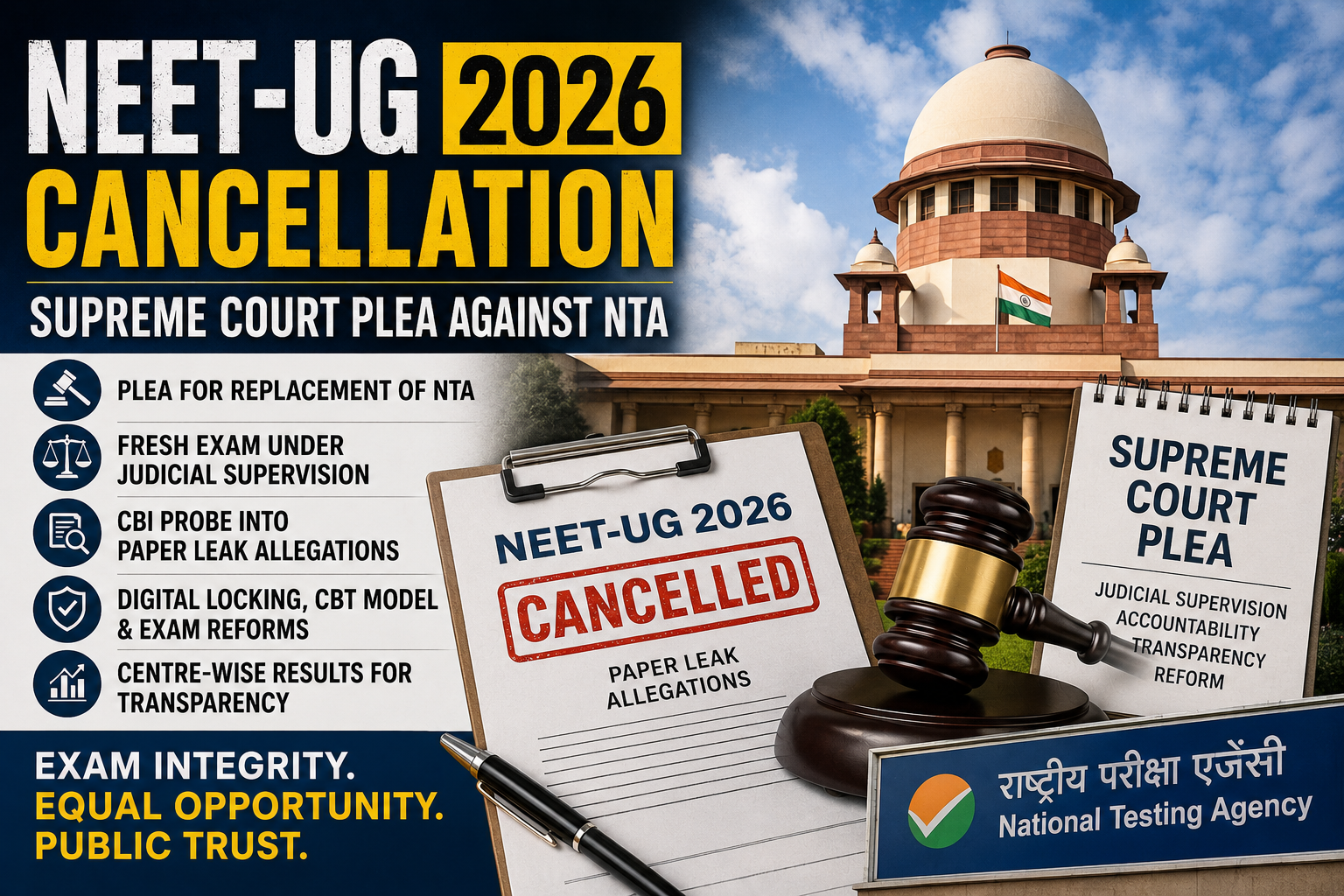
The reported Supreme Court plea filed after the cancellation of NEET-UG 2026 raises a question larger than one medical entrance examination: whether India’s national testing architecture can continue to command constitutional confidence when allegations of paper leak, compromised question security and institutional failure recur in high-stakes examinations. The petition reportedly seeks replacement or restructuring of…
1. Introduction: NEET-UG 2026 Is Not Merely an Examination Dispute
The cancellation of NEET-UG 2026 is not merely an administrative failure. It is a public law event.
A medical entrance examination is not a routine classroom test. It decides access to medical education, future professional opportunity, public trust in merit, and ultimately the quality of India’s medical pipeline. When such an examination is cancelled on account of alleged paper leak concerns, the harm is not limited to the candidates who allegedly benefited. The larger injury is caused to every honest candidate who prepared in good faith and entered the examination hall believing that merit would decide the result.
According to News On AIR, the National Testing Agency decided to cancel the NEET-UG 2026 examination conducted on 3 May 2026, and the matter was referred to the CBI for a comprehensive inquiry into allegations of paper leak. NTA reportedly stated that the examination would be reconducted on dates to be notified separately, with existing registration details, candidature information and selected centres carried forward, and without fresh registration or additional fee.
This is where the matter becomes legally significant. A re-test may address the immediate examination cycle. But it does not, by itself, answer the deeper institutional question:
Who audits the examiner?
That is the question the Supreme Court may now be called upon to address.
Also Read Who is Advocate Govind Bali | Fastrack Legal Solutions LLP
2. What the Supreme Court Plea Reportedly Seeks
As reported by LiveLaw, the Federation of All India Medical Association has moved the Supreme Court challenging what it describes as systemic failure of the National Testing Agency in conducting NEET-UG 2026. The plea has reportedly been filed through Advocate Tanvi Dubey and seeks directions to replace or fundamentally restructure the NTA and conduct a fresh NEET-UG 2026 examination under judicial supervision.
The petition reportedly seeks the replacement of NTA with a more robust, technologically advanced and autonomous body for conducting NEET examinations. It also seeks the constitution of a high-powered monitoring committee chaired by a retired Supreme Court judge, with the assistance of a cybersecurity expert and forensic scientist, to supervise the re-conduct of NEET-UG 2026 until a new independent examination body or interim oversight mechanism certifies the security of the revised examination process.
The plea further seeks digital locking of question papers, transition to a computer-based testing model, a CBI status report within four weeks on the alleged paper leak, and centre-wise publication of results to enable transparent detection of anomalies.
These prayers are not cosmetic. They convert the controversy from an “exam cancellation” issue into a broader claim for institutional redesign.
3. Why This Is a Constitutional Issue, Not Just an Education Issue
At first glance, NEET-UG appears to be an examination matter. Legally, however, it sits squarely within the domain of constitutional accountability.
A national entrance examination conducted by a statutory or public authority must satisfy the minimum constitutional requirements of fairness, non-arbitrariness, transparency and equal treatment. The moment a paper leak enters the system, the equality of competition is compromised. The honest candidate competes against uncertainty, while the tainted beneficiary competes with an unlawful advantage.
That is not merely malpractice. It is an assault on the constitutional promise of equal opportunity.
The Supreme Court’s own NEET-UG 2024 judgment recognised the legal test that courts must apply in such matters: whether the breach took place at a systemic level, whether it affected the integrity of the entire examination process, and whether it is possible to segregate tainted candidates from untainted candidates.
That test is now directly relevant to the NEET-UG 2026 controversy.
The legal question is not simply:
Was there a leak?
The legally decisive questions are:
- Was the leak isolated or systemic?
- Can the beneficiaries be identified?
- Can honest candidates be protected without cancelling the whole process?
- Has public confidence in the examination process been irreparably damaged?
- Has the examination body shown the institutional capacity to safely reconduct the examination?
That is the real constitutional frame.
4. The 2024 Supreme Court Standard: Why It Matters in 2026
The Supreme Court’s 2024 NEET judgment is central to the 2026 debate.
In 2024, the Supreme Court acknowledged that the NEET-UG paper leak at Hazaribagh and Patna was not in dispute, but declined to cancel the entire examination because there was no sufficient material at that stage to conclude that the entire result was vitiated or that there had been a systemic breach of the sanctity of the examination. The Court also relied on the principle that if tainted students can be segregated from untainted students, a full re-test may not be justified.
The Court also recognised that cancelling an examination of such scale would have serious consequences: disruption of the admission schedule, cascading effects on medical education, impact on the availability of qualified medical professionals, and disadvantage to candidates from marginalised and weaker sections.
That reasoning was appropriate for a situation where the Court did not find sufficient material of systemic compromise.
But 2026 appears procedurally different in one important respect: the examination has already been cancelled by NTA, and the present plea reportedly seeks judicial supervision over the re-conduct and structural reform of the examination body.
Therefore, the 2026 issue is not identical to 2024. In 2024, the question was whether the Court should cancel the exam. In 2026, the examination already stands cancelled; the question now is whether the same institutional mechanism should reconduct it without court-monitored safeguards.
That distinction matters.
5. The NTA Problem: Institutional Trust After Repeated Examination Controversies
The National Testing Agency’s own NEET website states that NEET-UG 2026 is conducted by NTA as the common and uniform entrance test for undergraduate medical education in all medical institutions. The same website describes NTA as an independent, autonomous and self-sustained premier testing organisation established for conducting efficient, transparent and international-standard tests.
Those words carry institutional weight. If the national testing body claims autonomy, efficiency, transparency and international standards, then repeated allegations of paper leakage and process compromise cannot be answered by routine press releases alone.
The Supreme Court, in the NEET-UG 2024 judgment, had already expressed serious concern about the manner in which NTA conducted the examination. It observed that national-level examinations with participation from lakhs of students require immense resources, coordination and planning, and stated that the scale of the exam is no excuse because that is precisely why a body such as NTA exists. The Court further observed that NTA had sufficient resources, funding, time and opportunity to organise NEET without lapses of the kind that occurred in 2024.
That observation now reads less like a warning and more like a judicial prologue.
If, despite the 2024 litigation and reform directions, another NEET cycle is cancelled in 2026 due to alleged leak concerns, the argument for external oversight becomes significantly stronger.
The question is no longer whether one leak occurred. The question is whether the institutional architecture has become vulnerable to recurring compromise.
6. Judicial Supervision: Necessary Safeguard or Administrative Overreach?
The plea reportedly seeks a fresh NEET-UG 2026 examination under judicial supervision. That prayer will require careful constitutional balancing.
Courts do not ordinarily conduct examinations. They are not examination boards. They cannot manage question-setting, encryption, logistics, biometric verification, OMR security, server hardening, centre allocation, transportation protocols or invigilation.
But courts can require accountability. Courts can require transparency. Courts can appoint oversight mechanisms. Courts can direct independent audits. Courts can demand status reports. Courts can ensure that public authorities do not treat lakhs of students as collateral damage in administrative experiments.
The appropriate judicial role may therefore not be to “run” NEET, but to ensure that the re-conducted NEET is supervised through a credible, independent, technically competent mechanism.
A court-appointed or court-monitored committee comprising a retired judge, cybersecurity expert, forensic professional, examination security specialist and administrative expert would not replace the examination authority. It would function as a confidence-restoring oversight layer.
That is not judicial overreach. It is institutional first aid.
7. Digital Locking and Computer-Based Testing: Technology Is Necessary, But Not Sufficient
The plea reportedly seeks digital locking of question papers and a transition to computer-based testing to reduce physical chain-of-custody risks.
This is a serious proposal because many paper leak controversies arise from physical vulnerability: printing, packaging, transportation, storage, local handling, centre-level access, delayed sealing, strongroom breaches and human collusion.
Computer-based testing may reduce some physical risks, but it creates its own cybersecurity risks. A CBT model requires secure servers, encryption, audit logs, independent penetration testing, randomised question pools, real-time monitoring, biometric access, device security, cyber incident response, and post-exam forensic trails.
Therefore, the correct reform is not merely “paper to computer.” The correct reform is:
secure examination architecture from question generation to result declaration.
A badly designed CBT exam can fail just as badly as a paper-based exam. It will only fail in a more expensive and technically embarrassing manner.
The legal system must therefore ask for independent technical audit, not decorative digitisation.
8. Centre-Wise Result Publication: Transparency or Privacy Risk?
The plea reportedly seeks publication of centre-wise results to detect anomalies transparently.
This prayer has precedent value. In the 2024 NEET litigation, the Supreme Court directed NTA to publish city-wise and centre-wise results after anonymising candidate identities, considering that such publication would serve transparency.
Centre-wise publication can help detect abnormal scoring patterns, cluster performance, suspicious concentration of high scores, or statistical deviation from ordinary trends. But it must be anonymised properly. Candidate privacy must not be sacrificed in the name of transparency.
The ideal model is:
- Publish anonymised centre-wise data;
- Use independent statistical audit;
- Flag abnormal performance clusters;
- Compare with historical centre/city data;
- Conduct forensic review where anomalies appear;
- Protect individual candidate identity unless wrongdoing is established.
Transparency should expose irregularities, not innocent students.
9. CBI Status Report: Why Investigation Timelines Matter
The plea reportedly seeks a CBI status report within four weeks, including details of the network identified, arrests made, persons charged and progress of prosecution.
This is a sensible demand because examination litigation often suffers from one chronic problem: by the time the criminal investigation matures, the admission cycle has already moved on.
If the investigation is delayed, three harms occur:
- Tainted beneficiaries may enter the system;
- Honest candidates lose confidence;
- Courts are forced to decide public law issues on incomplete investigative material.
The Supreme Court in the 2024 NEET case had considered CBI status reports and noted that the investigation was continuing. It also recorded that candidates later found to have engaged in fraud or malpractice would not acquire vested rights merely because counselling or admissions had progressed.
That principle must apply with equal force in 2026.
No student who benefits from a paper leak should be allowed to hide behind the calendar.
10. The Reform Committee Context: The Court Has Been Here Before
The Supreme Court’s 2024 judgment did not merely dispose of the immediate NEET dispute. It also dealt with structural reform.
The Court noted that the Union Government had constituted a seven-member expert committee chaired by Dr K. Radhakrishnan, former Chairman, ISRO, and expanded the committee’s remit to include examination security and administration, SOPs, centre allotment, candidate identity verification and other reforms.
The Court specifically directed that the committee must examine vulnerabilities and help restore trust in the examination system through robust safeguards. It also directed the Ministry of Education to act on the committee’s recommendations within the specified framework.
This background is crucial.
If the 2026 cancellation occurred after the 2024 reform process, then the Supreme Court may legitimately ask:
- Which recommendations were accepted?
- Which recommendations were implemented?
- Which were deferred?
- What security audit was conducted before NEET-UG 2026?
- Who certified the physical/digital chain of custody?
- What accountability has been fixed for recurrence?
Reform reports cannot become ceremonial paperwork. If the medicine was prescribed in 2024, the Court is entitled to ask in 2026 whether anyone actually took the dose.
11. The Legal Test the Supreme Court May Apply in 2026
The Supreme Court may likely examine the matter through the following legal framework:
A. Sanctity of Examination
Was the integrity of NEET-UG 2026 compromised in a manner that affects the fairness of the examination as a whole?
B. Systemic Failure
Was the leak or irregularity isolated, or does it indicate a deeper structural breakdown in question paper security and examination administration?
C. Possibility of Segregation
Can tainted beneficiaries be identified and excluded, or is the process so compromised that segregation is impossible?
D. Institutional Capacity
Can NTA safely reconduct the examination without independent oversight, especially after cancellation?
E. Impact on Honest Candidates
Would judicially supervised re-conduct protect honest candidates better than an ordinary re-test under the same agency?
F. Public Confidence
Has public confidence in the examination process fallen so severely that independent oversight is necessary to restore legitimacy?
This is not merely about relief. It is about institutional credibility.
12. What Relief Would Be Legally Balanced?
A legally balanced Supreme Court order need not immediately abolish NTA or judicially micromanage every operational detail. A more realistic set of directions may include:
- Court-monitored or court-appointed oversight committee for NEET-UG 2026 re-test;
- Independent cybersecurity and forensic audit of the revised examination process;
- Sealed disclosure of investigation status by CBI;
- Mandatory chain-of-custody protocol for question papers;
- Independent certification before question paper movement or digital deployment;
- Anonymised centre-wise result publication;
- Statistical anomaly audit before final result declaration;
- Candidate grievance window before counselling;
- Accountability report from NTA and Ministry of Education;
- Time-bound implementation update on post-2024 reform recommendations.
That would protect students without turning the Court into an examination control room.
13. Why Students Need Certainty, Not Just Sympathy
The worst part of examination failure is not only the cancellation. It is uncertainty.
Students preparing for NEET often spend years in pressure, coaching, financial sacrifice and emotional strain. A cancellation means more than a new date. It means disrupted mental preparation, travel plans, family finances, academic timelines and admissions uncertainty.
The Supreme Court recognised in 2024 that ordering a fresh NEET would have serious consequences for more than two million students, including cascading effects on medical education and disadvantage to marginalised candidates.
That concern remains valid in 2026. But after cancellation has already occurred, the immediate need is not to debate whether students will suffer. They already have.
The need now is to ensure that the re-test is unquestionably secure.
A second failure would be unforgivable.
14. The Bigger Question: Should NTA Be Replaced?
The plea reportedly seeks replacement or fundamental restructuring of NTA.
This is the most politically and administratively sensitive prayer. Courts may be cautious in directing replacement of an examination agency, because such decisions involve policy, executive domain, staffing, statutory framework, budget, technology, and inter-ministerial coordination.
However, courts can certainly direct an independent review, seek implementation reports, monitor compliance with reform recommendations, and require institutional safeguards where public trust has been damaged.
A court may not immediately say, “Replace NTA tomorrow.”
But it can ask, “Why should NTA continue in the same form if the same vulnerabilities recur?”
That question alone has institutional force.
15. Conclusion: NEET-UG 2026 Is a Test of the Testing System
The NEET-UG 2026 cancellation has moved the debate beyond one paper, one leak, one agency, or one re-test. It has exposed a deeper problem: the fragility of public confidence in national competitive examinations.
The law must protect honest candidates. It must punish beneficiaries of malpractice. It must require accountability from examination authorities. It must ensure that technological reform is real, not ornamental. And it must recognise that examination integrity is not a bureaucratic slogan — it is a constitutional necessity.
The Supreme Court’s role is not to conduct NEET. But where the examination system repeatedly fails, the Court may have to ensure that the system is made answerable.
Because in a country where lakhs of students gamble their youth on one examination, the least the State owes them is this:
Disclaimer
This article is for legal awareness, public law analysis and academic discussion only. It is based on publicly reported developments as available on 13 May 2026. It does not constitute legal advice, solicitation, advertisement or creation of an advocate-client relationship. Pending proceedings may develop further, and readers should verify subsequent orders, pleadings and official notifications before relying on the position stated herein.