
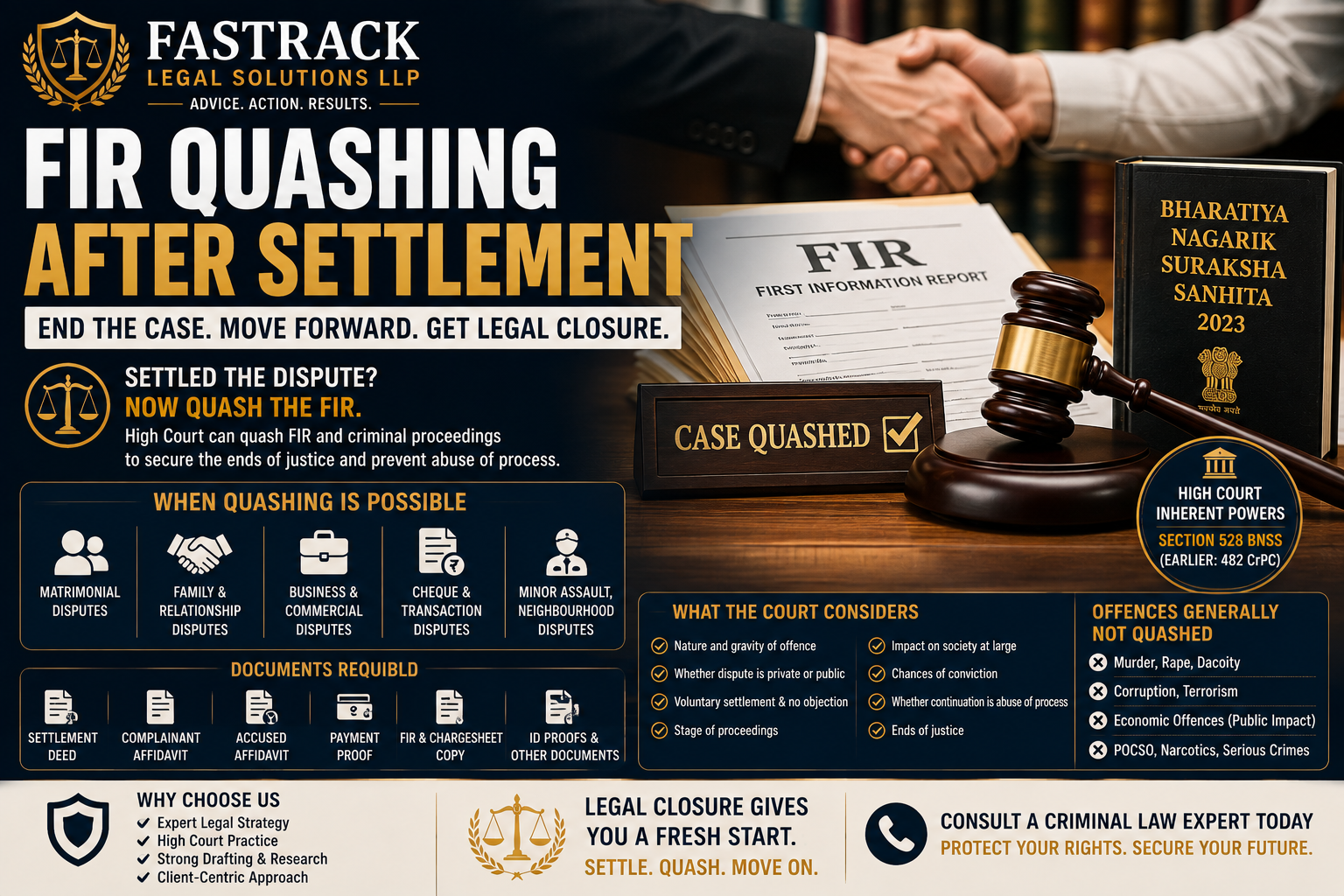
FIR quashing after settlement means approaching the High Court to end criminal proceedings because the accused and complainant have voluntarily resolved their dispute. The High Court may quash an FIR or criminal case in exercise of inherent powers where continuing the case would be an abuse of process or where quashing is necessary to secure the ends of justice. Settlement-based quashing is commonly allowed in matrimonial disputes, family disputes, commercial disputes, minor assault cases, cheque-related disputes and private disputes. However, serious offences such as murder, rape, dacoity, corruption, terrorism, offences against the State and offences having grave public impact are generally not quashed merely because parties have settled. The Supreme Court in Gian Singh, Narinder Singh and Parbatbhai Aahir has laid down the guiding principles for settlement-based FIR quashing.
Non-Solicitation Note
This article is for general legal awareness and educational purposes only and may be published by Fastrack Legal Solutions LLP. It is not an advertisement, solicitation, invitation or inducement for professional engagement. It does not create an advocate-client relationship. FIR quashing depends on the FIR allegations, sections invoked, stage of proceedings, nature of offence, settlement deed, complainant consent, public interest, criminal antecedents, payment terms and case-specific facts.
Introduction
Many criminal cases in India arise from personal disputes that are later settled. Matrimonial cases, family disputes, business transactions, cheque disputes, property disputes, neighbourhood fights, employment disputes and partnership disputes may result in FIRs. After emotions cool down, parties may compromise.
But settlement alone does not automatically cancel an FIR.
Once an FIR is registered, it becomes part of the criminal justice process. The complainant cannot simply “withdraw” every criminal case by writing a letter to the police. In many cases, especially where the offences are non-compoundable, the parties must approach the High Court for quashing.
This article explains when FIR quashing after settlement is possible, what documents are required, what the High Court examines, which offences can be quashed, which offences are difficult to quash, and how to prepare a strong quashing petition.
What Is FIR Quashing?
FIR quashing means the High Court sets aside the FIR and all criminal proceedings arising from it.
Once FIR is quashed:
- Investigation may come to an end.
- Chargesheet proceedings may be quashed.
- Trial may end.
- Accused may be discharged from the case.
- Bail conditions may become irrelevant.
- Look-out or police attendance issues may be resolved, depending on facts.
- The criminal case cannot continue on the same FIR.
FIR quashing is a discretionary judicial remedy. It is not automatic.
What Is FIR Quashing After Settlement?
FIR quashing after settlement means the accused and complainant have resolved the underlying dispute and jointly or effectively request the High Court to end the criminal proceedings.
This commonly happens in:
- Matrimonial disputes.
- Section 498A cruelty cases.
- Dowry-related settlement cases.
- Family property disputes.
- Business-payment disputes.
- Cheating allegations arising from commercial transactions.
- Simple hurt or minor assault cases.
- Neighbourhood quarrels.
- Partnership disputes.
- Cheque bounce connected settlements.
The High Court examines whether the dispute is overwhelmingly private or civil in nature and whether continuation of criminal proceedings would serve any useful purpose.
Section 528 BNSS and Old Section 482 CrPC
Under the old Code of Criminal Procedure, inherent powers of the High Court were recognised under Section 482 CrPC.
Under the Bharatiya Nagarik Suraksha Sanhita, 2023, the corresponding provision is Section 528 BNSS.
The principle remains that the High Court can exercise inherent powers:
- To give effect to any order under the criminal procedure law.
- To prevent abuse of process of any court.
- To secure the ends of justice.
Settlement-based quashing is generally filed under the High Court’s inherent jurisdiction.
People Also Ask: Can an FIR Be Quashed After Compromise?
Yes. An FIR can be quashed after compromise if the High Court is satisfied that the dispute is private in nature, the settlement is voluntary, the complainant has no objection, and continuation of proceedings would be an abuse of process. However, serious offences involving public interest are generally not quashed merely because parties have compromised.
Difference Between Compounding and Quashing
| Issue | Compounding | Quashing |
|---|---|---|
| Source | Statutory compounding provision | High Court inherent power |
| Forum | Trial court or appellate court, depending on stage | High Court |
| Applies to | Compoundable offences | Compoundable and some non-compoundable offences |
| Consent | Usually complainant/victim consent | Settlement plus High Court satisfaction |
| Discretion | Governed by statute | Equitable and discretionary |
| Public interest test | Limited | Stronger public-interest scrutiny |
This distinction is very important. Some offences can be compounded before the trial court. Others require High Court quashing.
Supreme Court Principles on Settlement-Based Quashing
1. Gian Singh v. State of Punjab
The Supreme Court held that High Courts may quash criminal proceedings involving private disputes where continuation would be unfair or contrary to the interest of justice. However, serious offences of mental depravity, murder, rape, dacoity and offences having serious impact on society cannot be quashed merely because parties have settled.
2. Narinder Singh v. State of Punjab
The Supreme Court laid down practical guidelines for quashing after compromise. The Court distinguished private disputes from serious crimes and directed courts to consider the stage of proceedings, nature of offence and whether conviction is likely.
3. Parbatbhai Aahir v. State of Gujarat
The Supreme Court summarised the governing principles and reiterated that offences which are private or civil in flavour may be quashed after settlement, but heinous and serious offences cannot be treated as merely private.
What the High Court Examines Before Quashing FIR
The High Court generally considers:
- Nature and gravity of offence.
- Whether dispute is private or public.
- Whether settlement is voluntary.
- Whether complainant is present or represented.
- Whether complainant has filed affidavit/no-objection.
- Whether payment/settlement terms are fulfilled.
- Whether case involves heinous offence.
- Whether offence affects society at large.
- Stage of proceedings.
- Chances of conviction after settlement.
- Whether continuation would be abuse of process.
- Criminal antecedents of accused.
- Whether any accused is absconding.
- Whether settlement is genuine or forced.
- Whether quashing would secure ends of justice.
Offences Commonly Quashed After Settlement
Settlement-based quashing is often considered in:
- Matrimonial cruelty cases.
- 498A-type disputes.
- Family settlement disputes.
- Minor hurt cases.
- Neighbourhood disputes.
- Commercial transaction disputes.
- Partnership disputes.
- Property transaction disputes.
- Cheque-related disputes.
- Employment disputes.
- Defamation-type private disputes.
- Simple intimidation cases.
This does not mean every such FIR will be quashed. The facts still matter.
Offences Generally Not Quashed Merely on Settlement
Courts are usually reluctant to quash:
- Murder.
- Rape.
- Dacoity.
- Terror offences.
- Corruption cases.
- Offences against the State.
- Serious economic offences affecting public interest.
- POCSO offences.
- Narcotics cases.
- Serious bodily offences.
- Offences involving public servants in official capacity.
- Organised crime.
- Cases involving vulnerable victims.
- Cases involving societal impact beyond private parties.
The reason is simple: serious crimes are not merely private disputes between complainant and accused.
FIR Quashing in Matrimonial Settlement Cases
Matrimonial quashing is one of the most common categories.
It may involve:
- Cruelty allegations.
- Dowry allegations.
- Misappropriation of stridhan.
- Domestic violence-connected allegations.
- Threat allegations.
- Family-member allegations.
- Settlement through mediation.
- Mutual consent divorce.
- Permanent alimony.
- Return of articles.
In such cases, the High Court generally examines whether the settlement is complete and voluntary.
Documents for Matrimonial FIR Quashing
- Settlement deed / MoU.
- Mediation settlement, if any.
- First motion divorce order, if applicable.
- Second motion divorce order, if completed.
- Proof of payment.
- Demand draft / bank transfer proof.
- Return of stridhan list.
- Complainant affidavit.
- Accused affidavits.
- FIR copy.
- Chargesheet, if filed.
- ID proofs of parties.
The complainant’s physical or video appearance may be required depending on High Court practice.
People Also Ask: Can 498A FIR Be Quashed After Settlement?
Yes. 498A FIRs are frequently quashed after settlement, especially where husband and wife have resolved matrimonial disputes, completed settlement terms and the complainant states before the High Court that she has no objection to quashing. However, the High Court still examines voluntariness, fairness and whether any serious independent offence exists.
FIR Quashing in Cheating and Business Disputes
Cheating FIRs arising out of business transactions may be quashed after settlement if the dispute is essentially commercial and the complainant has received settlement amount or otherwise resolved the dispute.
However, quashing may be difficult where allegations show:
- Fraud from inception.
- Large public impact.
- Multiple victims.
- Forged documents.
- Money laundering trail.
- Systematic cheating.
- Economic offence affecting public confidence.
- Government revenue loss.
Commercial colour alone is not enough; the High Court examines whether the criminality is private or serious.
FIR Quashing in Property Disputes
Property disputes often lead to FIRs for cheating, criminal breach of trust, forgery, trespass or intimidation.
Settlement-based quashing may be possible where:
- Parties are family members.
- Property settlement is recorded.
- Possession issue is resolved.
- Money is returned.
- Sale deed dispute is settled.
- Complainant has no objection.
- Forgery allegation is not grave or public-interest driven.
But if forged public records, multiple buyers or land-grabbing allegations are involved, quashing may be difficult.
FIR Quashing in Cyber or Bank-Freeze Cases
In cyber fraud cases, settlement alone may not be enough if the offence involves multiple victims, mule accounts, digital fraud networks or public interest. However, in individual payment disputes or transaction misunderstandings, quashing may be considered if the complainant is fully settled and the case is private in nature.
Care must be taken because cyber offences often have a broader investigation trail.
Stage of Proceedings: Does It Matter?
Yes. Quashing can be sought at different stages:
- After FIR registration.
- During investigation.
- After chargesheet.
- Before charge framing.
- After charge framing.
- During trial.
- At appellate stage in limited situations.
Earlier settlement and clean documentation usually help. But even after chargesheet, quashing may be possible if the dispute is private and settlement is genuine.
Procedure for FIR Quashing After Settlement
Step 1: Execute Settlement Deed
The settlement must be clear, voluntary and signed by parties.
Step 2: Complete Material Settlement Terms
If payment is part of settlement, record whether it is paid before filing, at first hearing or at final quashing stage.
Step 3: Prepare Affidavits
Complainant and accused should file affidavits confirming settlement and no objection.
Step 4: Draft Quashing Petition
Petition should include FIR details, sections, settlement background, law, grounds and prayer.
Step 5: File Before High Court
The petition is filed before the jurisdictional High Court.
Step 6: Serve State and Complainant
State is usually represented by APP/Standing Counsel. Complainant is arrayed as respondent.
Step 7: Complainant Appearance
The complainant may be required to appear and confirm settlement.
Step 8: Court Records Statement
The Court may record that settlement is voluntary and complainant has no objection.
Step 9: FIR and Proceedings Quashed
If satisfied, the Court may quash the FIR and proceedings arising from it.
Documents Required for FIR Quashing
Basic Case Documents
- FIR copy.
- Complaint copy, if available.
- Chargesheet, if filed.
- Court summons/order sheets.
- Bail order, if any.
- Mediation order, if any.
- Settlement deed.
- Complainant affidavit.
- Accused affidavits.
- ID proofs.
Settlement Documents
- MoU/compromise deed.
- Payment proof.
- Demand drafts.
- Bank transfer receipts.
- Return of property/articles proof.
- Divorce decree, if matrimonial.
- Withdrawal order of connected cases.
- No-dues confirmation.
- Undertaking of parties.
- Joint statement, if recorded.
Drafting Points for a Strong Quashing Petition
A good petition should show:
- The dispute is private in nature.
- Parties have settled voluntarily.
- No coercion or pressure exists.
- Settlement terms are fulfilled or secured.
- Complainant has no objection.
- Chances of conviction are remote.
- Continuation will waste judicial time.
- Quashing will secure ends of justice.
- Offence is not heinous or public-impact in nature.
- Petition is not filed to defeat public justice.
What Should the Settlement Deed Contain?
The settlement deed should mention:
- Names of parties.
- FIR number and police station.
- Sections invoked.
- Background of dispute.
- Settlement amount, if any.
- Payment schedule.
- Return of articles/documents.
- Withdrawal of connected cases.
- No-objection to quashing.
- Voluntary consent clause.
- No further claim clause.
- Consequence of default.
- Mode of appearance before High Court.
- Signatures and witnesses.
People Also Ask: Is Complainant Presence Required for FIR Quashing?
Usually, the High Court requires the complainant/victim to appear personally or through video conferencing to confirm that settlement is voluntary and that there is no objection to quashing. Exact practice varies by High Court and facts.
What If One Accused Is Not Part of Settlement?
If some accused are not part of settlement, quashing may still be considered for settling parties depending on allegations and severability. However, where allegations are inseparable or settlement is incomplete, the Court may refuse partial quashing.
What If Settlement Amount Is Not Fully Paid?
The High Court may:
- Adjourn until payment is made.
- Direct payment in Court.
- Record undertakings.
- Refuse quashing until terms are completed.
- Quash subject to compliance in limited cases.
Best practice is to make material payments before or at the time of quashing hearing.
What If Complainant Refuses to Come After Settlement?
This is common. Remedies depend on the settlement terms.
Options may include:
- Legal notice for compliance.
- Application in pending connected case.
- Mediation enforcement request.
- Civil recovery if settlement breached.
- Petition showing settlement and conduct.
- Renegotiation if terms are disputed.
However, without complainant confirmation, settlement-based quashing becomes harder.
Can State Oppose Quashing Despite Settlement?
Yes. The State can oppose quashing where:
- Offence is serious.
- Public interest is involved.
- Accused has antecedents.
- Settlement appears forced.
- Victim is vulnerable.
- Investigation reveals larger conspiracy.
- Public money or government interest is involved.
- Offence is not private in nature.
The High Court is not bound by private settlement.
FIR Quashing After Chargesheet
Quashing after chargesheet is possible. In fact, after chargesheet the Court may better understand the evidence and allegations.
However, the petition must address:
- Chargesheet contents.
- Whether complainant supports prosecution.
- Whether independent witnesses exist.
- Whether offence is private.
- Whether conviction is still possible despite settlement.
- Whether public interest demands trial.
FIR Quashing Before Chargesheet
Quashing before chargesheet may be possible where parties settle early.
This may help avoid:
- Arrest risk.
- Bail complications.
- Chargesheet filing.
- Trial proceedings.
- Travel restrictions.
- Employment impact.
- Passport/visa complications.
However, in serious offences the Court may prefer investigation to continue.
Common Mistakes in FIR Quashing Petitions
- Filing without proper settlement deed.
- Not making complainant a party.
- Not attaching complainant affidavit.
- Concealing serious allegations.
- Not disclosing chargesheet stage.
- Ignoring public-interest test.
- Filing before wrong High Court.
- Not completing settlement payment.
- Drafting generic grounds.
- Assuming compromise automatically cancels FIR.
Practical Strategy for Matrimonial FIR Quashing
In matrimonial matters:
- Settlement should cover all cases.
- Alimony/payment schedule should be clear.
- Stridhan return should be documented.
- Divorce timeline should be linked.
- Complainant affidavit should be specific.
- Both sides should appear before High Court.
- Connected cases should be listed.
- No further claim clause should be included.
- Quashing should usually happen after substantial compliance.
- Payment at final hearing should be arranged through demand draft or bank transfer.
Practical Strategy for Commercial FIR Quashing
In commercial matters:
- Show dispute was transactional.
- Attach invoices/agreement/payment proof.
- Show settlement amount paid.
- Show complainant’s no objection.
- Explain why no public interest remains.
- Address allegations of fraud from inception.
- Avoid calling every criminal case “civil dispute” without facts.
- Show continuation will serve no purpose.
- Clarify there are no other victims.
- Address economic-offence objections.
Can FIR be quashed after settlement?
Yes, if the High Court is satisfied that the dispute is private, settlement is voluntary and continuation of proceedings would be abuse of process.
Is complainant consent enough to quash FIR?
No. Complainant consent is important, but the High Court independently examines nature of offence and public interest.
Can non-compoundable offences be quashed after settlement?
Yes, some non-compoundable offences may be quashed by High Court if they are private in nature and quashing serves ends of justice.
Can serious offences be quashed after compromise?
Generally no. Serious offences affecting society are not quashed merely because parties have settled.
Which court can quash FIR?
The High Court can quash FIR under its inherent powers.
Frequently Asked Questions
1. What is FIR quashing after settlement?
It is a High Court remedy where criminal proceedings are ended because parties have voluntarily resolved the dispute and continuation would not serve justice.
2. Can police close FIR after compromise?
Police may record settlement in some contexts, but non-compoundable FIRs generally require court/High Court intervention for closure.
3. Can 498A FIR be quashed after settlement?
Yes, 498A FIRs are commonly quashed after matrimonial settlement, subject to High Court satisfaction.
4. Can cheating FIR be quashed after payment settlement?
It may be quashed if the dispute is private/commercial and does not involve serious public interest, multiple victims or grave fraud.
5. Is victim affidavit necessary?
It is highly advisable. Courts generally require complainant/victim confirmation of voluntary settlement.
6. Can FIR be quashed before chargesheet?
Yes, but the Court will examine the nature of allegations and whether investigation should continue.
7. Can FIR be quashed after chargesheet?
Yes. Quashing after chargesheet is possible if settlement is genuine and prosecution would serve no useful purpose.
8. Can POCSO or rape FIR be quashed after settlement?
Generally no. Such offences involve serious public interest and cannot ordinarily be quashed merely on settlement.
9. What documents are needed?
FIR copy, chargesheet if filed, settlement deed, affidavits, payment proof, ID proofs, bail orders and connected case documents are usually required.
10. Is settlement-based quashing guaranteed?
No. It is discretionary. The High Court may refuse quashing if offence is serious or settlement appears improper.
Conclusion
FIR quashing after settlement is a powerful remedy, but it is not automatic. The High Court does not act as a rubber stamp for private compromise. It examines the nature of offence, voluntariness of settlement, public interest, stage of proceedings and whether continuation of the case would amount to abuse of process.
The strongest cases for settlement-based quashing are those where the dispute is private, personal, matrimonial, commercial or family-related and where the complainant has voluntarily resolved the matter. The weakest cases are those involving serious crime, public harm, vulnerable victims, corruption, sexual offences, organised crime or grave economic offences.
The practical rule is simple: settle properly, document everything, secure complainant consent, fulfil material terms and file a precise High Court quashing petition.
Disclaimer
This article is for general legal awareness and educational purposes only and may be published by Fastrack Legal Solutions LLP. It is not an advertisement, solicitation, invitation or inducement for professional engagement. It does not create an advocate-client relationship. FIR quashing matters depend on FIR sections, facts, settlement terms, complainant consent, stage of proceedings, public interest and High Court discretion.