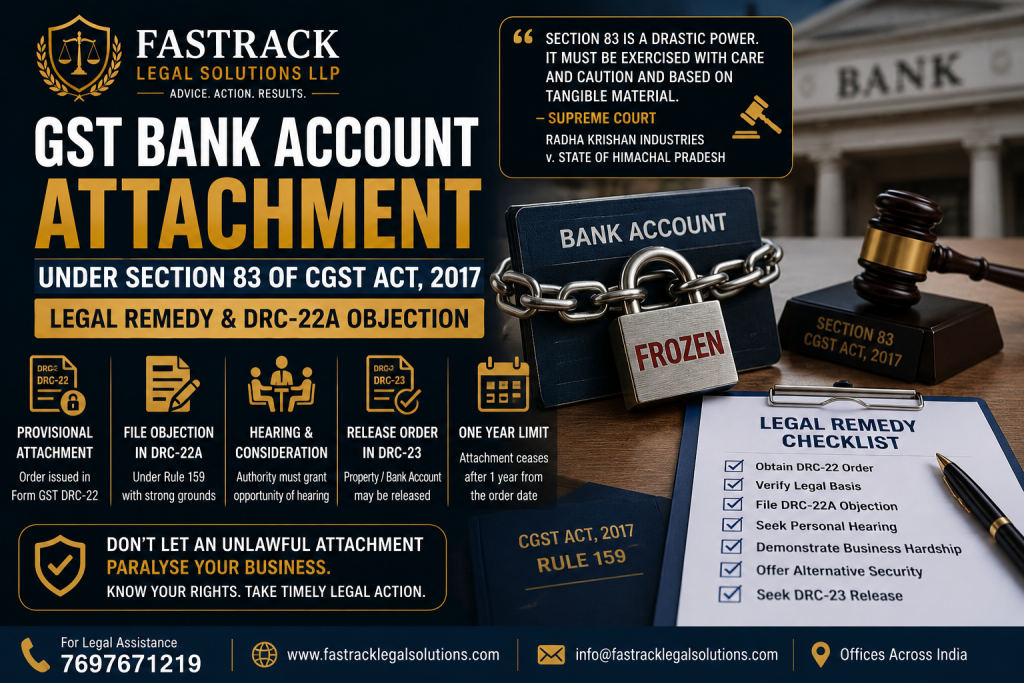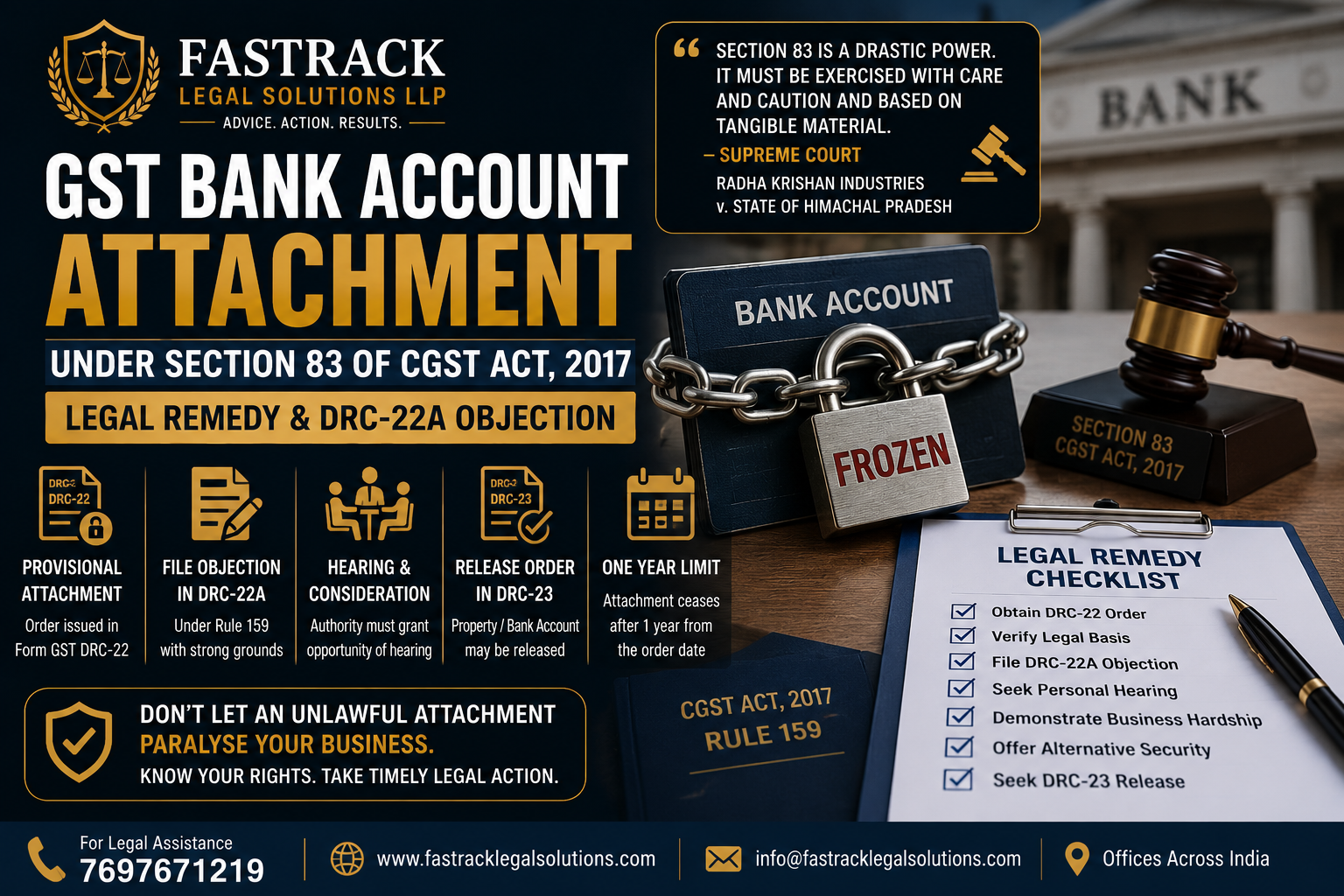
A GST bank account attachment under Section 83 of the CGST Act, 2017 is a provisional attachment made to protect government revenue during specified GST proceedings. The Commissioner may attach property, including a bank account, only after forming an opinion that such attachment is necessary to protect revenue. The attachment is not meant to be routine, punitive or automatic. It ceases after one year from the date of the order, and the affected person may file an objection under Rule 159 seeking release of the bank account. The Supreme Court in Radha Krishan Industries v. State of Himachal Pradesh held that Section 83 is a drastic power, must be exercised with care, must be based on tangible material, and bank account/trading asset attachment should be used only as a last resort.
Non-Solicitation Note
This article is for general legal awareness and educational purposes only and may be published by Fastrack Legal Solutions LLP. It is not an advertisement, solicitation, invitation or inducement for professional engagement. GST attachment matters depend on the attachment order, DRC-22, pending GST proceedings, tax demand, ITC allegation, investigation record, bank account use, business hardship, objections filed, hearing granted, department response and case-specific facts.
Introduction
A frozen bank account can stop a business overnight. Salary payments, vendor payments, rent, loan EMIs, GST compliance, employee dues and daily operations may all be affected.
In GST matters, bank accounts are often attached under Section 83 of the CGST Act, 2017, read with Rule 159 of the CGST Rules, 2017. The department may call it “provisional attachment,” but for a business owner it feels like a complete freeze.
The key legal issue is this:
Was the bank account attached lawfully, or was Section 83 used mechanically without proper material and necessity?
This article explains the legal position, documents needed, Rule 159 objection, DRC-22A procedure, writ remedy and practical strategy for release of a GST-attached bank account.
What Is Section 83 of the CGST Act?
Section 83 is titled “Provisional attachment to protect revenue in certain cases.”
The current statutory framework allows provisional attachment after initiation of proceedings under specified GST chapters, where the Commissioner forms an opinion that attachment is necessary to protect the interest of government revenue. The provision expressly covers property including bank account, and the attachment ceases after one year from the date of the order.
In simple words, Section 83 allows temporary attachment of property or bank accounts to protect revenue during GST proceedings. It is not a final recovery order.
What Is Provisional Attachment?
Provisional attachment means a temporary restraint placed on property or bank account before final adjudication or recovery.
It is different from final recovery because:
- Tax demand may not yet be finally confirmed.
- Liability may still be under investigation or adjudication.
- The attachment is temporary.
- It is meant only to protect revenue.
- It cannot be used as punishment.
- It cannot be used to paralyse business mechanically.
- It expires after the statutory period.
- It can be objected to under Rule 159.
The Supreme Court has described provisional attachment under Section 83 as a drastic and far-reaching power that must be exercised with care and caution.
When Can GST Department Attach a Bank Account?
The department must satisfy the statutory preconditions.
Broadly, the following should exist:
- Relevant GST proceedings must have been initiated.
- The competent authority must form an opinion.
- The opinion must be that attachment is necessary to protect revenue.
- There must be tangible material.
- The attachment must relate to property legally attachable under Section 83.
- The order must be in writing.
- The procedure under Rule 159 must be followed.
- The attachment must not be disproportionate or mechanical.
The Supreme Court in Radha Krishan Industries held that formation of opinion under Section 83 must be based on tangible material showing that the assessee is likely to defeat the demand and that attachment is necessary to protect government revenue.
What Is Form GST DRC-22?
When the Commissioner decides to attach property under Section 83, the attachment order is generally issued in Form GST DRC-22 under Rule 159.
The order should identify:
- Taxpayer details.
- GSTIN.
- Proceedings pending.
- Property or bank account attached.
- Bank name and account details, where relevant.
- Legal basis.
- Authority issuing order.
- Date of order.
If the taxpayer only receives an oral intimation from the bank, the first step is to obtain the DRC-22 order and the exact reason for attachment.
What Is Form GST DRC-22A?
Rule 159 allows the affected person to file an objection to the attachment. Current Rule 159 language refers to filing an objection in Form GST DRC-22A, stating that the property attached was or is not liable to attachment. The Commissioner must grant an opportunity of hearing and may release the property by order in Form GST DRC-23.
Therefore, a business should not only request the bank. The legal objection must be filed before the GST authority with facts, documents and grounds for release.
What Is Form GST DRC-23?
Form GST DRC-23 is the release order. If the Commissioner is satisfied that the bank account or property is no longer liable for attachment, the property may be released by issuing DRC-23. Rule 159 specifically contemplates release after objection and hearing.
Once DRC-23 is issued, the department should communicate release to the bank.
People Also Ask: Can GST Department Freeze a Bank Account Without Final Demand?
Yes, Section 83 permits provisional attachment even before final recovery in certain GST proceedings. However, the power is exceptional and must be based on necessity, tangible material and protection of revenue. It cannot be used mechanically only because proceedings are pending.
Supreme Court Principles on Section 83
The leading judgment is M/s Radha Krishan Industries v. State of Himachal Pradesh.
The Supreme Court laid down important safeguards:
- The power under Section 83 is drastic.
- It must be exercised with extreme care and caution.
- Formation of opinion must be based on tangible material.
- The authority must show necessity to protect revenue.
- The power should not be used to harass the assessee.
- It should not cause irreversible detrimental effect on business.
- Attachment of bank accounts and trading assets should be a last resort.
- The affected person has procedural safeguards under Rule 159.
- Objections must be considered.
- A reasoned order must be passed and communicated.
These principles are extremely useful when challenging a mechanical bank freeze.
When Section 83 Attachment May Be Illegal
A GST bank account attachment may be challenged where:
- No relevant proceedings were pending or initiated.
- Order was passed by an incompetent authority.
- No tangible material exists.
- The order is mechanical.
- The order does not show necessity.
- Attachment is disproportionate.
- Bank account is needed for running business.
- Revenue is already secured.
- Entire account is frozen for a small disputed amount.
- Objection is not heard.
- Reasoned order is not passed.
- Attachment continues beyond one year.
- Wrong person’s account is attached.
- Account belongs to a director/third party without legal basis.
- Attachment is used as pressure for deposit.
The Supreme Court has specifically warned that Section 83 should not be used as a tool of harassment or in a manner causing irreversible business damage.
One-Year Expiry of GST Bank Attachment
Section 83(2) provides that every provisional attachment ceases to have effect after expiry of one year from the date of the order.
This is a very important statutory safeguard.
The taxpayer should check:
- Date of DRC-22 order.
- Date of bank communication.
- Whether one year has expired.
- Whether any fresh order has been passed.
- Whether fresh order is based on new material or same grounds.
- Whether release letter has been sent to bank.
If one year has expired, a representation for automatic release should be made immediately.
Bank Account Attachment Should Be Last Resort
The Supreme Court recognised that attachment of bank accounts and trading assets can paralyse business. It approved the principle that such attachment should be resorted to only as a last resort or measure.
This is important for MSMEs, proprietorships, startups, logistics companies, traders, exporters and service businesses whose daily operations depend on banking access.
A strong objection should show:
- Business operations are paralysed.
- Employees cannot be paid.
- Statutory dues cannot be deposited.
- Vendors cannot be paid.
- Existing clients/contracts are affected.
- The disputed amount is lower than account freeze impact.
- Alternative security may be offered.
- Revenue is not at risk.
GST Bank Attachment vs Recovery
Section 83 attachment is provisional. It is not the same as final recovery after confirmed demand.
This difference matters because:
- Final tax liability may still be disputed.
- SCN may still be pending.
- The taxpayer may have valid defence.
- Recovery-stage safeguards may not yet apply.
- Attachment should protect revenue, not force premature payment.
The Supreme Court explained that provisional attachment is in aid of something else and should not be equated with attachment in recovery proceedings.
Documents Required to Challenge GST Bank Attachment
Basic Documents
- DRC-22 attachment order.
- Bank freeze communication.
- GSTIN details.
- Copy of notices received.
- Summons or search documents, if any.
- SCN, if issued.
- Reply to GST notice, if filed.
- Electronic liability ledger.
- GSTR-1, GSTR-3B and annual return records.
- Bank statements.
Business Hardship Documents
- Salary payable statement.
- Vendor payment details.
- Rent/EMI obligations.
- Loan repayment schedule.
- Employee count.
- Pending statutory payments.
- Current business orders.
- Working capital requirement.
- Proof of business disruption.
- Undertaking/security proposal.
Legal Defence Documents
- ITC purchase invoices.
- E-way bills.
- Transport documents.
- Ledger confirmations.
- Payment proof through banking channel.
- Supplier GST status.
- Reconciliation statements.
- Stock register.
- Books of account.
- Chartered accountant reconciliation.
Procedure to Unfreeze GST-Attached Bank Account
Step 1: Obtain DRC-22
Ask the bank and GST department for the attachment order. Do not proceed only on oral information.
Step 2: Identify Legal Basis
Check whether the order refers to Section 83 and whether relevant GST proceedings are pending.
Step 3: Calculate One-Year Period
Check whether the attachment has expired under Section 83(2).
Step 4: File Objection in DRC-22A
File a detailed objection under Rule 159, stating why the bank account was or is not liable to attachment.
Step 5: Ask for Personal Hearing
The Supreme Court has recognised Rule 159(5) safeguards, including objection and hearing.
Step 6: Seek DRC-23 Release
Request release of the bank account through DRC-23.
Step 7: Offer Alternative Security Where Appropriate
If commercially viable, offer proportionate security or undertaking without admitting liability.
Step 8: File Writ Petition if Necessary
If the order is illegal, mechanical, disproportionate, without hearing, or continues despite expiry, writ remedy may be considered.
Draft Grounds for DRC-22A Objection
The objection may raise the following grounds:
- The attachment is mechanical and without tangible material.
- The bank account is required for business survival.
- No reasoned satisfaction has been recorded.
- Revenue is not at risk.
- Applicant is not a fly-by-night operator.
- Applicant has cooperated in investigation.
- Proceedings are still pending and demand is unconfirmed.
- Attachment is disproportionate.
- Alternative security can protect revenue.
- Account freeze is causing irreversible business damage.
- Section 83 conditions are not satisfied.
- Attachment has expired after one year, if applicable.
Draft Prayer for Release of GST Bank Account
A practical prayer may state:
“Pass an order releasing the bank account provisionally attached under Section 83 of the CGST Act, 2017 read with Rule 159 of the CGST Rules, 2017, by issuing Form GST DRC-23, as the attachment is not necessary for protection of government revenue, is disproportionate, causes severe business hardship, and the applicant is ready to cooperate in all pending proceedings.”
This should be customised to the exact facts and documents.
Writ Petition Against GST Bank Attachment
A writ petition before the High Court may be considered where:
- Attachment is without jurisdiction.
- No proceedings existed when attachment was ordered.
- No tangible material exists.
- The order is arbitrary.
- The account belongs to the wrong person.
- Hearing under Rule 159 was denied.
- Objection was not decided by reasoned order.
- Attachment continues after one year.
- Entire business is paralysed.
- Alternative remedy is ineffective in the facts.
In Radha Krishan Industries, the Supreme Court held that the writ petition challenging provisional attachment was maintainable and that dismissal only on the ground of alternate remedy was erroneous in the facts of that case.
Can Personal Bank Account Be Attached for GST Dues?
This depends on the facts.
A bank account belonging to the taxable person may be attached if statutory conditions are satisfied. After amendments, Section 83 also refers to persons specified in Section 122(1A), but attachment of directors, partners, proprietors or third parties requires careful legal scrutiny.
Grounds to challenge may include:
- Account does not belong to taxable person.
- No proceedings are pending against that person.
- No link with alleged GST evasion.
- Account is salary/personal-use account.
- Attachment is disproportionate.
- No necessity to protect revenue.
- No reasoned order.
- Natural justice breach.
A personal account should not be casually attached only because the person is connected with the business.
Can GST Department Attach Entire Account for Small Demand?
A full freeze may be challenged as disproportionate where the disputed amount is small or adequately secured.
The objection should show:
- Alleged demand amount.
- Available ITC/reversal/payment.
- Bank balance attached.
- Business hardship.
- Alternate security.
- Revenue-neutral position.
- No risk of asset disposal.
- Regular compliance history.
The Supreme Court has endorsed the principle that attachment must be proportionate to the objective of protecting revenue and cannot be used to create irreversible harm to business.
Common Client Questions
Can GST officer freeze my bank account?
Yes, but only if Section 83 conditions are satisfied and the proper procedure is followed.
Is GST bank attachment final recovery?
No. Section 83 is provisional attachment to protect revenue. It is temporary and different from final recovery.
How long can GST bank attachment continue?
Every provisional attachment under Section 83 ceases after one year from the date of the order.
What form is used for GST bank attachment?
The attachment order is generally issued in Form GST DRC-22 under Rule 159.
How do I object to GST bank attachment?
The affected person may file objection in Form GST DRC-22A under Rule 159 and seek release through DRC-23 after hearing.
Can I go to High Court?
Yes, in appropriate cases, especially where the attachment is without jurisdiction, mechanical, disproportionate, without tangible material, or where Rule 159 safeguards are violated.
Practical Business Strategy After Bank Attachment
Step 1: Do Not Panic-Pay Without Assessment
Do not make immediate forced payment without understanding the order and demand.
Step 2: Get the Attachment Order
Ask for DRC-22 and DIN/order reference.
Step 3: Verify Proceedings
Check whether valid proceedings exist against the correct taxable person.
Step 4: Prepare Financial Hardship Note
Show how freeze affects salaries, vendors, statutory dues and business continuity.
Step 5: File DRC-22A Objection
Do not rely only on informal meetings.
Step 6: Seek Partial Release
Even if full release is resisted, seek release for business operations or release beyond disputed amount.
Step 7: Offer Cooperation
Give investigation cooperation without admitting liability.
Step 8: Escalate Legally
If the department refuses to pass a reasoned order or continues illegal attachment, consider writ remedy.
Mistakes to Avoid
- Ignoring DRC-22.
- Not filing DRC-22A objection.
- Depending only on bank manager.
- Paying under pressure without protest.
- Not checking one-year expiry.
- Not asking for hearing.
- Not documenting business hardship.
- Not preserving emails and representations.
- Not checking whether proceedings are pending.
- Not challenging disproportionate attachment.
Also Read Who is Advocate Govind Bali | Fastrack Legal Solutions LLP
Frequently Asked Questions
1. What is GST bank account attachment under Section 83?
It is provisional attachment of a bank account to protect government revenue during specified GST proceedings.
2. Is Section 83 attachment automatic?
No. The Commissioner must form an opinion based on tangible material that attachment is necessary to protect revenue.
3. How long does GST provisional attachment last?
It ceases after one year from the date of the attachment order.
4. What is DRC-22?
DRC-22 is the form generally used for issuing provisional attachment order under Rule 159.
5. What is DRC-22A?
DRC-22A is the objection form used to challenge provisional attachment under Rule 159.
6. What is DRC-23?
DRC-23 is the order used for release of attached property or bank account.
7. Can the department freeze a current account?
Yes, but bank account attachment should be used carefully and generally as a last resort because it can paralyse business.
8. Can personal account of proprietor be attached?
It depends on the facts, ownership of account, pending proceedings, statutory conditions and nexus with alleged liability.
9. Can writ petition be filed against GST bank attachment?
Yes, in appropriate cases, especially where the attachment is without jurisdiction, arbitrary, disproportionate or violates Rule 159 safeguards.
10. What is the first step after GST bank account freeze?
Obtain the DRC-22 order, verify the legal basis, check expiry, and file a reasoned DRC-22A objection seeking release through DRC-23.
Conclusion
GST bank account attachment under Section 83 is a serious coercive measure. It can protect government revenue, but it can also destroy business operations if used mechanically.
The law does not permit routine freezing of accounts merely because GST proceedings are pending. The Commissioner must form an opinion based on tangible material, the attachment must be necessary to protect revenue, and the taxpayer must be given procedural safeguards under Rule 159.
The strongest remedy is a structured response: obtain DRC-22, check validity, file DRC-22A objection, seek hearing, demonstrate hardship, offer lawful cooperation, and request DRC-23 release. If the attachment is illegal, disproportionate or continued beyond one year, High Court remedy may be considered.
The practical rule is simple: do not treat GST bank attachment as final defeat. Treat it as an urgent legal issue requiring immediate objection, documentation and strategy.
Disclaimer
This article is for general legal awareness and educational purposes only and may be published by Fastrack Legal Solutions LLP. It is not an advertisement, solicitation, invitation or inducement for professional engagement. It does not create an advocate-client relationship. GST attachment matters depend on Section 83 order, Rule 159 procedure, DRC-22, DRC-22A objection, DRC-23 release, pending proceedings, tax demand, ITC issues, bank records and case-specific facts