
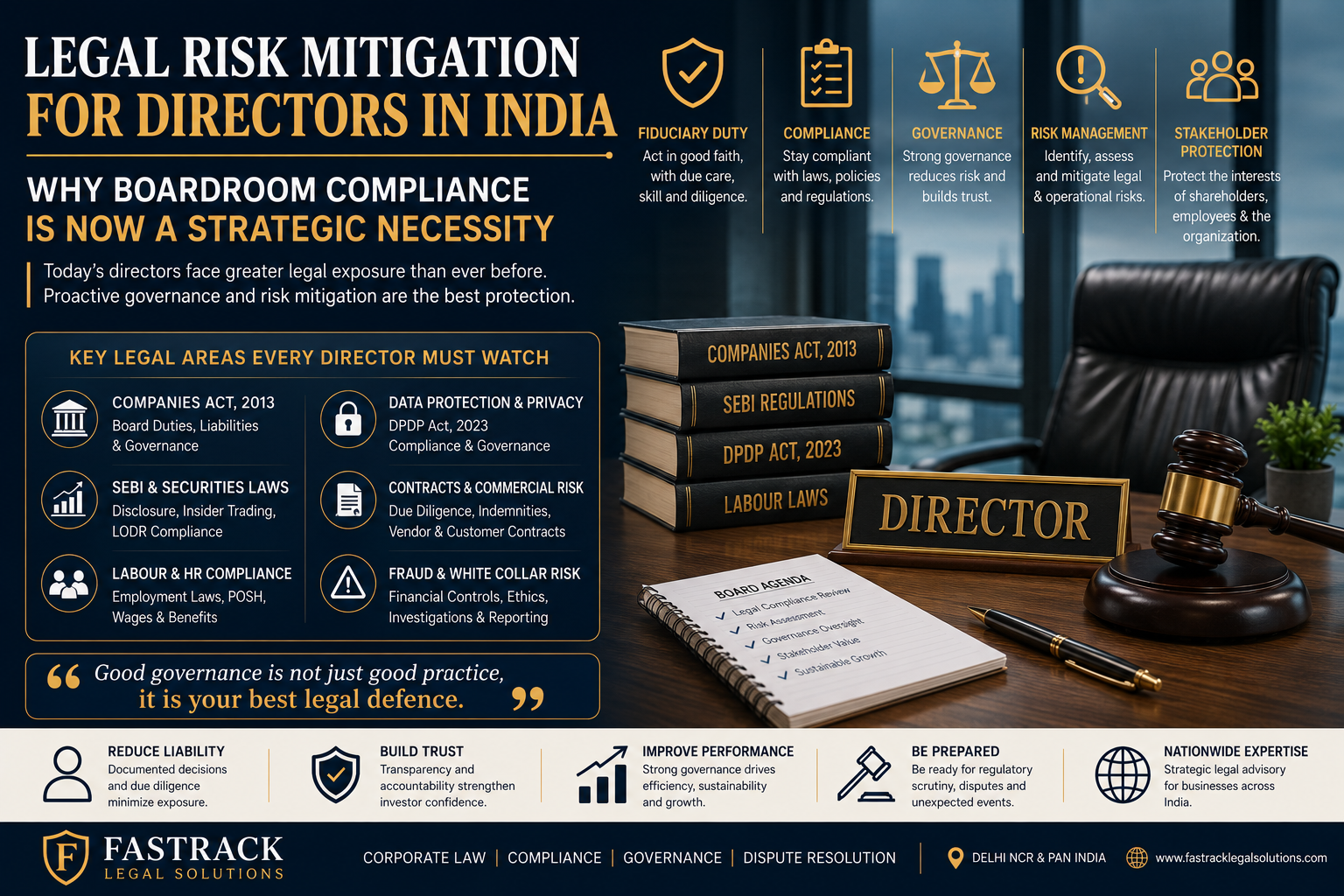
Summary
A legal risk audit for companies in India is a structured review of corporate, contractual, labour, data-protection, governance, litigation and regulatory risks. It helps companies identify weak documents, poor compliance systems, director liability exposure, contract vulnerabilities, HR risks, DPDP gaps and internal-control failures before they become legal notices, penalties, disputes or litigation. Companies in Delhi NCR and across India should conduct legal risk audits before fundraising, expansion, acquisition, regulatory inspection, major contracts, board restructuring or serious disputes.
1. What Is a Legal Risk Audit?
A legal risk audit is a systematic legal review of a company’s operations, documents, decisions and compliance systems to identify legal exposure before it becomes a dispute or proceeding.
It is different from a financial audit. A financial audit examines accounts, financial statements and accounting compliance. A legal risk audit examines legal vulnerability.
A proper legal risk audit should answer the following questions:
- Are the company’s statutory records updated?
- Are board decisions properly documented?
- Are contracts legally enforceable and commercially protective?
- Are employment documents legally compliant?
- Are data-protection practices aligned with law?
- Are vendor and customer arrangements properly structured?
- Are directors exposed due to weak governance?
- Are notices, disputes and litigations being tracked?
- Are internal controls sufficient to prevent fraud or misconduct?
- Can the company defend its decisions if questioned by a court, regulator, lender or investor?
The purpose is simple: identify legal cracks before they become litigation fractures.
2. Why Indian Companies Need Legal Risk Audits
Indian businesses now operate in a dense legal environment. A company may simultaneously face obligations under company law, labour law, tax law, data protection law, sectoral regulation, contract law, consumer law, securities law and criminal law.
For example, the Companies Act, 2013 governs corporate structure, management, board duties, financial reporting and statutory compliance. India Code records the Companies Act, 2013 as Act No. 18 of 2013, enacted to consolidate and amend the law relating to companies.
Under Section 166 of the Companies Act, directors must exercise duties with due and reasonable care, skill and diligence and must exercise independent judgment. This means that governance failure is not always only a company problem. It can also become a director-risk problem.
For listed companies, the SEBI LODR Regulations, 2015 remain a major compliance and disclosure framework. SEBI’s official page records the LODR Regulations as last amended on 22 January 2026.
For digital businesses, the Digital Personal Data Protection Act, 2023 creates a statutory framework for digital personal data processing in India. India Code identifies the DPDP Act as Act No. 22 of 2023.
For fraud, breach of trust and cheating concerns, the Bharatiya Nyaya Sanhita, 2023 now contains provisions dealing with criminal breach of trust, cheating, dishonest misappropriation and property-related offences.
The result is clear: legal risk is no longer isolated. It travels across departments.
Finance risk may become tax risk.
HR risk may become labour litigation.
Data risk may become regulatory exposure.
Contract risk may become commercial litigation.
Governance risk may become director liability.
Operational fraud may become a criminal complaint.
A legal risk audit helps connect these dots before the damage is done.
3. Legal Risk Audit vs Compliance Audit
A compliance audit usually checks whether the company has met specific statutory requirements.
A legal risk audit goes further.
It asks whether the company is legally protected, defensible and ready for scrutiny.
For example:
A compliance audit may check whether a board resolution exists.
A legal risk audit examines whether the board resolution records the risk, rationale, authority, conflict disclosure and implementation responsibility.
A compliance audit may check whether employment contracts exist.
A legal risk audit examines whether those contracts protect the company in confidentiality, termination, intellectual property, non-solicitation, dispute resolution and data handling.
A compliance audit may check whether a privacy policy exists.
A legal risk audit examines whether data collection, consent, storage, access, sharing and grievance mechanisms are actually aligned with the DPDP framework.
A compliance audit checks boxes.
A legal risk audit tests armour.
And in today’s regulatory environment, armour matters.
4. Key Areas Covered in a Legal Risk Audit
A comprehensive legal risk audit for Indian companies should cover at least the following areas.
4.1 Corporate and Board Governance
This includes review of:
- Board minutes.
- Committee minutes.
- Shareholder approvals.
- Delegation of authority.
- Related-party transactions.
- Director disclosures.
- Conflict-of-interest records.
- Statutory registers.
- ROC filings.
- Governance policies.
Corporate law is not only about incorporation and annual filings. It is a continuing governance system. Businesses should treat corporate law in India as part of their legal risk architecture, not merely as secretarial maintenance.
4.2 Director Liability Exposure
A legal risk audit must assess whether directors are exposed due to:
- Poor board documentation.
- Lack of legal review before major decisions.
- Weak delegation of authority.
- Informal approvals.
- Unrecorded dissent.
- Related-party issues.
- Inadequate compliance monitoring.
- Failure to act on notices or red flags.
The audit should examine whether the company can prove that directors acted with due care, skill, diligence and independent judgment as required under Section 166.
4.3 Contract Risk
Contracts are where many companies silently bleed.
A legal risk audit should examine:
- Customer contracts.
- Vendor agreements.
- Consultancy agreements.
- Employment contracts.
- NDAs.
- Service-level agreements.
- Indemnity clauses.
- Limitation of liability clauses.
- Payment terms.
- Termination rights.
- Dispute-resolution clauses.
- Jurisdiction clauses.
A weak contract does not look dangerous when business is going well. It becomes dangerous when money is unpaid, services fail, goods are defective, vendors disappear or customers raise claims.
4.4 Labour and HR Compliance
Employment risk is one of the most underestimated forms of legal exposure.
A legal risk audit should examine:
- Appointment letters.
- Employment contracts.
- HR policies.
- Wage structures.
- Termination procedure.
- Contractor compliance.
- POSH compliance.
- Gratuity, PF and ESI exposure.
- Leave and working-hour records.
- Disciplinary procedure.
- Full and final settlement records.
- Employee data-handling practices.
For businesses with multi-location operations, labour law compliance in India must be treated as a governance issue, not merely an HR formality.
4.5 Data Protection and DPDP Compliance
Digital personal data is now a major business risk.
A legal risk audit should review:
- What personal data is collected.
- Why the data is collected.
- Whether notice and consent mechanisms exist.
- Whether data is shared with third parties.
- Whether vendor contracts contain data-protection clauses.
- Whether access controls exist.
- Whether employee data is protected.
- Whether deletion and correction processes exist.
- Whether grievance mechanisms exist.
- Whether breach-response protocols exist.
The DPDP Act, 2023 has made digital personal data governance a serious compliance issue for Indian businesses. Companies collecting customer, employee, user, vendor or website data should treat DPDP Act compliance as part of their legal risk audit.
4.6 Litigation and Notice Management
Many companies suffer not because they receive notices, but because they do not manage them properly.
A legal risk audit should examine:
- Pending litigation.
- Legal notices received.
- Replies sent.
- Regulatory communications.
- Tax notices.
- Police complaints.
- Employee claims.
- Vendor disputes.
- Consumer complaints.
- Arbitration notices.
- Recovery claims.
- Limitation-period risks.
A company must maintain a central litigation and notice tracker. Without it, deadlines are missed, replies become inconsistent, and litigation strategy becomes reactive.
4.7 Fraud, White-Collar and Internal-Control Risk
Internal-control failure can convert a commercial dispute into a criminal allegation.
A legal risk audit should examine:
- Payment approval systems.
- Vendor onboarding.
- Procurement controls.
- Cash handling.
- Expense approvals.
- Inventory control.
- Financial authorisation limits.
- Whistleblower channels.
- Internal investigation procedure.
- Document preservation protocols.
Where internal controls collapse, companies may face white collar crime risk, particularly in matters involving cheating, breach of trust, misappropriation, falsification, diversion of funds or fraudulent documentation.
The Bharatiya Nyaya Sanhita, 2023 contains offences relating to criminal breach of trust, cheating and dishonest misappropriation of property.
5. Legal Risk Audit for Startups
Startups often assume that legal risk audits are only for large companies.
That is wrong.
Startups usually accumulate legal risk faster because they operate informally in the early stage. Founder arrangements are loose. ESOP promises are made over messages. Employment contracts are copied from templates. Vendor agreements are incomplete. Customer data is collected without proper governance. Board approvals are taken after decisions are already implemented.
This creates legal technical debt.
A legal risk audit for startups should cover:
- Founder agreements.
- Shareholding structure.
- IP ownership.
- Employment contracts.
- ESOP documentation.
- Vendor contracts.
- Website terms and privacy policy.
- Data-processing practices.
- Fundraising documents.
- Board approvals.
- Tax and compliance filings.
- Dispute-prevention mechanisms.
Early-stage legal solutions for startups should focus not only on incorporation but also on building a legally defensible business structure.
A startup may run fast with weak documentation.
But during funding, acquisition, due diligence, founder exit or investor dispute, weak documentation becomes expensive.
6. Legal Risk Audit for Companies in Delhi NCR
Companies operating in Delhi, South Delhi, Gurugram, Noida, Faridabad and the wider NCR region often have multi-jurisdictional operations.
A company may have:
- Registered office in Delhi.
- Vendors in Haryana.
- Employees in Uttar Pradesh.
- Customers across India.
- Warehouses in multiple states.
- Digital data stored on third-party platforms.
- Contracts governed by different jurisdiction clauses.
- Tax exposure across several locations.
This makes legal risk more complex.
For companies seeking a legal risk audit in Delhi NCR, the audit should not be limited to documents kept at the registered office. It should examine the actual operational structure of the business.
A Delhi-based company with operations across India requires a legal risk framework that is centralised, documented and jurisdiction-aware.
7. When Should a Company Conduct a Legal Risk Audit?
A company should conduct a legal risk audit before risk becomes visible.
However, the need becomes urgent in the following situations:
- Before fundraising.
- Before acquisition or merger.
- Before onboarding institutional investors.
- Before entering a major commercial contract.
- Before expanding to another state.
- Before hiring at scale.
- Before launching a digital platform.
- After receiving repeated legal notices.
- After employee complaints.
- After internal fraud suspicion.
- Before regulatory inspection.
- Before applying for major loans.
- Before board restructuring.
- Before appointing independent directors.
- Before sale of business or assets.
The worst time to discover legal risk is after the notice has arrived.
By then, the company is already playing defence.
8. Warning Signs That a Company Needs a Legal Risk Audit
A company should not wait for litigation. Certain warning signs are enough.
These include:
- Board minutes are brief and mechanical.
- Contracts are unsigned or poorly drafted.
- Employee termination records are weak.
- Vendor disputes are increasing.
- Customer complaints are rising.
- Legal notices are handled without a tracker.
- The company has no DPDP compliance system.
- HR policies are outdated.
- Related-party transactions are not properly documented.
- Directors approve decisions without legal notes.
- There is no delegation of authority matrix.
- There is no crisis-response protocol.
- The company has no central document repository.
- Internal fraud concerns are handled informally.
- Litigation records are scattered across departments.
These are not administrative defects.
They are litigation seeds.
9. The Legal Risk Audit Process
A structured legal risk audit should follow a clear process.
Step 1: Document Collection
The company should collect board records, statutory filings, contracts, HR documents, compliance records, notices, litigation papers, policies and internal approvals.
Step 2: Legal Risk Mapping
Each document and process should be mapped against applicable legal risks, including corporate, labour, tax, data, contract, governance and criminal exposure.
Step 3: Risk Classification
Risks should be classified as:
- Critical.
- High.
- Medium.
- Low.
- Immediate action required.
- Monitoring required.
Step 4: Director Liability Review
The audit should assess whether any risk may expose directors, promoters, key managerial personnel or authorised signatories.
Step 5: Compliance Gap Report
The report should identify missing documents, defective processes, weak clauses, compliance gaps and litigation vulnerabilities.
Step 6: Remediation Plan
A legal risk audit is useless without corrective action. The final plan should include timelines, responsible persons and priority actions.
Step 7: Governance Reset
The company should update policies, contracts, board processes, compliance calendars and reporting systems.
10. Documents Required for a Legal Risk Audit
A company should keep the following documents ready:
- Certificate of incorporation.
- Memorandum and Articles of Association.
- Board and shareholder minutes.
- Statutory registers.
- ROC filings.
- Shareholding records.
- Director disclosures.
- Major contracts.
- Vendor agreements.
- Customer agreements.
- Employment contracts.
- HR policies.
- POSH documents.
- Payroll and wage records.
- PF, ESI and gratuity records.
- Website terms and privacy policy.
- Data-processing records.
- Litigation files.
- Legal notices.
- Tax notices.
- Internal audit reports.
- Insurance policies.
- Loan documents.
- Related-party transaction records.
- Delegation of authority matrix.
If these documents are not available, that itself is the first audit finding.
11. What a Legal Risk Audit Report Should Contain
A good legal risk audit report should be practical, not ornamental.
It should contain:
- Executive summary.
- Risk heat map.
- Department-wise findings.
- Statutory compliance status.
- Contract-risk analysis.
- HR and labour-risk analysis.
- Data-protection findings.
- Director liability mapping.
- Litigation and notice review.
- Internal-control risk assessment.
- Red-flag findings.
- Remediation plan.
- Priority action chart.
- Document correction list.
- Governance recommendations.
The report should tell management exactly what is wrong, why it matters, what can happen, and what must be fixed.
Anything less is paperwork with better formatting.
12. Benefits of a Legal Risk Audit
A legal risk audit helps companies:
- Reduce litigation risk.
- Improve director protection.
- Strengthen corporate governance.
- Prepare for due diligence.
- Improve investor confidence.
- Reduce contract disputes.
- Improve HR compliance.
- Strengthen DPDP readiness.
- Prepare for regulatory scrutiny.
- Reduce fraud and internal-control risk.
- Centralise notices and litigation.
- Improve lender confidence.
- Protect business reputation.
- Support expansion and restructuring.
- Build long-term legal resilience.
Legal risk audit is not a cost.
It is insurance against ignorance.
And ignorance is usually the most expensive item on a company’s balance sheet.
13. Fastrack Legal Solutions’ Approach to Legal Risk Audit
At Fastrack Legal Solutions, the approach to legal risk audit is preventive, structured and business-facing.
The audit is designed to help companies, promoters, founders, directors and management teams understand where legal exposure exists and how it can be reduced before disputes escalate.
A legal risk audit may cover:
- Corporate governance review.
- Director liability mapping.
- Contract and vendor review.
- Labour and HR compliance review.
- DPDP and data-protection readiness.
- Litigation and notice tracking.
- Internal-control and fraud-risk assessment.
- Regulatory exposure review.
- Compliance calendar review.
- Crisis-response readiness.
The objective is not to produce a decorative report.
The objective is to build a legally defensible company.
Conclusion
A company does not become legally secure because it has filed forms, maintained templates or survived without litigation so far.
Legal security comes from systems.
A legal risk audit helps businesses identify legal exposure before it becomes a notice, dispute, penalty, investigation, litigation or reputational crisis.
For Indian companies, especially those operating in Delhi NCR and across multiple states, legal risk audit must be treated as a governance necessity.
The best time to fix legal risk is before the other side discovers it.
Good businesses prepare for growth.
Great businesses prepare for scrutiny.
Key Takeaways
- A legal risk audit identifies legal exposure before it becomes a dispute.
- It is broader than a compliance audit.
- It covers corporate governance, director liability, contracts, HR, DPDP, litigation and fraud risk.
- Directors need documented systems to show due care and diligence.
- Startups should conduct legal audits before funding or acquisition.
- Companies in Delhi NCR often need multi-state legal risk mapping.
- A legal risk audit report should include findings, risk rating and remediation steps.
- Preventive legal architecture is cheaper than emergency litigation.
FAQs
What is a legal risk audit for companies in India?
A legal risk audit is a structured review of a company’s legal, regulatory, contractual, employment, governance, data-protection and litigation exposure. It helps identify legal weaknesses before they become disputes, notices, penalties or regulatory proceedings.
Why do companies need a legal risk audit?
Companies need a legal risk audit to identify risks in contracts, board decisions, employment practices, data handling, statutory compliance, vendor arrangements, internal controls and litigation management before those risks become expensive legal problems.
How is a legal risk audit different from a compliance audit?
A compliance audit checks whether statutory requirements are being followed. A legal risk audit goes further and examines whether the company is legally protected, defensible and prepared for disputes, notices, regulatory scrutiny or litigation.
What areas are covered in a legal risk audit?
A legal risk audit usually covers corporate governance, director liability, contracts, labour and HR compliance, DPDP compliance, litigation records, legal notices, internal controls, fraud risk and regulatory exposure.
When should a company conduct a legal risk audit?
A company should conduct a legal risk audit before fundraising, acquisition, expansion, major contracts, board restructuring, regulatory inspection, employee disputes, vendor conflicts, data-processing scale-up or repeated legal notices.
Do startups need legal risk audits?
Yes. Startups need legal risk audits because informal founder decisions, weak contracts, poor employment documentation, IP issues, ESOP promises, privacy gaps and incomplete board approvals can create serious problems during funding, due diligence or acquisition.
Can a legal risk audit reduce director liability?
Yes. A legal risk audit can reduce director liability risk by identifying weak board processes, missing documentation, compliance gaps, related-party concerns, poor delegation and lack of legal review before major decisions.
Is legal risk audit useful for companies in Delhi NCR?
Yes. Companies in Delhi NCR often operate across Delhi, Gurugram, Noida, Faridabad and other states. A legal risk audit helps map multi-state compliance, contract exposure, labour risk, litigation and regulatory vulnerabilities.