
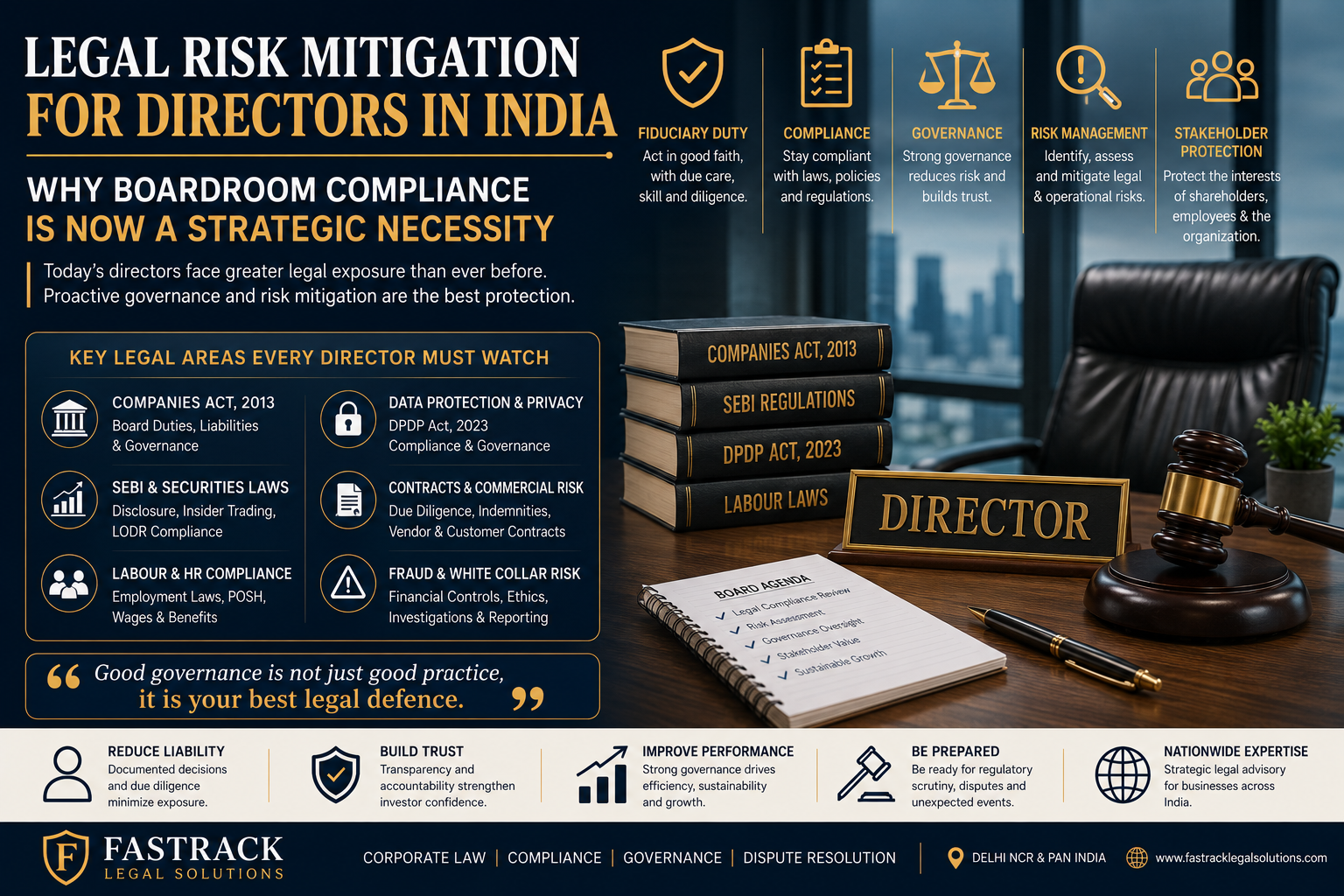
Legal Risk Mitigation for Directors in India: Why Boardroom Compliance Is Now a Strategic Necessity
There was a time when corporate compliance was treated as a secretarial function. Forms were filed, board meetings were recorded, registers were maintained, and directors assumed that their legal responsibility ended with signatures on minutes and resolutions.
That time is over.
In today’s India, a director is not merely a name on the board. A director is a fiduciary, risk-bearer, decision-maker, governance supervisor and, in several situations, the first person whose conduct may be examined when a company faces regulatory, financial, employment, data, tax, securities or criminal scrutiny.
The modern boardroom no longer operates in a single-law environment. It sits at the intersection of the Companies Act, 2013, SEBI regulations, labour laws, data protection obligations, tax statutes, financial reporting standards, contractual exposure, cyber risk, investor expectations and public reputation.
This is why legal risk mitigation for directors in India is no longer a defensive exercise. It is boardroom infrastructure.
This article forms part of the corporate legal-awareness resources published by Fastrack Legal Solutions, focusing on governance, director liability, business risk and preventive legal strategy for companies, promoters and directors in India.
Quick Answer: What Is Legal Risk Mitigation for Directors?
Legal risk mitigation for directors means creating systems that help directors discharge their statutory, fiduciary and governance duties with due care, skill, diligence and proper documentation. It includes board-level legal risk mapping, compliance calendars, contract review, litigation tracking, labour-law compliance, data-protection governance, related-party transaction review, internal-control mechanisms and proper recording of board decisions.
In simple terms, it ensures that if a director’s conduct is questioned later, there is a clear documentary trail showing lawful, reasonable and informed decision-making.
1. The Director Is Not a Rubber Stamp
The Companies Act, 2013 places clear statutory duties upon directors. Section 166 of the Companies Act, 2013 requires a director to act in accordance with the articles of the company, act in good faith, promote the objects of the company, act in the best interests of the company and its stakeholders, and exercise duties with due and reasonable care, skill and diligence.
The law also requires directors to exercise independent judgment.
That phrase — due and reasonable care, skill and diligence — is where many directors underestimate the law.
A director cannot simply say, “I did not know.”
A director cannot blindly rely upon oral assurances.
A director cannot approve transactions without understanding their legal, financial and operational consequences.
A director cannot ignore red flags and later claim that the matter was handled by management.
Board approval is not a ritual. It is a legal act.
When the board approves financial statements, borrowings, related-party transactions, capital infusion, employment structures, data-processing systems, vendor contracts, corporate guarantees or regulatory responses, the law expects application of mind.
The real question is simple: if the decision is questioned tomorrow, can the company show that the board acted lawfully, reasonably and with proper documentation?
If the answer is no, the director is exposed.
2. Compliance Has Moved From Paperwork to Personal Accountability
For years, many companies treated compliance as clerical work. The assumption was that if statutory forms were filed and board minutes existed, the company was safe.
That assumption is dangerously outdated.
Today, compliance failures can travel very quickly from the company to its directors and officers. A defective employment practice may become a labour dispute. A poor data practice may become a privacy violation. A misleading disclosure may become a securities-law issue. A weak internal-control system may become a fraud allegation. A casually approved related-party transaction may become a governance red flag.
This is why businesses must understand corporate law in India not merely as a formation or filing issue, but as a continuing governance obligation.
Corporate law is not only about incorporation, shareholding and board meetings. It is about lawful decision-making, protection of business interests, regulatory compliance, risk allocation and director accountability.
The point is blunt but necessary: compliance is no longer a back-office function. It is a board-level liability issue.
3. Corporate Governance Is a Liability Shield
Corporate governance is often spoken of in elegant language — transparency, accountability, independence, fairness and ethical business conduct.
In legal terms, corporate governance is something much more practical.
It is a liability shield.
A strong corporate governance framework helps directors demonstrate that decisions were taken after due consideration, with proper disclosure, legal review and documented reasoning.
This becomes especially important when the company faces a regulatory notice, shareholder dispute, investor concern, lender query, employee complaint, tax proceeding or criminal allegation.
For listed entities, the SEBI LODR Regulations, 2015 remain central to disclosure, transparency and governance compliance.
However, governance is not relevant only for listed companies. Private companies, startups, family businesses, foreign subsidiaries, MSMEs, fintech platforms, logistics companies, healthcare entities and technology companies also require governance discipline.
A company may not be listed, but it may still deal with employees, customers, investors, banks, lenders, regulators, vendors, tax authorities and law-enforcement agencies.
The question is not whether the company is public or private.
The question is whether the company can defend its decisions.
4. Why Directors in Delhi NCR and Across India Need Preventive Legal Systems
Companies operating in Delhi, South Delhi, Gurugram, Noida, Faridabad and the wider NCR region often face multi-layered business exposure. Many are incorporated in one state, have operations in multiple states, employ distributed teams, work with vendors across India, process customer data digitally and deal with banks, regulators and contractual counterparties in different jurisdictions.
This creates a practical problem.
A board sitting in Delhi may approve a contract for operations in Haryana. A vendor dispute may arise in Uttar Pradesh. An employee complaint may emerge from another state. A tax notice may be issued from a separate jurisdiction. A data breach may affect customers across India.
That is why businesses require a centralised legal risk system.
A company cannot afford a fragmented compliance structure where HR, finance, legal, operations and management work in separate silos. Directors need one consolidated view of risk.
For companies seeking corporate legal services in Delhi NCR, legal risk mitigation should therefore include:
- Board-level risk review.
- Multi-state compliance mapping.
- Contract and vendor-risk review.
- Labour and HR compliance checks.
- Data-protection audit.
- Litigation and notice tracking.
- Internal investigation protocols.
- Crisis-response planning.
In high-growth businesses, governance must travel faster than disputes.
5. Independent Judgment Cannot Be Outsourced
The law does not expect every director to personally become an expert in tax, labour law, data protection, securities regulation and finance. That would be impractical.
But the law does expect directors to ask questions.
A director must be able to ask:
What is the legal basis for this decision?
Has the company obtained legal or financial advice?
Are there statutory approvals required?
Is there any conflict of interest?
Has the risk been disclosed to the board?
Is the transaction commercially justified?
Are dissenting views recorded?
Who is responsible for implementation?
What happens if this decision is challenged later?
Independent judgment does not mean directors must act alone. It means they must not act blindly.
The boardroom is not a tea party with minutes. It is the legal cockpit of the company.
If directors do not ask the right questions at the right time, silence itself may become damaging.
6. The Danger of Cosmetic Compliance
Many companies believe they are compliant because policies exist on paper.
That is not enough.
A POSH policy may exist, but if the Internal Committee is defective, employees are unaware of the mechanism, complaints are mishandled or retaliation occurs, the policy will not protect the company.
A data privacy policy may be uploaded on the website, but if the company collects personal data without lawful purpose, fails to implement consent mechanisms, shares data casually or lacks breach-response discipline, the policy becomes cosmetic.
The Digital Personal Data Protection Act, 2023 deals with the processing of digital personal data and includes provisions on notice, consent, legitimate uses and obligations of data fiduciaries.
With digital operations becoming central to business, DPDP Act compliance must be treated as a board-level legal risk, not merely a website privacy-policy exercise.
Similarly, a board resolution may approve a high-value transaction, but if the note does not disclose risk, valuation basis, conflict, legal implications and commercial rationale, the resolution may not be enough.
Compliance without substance is not governance.
It is stage management.
And in litigation, stage management collapses fast.
7. Director Safeguarding: What It Actually Means
Director safeguarding does not mean helping directors escape liability for wrongdoing. That is not legal protection. That is legal fiction.
Director safeguarding means creating a structured framework so that honest directors are not exposed because of weak documentation, poor internal controls, unclear delegation, operational negligence or avoidable compliance failures.
A serious director safeguarding framework should include:
- Board-level legal risk mapping.
- Delegation of authority matrix.
- Defined roles for directors, officers and key managerial personnel.
- Statutory compliance calendar.
- Quarterly legal risk reports.
- Litigation and notice tracker.
- Contract approval protocols.
- Related-party transaction review.
- Labour and HR compliance checks.
- Data protection governance.
- Whistleblower and grievance-redressal mechanisms.
- Crisis-response protocol.
- Dissent and abstention recording mechanism.
- Independent legal review for high-risk decisions.
The purpose is simple: if a decision is questioned later, the company must be able to show a clean trail of lawful, reasoned and documented decision-making.
That trail is the director’s bulletproof jacket.
8. Why Startups Need Legal Risk Mitigation Early
Startups often operate with speed, informality and founder-driven decision-making. That gives them agility, but it also creates legal exposure.
Employment contracts are loosely drafted. ESOP promises are casually made. Vendor arrangements are handled over email. Customer data is collected without proper privacy architecture. Fundraising documents are signed without appreciating control rights. Founder disputes are ignored until they become litigation. Board approvals are taken after the fact.
This creates legal technical debt.
Like software technical debt, legal technical debt remains invisible in the early stage. It appears during investor due diligence, acquisition review, employment disputes, tax notices, founder exits, data breaches, lender audits or regulatory complaints.
Early-stage legal solutions for startups are therefore not merely about incorporation. They are about preventing future disputes before they become expensive.
Startup legal support becomes relevant across business-entity formation, intellectual-property protection, contracts, compliance and dispute-prevention structures.
A startup may survive weak paperwork in its first year. It may even grow despite poor governance. But when it seeks institutional funding, debt, acquisition, strategic partnership or listing, weak legal architecture becomes a valuation discount.
Investors do not merely examine revenue.
They examine risk.
9. Labour and HR Compliance Is Now a Director-Level Risk
Employment-related exposure is one of the most underestimated corporate risks in India.
Many companies treat HR compliance as an administrative matter. That approach is legally unsafe.
Termination, retrenchment, wage structuring, contractor deployment, workplace safety, gratuity, provident fund, maternity benefits, POSH compliance, disciplinary proceedings and employee data handling can all create legal consequences.
Director risk is therefore connected with labour law compliance in India, especially where wage structures, termination practices, workplace safety, contractor compliance and HR documentation are weak.
For directors, the concern is not merely whether a dispute arises. The concern is whether the company can prove that its employment decisions were lawful, documented and consistently implemented.
A defective termination process can become litigation.
A mishandled workplace complaint can become reputational damage.
A contractor compliance failure can become principal-employer exposure.
A wage-structure defect can become recurring financial liability.
HR is no longer just people management.
It is legal risk management.
10. Independent Directors Cannot Be Decorative
Independent directors occupy a particularly sensitive position.
The Code for Independent Directors under Schedule IV to the Companies Act, 2013 is described as a guide to professional conduct for independent directors. It recognises that adherence to these standards promotes confidence among the investment community, minority shareholders, regulators and companies.
This makes the role of independent directors especially important where public interest, institutional capital, minority shareholder protection or regulated-sector governance is involved.
Independent directors must not act as ornamental governance furniture.
They are expected to bring independence, scrutiny, objectivity and reasoned oversight.
Their protection lies in evidence of active participation: asking questions, reviewing board materials, recording concerns, seeking clarifications, insisting on compliance reporting and ensuring that material decisions are properly documented.
An independent director who signs without reading is not independent.
He is merely available.
And availability is not a defence.
11. The Company Must Maintain a Due Diligence Defence File
Every company should maintain a board-level Due Diligence Defence File.
This is not a statutory phrase. It is a practical governance tool.
The file should contain:
- Board and committee minutes.
- Legal opinions obtained for major decisions.
- Statutory compliance certificates.
- Internal audit reports.
- Risk notes placed before the board.
- Conflict-of-interest disclosures.
- Related-party transaction records.
- Data protection compliance records.
- HR and labour compliance records.
- Notices received and replies filed.
- Litigation status reports.
- Regulatory filings and acknowledgments.
- Dissent notes and abstentions.
- Action-taken reports.
This file becomes critical when allegations arise.
It shows that the board did not act casually, blindly or dishonestly.
In legal disputes, memory is weak. Documents are strong.
12. Internal Control Failures Can Become White-Collar Risk
Internal control failure is not always a civil issue. In several cases, it can escalate into allegations of fraud, misappropriation, breach of trust, falsification, fund diversion, regulatory violation or economic offence.
Where internal controls collapse, commercial disputes may quickly escalate into white collar crime risk, especially in matters involving fraud, financial misrepresentation, diversion of funds or regulatory breach.
This is particularly relevant for businesses operating in sectors involving cash movement, logistics, lending, fintech, customer deposits, vendor networks, public funds, institutional capital or high-volume transactions.
The director’s exposure increases where there is no delegation matrix, no audit trail, no transaction approval protocol, no fraud-response policy and no evidence that the board monitored risk.
A company does not need perfect control.
But it must have reasonable control.
That is the legal difference between an unfortunate incident and negligent governance.
13. The Three-Layer Model of Director Protection
A company serious about director safeguarding should adopt a three-layer model.
Layer 1: Preventive Compliance
This includes statutory filings, contracts, registers, policies, board approvals, employment documentation, data-protection systems, tax discipline and routine legal hygiene.
This is the base layer. Without it, the company is already exposed.
Layer 2: Risk Intelligence
This includes identifying the company’s most vulnerable areas: high-value contracts, cash handling, vendor leakage, employee disputes, customer data, regulatory licences, related-party transactions, tax positions, financing structures and operational misconduct.
This is where legal risk becomes business intelligence.
Layer 3: Crisis Defence
This includes response protocols for notices, inspections, raids, seizures, employee complaints, FIRs, regulatory summons, tax proceedings, shareholder disputes, data breaches and media-sensitive matters.
A company that begins preparing only after a notice arrives has already lost valuable time.
Crisis defence must be prepared before the crisis.
14. “I Was Not Involved” Is Not Always a Complete Defence
Many directors assume that if they were not involved in daily operations, they are automatically safe.
That is only partly correct.
Liability depends on the statute, role, knowledge, consent, connivance, negligence, participation, delegation structure and facts of the case.
A non-executive director may stand on a different footing from a managing director or whole-time director. But if the record shows that the director approved the relevant decision, ignored red flags, failed to seek clarification or was part of the committee responsible for the subject matter, the defence becomes complicated.
This is why role clarity matters.
Every company must define:
Who oversees finance?
Who supervises legal compliance?
Who monitors HR risk?
Who handles data protection?
Who approves contracts?
Who reports litigation?
Who escalates regulatory notices?
Who briefs the board on high-risk matters?
Ambiguity is dangerous.
When responsibility is not defined internally, liability becomes harder to defend externally.
15. Reputation Risk Is Also Legal Risk
Legal risk does not end with penalties.
Reputation damage often hurts faster.
A company may win a case after five years but lose investor confidence in five days. A director may eventually be discharged but still face reputational injury, banking discomfort, partner hesitation, employee distrust and market speculation.
This is especially true in sectors involving public money, consumer data, logistics, fintech, healthcare, education, employment-intensive operations and listed markets.
The board must therefore treat legal risk as enterprise risk.
A legal notice is not just a legal document.
A data breach is not just an IT issue.
A labour protest is not just an HR problem.
A regulatory summons is not just a compliance inconvenience.
A criminal complaint is not just an operational disturbance.
Each one has governance implications.
16. What Directors Should Do Immediately
Every director should insist on five immediate safeguards.
First, the company must maintain a live compliance calendar, not a dead spreadsheet.
Second, board notes must contain legal risk comments wherever the decision is material.
Third, high-value contracts, borrowings, guarantees, related-party transactions and sensitive employment decisions must undergo prior legal review.
Fourth, the company must maintain a director-level litigation and notice tracker.
Fifth, the board must receive periodic legal risk reports, not merely financial updates.
A board that tracks only revenue but not risk is flying with one eye closed.
17. How Fastrack Legal Solutions Approaches Director Risk Mitigation
At Fastrack Legal Solutions, the legal-risk approach for companies, directors, promoters and business owners is structured around preventive legal architecture rather than post-dispute firefighting.
For businesses in Delhi NCR and across India, this means examining legal risk across the company’s actual operational environment — board decisions, contracts, employment structures, compliance records, vendor exposure, notices, litigation, regulatory filings, internal controls and data-processing practices.
A robust director safeguarding framework generally requires:
- Legal risk audit of current business operations.
- Review of board and committee documentation.
- Compliance gap analysis.
- Contract and vendor-risk review.
- Labour and HR compliance assessment.
- DPDP and data-protection readiness review.
- Litigation and notice monitoring system.
- Director liability mapping.
- Governance documentation reset.
- Crisis-response protocol.
The objective is not to create paperwork for the sake of paperwork.
The objective is to ensure that directors can demonstrate lawful conduct, informed judgment and reasonable diligence if a dispute, notice, audit, inspection, regulatory inquiry or litigation arises.
Conclusion: The Director’s Best Defence Is Prepared Governance
Legal risk mitigation is not about fear. It is about discipline.
A director who acts honestly, asks questions, insists on documentation, records dissent where necessary, monitors compliance and ensures legal review is far better protected than a director who relies on verbal assurances and post-facto explanations.
The modern director needs more than confidence.
He needs a system.
Good governance is not decoration. It is defence.
For companies, promoters and directors, the lesson is simple: legal risk mitigation must be treated as governance infrastructure, not emergency firefighting.
Businesses seeking structured corporate legal support, governance advisory and preventive risk management may refer to the corporate-law resources available at Fastrack Legal Solutions.
FAQs on Legal Risk Mitigation for Directors in India
1. What is legal risk mitigation for directors?
Legal risk mitigation for directors means creating systems, documents and compliance processes that help directors discharge their duties lawfully and reasonably. It includes compliance calendars, board documentation, legal review, litigation tracking, contract review, HR compliance, DPDP compliance and risk reporting.
2. Can a director be personally liable for company non-compliance?
Yes, depending on the statute, facts, role of the director, knowledge, consent, negligence, participation and board record, a director may face personal exposure. Liability is not automatic in every case, but directors must maintain proper documentation to show diligence and lawful conduct.
3. Why is Section 166 of the Companies Act important for directors?
Section 166 of the Companies Act, 2013 lays down the statutory duties of directors, including the duty to act in good faith, promote the company’s objects, act in the best interests of stakeholders, exercise due care, skill and diligence, and exercise independent judgment.
4. Why do startups need legal risk mitigation?
Startups often work informally, which creates legal technical debt. Weak contracts, unclear founder arrangements, poor employment documentation, data-protection gaps and delayed board approvals can create serious problems during funding, acquisition, litigation or regulatory scrutiny.
5. Is corporate governance necessary for private companies?
Yes. Even private companies require governance discipline because they deal with employees, vendors, banks, customers, regulators and investors. Good governance helps defend board decisions and reduces legal, financial and reputational exposure.
6. What should a director ask before approving a major transaction?
A director should ask whether the transaction has legal approval, financial justification, proper documentation, conflict disclosure, risk analysis, compliance clearance and implementation responsibility. If a transaction is challenged later, the board record should show proper application of mind.
7. Why is DPDP compliance relevant for directors?
Companies that collect, store or process digital personal data must treat data protection as a legal and governance issue. Poor data practices may expose the company to regulatory, contractual and reputational risk.
8. How can companies in Delhi NCR reduce director liability risk?
Companies in Delhi NCR can reduce director liability risk by maintaining board documentation, legal-risk reports, compliance calendars, employment-law compliance, contract review systems, DPDP readiness, internal-control mechanisms and litigation trackers.