The Supreme Court has modified the entry requirements for Civil Judge (Junior Division) recruitment, reducing prior Bar practice from three years to one year while adding structured judicial training and clerkships. Here is what the 21 August 2026 ruling means for judicial-service aspirants.
Read MoreThe Supreme Court cancelled bail granted to two accused in a murder case, finding that the lower courts overlooked material indicating a pre-planned attack.
Read MoreThe Supreme Court has held that a plaint cannot be rejected at the threshold when fixed versus ad valorem court fee depends on disputed facts requiring evidence.
Read MoreA detailed case comment by Adv. Govind Bali on Bhumika Trust v. Union of India, 2026 INSC 904, analysing the Supreme Court’s new framework for Civil Judge (Junior Division) recruitment, transitional eligibility, one-year actual practice, judicial academy training, law clerkship, certification, equality concerns, and Justice K. Vinod Chandran’s dissent.
Read MoreAdv. Govind Bali analyses the Supreme Court’s 21 August 2026 decision modifying the three-year practice rule for Civil Judge (Junior Division) recruitment, the new one-year practice requirement, mandatory judicial academy training, structured clerkship, the dissent, and the implementation challenges ahead.
Read MoreThe Supreme Court has reduced the prior-practice requirement for Civil Judge (Junior Division) recruitment from three years to one year, with mandatory judicial academy training and structured clerkship after selection.
Read More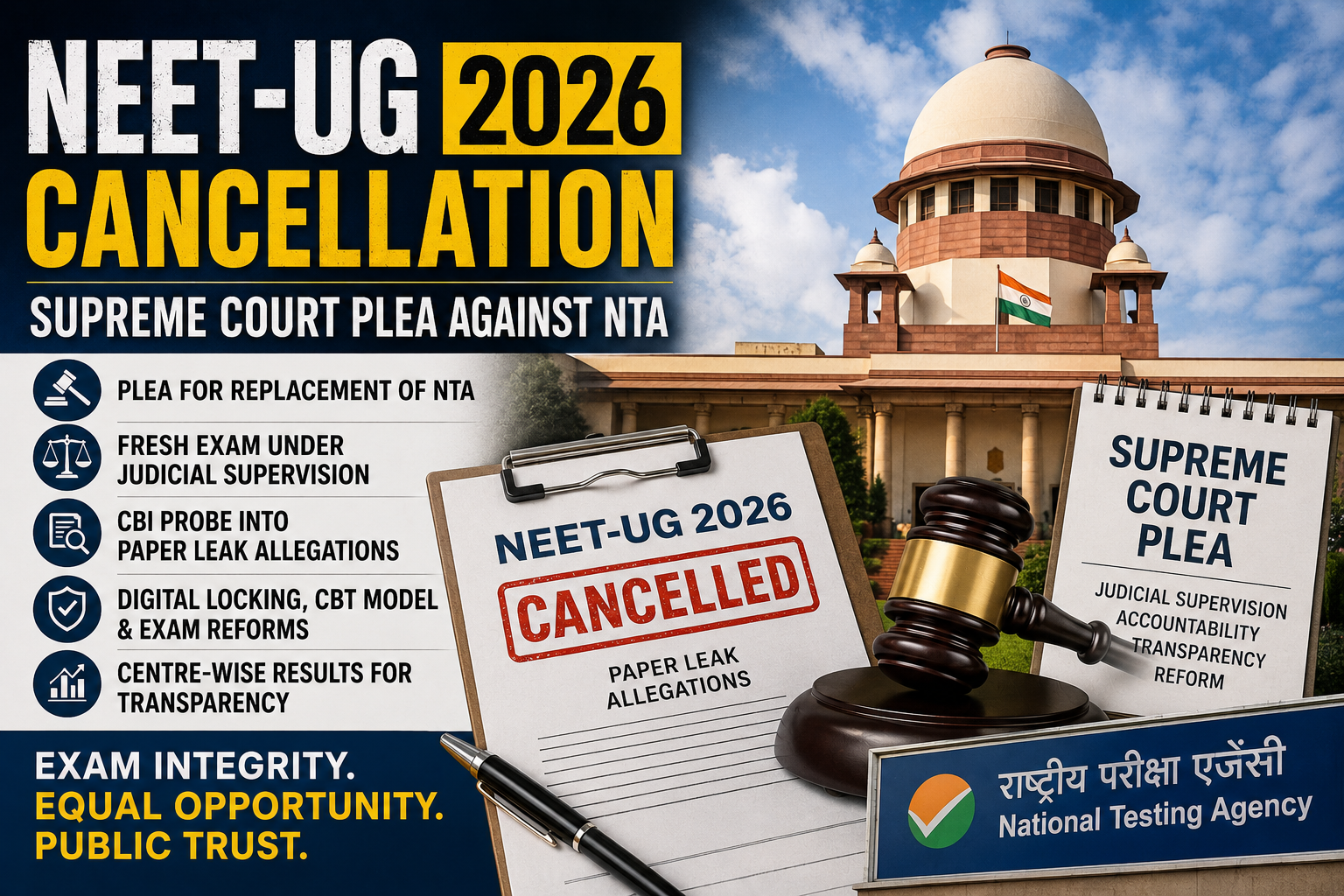
The reported Supreme Court plea filed after the cancellation of NEET-UG 2026 raises a question larger than one medical entrance examination: whether India’s national testing architecture can continue to command constitutional confidence when allegations of paper leak, compromised question security and institutional failure recur in high-stakes examinations. The petition reportedly seeks replacement or restructuring of the National Testing Agency, a fresh NEET-UG 2026 examination under judicial supervision, constitution of a high-powered monitoring committee, digital locking of question papers, transition towards computer-based testing, CBI status reporting, and publication of centre-wise results for anomaly detection.
Read More
Legislative Immunity – The pronouncement delivered by the Supreme Court on Monday stands as a pivotal moment regarding one of the most closely examined facets of the Parliament: lawmakers receiving inducements in return for their voting or orations delivered during a parliamentary session in a specific manner. Currently, Members of Parliament (MPs) and Members of...
Read More