
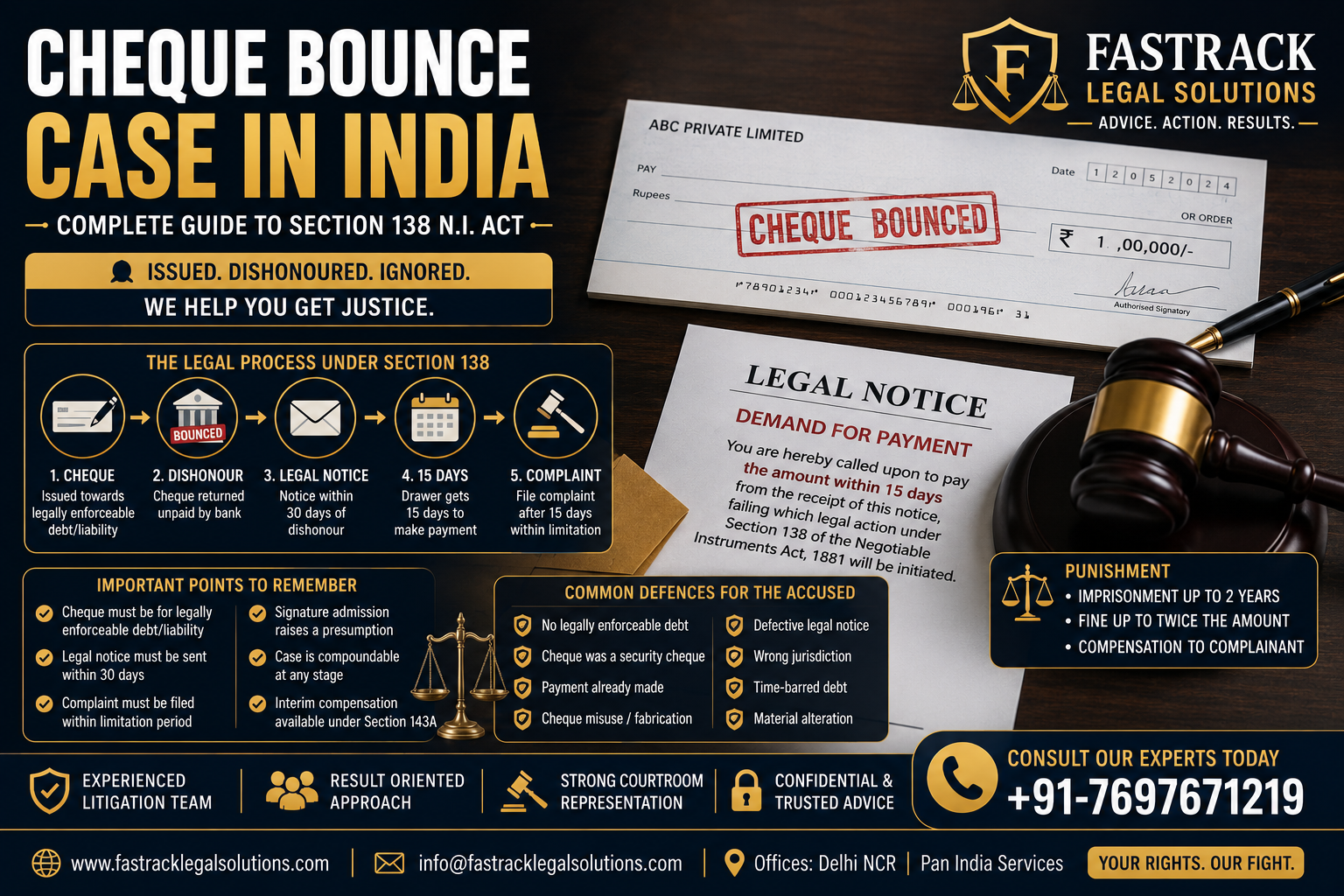
A cheque bounce case in India is generally filed under Section 138 of the Negotiable Instruments Act, 1881 when a cheque issued towards a legally enforceable debt or liability is dishonoured due to insufficiency of funds, exceeds arrangement, account closure, payment stopped or other legally recognised reasons. The payee must issue a written demand notice within 30 days of receiving information of dishonour. If the drawer fails to pay within 15 days of receiving the notice, the complainant may file a criminal complaint within the prescribed limitation period before the competent court.
Introduction
Cheque bounce litigation is one of the most common commercial-criminal remedies in India. It is used in business payments, friendly loans, property transactions, settlement agreements, service contracts, supply of goods, professional dues, partnership disputes, company transactions and financial recovery matters.
A dishonoured cheque is not automatically a criminal offence. Section 138 applies only when statutory conditions are satisfied. The complainant must prove issuance of cheque, legally enforceable debt or liability, dishonour, valid demand notice, non-payment within the statutory period and filing of complaint within limitation.
At the same time, the drawer of the cheque is not helpless. The accused can raise defences such as absence of legally enforceable debt, security cheque without crystallised liability, forged signature, time-barred debt, defective notice, wrong jurisdiction, misuse of cheque, payment already made, material alteration or lack of company/director liability.
This article explains the complete law and procedure for cheque bounce cases in India.
What is a Cheque Bounce Case?
A cheque bounce case arises when a cheque presented for payment is returned unpaid by the bank. The return may be due to:
- Insufficient funds.
- Exceeds arrangement.
- Account closed.
- Payment stopped by drawer.
- Signature mismatch.
- Account frozen.
- Dormant account.
- Cheque irregularity.
- Alteration or overwriting.
- Other bank return reasons.
Not every cheque return automatically attracts Section 138. The cheque must have been issued for discharge, wholly or partly, of a legally enforceable debt or liability.
Legal Provision: Section 138 N.I. Act
Section 138 of the Negotiable Instruments Act makes dishonour of cheque an offence where the cheque is issued towards discharge of debt or liability and is returned unpaid due to insufficiency of funds or because it exceeds the arrangement with the bank.
The provision requires:
- Cheque drawn by the drawer on an account maintained by him.
- Cheque issued for discharge of legally enforceable debt or liability.
- Cheque presented within its validity period.
- Cheque returned unpaid.
- Written demand notice issued within 30 days of receiving bank return information.
- Drawer fails to pay within 15 days of receipt of notice.
- Complaint filed within limitation.
People Also Ask: Is Cheque Bounce a Criminal Case?
Yes. Dishonour of cheque under Section 138 N.I. Act is a criminal offence, though it has a strong compensatory character. The court may impose imprisonment, fine up to twice the cheque amount, compensation, or other legally permissible directions depending on facts.
Cheque bounce litigation is often used for recovery, but it is not a simple civil recovery suit. It is a criminal complaint governed by strict statutory timelines.
Essential Ingredients of Section 138
1. Cheque Must Be Issued by the Drawer
The cheque must be drawn on an account maintained by the accused. If the cheque is forged or not signed by the accused, liability may be disputed.
2. Legally Enforceable Debt or Liability
The cheque must be issued towards a legally enforceable debt or liability. If the alleged debt is illegal, time-barred without acknowledgment, non-existent or not legally recoverable, the accused may raise a defence.
3. Presentation Within Validity
The cheque must be presented within its validity period. Although Section 138 refers to six months or validity period, whichever is earlier, banking practice presently treats cheques as valid for a shorter period as per RBI directions. Therefore, practically, cheques should be presented within the validity printed/applicable under banking norms.
4. Dishonour by Bank
The bank must return the cheque unpaid. The bank return memo is a key document.
5. Demand Notice Within 30 Days
The payee/holder must issue a demand notice within 30 days from receiving information from the bank regarding dishonour.
6. Failure to Pay Within 15 Days
The drawer gets 15 days from receipt of notice to make payment. The offence is completed only after failure to pay within this period.
7. Complaint Within Limitation
The complaint must be filed within limitation after the cause of action arises. Delay may require condonation.
People Also Ask: What is the Time Limit for Cheque Bounce Notice?
The legal notice must be issued within 30 days from the date when the payee receives information from the bank that the cheque has been dishonoured. If the drawer does not pay within 15 days of receiving the notice, the complainant can file a complaint under Section 138.
Step-by-Step Procedure in Cheque Bounce Case
Step 1: Presentation of Cheque
The payee presents the cheque within validity.
Step 2: Cheque Dishonour
The bank returns the cheque unpaid and issues a return memo.
Step 3: Legal Notice
The payee issues a written demand notice within 30 days from receiving dishonour information.
Step 4: Waiting Period
The drawer gets 15 days from receipt of notice to pay the cheque amount.
Step 5: Complaint Filing
If payment is not made within 15 days, the complainant files a complaint under Section 138 before the competent court.
Step 6: Pre-Summoning Evidence
The complainant files affidavit and documents. The court examines whether summons should be issued.
Step 7: Summoning of Accused
If the court is satisfied, summons are issued to the accused.
Step 8: Plea / Notice
The accused appears and the court frames notice/substance of accusation in a summons trial.
Step 9: Interim Compensation
The complainant may seek interim compensation under Section 143A, where applicable.
Step 10: Evidence and Cross-Examination
Complainant and accused lead evidence. Cross-examination is crucial.
Step 11: Final Arguments
The court hears arguments on debt, issuance, dishonour, notice, limitation and defence.
Step 12: Judgment
The court may convict, acquit or record compromise/compounding.
Jurisdiction in Cheque Bounce Cases
Jurisdiction in cheque bounce cases is now governed by the statutory framework under Sections 142 and 142A of the N.I. Act.
Broadly:
- If the cheque is delivered for collection through an account, the case lies where the payee’s bank branch is situated.
- If the cheque is presented otherwise than through an account, the case lies where the drawer’s drawee bank branch is situated.
This statutory position was introduced after the jurisdictional complications caused by earlier Supreme Court decisions. The practical rule for most account-presented cheques is that jurisdiction lies at the payee’s bank branch where the payee maintains the account.
People Also Ask: Where Should a Cheque Bounce Case Be Filed?
In most cases where the cheque is deposited through the payee’s bank account, the complaint is filed before the court having territorial jurisdiction over the branch of the bank where the payee maintains the account. Jurisdiction must still be checked carefully from the cheque deposit mode, bank branch and statutory provision.
Legal Notice in Cheque Bounce Case
A cheque bounce notice is not a formality. It is a statutory condition.
What Should the Notice Contain?
- Details of complainant/payee.
- Details of drawer/accused.
- Cheque number.
- Cheque date.
- Cheque amount.
- Bank details.
- Date of presentation.
- Date of dishonour.
- Reason for dishonour.
- Liability for which cheque was issued.
- Demand for payment of cheque amount.
- 15-day statutory payment period.
- Warning of legal action under Section 138.
Service of Notice
Notice should be sent to the correct address by reliable modes such as speed post, registered post, courier and email/WhatsApp as additional modes where appropriate.
The Supreme Court has held that a drawer who claims non-receipt of notice may still avoid prosecution by making payment within 15 days of receiving summons with copy of complaint. Therefore, technical denial of notice is not always a complete defence.
Documents Required for Cheque Bounce Complaint
The complainant should prepare:
- Original cheque.
- Bank return memo.
- Copy of legal notice.
- Postal receipt.
- Tracking report.
- Acknowledgment card, if available.
- Courier receipt, if used.
- Email/WhatsApp proof, if used.
- Loan agreement / invoice / ledger / settlement deed.
- Bank statement.
- Proof of debt or liability.
- Board resolution or authorisation, if complainant is company.
- Power of attorney, if filed through authorised representative.
- Identity and address details.
- Complaint affidavit.
In high-value cases, the complainant should also maintain a complete transaction file proving the underlying liability.
Presumption Under Sections 118 and 139
The N.I. Act contains statutory presumptions in favour of the holder of the cheque. Once execution/signature of the cheque is admitted or proved, the court may presume that the cheque was issued for consideration and discharge of legally enforceable debt or liability.
However, this presumption is rebuttable. The accused can raise a probable defence. The accused is not required to prove defence beyond reasonable doubt. A probable defence based on preponderance of probabilities may be sufficient.
This is why cheque bounce trials are often decided on whether the accused has successfully rebutted the presumption.
People Also Ask: Does Signature on Cheque Prove Liability?
Admission of signature creates a strong presumption in favour of the complainant under Section 139, but it does not make conviction automatic. The accused can rebut the presumption by showing absence of legally enforceable debt, misuse of cheque, payment already made, security cheque without liability, or other probable defence.
Common Defences in Cheque Bounce Cases
1. No Legally Enforceable Debt
The accused may argue that no debt or liability existed when the cheque was presented.
2. Security Cheque
A security cheque can still attract Section 138 if liability had crystallised when it was presented. But if there was no enforceable liability, the accused may raise a defence.
3. Time-Barred Debt
A cheque issued for a time-barred debt may create legal complications unless there is proper acknowledgment or legally enforceable liability.
4. Cheque Misused
The accused may claim that a blank signed cheque was misused. This defence must be supported by circumstances, complaints, correspondence or other material.
5. Payment Already Made
If the drawer has already paid the cheque amount or underlying liability, proof of payment is essential.
6. Defective Notice
Notice may be challenged if it does not demand cheque amount, is issued beyond time, sent to wrong party, or is legally defective.
7. Wrong Jurisdiction
The accused may challenge territorial jurisdiction if complaint is filed in the wrong court.
8. Company Not Arraigned
Where the cheque is issued by a company, the company is generally a necessary accused for prosecuting directors/officers under Section 141, subject to settled exceptions and facts.
9. Director Not In Charge
A director may argue that he was not in charge of and responsible for conduct of business when the offence occurred.
10. Forgery or Signature Dispute
If signature is disputed, the accused may seek appropriate forensic or bank evidence.
Cheque Bounce by Company
Where cheque is issued by a company, Section 141 N.I. Act deals with liability of companies and persons in charge.
The complaint should generally include:
- Company as accused.
- Signatory of cheque.
- Managing Director/Joint Managing Director, where applicable.
- Directors/persons in charge of and responsible for business conduct.
- Specific averments regarding role and responsibility.
A bald statement that all directors are liable may not be enough. The complaint should plead how the person was responsible for the conduct of business at the relevant time.
People Also Ask: Can Directors Be Arrested in Cheque Bounce Case?
Cheque bounce under Section 138 is a criminal complaint, but it is generally tried as a summons case. Arrest is not the normal first step. However, if an accused repeatedly avoids summons, bailable warrants or non-bailable warrants may be issued depending on court orders. Directors should not ignore summons.
Interim Compensation Under Section 143A
Section 143A empowers the trial court to direct the drawer of the cheque to pay interim compensation to the complainant in specified situations, such as where the accused pleads not guilty in a summary trial or summons case.
The interim compensation cannot exceed 20% of the cheque amount.
This provision is important because it gives complainants early monetary relief during trial. However, courts must exercise discretion judicially and not mechanically.
Appellate Deposit Under Section 148
If the accused is convicted and files appeal, the appellate court may direct deposit of a minimum percentage of fine or compensation awarded by the trial court, as per Section 148.
This provision reduces frivolous appeals and protects complainants after conviction. However, deposit orders must still be examined from the facts and statutory framework.
Compounding and Settlement
Cheque bounce cases are compoundable. Settlement is common at different stages:
- After notice.
- After summons.
- During mediation.
- Before evidence.
- During appeal.
- Even at later stages, subject to court discretion and terms.
The Supreme Court has repeatedly recognised the compensatory nature of Section 138 litigation. The purpose is not merely punishment, but ensuring payment and credibility of commercial transactions.
A settlement should record:
- Total settlement amount.
- Payment schedule.
- Mode of payment.
- Consequences of default.
- Withdrawal/compounding terms.
- Return of cheques, if any.
- Closure of civil/criminal claims.
Cheque Bounce and Civil Recovery
A Section 138 complaint is not the only remedy. The complainant may also consider:
- Civil recovery suit.
- Summary suit, where maintainable.
- Arbitration, if agreement contains arbitration clause.
- Insolvency route, where legally permissible.
- Commercial suit, depending on facts.
- Criminal complaint for cheating, if fraudulent intention existed from inception.
Section 138 is a powerful remedy, but it should be integrated with the recovery strategy.
Limitation Checklist for Complainant
| Step | Timeline |
|---|---|
| Present cheque | Within validity period |
| Issue demand notice | Within 30 days of dishonour information |
| Drawer payment period | 15 days from receipt of notice |
| Cause of action | After expiry of 15 days without payment |
| File complaint | Within statutory limitation after cause of action |
| Delay | May require condonation application |
Limitation mistakes can destroy an otherwise strong cheque bounce case.
People Also Ask: What Happens If Legal Notice Is Not Received?
If notice is sent to the correct address by post, service may be presumed depending on facts. Also, if the drawer claims non-receipt, he may still pay the cheque amount within 15 days of receiving court summons and complaint copy. If he does not do so, non-receipt of notice may not automatically defeat the complaint.
Do’s for Complainant
- Preserve original cheque.
- Preserve bank return memo.
- Issue notice within 30 days.
- Send notice to correct address.
- Keep postal/courier proof.
- File complaint within limitation.
- Attach proof of debt.
- File proper authorisation if company.
- Plead director liability carefully.
- Seek interim compensation where justified.
Don’ts for Complainant
- Do not delay notice.
- Do not issue vague notice.
- Do not demand unrelated amounts only.
- Do not file without original cheque/return memo.
- Do not ignore jurisdiction.
- Do not proceed against directors without role averments.
- Do not conceal payments received.
- Do not use Section 138 for clearly time-barred or illegal debt.
- Do not rely only on oral loan story in high-value cases.
- Do not miss limitation.
Do’s for Accused
- Do not ignore legal notice.
- Reply to notice if you have a defence.
- Preserve bank records.
- Preserve proof of payment.
- File police complaint if cheque is misused, where facts justify.
- Collect communication showing no liability.
- Challenge defective complaint at proper stage.
- Prepare probable defence.
- Attend court regularly.
- Explore settlement if liability exists.
Don’ts for Accused
- Do not avoid summons.
- Do not take false defences.
- Do not ignore bailable/non-bailable warrants.
- Do not assume “security cheque” is always safe.
- Do not admit liability casually in messages.
- Do not hide company records.
- Do not delay appeal after conviction.
- Do not ignore Section 143A/148 orders.
- Do not rely only on oral denial.
- Do not forget that presumptions operate against the drawer.
Also Read Cheque Bouncing section 138 : Recent Legal Developments , Exploring Legal Aspects of Section 138 Negotiable Instrument Act
Important Supreme Court Judgments
1. Rangappa v. Sri Mohan
The Supreme Court held that once execution of cheque is admitted, the presumption under Section 139 includes presumption of legally enforceable debt or liability. The presumption is rebuttable, and the accused can raise a probable defence.
2. C.C. Alavi Haji v. Palapetty Muhammed
The Supreme Court dealt with service of notice and held that a drawer claiming non-receipt can still make payment within 15 days of receiving summons with complaint copy. If he does not pay even then, the defence of non-service becomes weak.
3. Bridgestone India Pvt. Ltd. v. Inderpal Singh
The Supreme Court applied the amended jurisdiction provisions and recognised that territorial jurisdiction may lie where the cheque is delivered for collection through the payee’s bank branch.
4. Meters and Instruments Pvt. Ltd. v. Kanchan Mehta
The Supreme Court emphasised the compensatory nature of Section 138 proceedings and encouraged resolution/compounding, though later jurisprudence has clarified limits on certain procedural observations.
5. Dashrath Rupsingh Rathod v. State of Maharashtra
This judgment earlier restricted jurisdiction to the drawee bank location, but the law was subsequently altered by statutory amendment introducing Sections 142(2) and 142A.
What is Section 138 N.I. Act?
Section 138 makes dishonour of cheque an offence where the cheque was issued for a legally enforceable debt or liability and statutory notice/payment conditions are not complied with.
What is cheque bounce notice period?
Demand notice must be issued within 30 days from receiving bank information of dishonour.
How much time is given after cheque bounce notice?
The drawer gets 15 days from receipt of notice to pay the cheque amount.
Can cheque bounce case be settled?
Yes. Section 138 cases are compoundable and may be settled at different stages.
Can security cheque attract Section 138?
Yes, if legally enforceable liability existed when the security cheque was presented. If no liability existed, the accused may raise a defence.
Frequently Asked Questions
1. What is a cheque bounce case?
A cheque bounce case is a criminal complaint under Section 138 N.I. Act where a cheque issued towards legally enforceable debt or liability is dishonoured and the drawer fails to pay despite statutory notice.
2. What is the punishment for cheque bounce?
Punishment may include imprisonment, fine up to twice the cheque amount, compensation, or other legally permissible orders depending on facts and court discretion.
3. What is the limitation for cheque bounce notice?
The demand notice must be issued within 30 days of receiving information of cheque dishonour from the bank.
4. What happens after cheque bounce notice?
The drawer gets 15 days from receipt of notice to make payment. If payment is not made, the complainant may file Section 138 complaint within limitation.
5. Can cheque bounce case be filed for security cheque?
Yes, if liability had crystallised when the cheque was presented. If there was no legally enforceable debt or liability, the accused may raise defence.
6. Can directors be made accused in cheque bounce case?
Yes, if the cheque was issued by a company and the directors/persons were in charge of and responsible for conduct of business, subject to proper pleadings under Section 141.
7. Can cheque bounce case be quashed?
Yes, in limited cases such as absence of basic ingredients, defective complaint, no legally enforceable liability, wrong accused, lack of company arraignment, limitation defect, settlement, or abuse of process.
8. Can I file civil recovery along with cheque bounce case?
Yes. A Section 138 complaint does not bar civil recovery, summary suit, arbitration or other recovery remedies, depending on facts.
9. Is reply to cheque bounce notice necessary?
It is not mandatory in every case, but a reply is advisable where the drawer has a genuine defence such as no liability, payment already made, misuse of cheque or defective claim.
10. What is the strongest defence in cheque bounce case?
The strongest defence depends on facts, but common strong defences include absence of legally enforceable debt, payment already made, cheque misuse, time-barred debt, defective notice, wrong jurisdiction, and lack of company/director liability.
Conclusion
Cheque bounce litigation under Section 138 N.I. Act is technical, document-driven and limitation-sensitive. A complainant must act quickly: preserve the cheque and return memo, issue a proper legal notice within time, wait for the statutory payment period and file the complaint before the competent court.
For the accused, denial alone is rarely enough because statutory presumptions operate in favour of the complainant once cheque execution is admitted. The defence must be probable, documented and legally coherent.
A strong cheque bounce case is built on timing, documents, jurisdiction, notice drafting, proof of liability and correct use of presumptions. In commercial disputes, Section 138 remains one of the most effective legal remedies when used properly.
Disclaimer
This article is intended for general legal awareness and educational purposes only. It does not constitute legal advice, solicitation, advertisement or creation of an advocate-client relationship. Cheque bounce cases depend on cheque details, bank memo, legal notice, limitation, debt documents, company status, jurisdiction, payments, defences and case-specific facts.