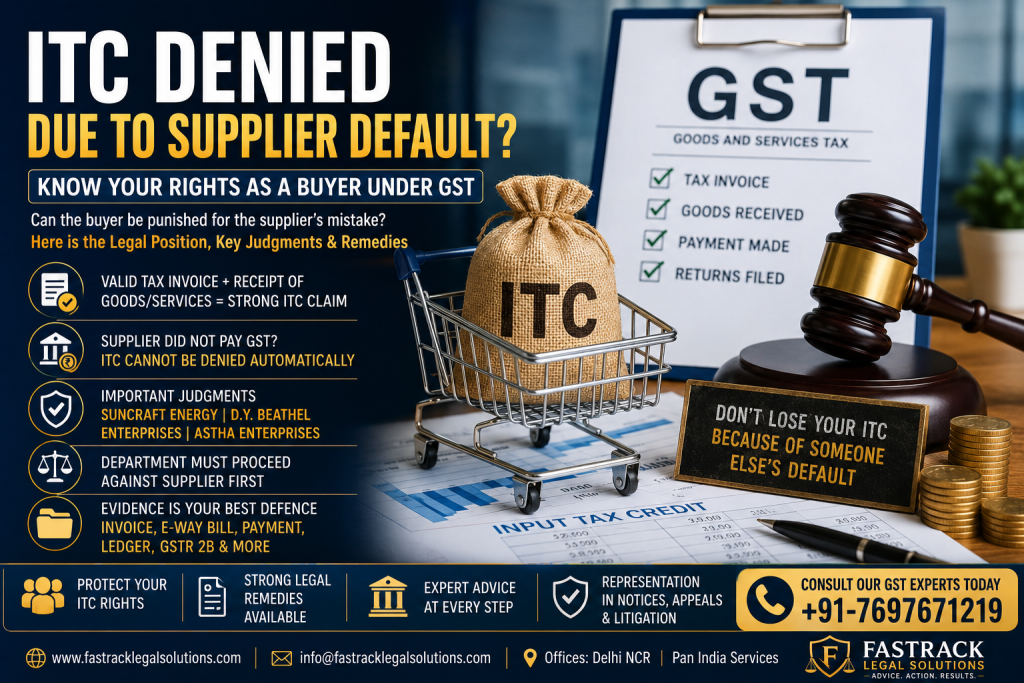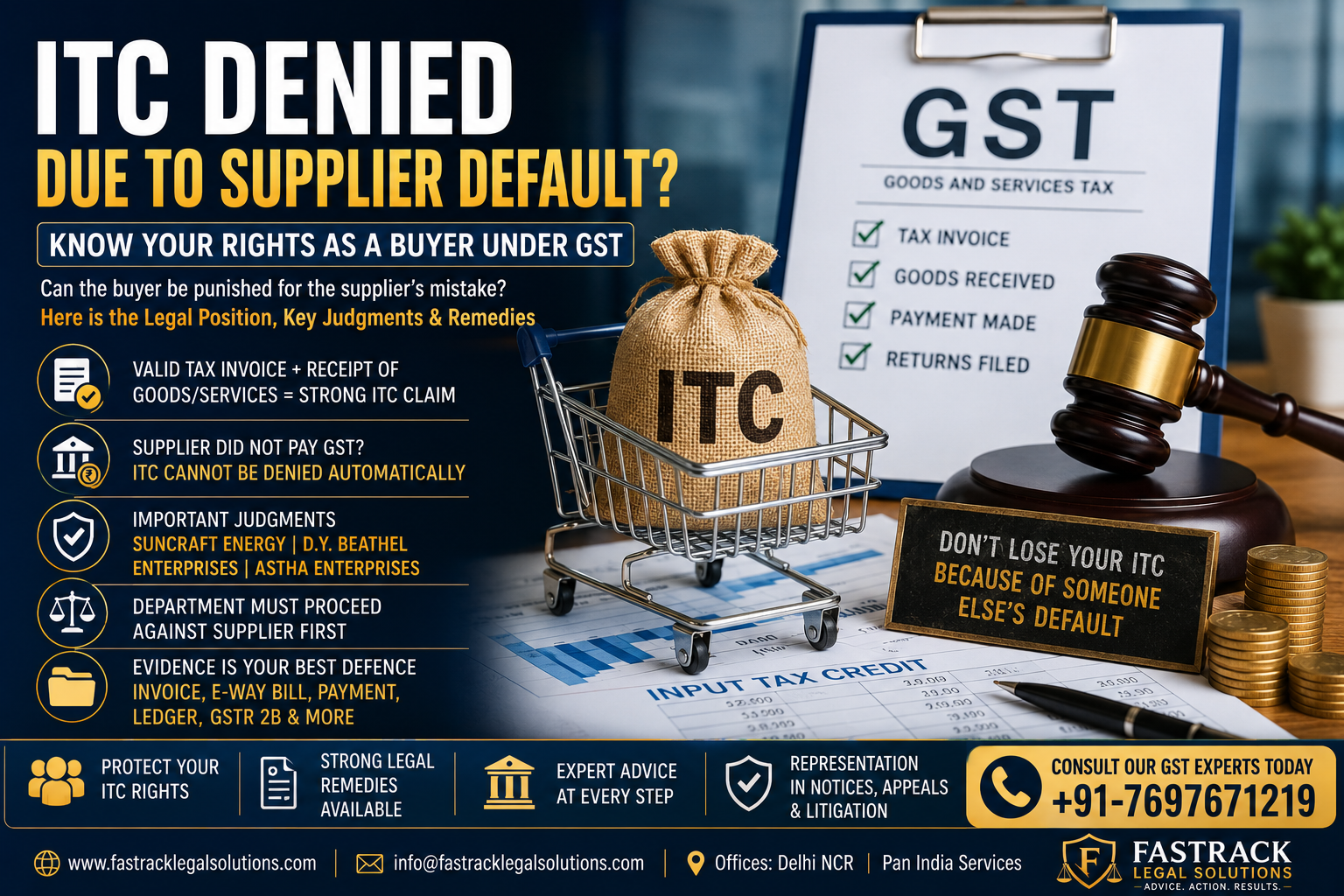
ITC DENIED -Input Tax Credit cannot be denied mechanically to a bona fide buyer merely because the supplier failed to pay GST or failed to reflect invoices in GSTR-1/GSTR-2A, if the buyer has fulfilled statutory conditions such as possession of tax invoice, receipt of goods or services, payment to supplier through banking channels, filing of returns, and absence of collusion. However, Section 16(2)(c) of the CGST Act requires that tax charged in respect of supply must have been actually paid to the Government. Therefore, the legal position is not absolute. Courts have protected genuine buyers in cases like Suncraft Energy and D.Y. Beathel Enterprises, but Aastha Enterprises took a stricter view of Section 16(2)(c). The strongest defence for a buyer is to prove genuineness of transaction, absence of collusion, due diligence, and that the department did not first proceed against the defaulting supplier.
Introduction
Input Tax Credit is the central feature of GST. The entire GST system is designed to avoid cascading tax. A registered buyer pays GST to the supplier and claims ITC on that tax. But a serious problem arises when the supplier collects GST from the buyer and does not deposit it with the Government.
The department then issues notice to the buyer asking: why should your ITC not be reversed because the supplier did not pay tax or did not upload invoices?
This creates a harsh situation. The buyer has already paid the invoice value plus GST to the supplier. Goods or services have been received. The transaction is recorded in books. Payment has gone through bank. Yet the buyer is asked to reverse ITC and pay tax again.
The question is: Can the buyer be punished for the supplier’s default?
The answer depends on facts, documents, statutory compliance and jurisdictional case law. The buyer’s remedy lies in a carefully drafted reply, evidence-based representation, and where necessary, writ petition before the High Court.
What is the Core Issue?
The issue usually arises in these situations:
- Supplier collected GST but did not pay it to Government.
- Supplier did not file GSTR-1.
- Supplier filed wrong GST return.
- Invoice is not reflected in GSTR-2A or GSTR-2B.
- Supplier’s registration was cancelled later.
- Supplier is alleged to be non-existent.
- Supplier is declared suspicious by department.
- Department alleges fake invoices.
- Department alleges no movement of goods.
- Buyer is asked to reverse ITC with interest and penalty.
The department generally relies on Section 16 of the CGST Act. The buyer generally argues bona fide purchase, actual receipt, payment of tax to supplier, no collusion, and that recovery should first be made from the supplier.
Section 16 CGST Act: Conditions for Taking ITC
Section 16 of the CGST Act lays down eligibility and conditions for taking Input Tax Credit.
A buyer should broadly satisfy:
- Possession of tax invoice or debit note.
- Details of invoice furnished by supplier and communicated to recipient, where applicable.
- Receipt of goods or services.
- ITC not restricted under the communication mechanism, where applicable.
- Tax charged in respect of supply actually paid to Government.
- Return furnished by the buyer.
- Payment to supplier within 180 days, subject to statutory consequences.
- ITC availed within the time limit prescribed under Section 16(4).
The difficulty is Section 16(2)(c), which speaks of tax charged in respect of such supply being actually paid to the Government. This is the provision invoked against the buyer where the supplier defaults.
People Also Ask: Can ITC Be Denied if Supplier Has Not Paid GST?
ITC should not be denied mechanically only because the supplier has not paid GST, especially where the buyer has valid tax invoice, proof of receipt, bank payment and no collusion. However, because Section 16(2)(c) requires actual payment of tax to Government, the department may still issue notices. The defence depends on proving bona fide conduct and relying on judgments that require the department to first proceed against the defaulting supplier unless exceptional circumstances exist.
Suncraft Energy: Relief for Bona Fide Buyers
Suncraft Energy is one of the most important GST judgments for buyers facing ITC denial due to supplier default or GSTR-2A mismatch.
In that case, the buyer had tax invoices, received goods/services and made payment to the supplier. The department denied ITC because the supplier’s invoices were not reflected properly and tax payment issue arose. The Calcutta High Court held that the buyer could not be straightaway asked to reverse ITC without the department first proceeding against the supplier, unless exceptional circumstances existed.
The Court treated automatic reversal from buyer as arbitrary where:
- Buyer had tax invoice.
- Buyer received goods or services.
- Buyer paid the supplier including GST.
- Department did not first proceed against the supplier.
- No collusion was shown.
- No exceptional case such as missing supplier or closed business was established.
The Supreme Court later dismissed the department’s SLP against the Calcutta High Court order. This has strengthened the position of genuine buyers, though dismissal of SLP must still be used carefully in legal arguments.
D.Y. Beathel Enterprises: Supplier Must Be Examined
In D.Y. Beathel Enterprises, the Madras High Court dealt with a situation where the seller had collected tax from the purchaser but allegedly did not remit it to the Government.
The Court noted that the supplier had not been examined and that action had not been initiated against the seller. The Court interfered with the orders against the buyer and emphasised that where the seller has collected tax, the omission of the seller to remit tax must be viewed seriously.
This judgment is useful where the buyer can show that the department proceeded only against the recipient without confronting or acting against the supplier.
Aastha Enterprises: Strict View Against Buyer
Aastha Enterprises from the Patna High Court is a cautionary judgment. The Court took a strict view of Section 16(2)(c) and held that unless tax collected from the buyer is actually paid to the Government by the supplier, the buyer cannot claim ITC.
The Court distinguished D.Y. Beathel and emphasised that Section 16(2)(c) cannot be ignored. This judgment is often relied upon by the department.
Therefore, taxpayers must understand that the issue is not fully risk-free. A buyer cannot simply say, “I paid the supplier, therefore ITC is automatically protected.” The buyer must build a stronger case on facts, documents, bona fides, due diligence and absence of collusion.
Practical Legal Position After Conflicting Judgments
The practical legal position may be summarised as follows:
Buyer-Friendly Position
A bona fide buyer should not be penalised for the supplier’s default where the buyer has:
- Valid tax invoice.
- Proof of receipt of goods/services.
- Bank payment to supplier.
- GST paid to supplier.
- Transaction recorded in books.
- No collusion with supplier.
- No knowledge of supplier’s default.
- Supplier was registered at the time of transaction.
- Department has not first proceeded against supplier.
- No exceptional situation such as missing supplier or fake transaction.
Department-Friendly Position
Section 16(2)(c) requires actual payment of tax to Government. Therefore, if supplier has not paid tax, buyer’s ITC may be denied unless the buyer can establish legal and factual grounds for protection.
Stronger Litigation Position
The strongest buyer argument is not merely “supplier default cannot affect me”. The stronger argument is:
- The transaction is genuine.
- Goods/services were actually received.
- Payment including GST was made through banking channel.
- Supplier was registered and active at transaction stage.
- Buyer had no control over supplier’s tax payment.
- Department has recovery powers against supplier.
- Department did not establish collusion.
- Department did not first attempt recovery from supplier.
- Automatic reversal violates fairness and proportionality.
- Demand against buyer should be limited to exceptional cases.
People Also Ask: What if Invoice is Not Showing in GSTR-2A or GSTR-2B?
Non-reflection in GSTR-2A or GSTR-2B is a serious compliance issue, but it should not automatically prove that the transaction is fake. The buyer should submit:
- Tax invoice.
- E-way bill.
- Goods receipt note.
- Transport documents.
- Payment proof.
- Ledger account.
- Stock register.
- Purchase order.
- Correspondence with supplier.
- Proof that supplier was registered.
For earlier periods, courts have treated GSTR-2A as a facilitation mechanism and have discouraged automatic ITC reversal solely on mismatch. For later periods, statutory amendments and GSTR-2B matching have increased compliance burden. Therefore, period-specific analysis is essential.
People Also Ask: Can Buyer Claim ITC if Supplier Registration Was Cancelled Later?
If the supplier was registered and active when the transaction occurred, and cancellation happened later, the buyer may argue bona fide purchase. The buyer should collect GST registration status, invoice date proof, payment records and delivery evidence.
However, if the supplier was non-existent at the time of transaction or registration was cancelled retrospectively due to fraud, the matter becomes more serious. The buyer must prove actual transaction and due diligence.
People Also Ask: What if Supplier Is Missing or Non-Existent?
If the supplier is missing, fake, non-existent, or has closed business and has no assets, the department may argue that this is an exceptional situation where ITC recovery can be made from the buyer.
The buyer must then prove:
- Supplier existed at transaction time.
- GSTIN was valid.
- Goods/services were actually supplied.
- Payment was made through bank.
- Transport and delivery records exist.
- Buyer had no collusion.
- Buyer conducted reasonable due diligence.
- Department has not shown fake transaction.
Buyer’s Evidence Checklist for ITC Defence
A buyer facing ITC denial due to supplier default should immediately prepare a document file.
A. Tax Documents
- Tax invoices.
- Debit notes, if any.
- GSTR-2A / GSTR-2B.
- GSTR-3B.
- Purchase register.
- ITC ledger.
- Supplier GSTIN details.
- GST registration status of supplier.
B. Goods / Services Receipt Proof
- Goods receipt note.
- E-way bills.
- Transport receipts.
- Lorry receipts.
- Delivery challans.
- Weighment slips.
- Stock register.
- Gate entry register.
- Consumption records.
- Job work records, where applicable.
C. Payment Proof
- Bank statement.
- NEFT/RTGS/IMPS/UPI proof.
- Ledger account of supplier.
- Payment vouchers.
- Confirmation from supplier.
- No cash-heavy unexplained payment.
D. Business Proof
- Purchase order.
- Contract/work order.
- Email correspondence.
- WhatsApp/business communication.
- Vendor onboarding records.
- Due diligence screenshots.
- PAN and GST details.
- Supplier KYC documents.
E. No Collusion Proof
- Normal commercial pricing.
- Ordinary business relationship.
- No circular trading.
- No related-party link.
- No cash-back arrangement.
- No abnormal credit pattern.
- No immediate suspicious reversal.
Legal Grounds in Reply to GST Notice
A reply to ITC reversal notice may raise the following grounds:
1. Transaction is Genuine
The buyer received goods/services and used them in the course or furtherance of business.
2. Invoice and Payment Conditions Satisfied
The buyer has valid tax invoice and made payment including GST to the supplier through banking channel.
3. No Control Over Supplier’s Tax Payment
The buyer cannot access or control whether the supplier finally deposited tax with Government.
4. Department Must Proceed Against Supplier First
Where supplier collected tax, primary recovery should be against supplier unless exceptional circumstances exist.
5. No Collusion
No material shows collusion, fake billing, circular trading or knowledge of supplier default.
6. No Automatic Reversal
ITC cannot be reversed mechanically merely because invoices did not reflect in GSTR-2A/2B or supplier defaulted.
7. Violation of Natural Justice
If the supplier was not examined, cross-material not supplied, or no hearing granted, the demand may be procedurally defective.
8. Burden on Department to Prove Fraud
Where fraud or fake invoice is alleged, the department must produce material and cannot proceed on suspicion alone.
When Should Buyer File Writ Petition?
A writ petition before the High Court may be considered where:
- ITC is denied without inquiry against supplier.
- Buyer has all documents.
- Department proceeds mechanically on GSTR mismatch.
- Supplier was not examined.
- No collusion is alleged or proved.
- Order is non-speaking.
- Natural justice was violated.
- ITC is blocked or recovered coercively.
- Demand is based only on system mismatch.
- Recovery is initiated without proper adjudication.
However, where disputed facts are heavy, appellate remedy may be insisted upon. Strategy depends on the order, stage and jurisdiction.
Defence Against GSTR-2A / GSTR-2B Mismatch Notices
A mismatch notice should not be answered with a generic denial. Reply invoice-wise.
Suggested Reply Structure
- Table of disputed invoices.
- Supplier GSTIN.
- Invoice number and date.
- Taxable value and GST amount.
- Payment date and bank reference.
- E-way bill number.
- Goods receipt proof.
- GSTR-3B reporting.
- GSTR-2A/2B status.
- Explanation for mismatch.
- Request for action against supplier.
- Prayer to drop demand.
A table-based reply is stronger than paragraph-only defence.
Buyer Due Diligence Before Claiming ITC
To reduce future disputes, businesses should adopt supplier due diligence.
Recommended Vendor Checks
- GSTIN status check.
- Registration effective date.
- Return filing status.
- E-invoice applicability.
- PAN verification.
- Principal place of business.
- Bank account verification.
- Vendor declaration.
- Contract clause requiring GST compliance.
- Indemnity for ITC loss due to supplier default.
Contract Clause
Every purchase contract should include GST compliance clauses requiring supplier to:
- Issue valid tax invoice.
- File GSTR-1 correctly.
- Pay GST to Government.
- Ensure ITC reflection.
- Indemnify buyer for ITC loss, interest and penalty.
- Cooperate in GST proceedings.
- Provide return filing proof on request.
Can Buyer Recover ITC Loss from Supplier?
Yes, if the supplier contract, invoice terms, purchase order or commercial arrangement supports recovery. Even otherwise, if supplier collected GST and failed to deposit it, the buyer may explore civil and contractual remedies.
Possible remedies include:
- Legal notice.
- Contractual indemnity claim.
- Recovery suit.
- Arbitration, if clause exists.
- Debit note / commercial adjustment.
- Complaint for cheating, where fraud is evident.
- Supplier blacklisting.
- Vendor compliance action.
A strong GST contract clause helps reduce future loss.
Practical Strategy for Taxpayers
Stage 1: Before Notice
- Reconcile ITC monthly.
- Match invoices with GSTR-2B.
- Follow up with suppliers.
- Hold payment where supplier is non-compliant, if contract permits.
- Maintain proof of receipt and payment.
- Include GST indemnity clauses.
Stage 2: After Notice
- Reply invoice-wise.
- Attach all evidence.
- Ask for supplier inquiry.
- Ask for material relied upon.
- Deny collusion.
- Seek personal hearing.
- Cite Suncraft and D.Y. Beathel where applicable.
- Distinguish Aastha on facts where possible.
Stage 3: After Adverse Order
- Check limitation for appeal.
- Consider writ if natural justice violation exists.
- Seek stay against recovery.
- Preserve all documents.
- Examine supplier recovery.
- Consider parallel civil remedy against supplier
Also Read Rule 86A ITC Blocking After K-9 Enterprises | GST Legal Remedies
People Also Ask: What Should I Do If GST Department Sends ITC Reversal Notice?
Do not file a short generic reply. Prepare an invoice-wise response with tax invoices, payment proof, goods receipt documents, e-way bills, ledger, GSTR records and supplier details. Ask the department to proceed against the supplier first and to disclose any material alleging collusion or fake transaction.
People Also Ask: Can ITC Be Denied for GSTR-2A Mismatch?
ITC should not be denied automatically only because of GSTR-2A mismatch, especially for earlier periods and where the buyer has genuine transaction documents. However, current GST compliance requires careful GSTR-2B reconciliation. The legal defence depends on the tax period, statutory amendments, facts and evidence.
What is ITC denial due to supplier default?
It means GST department denies buyer’s Input Tax Credit because the supplier did not pay GST, did not file return, did not upload invoice or is alleged to be fake/non-compliant.
Can buyer be punished for supplier not paying GST?
A bona fide buyer should not be mechanically punished if he has invoice, goods receipt, bank payment and no collusion. But Section 16(2)(c) creates litigation risk because it requires tax to be actually paid to Government.
Which case helps buyers in ITC supplier default disputes?
Suncraft Energy and D.Y. Beathel Enterprises support bona fide buyers where department did not first proceed against the supplier and no collusion was shown.
Which case is against buyer in ITC supplier default disputes?
Aastha Enterprises took a stricter view and held that Section 16(2)(c) requires actual payment of tax to Government by supplier.
What is the strongest evidence for ITC defence?
Tax invoice, e-way bill, goods receipt proof, bank payment, stock register, ledger account, GSTR records, supplier GST status and absence of collusion.
Frequently Asked Questions
1. Can ITC be denied because supplier did not pay GST?
ITC should not be denied mechanically to a bona fide buyer, but Section 16(2)(c) creates a statutory condition that tax must be paid to Government. The issue depends on facts, documents and case law.
2. What if I have paid GST to supplier?
Payment to supplier is strong evidence, especially if made through bank. However, the department may still rely on Section 16(2)(c). The buyer should prove genuine transaction and absence of collusion.
3. What if invoice is not reflected in GSTR-2A?
Non-reflection in GSTR-2A should not automatically defeat ITC, particularly for earlier periods, if the buyer proves invoice, receipt and payment. But period-specific law and GSTR-2B compliance must be checked.
4. What is Suncraft Energy case?
Suncraft Energy protected a bona fide buyer and held that the department should first proceed against the supplier unless exceptional circumstances such as collusion, missing supplier or supplier closure exist.
5. What is Aastha Enterprises case?
Aastha Enterprises took a strict view that ITC cannot be claimed unless tax collected from the buyer is actually paid to the Government by the supplier, relying on Section 16(2)(c).
6. Can department recover tax from buyer and supplier both?
The department may proceed according to law, but double recovery of the same tax component is legally contestable. Buyer should demand clarity on recovery from supplier and status of supplier proceedings.
7. What documents are needed to defend ITC?
Invoices, e-way bills, delivery proof, bank payment, stock records, ledger, purchase orders, GSTR-2A/2B, GSTR-3B, supplier GST status and correspondence are important.
8. Can I file writ petition against ITC denial?
Yes, where there is violation of natural justice, mechanical denial, no supplier inquiry, no collusion, non-speaking order or purely system-based mismatch. Otherwise, statutory appeal may be the usual route.
9. Can I recover loss from supplier?
Yes, through contractual indemnity, legal notice, arbitration, recovery suit or other remedies depending on contract and facts.
10. How can businesses avoid ITC denial due to supplier default?
Businesses should conduct GSTIN verification, monitor return filing, reconcile GSTR-2B, use GST compliance clauses, retain payment proof and maintain complete receipt/stock records.
Conclusion
ITC denial due to supplier default is one of the most contested issues under GST. The law is not entirely one-sided. Section 16(2)(c) gives the department a statutory basis to question ITC where tax has not reached the Government. At the same time, courts have protected bona fide buyers where transactions are genuine, tax was paid to supplier, goods/services were received, and no collusion exists.
The strongest taxpayer defence is evidence. A buyer must show real transaction, valid invoice, receipt of supply, bank payment, business use, due diligence and absence of collusion. The department should not mechanically reverse ITC without first examining supplier default and exceptional circumstances.
For businesses, GST compliance is no longer only about filing returns. It is about building an ITC defence file before the dispute arises.
Disclaimer
This article is intended for general legal awareness and educational purposes only. It does not constitute legal advice, tax advice, solicitation, advertisement or creation of an advocate-client relationship. ITC disputes depend on tax period, statutory amendments, invoices, GSTR-2A/2B, supplier conduct, payment records, goods movement, adjudication order, jurisdictional precedent and case-specific facts.