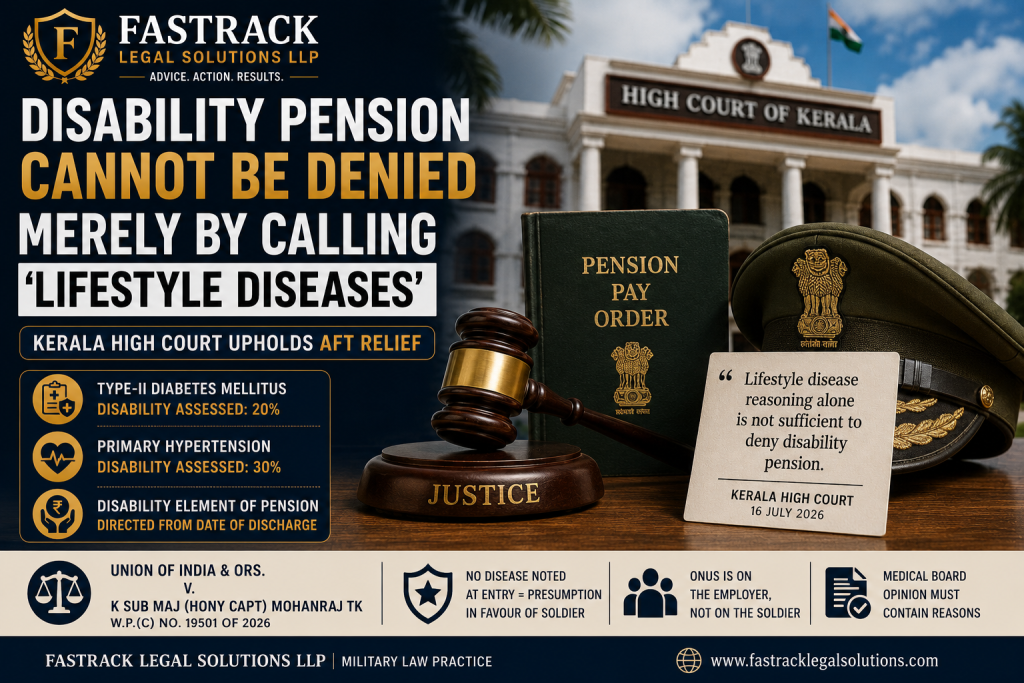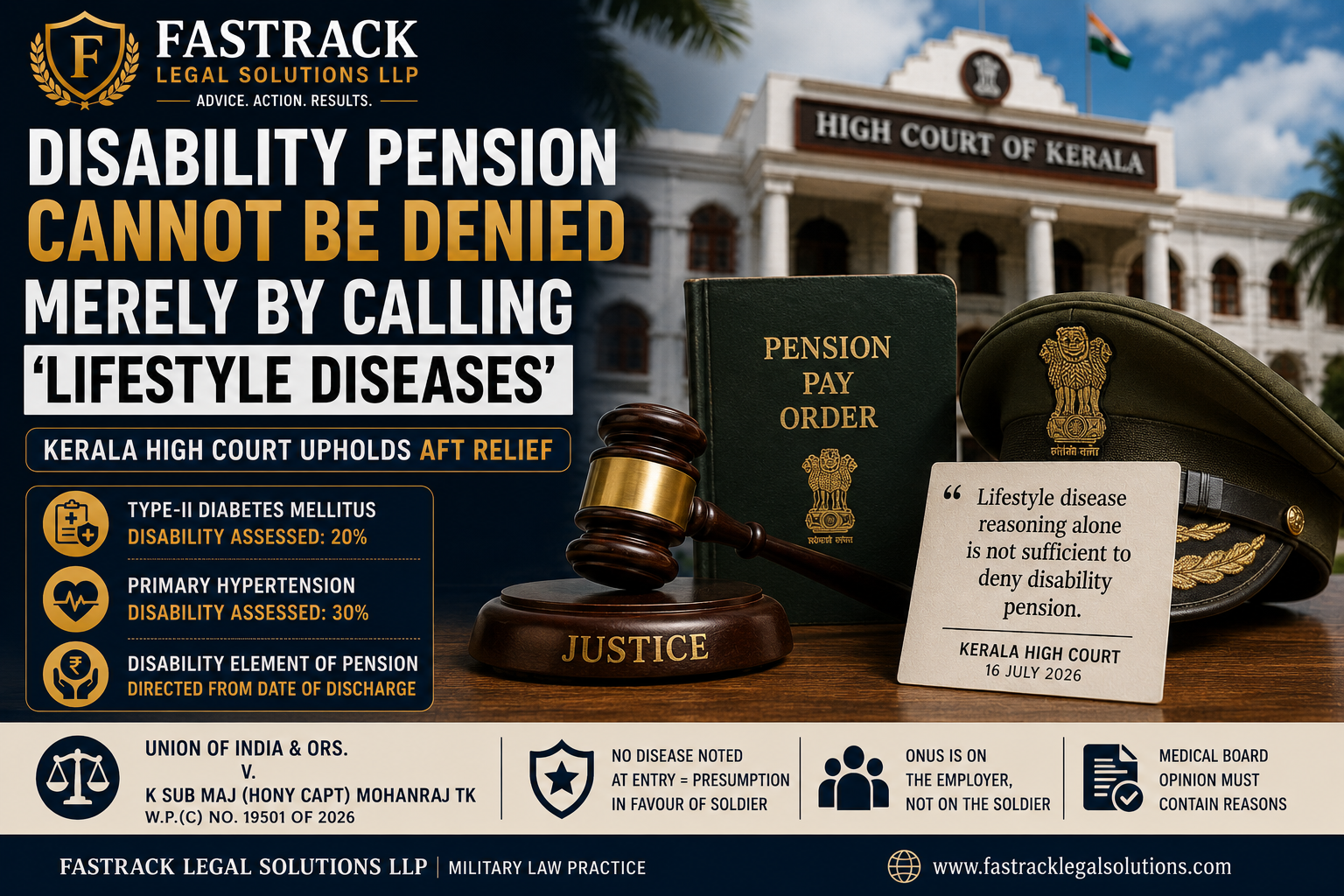
In Union of India v. Mohanraj TK, the Kerala High Court dismissed the Union of India’s writ petition challenging the Armed Forces Tribunal, Kochi’s order granting disability pension-related relief to a retired Subedar Major/Honorary Captain. The Court held that where no disease was recorded at the time of enrolment, the soldier is entitled to statutory presumptions in his favour. The Court further held that merely describing Type-II Diabetes Mellitus and Primary Hypertension as “lifestyle diseases” is not sufficient to deny disability element of pension.
Non-Solicitation Note
This article is for general legal awareness and educational purposes only and may be published by Fastrack Legal Solutions LLP. It is not an advertisement, solicitation, invitation, or inducement for professional engagement. It does not create an advocate-client relationship. Disability pension claims depend on the Release Medical Board, Invaliding Medical Board, service profile, onset of disease, attributability/aggravation opinion, reasons recorded by the Medical Board, appeal orders, AFT record and case-specific facts.
Introduction
The Kerala High Court’s judgment in Union of India v. Mohanraj TK, W.P.(C) No. 19501 of 2026, decided on 16 July 2026, is a significant disability pension decision for armed forces personnel suffering from diseases such as Type-II Diabetes Mellitus and Primary Hypertension.
The judgment is important because the Union of India challenged the Armed Forces Tribunal’s direction granting disability element of pension. The Medical Board had denied attributability and aggravation by recording that the diseases were linked to “lifestyle modification” as per the Guide to Medical Officers. However, the High Court refused to interfere with the AFT’s order and reaffirmed the soldier-friendly presumptions laid down in Dharamvir Singh, Sukhvinder Singh, Bijender Singh and Rajumon T.M.
The Court made one point very clear: a bare medical-board opinion calling the disease a lifestyle disorder is not enough to deny disability pension.
Background of the Case
The respondent, K Sub Maj (Hony Capt) Mohanraj TK, had approached the Armed Forces Tribunal, Regional Bench, Kochi, challenging rejection of his disability pension claim.
The AFT directed the authorities to obtain the composite degree of disability for two invaliding diseases:
- Type-II Diabetes Mellitus assessed at 20%; and
- Primary Hypertension assessed at 30%.
The Tribunal further directed issuance of a Corrigendum PPO granting disability element of pension from the date of discharge, after the composite disability was quantified by a competent Medical Board/authority. The Tribunal also directed payment of arrears within six months, failing which interest at 9% per annum would apply.
The Union of India challenged this order before the Kerala High Court.
Issue Before the Kerala High Court
The central issue was:
Whether the Armed Forces Tribunal was justified in granting disability pension relief despite the Medical Board recording that Type-II Diabetes Mellitus and Primary Hypertension were neither attributable to nor aggravated by military service.
The Union of India argued that the Tribunal should not have interfered with the Medical Board opinion.
The respondent relied on Supreme Court judgments to argue that if no disease was recorded at entry into service, the soldier is presumed to have been in sound physical and mental condition, and subsequent deterioration is presumed to be service-related unless the employer proves otherwise.
What Did the Release Medical Board Say?
The Release Medical Board recorded multiple disabilities. For the two relevant conditions, it stated:
| Disability | Attributable to Service | Aggravated by Service | Medical Board Justification |
|---|---|---|---|
| Type-II Diabetes Mellitus | No | No | Disability denied as attributable/aggravated due to lifestyle modification as per Para 26, Chapter VI, GMO (MP) 2008 |
| Primary Hypertension | No | No | Disability denied as attributable/aggravated due to lifestyle modification as per Para 43, Chapter VI, GMO (MP) 2008 |
The Medical Board therefore rejected attributability/aggravation mainly on the ground that these were lifestyle-related conditions.
Why the High Court Rejected the Union of India’s Case
The High Court found no reason to interfere with the AFT order. The Court relied on four important principles.
1. No Disease Was Recorded at Entry Into Service
The Court noted that it was undisputed that no disease was recorded when the respondent enrolled for military service.
This fact triggered the statutory presumption in favour of the soldier.
Where a person enters service without any recorded disease and later suffers deterioration in health, the law presumes that the disease arose during service unless the authorities prove the contrary with proper reasons and medical basis.
2. Medical Board Must Give Reasons
The Court relied on Rajumon T.M. v. Union of India, where the Supreme Court held that if a Medical Board opinion is devoid of reasons, action based merely on such opinion can be questioned.
This is crucial. A Medical Board cannot simply write “not attributable, not aggravated” and close the matter. It must provide proper reasons, especially where the disease was not recorded at enrolment.
3. “Lifestyle Disease” Is Not Enough
The most important part of the judgment is the Court’s treatment of the “lifestyle disease” defence.
The High Court referred to Rajumon T.M. and held that the mere fact that military service was rendered in peace locations, or that the disease is a lifestyle disorder, is not by itself sufficient to deny attributability to military service.
This directly helps many armed forces personnel whose claims are rejected on standard phrases such as:
- Lifestyle disease.
- Constitutional disease.
- Metabolic disorder.
- Not connected with military service.
- Peace station service.
- No close-time association with field area.
- Due to dietary habits.
- Due to personal lifestyle.
The judgment reinforces that such phrases cannot replace reasoned medical analysis.
4. Disability Pension Law Must Be Interpreted Beneficially
The Court also referred to beneficial interpretation of social-security legislation. Disability pension is not a bounty. It is part of the protective framework for those who serve the armed forces.
The Court observed that soldiers risk their lives for the country, and their morale must be protected. It also noted that Article 33 of the Constitution permits restriction of certain fundamental rights of armed forces personnel for discipline and duty; therefore, the State cannot lightly deny disability pension by merely calling the disease a lifestyle disorder.
Key Legal Principles Applied by the Court
Principle 1: Presumption of Sound Health at Entry
If no disease or disability is recorded at the time of recruitment, the soldier is presumed to have entered service in sound physical and mental condition.
This principle comes from Dharamvir Singh v. Union of India.
Principle 2: Onus Is Not on the Soldier
The soldier does not have to prove that every disease was caused by military service. Once the disease arises during service and there was no entry-time note, the burden shifts to the employer to prove non-entitlement.
Principle 3: Benefit of Doubt Goes to the Soldier
Disability pension law is beneficial in nature. Reasonable doubt must be resolved in favour of the claimant.
Principle 4: Medical Board Opinion Is Not Untouchable
Medical Board opinion has value, but it must be reasoned. If the opinion is mechanical, formulaic, unsupported or contrary to legal presumptions, it can be questioned.
Principle 5: Lifestyle Disease Label Is Not Conclusive
A disease cannot be denied merely because it is commonly described as lifestyle-related. The authorities must still examine service conditions, onset, aggravation, stress, duties, postings and statutory presumptions.
Important Judgments Referred in the Case
1. Dharamvir Singh v. Union of India
The High Court quoted the principles from Dharamvir Singh. The Supreme Court held that where no note of disease is made at entry, deterioration in health is presumed to be due to service. It also held that the onus is not on the claimant; rather, the employer must prove the condition for non-entitlement.
2. Sukhvinder Singh v. Union of India
The Supreme Court held that any disability not recorded at recruitment must be presumed to have been caused subsequently and, unless proved to the contrary, to be a consequence of military service. The High Court relied on this principle to support the respondent’s case.
3. Bijender Singh v. Union of India
The respondent cited Bijender Singh to support the position that armed forces disability pension cases must apply the statutory presumptions and that the burden does not fall unfairly on the soldier.
4. Rajumon T.M. v. Union of India
The High Court relied on Rajumon T.M. for two important propositions:
- A Medical Board opinion without reasons can be questioned.
- Peace-station service or the label of lifestyle disorder is not by itself sufficient to deny attributability.
5. Maniben Maganbhai Bhariya v. District Development Officer
The Court referred to this judgment for the principle that social-security legislation must receive beneficial interpretation.
6. Union of India v. Parashotam Dass
The Court referred to Parashotam Dass while discussing the limits of High Court interference under Article 226 against AFT orders. The Court noted that writ interference is justified for denial of fundamental rights, jurisdictional error, or error apparent on the face of record, but not for correcting every alleged error.
Also Read The Ultimate Guide to Understanding RERA 2023
Why This Judgment Matters for Armed Forces Personnel
This judgment is important because many disability pension claims are rejected through standard Medical Board language. Common rejection phrases include:
- “Lifestyle disease.”
- “Not attributable to military service.”
- “Not aggravated by service.”
- “Onset in peace station.”
- “No close-time association with field service.”
- “Constitutional disorder.”
- “Due to personal habits.”
- “Due to age-related changes.”
The Mohanraj judgment clarifies that such reasoning may not be enough. The authorities must address statutory presumptions and provide proper reasons.
Impact on Diabetes and Hypertension Disability Pension Cases
Diabetes and hypertension cases are often contested because the authorities frequently describe them as lifestyle diseases.
However, service conditions may contribute to or aggravate these conditions through:
- Stress of military duties.
- Irregular working hours.
- Field postings.
- Operational pressure.
- Long separation from family.
- Difficult terrain.
- Sleep disturbance.
- Administrative and command responsibilities.
- Diet limitations in service conditions.
- Cumulative stress over long service.
Therefore, each case must be examined on facts. A generic lifestyle-disease label is insufficient.
What Should Be Checked in Similar Disability Pension Cases?
In similar cases, the following documents should be examined carefully:
- Enrolment medical record.
- Service medical documents.
- First diagnosis record.
- Categorisation medical board proceedings.
- Release Medical Board / Invaliding Medical Board proceedings.
- Part VII opinion of the Medical Board.
- Reasons for denying attributability/aggravation.
- Service profile and postings.
- Field/high-altitude/counter-insurgency/operational tenure.
- Appeal rejection order.
- First appeal and second appeal documents.
- PPO and discharge documents.
- Relevant AFT orders and Supreme Court judgments.
Practical Grounds for Challenging Rejection of Disability Pension
A rejection order may be challenged where:
- No disease was recorded at entry into service.
- Medical Board gave no reasons.
- Medical Board used standard phrases.
- Disease was simply called lifestyle disease.
- Service stress and duties were ignored.
- Statutory presumptions were ignored.
- Appeal order is non-speaking.
- Disability was assessed at 20% or more.
- The soldier was invalided/discharged with disease.
- Composite disability was not properly calculated.
- Broad-banding/rounding off was not granted where applicable.
People Also Ask: Can Diabetes Be Considered for Disability Pension in Armed Forces?
Yes. Diabetes cannot be rejected automatically merely because it is described as a lifestyle disease. If no diabetes was recorded at entry into service, and the Medical Board does not give proper reasons to rebut statutory presumptions, denial of disability pension may be challenged.
People Also Ask: Can Hypertension Be Treated as Aggravated by Military Service?
Yes, depending on facts. Hypertension may be considered attributable to or aggravated by service where statutory presumptions apply and the authorities fail to give adequate reasons for denial. The Mohanraj judgment supports the proposition that calling hypertension a lifestyle disorder is not by itself sufficient.
People Also Ask: Is Medical Board Opinion Final in Disability Pension Cases?
No. Medical Board opinion is important, but it is not final where it is unsupported by reasons, ignores statutory presumptions, or mechanically denies attributability/aggravation. Courts and AFTs can examine whether the opinion is legally sustainable.
People Also Ask: What If No Disease Was Recorded at Recruitment?
If no disease was recorded at recruitment, the soldier is presumed to have been in sound health at entry. If disease develops during service, deterioration is presumed to be due to service unless the employer rebuts the presumption with proper reasons and medical evidence.
The High Court’s Final Decision
The Kerala High Court held that there was no illegality or jurisdictional error in the AFT’s order. It refused to interfere under Article 226 and dismissed the Union of India’s writ petition.
The Court upheld the finding that the respondent was entitled to disability element of pension for the invaliding diseases:
- Type-II Diabetes Mellitus; and
- Primary Hypertension.
The Court also upheld the direction that the composite disability of these diseases should be assessed by a competent Medical Board.
Search-Optimised Quick Answers
What did the Kerala High Court decide in Union of India v. Mohanraj TK?
The Court dismissed the Union of India’s writ petition and upheld AFT relief granting disability element of pension for Type-II Diabetes Mellitus and Primary Hypertension, subject to composite disability assessment.
Can disability pension be denied because diabetes is a lifestyle disease?
Not merely on that ground. The Medical Board must give proper reasons and must address statutory presumptions where no disease was recorded at entry into service.
Can hypertension qualify for disability pension?
Yes, depending on facts. If no hypertension was recorded at enrolment and the authorities fail to rebut statutory presumptions with reasons, denial can be challenged.
Is AFT order easily interfered with by High Court?
No. The High Court observed that Article 226 jurisdiction is extraordinary and is not meant to correct every alleged error in an AFT order.
What is the importance of Rajumon T.M. in disability pension cases?
Rajumon T.M. is important because it holds that Medical Board opinions must contain reasons and that peace posting or lifestyle-disorder reasoning alone is not sufficient to deny attributability.
Frequently Asked Questions
1. What was the Mohanraj TK case about?
It concerned rejection of disability pension for Type-II Diabetes Mellitus and Primary Hypertension. The AFT granted relief, and the Union of India challenged the AFT order before the Kerala High Court.
2. What did the AFT direct?
The AFT directed the authorities to obtain composite disability assessment for Type-II Diabetes Mellitus and Primary Hypertension and issue Corrigendum PPO granting disability element of pension from the date of discharge.
3. What was the Union of India’s argument?
The Union of India argued that the Tribunal should not have interfered with the Medical Board opinion that the disabilities were neither attributable to nor aggravated by military service.
4. What did the Medical Board say?
The Medical Board denied attributability and aggravation for Type-II Diabetes Mellitus and Primary Hypertension by referring to lifestyle modification under the Guide to Medical Officers.
5. Why did the High Court reject the Union’s writ petition?
The Court found that no disease was recorded at entry into service, statutory presumptions applied, and lifestyle-disease reasoning alone was insufficient to deny disability pension.
6. Does this judgment help diabetes pension cases?
Yes. It helps cases where diabetes was not recorded at entry and the Medical Board has denied attributability/aggravation through mechanical lifestyle-disease reasoning.
7. Does this judgment help hypertension pension cases?
Yes. It supports the argument that hypertension cannot be denied merely by labelling it a lifestyle disorder without adequate reasons.
8. Can a Medical Board opinion be challenged?
Yes. A Medical Board opinion can be questioned if it is devoid of reasons, ignores statutory presumptions or relies on generic conclusions.
9. What is the role of Dharamvir Singh?
Dharamvir Singh lays down that a soldier is presumed sound at entry if no disease is recorded, and deterioration during service is presumed service-related unless proved otherwise.
10. What was the final result?
The Kerala High Court dismissed the Union of India’s writ petition and upheld the AFT’s direction in favour of the respondent.
Conclusion
The Kerala High Court’s judgment in Union of India v. Mohanraj TK is a valuable ruling for armed forces disability pension claims involving diabetes, hypertension and similar diseases often rejected as “lifestyle disorders”.
The judgment reinforces that the State cannot deny disability pension through mechanical Medical Board language. If no disease was recorded at entry, statutory presumptions operate in favour of the soldier. The burden lies on the employer to rebut entitlement with proper reasons and medical material.
The decision is especially useful where the Medical Board has merely written “not attributable, not aggravated” or “lifestyle disease” without explaining why service conditions did not cause or aggravate the disease.
For armed forces personnel, the judgment strengthens the argument that disability pension law must be interpreted beneficially, with due regard to military service, morale, statutory presumptions and the requirement of reasoned medical opinion.
Disclaimer
This article is for general legal awareness and educational purposes only and may be published by Fastrack Legal Solutions LLP. It is not an advertisement, solicitation, invitation, or inducement for professional engagement. It does not create an advocate-client relationship. Disability pension cases depend on medical board record, service profile, onset of disease, percentage of disability, attributability/aggravation opinion, appeal orders and individual facts.