
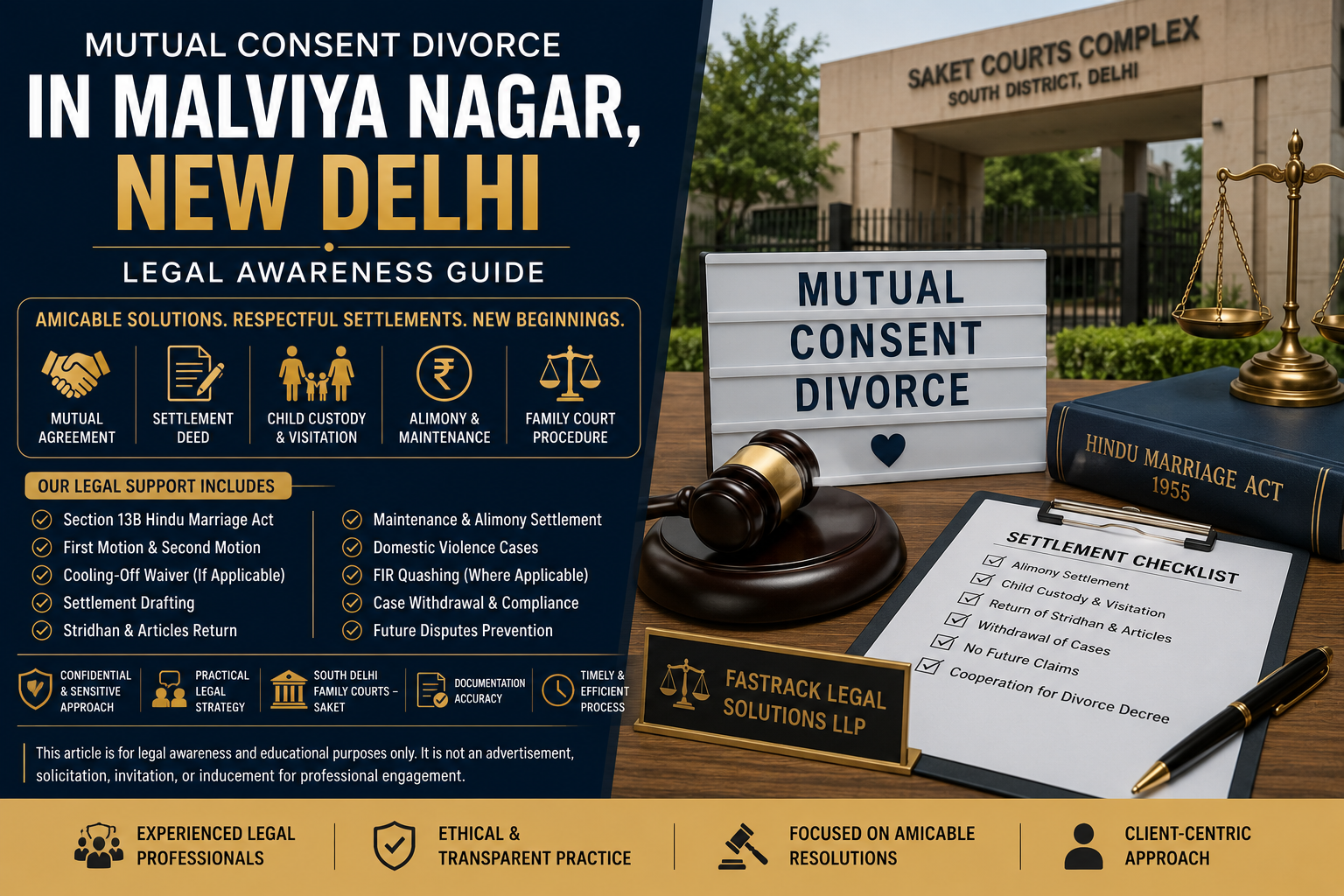
Mutual consent divorce in Malviya Nagar, New Delhi is a court-based process where both spouses jointly agree to dissolve the marriage and settle all issues such as permanent alimony, maintenance, child custody, visitation, return of stridhan/articles, withdrawal of pending cases and future claims. For Hindu marriages, Section 13B of the Hindu Marriage Act, 1955 applies. The correct court is determined by statutory jurisdiction, not merely by the location of the lawyer or residence in Malviya Nagar. For South Delhi matters, Saket Family Court may be relevant where jurisdiction is legally established.
This article is for general legal awareness and educational purposes only. It is not an advertisement, solicitation, invitation, or inducement for professional engagement. It does not claim any guaranteed result, special status, or exclusive expertise. Matrimonial disputes should be evaluated on their facts, documents, jurisdiction and applicable personal law.
Introduction
Mutual consent divorce is generally the least adversarial way to legally dissolve a marriage. It is suitable where both spouses have decided that the marriage cannot continue and are willing to settle all connected disputes.
In areas such as Malviya Nagar, Saket, Hauz Khas, Khirki Extension, Shivalik, Sheikh Sarai, Panchsheel, Green Park and other parts of South Delhi, mutual consent divorce often involves more than a simple joint petition. There may be issues of permanent alimony, child custody, school expenses, visitation, domestic violence proceedings, FIR settlement, return of jewellery, residence, bank accounts, property documents and pending maintenance cases.
A properly drafted mutual consent divorce settlement can prevent future litigation. A vague settlement may create disputes even after the divorce decree.
This article explains the legal process for mutual consent divorce in Malviya Nagar and South Delhi from a neutral, educational perspective.
What is Mutual Consent Divorce?
Mutual consent divorce means both spouses jointly approach the court and state that they have been living separately, are unable to live together, and have mutually agreed that the marriage should be dissolved.
For Hindus, Buddhists, Jains and Sikhs, the relevant provision is Section 13B of the Hindu Marriage Act, 1955.
The process generally involves:
- Settlement between spouses.
- Drafting of settlement deed.
- Filing of first motion petition.
- Recording of statements.
- Cooling-off period or waiver application, where applicable.
- Filing of second motion petition.
- Final confirmation of consent.
- Divorce decree by the court.
A private agreement, notarised document, family settlement or written compromise does not by itself dissolve marriage. A decree from a competent court is necessary.
Essential Conditions for Mutual Consent Divorce
Under Section 13B, the parties must broadly satisfy the following requirements:
- They are legally married.
- They have been living separately for the required statutory period.
- They have not been able to live together.
- They have mutually agreed that the marriage should be dissolved.
- Consent is free, voluntary and continuing.
- The court is satisfied that the statutory requirements are met.
The court does not act as a rubber stamp. It verifies consent, identity, settlement terms and statutory compliance.
People Also Ask: Can a Malviya Nagar Resident File Mutual Consent Divorce at Saket Court?
Possibly, but not automatically. Saket Family Court may be relevant for South Delhi matters where jurisdiction is made out. Jurisdiction depends on statutory factors such as where the marriage was solemnised, where the respondent resides, where the parties last resided together, and in certain cases where the wife resides at the time of filing.
The residence of one spouse in Malviya Nagar may be relevant, but jurisdiction must be legally checked before filing.
Jurisdiction in Mutual Consent Divorce
Jurisdiction is one of the first issues to verify.
Under matrimonial law, jurisdiction may depend on:
- Place where marriage was solemnised.
- Place where respondent resides.
- Place where parties last resided together.
- In certain cases, place where wife resides at the time of filing.
- Other statutory circumstances depending on personal law.
For South Delhi residents, Saket Courts may often arise in the discussion, but the petition should not be filed merely for convenience unless jurisdiction exists.
Filing in the wrong court can cause delay, objection, return of petition or dismissal.
First Motion in Mutual Consent Divorce
The first motion is the first formal stage of mutual consent divorce.
What Happens in First Motion?
- Joint petition is filed.
- Settlement deed is placed on record.
- Documents are filed.
- Parties appear before the Family Court.
- Court verifies identity and consent.
- Statements of both parties are recorded.
- First motion order is passed.
The first motion does not dissolve the marriage. It only records the first stage of mutual consent.
Second Motion in Mutual Consent Divorce
The second motion is the final stage.
What Happens in Second Motion?
- Parties confirm that consent continues.
- Court verifies compliance of settlement terms.
- Balance alimony/payment may be completed as per settlement.
- Statements are recorded.
- Court passes decree of divorce if satisfied.
The marriage is dissolved only after the decree of divorce is passed.
Cooling-Off Period and Waiver
Section 13B contemplates a second motion after the statutory period. However, the Supreme Court has held that the six-month cooling-off period may be waived in appropriate cases.
A waiver application may be considered where:
- Parties have already been separated for sufficient time.
- Settlement is complete.
- Mediation/reconciliation has failed.
- Alimony and maintenance are settled.
- Child custody and visitation are settled.
- Pending proceedings are addressed.
- Waiting further would serve no useful purpose.
The waiver is not automatic. It depends on the facts and judicial satisfaction.
People Also Ask: Can Mutual Consent Divorce Be Completed Quickly?
It can be completed faster where the settlement is complete, documents are proper, both parties cooperate, and the court allows waiver of the cooling-off period. However, no timeline should be assumed without examining court practice, jurisdiction, settlement terms and whether connected cases are pending.
Settlement Deed: The Most Important Document
The settlement deed is the backbone of mutual consent divorce. It should be precise, complete and enforceable.
Essential Terms in Settlement Deed
- Date and place of marriage.
- Details of separation.
- Confirmation that reconciliation is not possible.
- Agreement to dissolve marriage by mutual consent.
- Permanent alimony amount.
- Payment schedule.
- Mode of payment.
- Interim maintenance closure.
- Child custody terms.
- Visitation schedule.
- Education and medical expenses of child.
- Return of stridhan and articles.
- Withdrawal of pending cases.
- Quashing of FIR, if applicable.
- No future claims.
- Cooperation for first and second motion.
- Consequences of breach.
- Confidentiality and non-interference terms, where appropriate.
A one-page settlement is usually inadequate where children, criminal proceedings, maintenance or property issues exist.
Alimony in Mutual Consent Divorce
Alimony in mutual consent divorce is settlement-based. It may be:
- Lump-sum payment.
- Instalment-based payment.
- Monthly maintenance.
- Child-specific support.
- Property-linked settlement.
- No alimony, if both parties freely agree.
The settlement must clearly state whether the amount is towards:
- Permanent alimony.
- Full and final settlement.
- Maintenance.
- Child support.
- Litigation expenses.
- Return of stridhan/articles.
- Any other financial claim.
Payment stages must be carefully drafted. In many matters, payment is linked to first motion, second motion, withdrawal of cases and FIR quashing.
Child Custody and Visitation
Where parties have children, mutual consent divorce should never treat custody as a side issue. The child’s welfare remains paramount.
A proper custody clause should address:
- Permanent custody.
- Visitation rights.
- Weekend access.
- Festival access.
- School holidays.
- Video calls.
- Education expenses.
- Medical expenses.
- Emergency decision-making.
- Passport and travel permission.
- Relocation consent.
- Future modification mechanism.
The court may examine whether the settlement protects the child’s welfare.
Return of Stridhan and Articles
The settlement deed should clearly record whether stridhan and articles have been returned or will be returned at a specific stage.
Items may include:
- Jewellery.
- Cash gifts.
- Wedding articles.
- Household items.
- Personal belongings.
- Bank locker articles.
- Vehicles.
- Documents.
- Electronics.
- Gifts from either side.
Where possible, an annexed article list is safer than vague language such as “all articles settled”.
Pending DV, Maintenance and Criminal Cases
Mutual consent divorce often overlaps with other proceedings.
These may include:
- Domestic Violence Act case.
- Maintenance proceedings.
- FIR under matrimonial allegations.
- CAW Cell complaint.
- Child custody case.
- Civil suit or injunction.
- Execution proceedings.
- Transfer petition.
The settlement deed should specify:
- Which cases will be withdrawn.
- Who will file withdrawal applications.
- Stage at which withdrawal will happen.
- Whether High Court quashing is required.
- Whether payment is linked to withdrawal/quashing.
- Consequences if one party fails to cooperate.
A divorce decree does not automatically quash an FIR. FIR quashing usually requires separate legal proceedings before the High Court where legally maintainable.
People Also Ask: Can Mutual Consent Divorce Close a 498A FIR?
A mutual consent divorce decree does not automatically close a criminal FIR. If a matrimonial FIR has been registered, the parties may need to approach the High Court for quashing on the basis of settlement, depending on the offences and facts. The settlement deed should clearly mention cooperation for quashing.
Documents Required for Mutual Consent Divorce
Basic Documents
- Marriage certificate, if available.
- Wedding photographs.
- Marriage invitation card.
- Identity proof of both parties.
- Address proof of both parties.
- Passport-size photographs.
- Proof of separate residence, where available.
Settlement Documents
- Settlement deed.
- Payment proof.
- Demand draft/cheque details, if applicable.
- List of articles/stridhan.
- No-claim undertakings.
- Case withdrawal schedule.
Child-Related Documents
- Child birth certificate.
- School details.
- Education expense records.
- Medical records, if relevant.
- Custody and visitation terms.
Pending Case Documents
- DV Act case papers.
- Maintenance case papers.
- FIR copy.
- CAW Cell complaint.
- Previous court orders.
- Mediation settlement, if any.
- Bail or protection orders, where relevant.
NRI or Outstation Mutual Consent Divorce
If one spouse is outside Delhi, outside India, or unable to attend physically, additional issues arise.
These may include:
- Video conferencing permission.
- Power of attorney.
- Embassy/consulate attestation.
- Apostille, where applicable.
- Foreign address proof.
- Travel and appearance planning.
- Recognition of Indian divorce abroad.
- Foreign court proceedings, if any.
Virtual appearance depends on court practice and judicial permission. It should not be assumed as an automatic right.
People Also Ask: Can Mutual Consent Divorce Be Done Online?
Some courts may permit video-conferencing appearance in appropriate circumstances, especially where one party is abroad or unable to travel. However, the petition, settlement deed, identity verification and court permission must be proper. The practice depends on the court and facts.
Common Mistakes in Mutual Consent Divorce
- Signing vague settlement deed.
- Not mentioning pending cases.
- Not linking payment stages clearly.
- Ignoring FIR quashing requirement.
- Leaving child custody vague.
- Not listing stridhan/articles.
- Filing in wrong jurisdiction.
- Assuming first motion is final divorce.
- Making cash payments without proof.
- Not recording no-future-claim terms properly.
- Not dealing with maintenance arrears.
- Not dealing with school fees and medical expenses of child.
These mistakes can lead to avoidable future disputes.
How to Prepare Before Filing
Before filing mutual consent divorce, parties should prepare a written checklist:
- Have both parties agreed to divorce?
- Is jurisdiction clear?
- Is settlement complete?
- Is alimony finalised?
- Are payment stages clear?
- Are children’s issues settled?
- Are pending cases identified?
- Is FIR quashing required?
- Are articles returned or listed?
- Are all documents available?
A carefully prepared file reduces court objections and settlement disputes.
Quick Answers
What is mutual consent divorce in Malviya Nagar?
It is a joint divorce process where both spouses agree to dissolve marriage and settle all connected issues. For South Delhi jurisdiction, Saket Family Court may be relevant where legally made out.
Is court decree necessary for mutual consent divorce?
Yes. A private agreement or notarised document does not dissolve marriage. Divorce requires a decree from a competent court.
What is the first motion?
First motion is the first stage where the joint petition is filed and the court records statements of both parties.
What is the second motion?
Second motion is the final stage where parties confirm continuing consent and the court may pass the decree of divorce.
Can cooling-off period be waived?
Yes, in suitable cases, if the court is satisfied that statutory conditions are met and further waiting serves no useful purpose.
Frequently Asked Questions
1. Is this article an advertisement for mutual consent divorce services?
No. This article is for legal awareness only. It does not solicit work or claim guaranteed results.
2. Can mutual consent divorce be filed from Malviya Nagar?
It may be filed before the competent court if jurisdiction is made out. Malviya Nagar residence may be relevant, but jurisdiction depends on statutory factors.
3. Which court is relevant for South Delhi mutual consent divorce?
Saket Family Court may be relevant for South Delhi matters where jurisdiction exists. Filing must be based on law, not convenience alone.
4. What is Section 13B Hindu Marriage Act?
Section 13B provides for divorce by mutual consent where parties have lived separately for the required period, cannot live together and mutually agree to dissolve the marriage.
5. Is settlement deed required?
A settlement deed is strongly advisable because it records alimony, custody, visitation, return of articles, withdrawal of cases and no-future-claim terms.
6. Can one party withdraw consent?
Consent must continue until the decree. If one party withdraws consent before final decree, the matter may not proceed as mutual consent divorce unless legally resolved.
7. Can mutual consent divorce settle maintenance?
Yes. The settlement can include interim maintenance, permanent alimony, arrears, future claims and child support.
8. Can mutual consent divorce settle child custody?
Yes. Parties can agree on custody and visitation, but the court will consider the welfare of the child.
9. Can a 498A FIR be quashed through divorce petition?
No. FIR quashing generally requires separate High Court proceedings, though the mutual consent settlement may form the basis for quashing.
10. What documents are required?
Marriage proof, identity/address proof, photographs, settlement deed, child documents, pending case papers, payment proof and article list are commonly required.
Conclusion
Mutual consent divorce is a structured legal process, not merely a private agreement. For parties in Malviya Nagar and South Delhi, the important issues are jurisdiction, settlement clarity, alimony, custody, return of articles, pending cases and court procedure.
The strongest mutual consent divorce settlement is one where every issue is recorded clearly before filing. Ambiguity in settlement often becomes future litigation.
A proper mutual consent divorce petition should therefore be supported by a complete settlement deed, correct documents, clear jurisdiction and a realistic plan for withdrawal or quashing of connected proceedings.
Disclaimer
This article is for general legal awareness and educational purposes only and may be published by Fastrack Legal Solutions LLP. It is not an advertisement, solicitation, invitation, or inducement for professional engagement. It does not create an advocate-client relationship. Mutual consent divorce depends on personal law, jurisdiction, consent, settlement terms, pending proceedings, child welfare, financial disclosure and court practice.