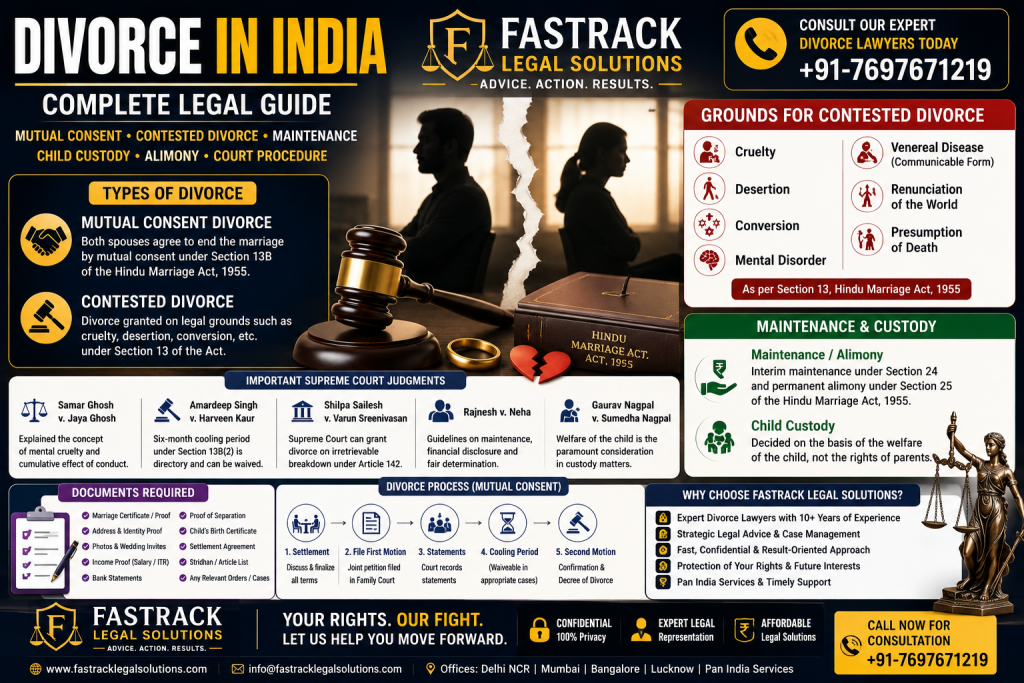
Divorce in India may be obtained either by mutual consent or through a contested divorce petition depending on the personal law applicable to the parties. Under the Hindu Marriage Act, 1955, contested divorce grounds include cruelty, desertion, conversion, mental disorder, communicable venereal disease, renunciation and presumption of death, while Section 13B provides divorce by mutual consent where parties have lived separately for one year or more, cannot live together, and mutually agree to dissolve the marriage. Divorce petitions are generally filed before the competent Family Court having jurisdiction.
Introduction
Divorce is not merely the end of a marriage. It is a legal process that may involve dissolution of marital status, permanent alimony, interim maintenance, child custody and visitation, return of articles, criminal case settlement, domestic violence proceedings, property issues, and sometimes transfer of cases between courts.
In India, divorce law is governed by the personal law applicable to the parties, along with procedural law and Family Court practice. For Hindus, Buddhists, Jains and Sikhs, the main statute is the Hindu Marriage Act, 1955. For inter-faith or civil marriages, the Special Marriage Act, 1954 may apply. Christians, Parsis and Muslims have separate personal-law frameworks, while maintenance, domestic violence and custody remedies may arise under secular statutes.
This article explains divorce in India in a practical, search-friendly and litigation-focused manner: what grounds are available, how mutual consent divorce works, how contested divorce is filed, what documents are required, how maintenance and custody are decided, and what mistakes parties should avoid. For representation across connected proceedings, see our Divorce & Matrimonial Disputes service page.
Types of Divorce in India
There are two broad types of divorce:
1. Mutual Consent Divorce
Mutual consent divorce is where both spouses agree to end the marriage and settle all terms. Under Section 13B of the Hindu Marriage Act, both parties may jointly present a petition for dissolution of marriage if they have been living separately for one year or more, have not been able to live together, and have mutually agreed that the marriage should be dissolved.
Mutual consent divorce usually covers:
- Permanent alimony or full-and-final settlement.
- Child custody and visitation.
- Return of stridhan, jewellery and articles.
- Withdrawal or quashing of criminal cases, where applicable.
- Domestic violence case settlement.
- Maintenance case closure.
- Property or residence settlement.
- No-future-claim clauses.
2. Contested Divorce
Contested divorce is filed by one spouse against the other when there is no mutual agreement. Under the Hindu Marriage Act, divorce may be sought on statutory grounds such as cruelty, desertion, conversion, mental disorder, venereal disease in communicable form, renunciation of the world, or presumption of death, subject to the statutory language and facts.
A contested divorce requires pleadings, evidence, cross-examination and final arguments. It is slower than mutual consent divorce and may run parallel with maintenance, custody, domestic violence or criminal proceedings.
Which Court Handles Divorce Cases?
Divorce cases are generally handled by the Family Court where a Family Court has been established. The Family Courts Act, 1984 provides for Family Courts and contains jurisdiction and procedure provisions, including jurisdiction in matrimonial and family disputes.
Under the Hindu Marriage Act, jurisdiction is also governed by Section 19, which deals with the court to which a matrimonial petition may be presented. The proper forum may depend on where the marriage was solemnised, where parties last resided together, where the respondent resides, and in certain circumstances where the petitioner resides.
People Also Ask: Can Divorce Be Filed Within One Year of Marriage?
Generally, under Section 14 of the Hindu Marriage Act, no divorce petition can be presented within one year of marriage. However, the court may permit presentation within one year in cases of exceptional hardship to the petitioner or exceptional depravity on the part of the respondent.
This means that a normal divorce petition filed immediately after marriage may face a maintainability objection unless the statutory exception is properly pleaded and supported.
Grounds for Contested Divorce in India
1. Divorce on Ground of Cruelty
Cruelty is one of the most commonly invoked divorce grounds. It may be physical or mental. Mental cruelty is often harder to plead and prove because it depends on the cumulative impact of conduct.
The Supreme Court in Samar Ghosh v. Jaya Ghosh explained that mental cruelty cannot be put into a rigid formula and depends on the facts, conduct, social background, relationship dynamics and cumulative circumstances of the marriage.
Examples of conduct that may support cruelty, depending on evidence, include:
- Repeated humiliation.
- False criminal complaints.
- Serious defamatory allegations.
- Denial of basic marital companionship.
- Sustained verbal abuse.
- Public scandalising of spouse.
- Threats and intimidation.
- Persistent refusal to cohabit without justification.
- Alienation from family without cause.
- Litigation used as harassment.
Cruelty pleadings must be specific. Vague allegations such as “the respondent treated me badly” are weak. Dates, events, messages, witnesses, complaints and circumstances should be pleaded.
2. Divorce on Ground of Desertion
Desertion means abandonment of one spouse by the other without reasonable cause and with intention to end cohabitation permanently. It is not mere physical separation. The classic Supreme Court formulation in Bipinchandra Jaisinghbai Shah v. Prabhavati requires both factum of separation and animus deserendi, meaning intention to desert.
A strong desertion case should plead:
- When the respondent left.
- Whether leaving was without reasonable cause.
- Whether the petitioner made efforts to resume cohabitation.
- Whether the respondent refused to return.
- Whether statutory period is complete.
- Whether there was intention to permanently abandon the marriage.
3. Divorce by Mutual Consent
Under Section 13B of the Hindu Marriage Act, parties must show that they have lived separately for one year or more, cannot live together, and mutually agree that marriage should be dissolved.
Mutual consent divorce normally has two stages:
- First motion: joint petition, statements and settlement terms.
- Second motion: confirmation after statutory waiting period, unless waived.
The Supreme Court in Amardeep Singh v. Harveen Kaur held that the six-month period under Section 13B(2) is directory and may be waived in appropriate cases where statutory conditions are satisfied and reconciliation is not possible.
A waiver application should clearly show:
- Separation is complete.
- Settlement is final.
- Alimony issues are resolved.
- Child custody and visitation are settled.
- There is no chance of reconciliation.
- Waiting will only prolong hardship.
4. Divorce on Irretrievable Breakdown of Marriage
“Irretrievable breakdown of marriage” is not a standalone statutory ground for divorce under the Hindu Marriage Act before the Family Court. However, the Supreme Court in Shilpa Sailesh v. Varun Sreenivasan held that the Supreme Court may dissolve a marriage under Article 142 of the Constitution on the ground of irretrievable breakdown in appropriate cases.
This distinction is important. A Family Court cannot simply grant divorce only because the marriage has broken down unless a statutory ground is made out. However, long separation and complete collapse of marital relationship may support cruelty, settlement or Supreme Court Article 142 relief depending on facts.
People Also Ask: What is the Fastest Way to Get Divorce in India?
The fastest lawful route is usually mutual consent divorce, provided both spouses agree on all issues including alimony, child custody, return of articles and withdrawal of cases. Where the requirements are satisfied, parties may seek waiver of the six-month cooling-off period under the principles laid down in Amardeep Singh v. Harveen Kaur.
Contested divorce is not fast because it requires pleadings, reply, evidence, cross-examination and final arguments.
People Also Ask: What Documents Are Required for Divorce?
The usual documents include:
- Marriage certificate, if available.
- Wedding photographs or proof of marriage.
- Address proof of parties.
- Identity proof of parties.
- Proof of separation.
- Income proof for maintenance issues.
- Child documents, if custody is involved.
- Settlement agreement, in mutual consent cases.
- Evidence of cruelty/desertion, in contested cases.
- FIR, DV Act case, maintenance orders, mediation records, if relevant.
- Bank statements, salary slips, ITRs and asset details for alimony/maintenance.
For mutual consent divorce, the settlement deed is critical. It should be precise and enforceable.
Maintenance and Alimony in Divorce Cases
Maintenance and alimony may arise during divorce proceedings and after divorce. Under the Hindu Marriage Act, Section 24 deals with maintenance pendente lite and litigation expenses, while Section 25 deals with permanent alimony and maintenance. The Hindu Marriage Act contains these provisions within the matrimonial relief framework.
The Supreme Court in Rajnesh v. Neha issued detailed guidelines on maintenance, including financial disclosure, overlapping remedies, date from which maintenance should ordinarily be awarded, and enforcement mechanisms.
Factors considered in maintenance may include:
- Income of both parties.
- Standard of living during marriage.
- Needs of wife/husband claiming maintenance.
- Child expenses.
- Liabilities.
- Assets and lifestyle.
- Earning capacity.
- Conduct, where legally relevant.
- Existing maintenance orders.
- Medical and educational expenses.
Maintenance is not meant to be punitive. It is meant to prevent financial hardship and ensure reasonable support based on facts.
Child Custody in Divorce
Child custody and visitation is decided on the principle of welfare of the child, not the legal entitlement or ego of either parent. The Supreme Court in Gaurav Nagpal v. Sumedha Nagpal reiterated that the welfare of the minor is the paramount consideration in custody disputes.
Courts may consider:
- Age of the child.
- Emotional bond with each parent.
- Education.
- Health.
- Stability of home environment.
- Parent’s availability.
- Child’s preference, depending on age and maturity.
- Risk of parental alienation.
- Safety and welfare.
- Overall best interest.
Custody litigation should not be drafted as a character assassination contest. The stronger approach is to show how the proposed custody or visitation arrangement serves the child’s welfare.
Transfer of Divorce Cases
Transfer petitions are common in matrimonial disputes, especially where one spouse files proceedings in a distant court. The Supreme Court in N.C.V. Aishwarya v. A.S. Saravana Karthik Sha recognised that in matrimonial transfer matters, the convenience of the wife is generally an important factor, though each case depends on facts.
Relevant factors in transfer may include:
- Distance between courts.
- Financial hardship.
- Child-care responsibility.
- Medical condition.
- Safety concerns.
- Multiple connected proceedings.
- Access to justice.
- Whether video conferencing can reduce hardship.
Procedure for Mutual Consent Divorce
Step 1: Settlement Discussion
Parties settle all terms, including alimony, articles, children, pending cases and future claims.
Step 2: Draft Settlement Deed
The settlement deed should cover:
- Full-and-final alimony.
- Mode and stage of payment.
- Child custody and visitation.
- Return of stridhan and belongings.
- Withdrawal/quashing of cases.
- No future claims.
- Cooperation for first and second motion.
- Consequences of breach.
Step 3: File First Motion
Joint petition is filed before the competent Family Court.
Step 4: Statements of Parties
Court records statements and verifies consent.
Step 5: Cooling-Off Period / Waiver
If appropriate, parties may file waiver application relying on Amardeep Singh.
Step 6: Second Motion and Decree
If parties confirm consent, court may pass decree of divorce.
Procedure for Contested Divorce
Step 1: Legal Notice / Pre-Litigation Strategy
A legal notice may be issued in some cases, though not mandatory in every divorce matter.
Step 2: Filing Divorce Petition
The petition must plead statutory ground, facts, jurisdiction and reliefs.
Step 3: Notice to Respondent
The court issues notice to the other spouse.
Step 4: Written Statement
The respondent files reply, denying or admitting allegations and raising defences.
Step 5: Interim Applications
Common interim applications include maintenance, litigation expenses, child visitation, injunction, residence-related relief, or production of documents.
Step 6: Evidence
Petitioner and respondent lead evidence by affidavit and cross-examination.
Step 7: Final Arguments
The court decides whether statutory grounds are proved.
Step 8: Decree
The court may grant or dismiss divorce. Appeals may lie as per applicable law.
Do’s in Divorce Cases
- Preserve evidence from the beginning.
- Avoid vague pleadings.
- Keep financial records ready.
- Do not exaggerate allegations.
- Keep child welfare separate from marital bitterness.
- Record settlement terms clearly.
- Disclose income honestly in maintenance cases.
- Avoid social media posts about the dispute.
- Use mediation strategically.
- Take legal advice before signing any settlement.
Don’ts in Divorce Cases
- Do not file false allegations.
- Do not hide income or assets.
- Do not use children as pressure tools.
- Do not sign vague settlement papers.
- Do not agree to oral alimony terms.
- Do not delay compliance with court orders.
- Do not threaten criminal cases during settlement.
- Do not ignore jurisdiction objections.
- Do not file divorce on irretrievable breakdown alone before Family Court.
- Do not treat mutual consent divorce as complete until decree is passed.
Search-Optimised Quick Answers
What is divorce in India?
Divorce is the legal dissolution of marriage by a competent court under the personal law applicable to the parties.
What are the two main types of divorce?
The two main types are mutual consent divorce and contested divorce.
How long does mutual consent divorce take?
It depends on the court and whether cooling-off period is waived. Section 13B provides a statutory framework, and the Supreme Court has held that the six-month period may be waived in appropriate cases.
Can wife and husband both claim maintenance?
Depending on law and facts, either spouse may claim maintenance if statutory requirements are satisfied. Under the Hindu Marriage Act, Sections 24 and 25 are not restricted only to wives.
Can divorce be granted without both parties agreeing?
Yes. That is contested divorce. The petitioner must prove a statutory ground such as cruelty, desertion or another ground recognised under the applicable law.
Also Read Decoding Divorce: Navigating Family Law in South Delhi
Frequently Asked Questions
1. How can I get divorce in India?
You can seek divorce either by mutual consent or by filing a contested divorce petition on a recognised statutory ground before the competent Family Court.
2. What is mutual consent divorce?
Mutual consent divorce is a joint petition by both spouses agreeing that they have lived separately for one year or more, cannot live together, and mutually want dissolution of marriage under Section 13B of the Hindu Marriage Act.
3. What are the grounds for contested divorce?
Under the Hindu Marriage Act, grounds include cruelty, desertion, conversion, mental disorder, venereal disease in communicable form, renunciation and presumption of death, subject to statutory wording and proof.
4. Can divorce be filed before one year of marriage?
Generally no. Section 14 bars divorce petitions within one year of marriage, except where the court permits filing on grounds such as exceptional hardship or exceptional depravity.
5. Can the six-month cooling-off period be waived?
Yes. The Supreme Court in Amardeep Singh v. Harveen Kaur held that the six-month period under Section 13B(2) is directory and can be waived in suitable cases.
6. Is irretrievable breakdown a ground for divorce?
Before Family Courts, irretrievable breakdown is generally not a standalone statutory ground under the Hindu Marriage Act. The Supreme Court may dissolve marriage under Article 142 in appropriate cases, as explained in Shilpa Sailesh v. Varun Sreenivasan.
7. How is maintenance decided in divorce cases?
Maintenance is decided based on income, expenses, standard of living, liabilities, child expenses and financial capacity. Rajnesh v. Neha provides important Supreme Court guidelines on maintenance and disclosure.
8. Who gets child custody after divorce?
There is no automatic rule. The court decides custody based on the welfare of the child, which is the paramount consideration.
9. Can divorce cases be transferred?
Yes. Matrimonial cases can be transferred in appropriate cases. In transfer matters, courts often consider convenience, hardship, child-care responsibilities and access to justice.
10. Is a notarised divorce valid?
No. Divorce requires a decree from a competent court. A private, notarised or informal separation document does not dissolve marriage.
Conclusion
Divorce in India must be handled with legal precision. Mutual consent divorce is the cleaner route where settlement is possible. Contested divorce requires proof of statutory grounds such as cruelty or desertion. Maintenance, custody, alimony, return of articles, domestic violence proceedings and criminal complaints must be integrated into the strategy from the beginning.
The strongest divorce cases are built on clear facts, proper jurisdiction, documentary evidence, careful pleadings and realistic reliefs. Emotional allegations alone do not win matrimonial litigation. Legal structure does.
Disclaimer
This article is intended for general legal awareness and educational purposes only. It does not constitute legal advice, solicitation, advertisement or creation of an advocate-client relationship. Divorce proceedings depend on personal law, facts, jurisdiction, evidence, settlement terms, children’s welfare, income disclosure, pending cases and court practice.