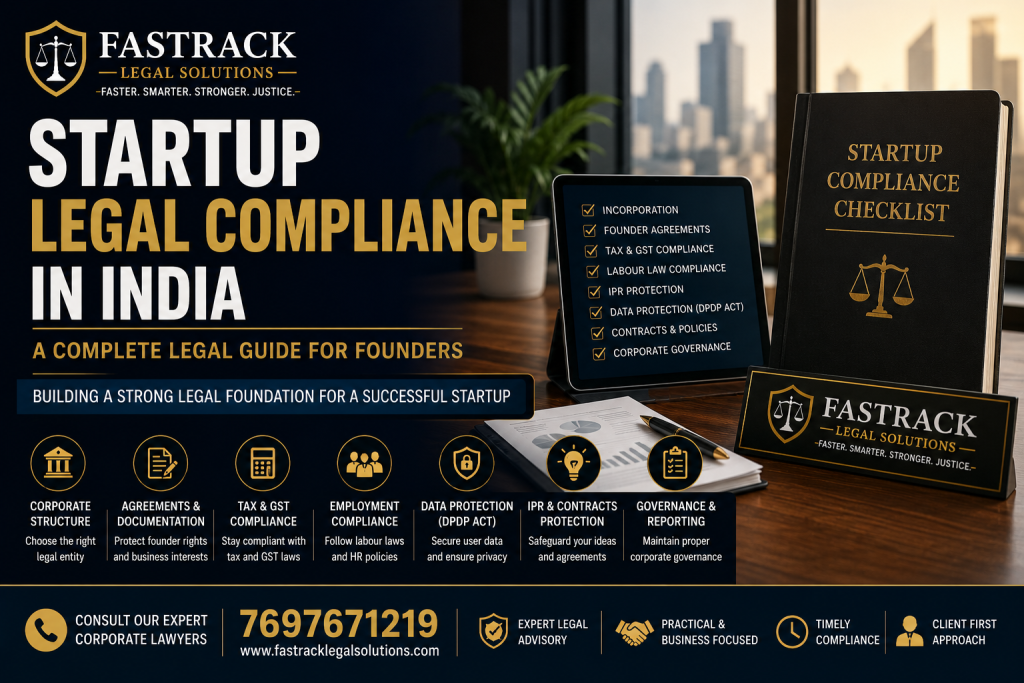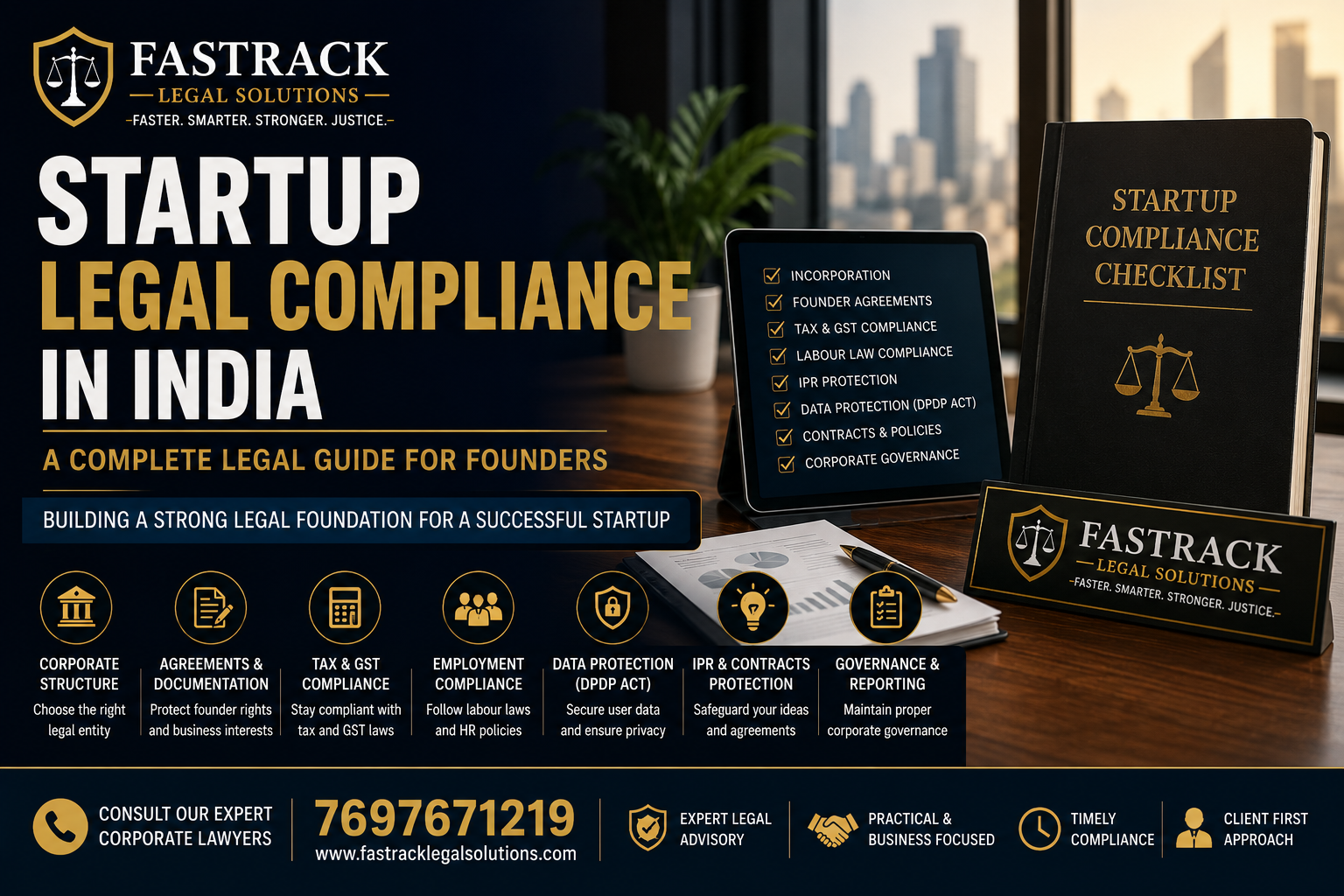
Startup legal compliance in India begins with choosing the correct business structure, completing incorporation, maintaining statutory registers, executing founder and shareholder agreements, protecting intellectual property, complying with tax and GST law, following labour and HR requirements, and ensuring data protection compliance. Startups seeking government recognition must also examine the DPIIT recognition framework, which was revised in 2026 to raise the general startup turnover eligibility limit to ₹200 crore, with separate enhanced criteria for deep-tech startups.
Introduction
A startup is not legally protected merely because it has an innovative idea, a website, an app, investor interest or early revenue. In Indian law, a startup becomes commercially credible only when its legal foundation is clean: proper entity formation, clear founder rights, enforceable contracts, statutory compliance, tax discipline, employment documentation, intellectual property protection and data governance.
For founders, legal compliance is often treated as a later-stage formality. That is a serious mistake. Most startup disputes arise not because the business idea failed, but because the legal architecture was weak at the beginning. Common problems include unclear founder equity, no vesting, undocumented loans, unpaid statutory dues, informal employee arrangements, copied software/IP, missing privacy documentation, defective investor paperwork and poor ROC filings.
This article provides a practical legal compliance guide for Indian startups, covering incorporation, DPIIT recognition, corporate governance, taxation, GST, employment law, contracts, intellectual property, data protection, funding readiness and founder protection.
Why Legal Compliance Matters for Startups
Legal compliance serves four core purposes.
First, it protects founders from personal, contractual, tax and regulatory exposure. Secondly, it makes the startup investor-ready. Thirdly, it reduces disputes between founders, employees, vendors and customers. Fourthly, it creates a clean legal record for due diligence during fundraising, acquisition, lending or strategic partnerships.
A startup with good compliance is easier to fund, scale, sell and defend. A startup with poor compliance may survive in the early stage, but it usually suffers during investment due diligence, bank scrutiny, tax assessment, employee dispute, IP claim or founder exit.
Choosing the Right Legal Structure
The first decision is the legal structure. The common options are:
| Structure | Suitable For | Key Legal Position |
|---|---|---|
| Sole Proprietorship | Very small individual business | No separate legal personality |
| Partnership Firm | Small founder-led businesses | Partners may have personal liability |
| LLP | Professional services, lean businesses | Separate legal entity with limited liability |
| Private Limited Company | Scalable startups, funding, ESOPs, investors | Most preferred for venture-backed startups |
| One Person Company | Solo founder structure | Separate legal personality, but limited scalability |
For most scalable startups, a private limited company is the preferred structure because it supports equity issuance, investor participation, ESOPs, share transfers, preference shares, governance rights and structured exits.
However, an LLP may be better for professional services, consulting, small bootstrapped businesses and ventures where external equity investment is not immediately expected.
Incorporation Compliance
A startup incorporated as a private limited company must complete basic incorporation and post-incorporation compliances. These generally include:
- Name approval.
- Digital Signature Certificates.
- Director Identification Numbers.
- Memorandum of Association.
- Articles of Association.
- Certificate of Incorporation.
- PAN and TAN.
- Registered office compliance.
- First board meeting.
- Appointment of auditor.
- Issue of share certificates.
- Maintenance of statutory registers.
- Opening of bank account.
- Accounting and bookkeeping setup.
Incorporation should not be done with generic constitutional documents if the startup is expected to raise investment. The Articles of Association should be capable of aligning with a future shareholders agreement, investment rights, share transfer restrictions and founder vesting.
DPIIT Startup Recognition
DPIIT recognition under the Startup India framework can be important for eligible startups because it may support access to government benefits, certain tax incentives, public procurement relaxations and ecosystem credibility.
The Government of India revised the startup recognition framework in February 2026. The Press Information Bureau records that the turnover limit for recognition as a startup was increased from ₹100 crore to ₹200 crore. It also records a dedicated deep-tech startup category, with the age limit extended to 20 years and turnover limit enhanced to ₹300 crore for deep-tech startups.
A founder should not assume DPIIT recognition automatically gives all tax exemptions. DPIIT recognition and income-tax exemption under Section 80-IAC are connected but distinct compliance steps.
Section 80-IAC Tax Exemption
Eligible startups may apply for income-tax exemption under Section 80-IAC of the Income-tax Act. Startup India’s official 80-IAC page describes the benefit as a 100% tax deduction for three consecutive financial years within the first ten years of incorporation, subject to eligibility and approval.
The application generally requires proper records, audited financial statements where applicable, formation declarations and confirmation that the startup was not formed by splitting up or reconstructing an existing business, except where legally permitted. Startup India’s 80-IAC materials expressly require declarations on formation, splitting up/reconstruction and transfer of previously used plant or machinery.
For founders, the practical point is simple: do not treat startup tax exemption as automatic. It requires eligibility analysis, proper documentation and careful application.
Founder Agreement
A founder agreement is one of the most important documents in a startup. Many startups fail not because of market conditions, but because of founder disputes.
A founder agreement should cover:
- Founder roles and responsibilities.
- Equity ownership.
- Vesting schedule.
- Cliff period.
- Founder exit.
- Good leaver and bad leaver consequences.
- IP assignment to company.
- Confidentiality.
- Non-solicitation.
- Non-compete, to the extent legally enforceable.
- Deadlock resolution.
- Reserved matters.
- Decision-making rights.
- Dispute resolution.
- Consequences of fraud, misconduct or abandonment.
A founder who receives full equity on day one and leaves after six months can seriously damage the startup. Vesting protects the company from this risk.
Shareholders Agreement
A shareholders agreement becomes important when there are multiple founders, investors, strategic partners or employee shareholders.
A strong shareholders agreement should include:
- Shareholding structure.
- Rights and obligations of shareholders.
- Transfer restrictions.
- Right of first refusal.
- Right of first offer.
- Tag-along rights.
- Drag-along rights.
- Reserved matters.
- Anti-dilution protection, where applicable.
- Investor information rights.
- Board composition.
- Exit rights.
- Deadlock resolution.
- Confidentiality.
- Dispute resolution.
The shareholders agreement should align with the Articles of Association. If the Articles do not reflect key shareholder rights, enforceability issues may arise.
ROC and Companies Act Compliance
Private limited companies must maintain regular corporate compliance. This is not optional merely because the company is small, bootstrapped or loss-making.
Key ROC and Companies Act compliances include:
- Board meetings.
- Annual General Meeting, where applicable.
- Maintenance of minutes.
- Statutory registers.
- Auditor appointment.
- Financial statement filing.
- Annual return filing.
- Disclosure of director interests.
- Share allotment filings.
- Charge registration, if loans are secured.
- Event-based filings for change in directors, registered office, share capital or company structure.
Under the Companies Act, 2013, Section 92 requires every company to file its annual return with the Registrar within 60 days from the date on which the annual general meeting is held, or where no AGM is held, within the prescribed period from the date on which the AGM should have been held.
Section 137 deals with filing financial statements with the Registrar. In ordinary practice, financial statements are filed through Form AOC-4 within the statutory timeline linked to the AGM.
Accounting, Audit and Tax Compliance
Startups must maintain proper books of account from the beginning. Informal accounting is dangerous, particularly where there are founder contributions, angel investments, loans, revenue invoices, vendor payments, employee reimbursements and software subscriptions.
Important tax and accounting compliances include:
- Books of account.
- Income-tax return filing.
- Tax audit, where applicable.
- TDS deduction and deposit.
- TDS returns.
- Advance tax, where applicable.
- GST registration and returns, where applicable.
- Professional tax, where applicable.
- Proper invoicing.
- Expense documentation.
- Related-party documentation.
- Maintenance of bank and ledger records.
The CBIC GST FAQ states that a person may be liable for GST registration where aggregate turnover exceeds the prescribed threshold or where the person is engaged in inter-State supplies, subject to applicable exemptions and category-specific rules.
Startups should not wait for a tax notice before regularising GST, TDS or accounting records.
GST Compliance
GST compliance depends on the nature of supply, turnover, state, inter-State transactions, e-commerce activity, export of services, reverse charge, marketplace structure and nature of goods or services.
Startup GST compliance usually involves:
- Determining whether GST registration is required.
- Correct HSN/SAC classification.
- Tax invoice format.
- GST return filing.
- Input tax credit reconciliation.
- Reverse charge compliance.
- Export documentation, if applicable.
- LUT for export of services, where applicable.
- Marketplace/e-commerce compliance.
- Vendor GST verification.
A SaaS startup, marketplace startup, D2C brand, consultancy startup and ed-tech platform may all have different GST issues. GST planning should be done before invoices begin, not after notices arrive.
Labour and Employment Law Compliance
Even early-stage startups must treat employment documentation seriously. Informal hiring creates future disputes around salary, termination, confidentiality, IP ownership, notice period, incentives and misconduct.
Basic employment documents should include:
- Offer letter.
- Employment agreement.
- Consultant agreement, where applicable.
- Internship agreement.
- Confidentiality agreement.
- IP assignment clause.
- Device and data policy.
- Leave policy.
- POSH policy, where applicable.
- Termination and notice period clauses.
- Code of conduct.
- Work-from-home policy.
- Payroll records.
PF, ESI, gratuity, bonus, shops and establishments registration, professional tax and labour welfare fund obligations depend on employee strength, wage thresholds, state law and nature of establishment. A startup should review these obligations before scaling hiring.
POSH Compliance
The Sexual Harassment of Women at Workplace (Prevention, Prohibition and Redressal) Act, 2013 applies to workplaces in India. Startups must not assume that POSH compliance is only for large companies.
A startup should have:
- POSH policy.
- Internal Committee, where legally required.
- External Member, where applicable.
- Complaint redressal process.
- Awareness training.
- Annual reporting, where applicable.
- Confidentiality protocols.
- Anti-retaliation safeguards.
Investors and enterprise clients increasingly examine workplace policies during due diligence. POSH non-compliance can become a governance red flag.
Intellectual Property Compliance
For many startups, intellectual property is the principal asset. If IP is not properly owned by the company, valuation and fundraising can suffer.
Key IP compliances include:
- Trademark search.
- Trademark application for brand name and logo.
- Copyright protection for content, software, design and creative assets.
- Patent assessment for patentable inventions.
- IP assignment from founders.
- IP assignment from employees.
- IP assignment from consultants and freelancers.
- Open-source software review.
- Domain name protection.
- Brand monitoring.
The company should own the IP. If the software code is written by a freelancer without an assignment clause, or if the brand name is owned by a founder personally, the startup may face serious issues during investment or acquisition.
Website, App and Platform Compliance
A startup operating a website, mobile application or digital platform should have legally sound user-facing documents.
These may include:
- Terms of use.
- Privacy policy.
- Refund and cancellation policy.
- Shipping policy, where applicable.
- Cookie policy, where applicable.
- Community guidelines.
- User-generated content policy.
- Acceptable use policy.
- Grievance redressal mechanism.
- Disclaimers.
For fintech, health-tech, ed-tech, gaming, marketplace, AI and SaaS startups, sector-specific terms are critical. Generic copied website policies are legally unsafe.
DPDP Act Compliance for Startups
The Digital Personal Data Protection Act, 2023 applies to processing of digital personal data in the manner contemplated by the statute. India Code records the long title of the Act as recognising both the right of individuals to protect their personal data and the need to process personal data for lawful purposes.
Startup DPDP compliance should generally include:
- Personal data mapping.
- Purpose limitation.
- Consent mechanism, where consent is relied upon.
- Notice to users.
- Privacy policy update.
- Vendor/data processor contracts.
- Data retention policy.
- Data breach response process.
- User rights handling process.
- Children’s data safeguards, where applicable.
- Internal data access controls.
- Security safeguards.
Data protection is no longer only a large-company issue. Any startup collecting customer names, phone numbers, emails, location, payment information, health information, employee records or user behaviour data must build privacy compliance early.
Contracts Every Startup Should Have
A startup’s contract stack should be designed according to its business model. At minimum, most startups require:
- Founder agreement.
- Shareholders agreement.
- Employment agreement.
- Consultant agreement.
- IP assignment agreement.
- Vendor agreement.
- Customer agreement.
- SaaS agreement, where applicable.
- NDA.
- Terms of use.
- Privacy policy.
- Service-level agreement.
- Partnership agreement.
- Reseller or distributor agreement.
- Investment term sheet.
The weakest startup contracts are usually copied templates with no connection to the actual business model. A good contract must reflect revenue flow, liability, payment risk, IP ownership, data obligations, termination rights and dispute resolution.
Funding and Investment Readiness
Before raising funds, a startup should clean up its legal records. Investors usually examine:
- Cap table.
- Incorporation documents.
- Articles of Association.
- Board and shareholder approvals.
- Founder agreement.
- Share allotment records.
- IP ownership.
- Material contracts.
- Employee and consultant agreements.
- Litigation and notices.
- Tax filings.
- GST compliance.
- ROC filings.
- Data protection policies.
- Regulatory licences.
A startup that raises funds without a clean cap table and IP assignment often pays a heavy price later.
Common Startup Legal Mistakes
The most common legal mistakes by Indian startups are:
- No founder agreement.
- Equal equity without vesting.
- No IP assignment from founders or freelancers.
- Using copied website policies.
- Raising money without proper documentation.
- Treating employees as consultants to avoid compliance.
- Not deducting TDS.
- Ignoring GST registration and invoicing.
- Not maintaining board minutes.
- Missing ROC filings.
- Not protecting the brand through trademark.
- No data protection framework.
- No written customer/vendor contracts.
- Poor record of loans and founder contributions.
- No exit mechanism between founders.
These defects are manageable early. They become expensive during disputes, funding, due diligence or regulatory scrutiny.
Startup Legal Compliance Checklist
Incorporation and Governance
- Choose correct entity structure.
- Incorporate private limited company / LLP / partnership as required.
- Maintain registered office records.
- Conduct first board meeting.
- Appoint auditor.
- Issue share certificates.
- Maintain statutory registers.
- Record board and shareholder approvals.
Founder and Equity Protection
- Execute founder agreement.
- Define roles and responsibilities.
- Create vesting schedule.
- Assign IP to company.
- Define exit rights.
- Create deadlock mechanism.
- Maintain clean cap table.
Tax and Finance
- Maintain books of account.
- File income-tax returns.
- Register under GST, where applicable.
- File GST returns, where applicable.
- Deduct and deposit TDS.
- Maintain invoices and ledgers.
- Record founder loans and investments properly.
Employment and HR
- Issue offer letters.
- Execute employment agreements.
- Execute consultant agreements.
- Include confidentiality and IP clauses.
- Maintain payroll records.
- Comply with PF/ESI/professional tax, where applicable.
- Implement POSH policy.
IP and Technology
- File trademark application.
- Execute IP assignments.
- Review open-source software usage.
- Protect domain and brand assets.
- Maintain code ownership records.
- Secure software development contracts.
Data and Platform
- Privacy policy.
- Terms of use.
- DPDP compliance assessment.
- Consent and notice mechanism.
- Vendor data processing clauses.
- Cybersecurity and breach response protocol.
Practical Legal Strategy for Founders
Founders should treat legal compliance as a business asset, not an administrative burden. The correct approach is phased.
At the idea stage, focus on entity structure, founder arrangement, IP ownership and confidentiality.
At the launch stage, focus on website policies, customer contracts, GST/tax setup, employment documentation and accounting.
At the fundraising stage, focus on cap table, ROC filings, board approvals, investor documentation, due diligence readiness and data protection.
At the scale stage, focus on labour law, ESOPs, vendor risk, sectoral regulation, litigation management and board governance.
Do Read DPDP Act Compliance Checklist for Businesses in India: A Practical Step-by-Step Guide (2026)
Frequently Asked Questions
1. What is startup legal compliance in India?
Startup legal compliance means fulfilling all legal, tax, corporate, employment, intellectual property, contract and data protection obligations applicable to a startup based on its structure, business model, location, workforce, turnover and sector.
2. Which legal structure is best for startups in India?
For scalable and investor-backed startups, a private limited company is usually preferred. LLPs may be suitable for professional services and smaller founder-led businesses where external equity funding is not immediately expected.
3. Is DPIIT recognition mandatory for every startup?
No. DPIIT recognition is not mandatory for every business, but it may be useful for eligible startups seeking Startup India benefits, government recognition, procurement relaxations or tax-related incentives.
4. What is the current turnover limit for startup recognition?
As per the Government’s revised startup recognition framework announced in February 2026, the general turnover eligibility limit for startup recognition has been increased to ₹200 crore, while deep-tech startups have a separate enhanced turnover limit of ₹300 crore and extended age eligibility.
5. Does DPIIT recognition automatically give income-tax exemption?
No. DPIIT recognition and Section 80-IAC tax exemption are separate. Eligible startups must apply for tax exemption and satisfy the applicable conditions.
6. Why is a founder agreement important?
A founder agreement prevents disputes by defining equity, vesting, roles, IP ownership, exits, confidentiality, decision-making and deadlock resolution.
7. Do startups need GST registration?
GST registration depends on turnover, state, nature of supply, inter-State transactions, e-commerce activity and applicable exemptions. Startups should assess GST before raising invoices or scaling revenue.
8. Do startups need DPDP Act compliance?
Yes, startups processing digital personal data should examine compliance under the Digital Personal Data Protection Act, 2023, including user notice, consent, data security, retention, vendor contracts and grievance handling.
9. What contracts should every startup have?
Most startups should have a founder agreement, employment agreement, consultant agreement, IP assignment agreement, NDA, customer contract, vendor agreement, terms of use, privacy policy and shareholders agreement where applicable.
10. What is the biggest legal mistake founders make?
The biggest mistake is delaying legal documentation until a dispute, funding round or regulatory notice arises. Founder rights, IP ownership, tax compliance and customer contracts should be structured from the beginning.
Conclusion
Startup legal compliance in India is not a one-time incorporation exercise. It is a continuing legal architecture that protects the company, founders, investors, employees, customers and business assets.
The strongest startups are not merely innovative; they are legally well-structured. They have clean founder arrangements, enforceable contracts, protected IP, proper tax records, compliant employment documentation, strong data protection practices and disciplined corporate governance.
For founders, the legal lesson is clear: build compliance before scale. A legally weak startup may still grow, but a legally strong startup can grow, raise funds, defend itself and exit with far greater confidence. Also Read: Legal Risk Mitigation
Disclaimer
This article is intended for general legal awareness and educational purposes only. It does not constitute legal advice, solicitation, advertisement or creation of an advocate-client relationship. Startup compliance depends on the entity structure, sector, turnover, state laws, tax position, workforce size, investor documentation, data processing activities and applicable regulatory framework.