
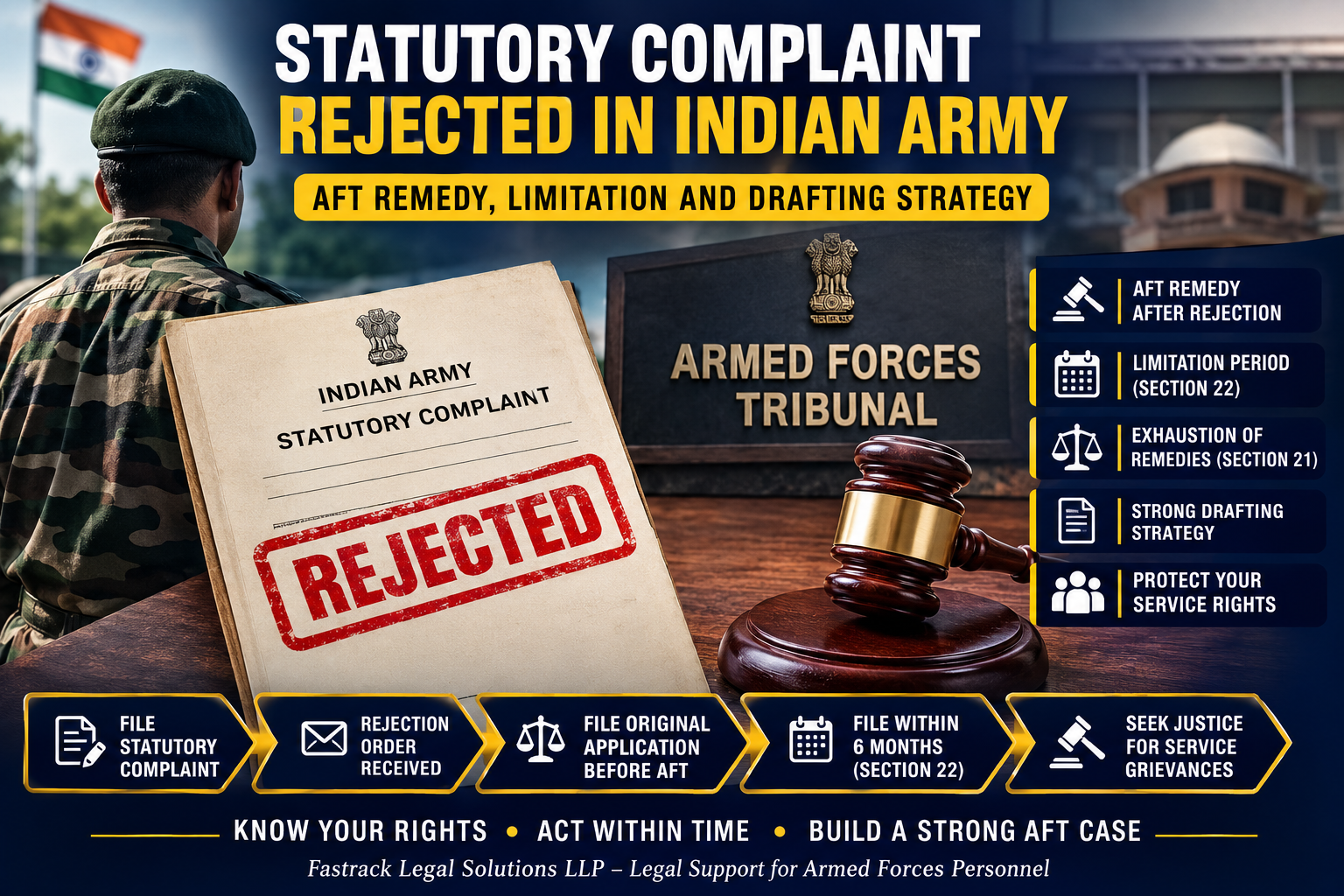
If a statutory complaint in the Indian Army is rejected, the aggrieved person may approach the Armed Forces Tribunal by filing an Original Application, provided the dispute falls within the Tribunal’s service-matter jurisdiction. For officers, the statutory remedy is linked to Section 27 of the Army Act, 1950, which allows an officer who deems himself wronged by his Commanding Officer or superior officer, and who does not receive redress on due application, to complain to the Central Government in the prescribed manner. For persons other than officers, Section 26 of the Army Act, 1950 provides the statutory remedy framework for aggrieved persons other than officers.
Under Section 21 of the Armed Forces Tribunal Act, 2007, the Tribunal does not ordinarily admit an application unless the applicant has availed the remedies available under the Army Act, Navy Act or Air Force Act and their rules/regulations. A person is deemed to have exhausted remedies where a final order rejecting the petition or representation has been passed, or where no final order has been passed and six months have expired from the date of the petition or representation.
The limitation position is critical. Under Section 22 of the Armed Forces Tribunal Act, 2007, where a final rejection order has been made, the application should be filed within six months from the date of the final order. The Tribunal may admit a delayed application if sufficient cause is shown.
Non-Solicitation Note
This article is intended for general legal awareness and educational purposes only and may be published by Fastrack Legal Solutions LLP. It does not constitute advertisement, solicitation, invitation or inducement for professional engagement. AFT remedy, limitation, maintainability and relief depend on the nature of grievance, rank, service status, date of the impugned order, statutory-complaint route, date of rejection, communication of order, delay, prejudice, available records and case-specific facts.
Also Read Statutory Complaint in Indian Army: Law, Procedure, AFT Remedy and Case Laws
Introduction
A statutory complaint is often the most important internal remedy for an Army officer or other aggrieved service person before approaching the Armed Forces Tribunal.
However, many statutory complaints are rejected by short, mechanical, non-speaking or broadly worded orders. The rejection may say that the complaint has been examined and found devoid of merit, without dealing with specific grounds, records, procedural violations, comparative injustice, mala fides, denial of opportunity, incorrect ACR assessment, promotion injustice, medical-board error, disciplinary prejudice or administrative arbitrariness.
Once a statutory complaint is rejected, the next legal question is:
Should the person accept the rejection, file another representation, or approach the Armed Forces Tribunal?
In most cases, the answer depends on three issues:
- Whether the grievance is a service matter within AFT jurisdiction.
- Whether internal remedies have been exhausted under Section 21 of the AFT Act.
- Whether the OA is within limitation under Section 22 of the AFT Act.
A rejected statutory complaint should not be treated as the end of the matter. It may become the foundation for a properly drafted AFT challenge.
What Is a Statutory Complaint in the Indian Army?
A statutory complaint is a formal legal remedy available under the Army Act framework to a person who considers himself wronged in service.
Broadly:
| Category | Statutory Route |
|---|---|
| Officers | Section 27, Army Act, 1950 |
| Persons other than officers | Section 26, Army Act, 1950 |
| Service grievances | May ultimately fall under AFT service-matter jurisdiction, depending on facts |
Section 27 states that an officer who deems himself wronged by his Commanding Officer or superior officer and who, on due application to his Commanding Officer, does not receive the redress he considers himself entitled to, may complain to the Central Government in the specified manner.
Section 26 is titled “Remedy of aggrieved persons other than officers” and provides the statutory redress route for persons subject to the Army Act other than officers.
Common Issues Raised in Statutory Complaints
Statutory complaints may arise from a wide range of service grievances.
Common Officer Grievances
- Adverse remarks in ACR/APAR.
- Incorrect assessment in confidential report.
- Non-empanelment.
- Promotion denial.
- Discriminatory grading.
- Delay in consideration.
- Supersession.
- Wrong seniority.
- Premature retirement.
- Denial of command/appointment.
- Medical categorisation issues.
- Disciplinary bias affecting career.
- Non-statutory punishment or censure.
- Court of Inquiry prejudice.
- Administrative action without hearing.
Common PBOR / JCO Grievances
- Discharge-related grievances.
- Denial of promotion.
- Seniority issues.
- Pension and disability pension disputes.
- Wrong service record entry.
- Punishment or administrative action.
- Medical board disputes.
- Denial of benefits.
- Incorrect character assessment.
- Non-grant of entitled allowances.
The complaint must not merely narrate hardship. It must identify the legal wrong, the record supporting the wrong, and the relief sought.
What Happens When the Statutory Complaint Is Rejected?
A rejection order can be challenged before the Armed Forces Tribunal if the matter falls within the Tribunal’s jurisdiction.
The Armed Forces Tribunal Act, 2007 was enacted to provide adjudication or trial by the Tribunal of disputes and complaints relating to commission, appointments, enrolment and conditions of service of persons subject to the Army Act, Navy Act and Air Force Act, and also appeals arising out of court martial orders, findings or sentences.
Section 14 of the AFT Act gives the Tribunal jurisdiction, powers and authority in service matters. It also permits a person aggrieved by an order pertaining to a service matter to make an application to the Tribunal with documents and evidence.
Therefore, after rejection of a statutory complaint, the normal remedy is not an endless chain of fresh representations. The correct legal step is usually to evaluate whether an OA should be filed before the AFT.
Why Filing Repeated Representations Is Risky
After rejection, many personnel keep sending fresh representations, mercy petitions, reminders or re-styled complaints.
This is risky for five reasons:
- It may not extend limitation.
- It may create delay.
- It may weaken urgency.
- It may allow the department to argue that the applicant slept over rights.
- It may blur the original cause of action.
A fresh representation does not automatically revive a stale claim. The safer approach is to calculate limitation from the final rejection order and prepare the AFT case promptly.
Section 21 AFT Act: Exhaustion of Remedies
Section 21 of the AFT Act is important because the Tribunal does not ordinarily admit an application unless the applicant has availed of the remedies available under the Army Act, Navy Act or Air Force Act and the relevant rules and regulations.
For practical purposes, this means:
| Situation | AFT Position |
| Statutory complaint rejected by final order | Remedies treated as exhausted |
| No order passed for six months after complaint/representation | Remedies may be deemed exhausted |
| Applicant approaches AFT without using available remedy | Maintainability objection may arise |
| Urgent exceptional case | Legal strategy depends on facts and urgency |
Section 21 also states that a person is deemed to have availed remedies if a final order has been made rejecting the petition or representation, or where no final order is made and six months have expired from the date of the petition or representation.
Section 22 AFT Act: Limitation After Rejection
Limitation is the most dangerous technical issue after statutory complaint rejection.
Section 22 provides that where a final order has been made, the application must be made within six months from the date on which such final order has been made. It also deals with the situation where a petition or representation has been made and six months have expired without a final order. The Tribunal may admit an application after the prescribed period if sufficient cause is shown.
Practical Limitation Table
| Situation | Safer Filing Strategy |
| Final rejection order received | File OA within six months |
| Complaint pending beyond six months | Consider OA after six months instead of waiting indefinitely |
| Delay already occurred | File OA with delay-condonation application |
| Rejection order not supplied | Seek copy and preserve proof of request |
| Fresh representation filed after rejection | Do not assume limitation is automatically extended |
| Continuing wrong claimed | Plead carefully with facts and relief-specific limitation |
The safest litigation practice is to treat the rejection order as a limitation-triggering event and prepare the AFT case immediately.
What Should Be Challenged in the AFT OA?
A strong OA should not challenge only the rejection order. It should challenge the original prejudicial action and the rejection order.
For example:
| Case Type | Orders / Actions to Challenge |
| ACR / APAR grievance | Impugned ACR entry, non-redressal, statutory complaint rejection |
| Promotion denial | Promotion board result, comparative grading defect, rejection order |
| Premature retirement | Retirement order, rejection of statutory complaint |
| Medical-board issue | RMB/IMB opinion, appeal rejection, statutory complaint rejection |
| Administrative censure | Censure order, rejection order |
| Discharge | Discharge order, appellate/statutory rejection |
| Seniority dispute | Seniority fixation order, rejection order |
If only the rejection order is challenged, the respondents may argue that the underlying cause has become final. The OA should be drafted to cover the complete chain of prejudice.
Grounds for Challenging Rejection of Statutory Complaint
A rejection order may be challenged on multiple legal and factual grounds.
Common Grounds
- Non-speaking order.
- Failure to consider specific grounds.
- Mechanical rejection.
- Violation of natural justice.
- Non-supply of relevant documents.
- Reliance on incorrect service record.
- Ignoring comparative record.
- Ignoring policy instructions.
- Mala fide or colourable exercise of power.
- Wednesbury unreasonableness / arbitrariness.
- Disproportionate administrative consequence.
- Failure to consider representation in proper perspective.
- Procedural irregularity in original action.
- Incorrect medical/legal/administrative basis.
- Prejudice caused by delay.
Drafting Note
The strongest ground is rarely “my complaint was rejected.” The stronger ground is:
The original action was illegal, arbitrary or procedurally defective, and the statutory authority failed to correct it despite a detailed statutory complaint.
Non-Speaking Rejection Orders
Many rejection orders are extremely short.
A non-speaking order may say:
“The statutory complaint has been examined in detail and rejected being devoid of merit.”
This kind of order may be vulnerable where the complaint had raised serious, specific and record-based issues.
How to Challenge a Non-Speaking Rejection
The OA should show:
- What exact grounds were raised in the statutory complaint.
- Which grounds were not considered.
- Which documents were ignored.
- Which policy provisions were not applied.
- How the rejection affects service rights.
- Why the rejection is arbitrary or unsustainable.
A comparative table is useful.
| Ground Raised in Complaint | Material Relied Upon | Rejection Order Finding | Defect |
| ACR entry contradicted performance record | Course grading, appreciation, appointment record | No specific finding | Non-consideration |
| Promotion denial caused by incorrect profile | Board profile and comparative record | No discussion | Mechanical rejection |
| Medical board ignored service conditions | RMB/IMB, posting profile, onset record | NANA upheld | No reasoned analysis |
| Disciplinary action violated procedure | COI/SOE record | Complaint rejected | Procedural violation ignored |
Documents Required for AFT After Statutory Complaint Rejection
The AFT case should be built as a record-based challenge.
Essential Documents
- Statutory complaint copy.
- Proof of filing / forwarding.
- Rejection order.
- Date of receipt / communication proof.
- Original impugned order.
- Service profile.
- Relevant ACR/APAR extracts, where applicable.
- Promotion board / non-empanelment material, where available.
- Medical board proceedings, where applicable.
- Court of Inquiry / Summary of Evidence records, where relevant.
- Policy letters / Army Instructions / Regulations relied upon.
- Earlier representations and replies.
- Comparative documents.
- Chronology.
- Delay explanation, if any.
- Proof of prejudice.
Practical Advice
Do not draft the OA first and collect documents later. Prepare the document record first, then draft the grounds.
Drafting Strategy for the Statutory Complaint Itself
The best AFT case often begins at the statutory complaint stage.
A weak statutory complaint creates a weak record. A strong statutory complaint creates the foundation for AFT.
Statutory Complaint Should Contain
- Clear identity and service particulars.
- Exact impugned action/order.
- Chronology of events.
- Relevant policy provisions.
- Grounds of illegality.
- Facts showing prejudice.
- Documents relied upon.
- Specific relief sought.
- Request for speaking order.
- Request for supply of relied-upon documents, where needed.
Avoid These Mistakes
| Mistake | Why It Hurts Later |
| Emotional language | Weakens legal focus |
| No chronology | Confuses cause of action |
| No document reference | Makes complaint look unsupported |
| No specific relief | Authority may avoid precise decision |
| No policy citation | Legal violation becomes vague |
| No prejudice shown | Tribunal may treat issue as academic |
| Repeating allegations without evidence | Reduces credibility |
A statutory complaint should be drafted as if it will later be read by the AFT.
Drafting Strategy for AFT OA After Rejection
The AFT OA should be structured in a disciplined way.
Suggested OA Structure
- Jurisdiction clause.
- Limitation clause.
- Details of applicant.
- Details of respondents.
- Service particulars.
- Impugned orders.
- Chronology.
- Facts.
- Grounds.
- Reliefs.
- Interim relief, if required.
- Delay-condonation application, if required.
- Annexure list.
- Affidavit.
Key Pleadings
The OA should plead:
- When the original grievance arose.
- When statutory complaint was filed.
- When rejection was passed.
- How Section 21 is satisfied.
- How the OA is within limitation under Section 22.
- Why the rejection is illegal.
- Why the original action is illegal.
- What relief is required.
Limitation Drafting in the OA
A limitation paragraph should never be casual.
Model Structure
The Applicant filed a statutory complaint dated ____. The said statutory complaint was rejected by order dated ____ and communicated/received on ____. The present Original Application is being filed within the period prescribed under Section 22 of the Armed Forces Tribunal Act, 2007. The Applicant has exhausted the statutory remedies contemplated under Section 21 of the Armed Forces Tribunal Act, 2007.
Where delayed:
Without prejudice, if any delay is computed, the delay is neither intentional nor deliberate and deserves to be condoned in view of the facts set out in the accompanying application for condonation of delay.
This must be supported by dates and documents.
Reliefs That May Be Sought
Reliefs depend on the case, but common reliefs include:
- Quashing of statutory complaint rejection order.
- Quashing of original impugned order.
- Direction for reconsideration by competent authority.
- Direction for fresh speaking order.
- Expunction of adverse remarks.
- Restoration of seniority.
- Fresh promotion consideration.
- Reassessment of medical/disability claim.
- Reinstatement or service benefit, where applicable.
- Release of consequential benefits.
- Interest on monetary dues.
- Costs, in appropriate cases.
Drafting Note
Do not ask only for “any other relief.” The main relief must be precise.
Interim Relief After Rejection
Interim relief may be required where the rejection causes immediate prejudice.
Possible Situations
- Imminent retirement.
- Promotion board due.
- Course nomination affected.
- Posting/command appointment affected.
- Discharge pending.
- Pensionary benefits being withheld.
- Medical-board consequence being implemented.
- Disciplinary consequence affecting career.
Section 26 of the AFT Act contains conditions for interim orders and generally requires copies and hearing, though the Tribunal may dispense with those requirements as an exceptional measure for reasons recorded to prevent loss.
Interim relief must be drafted carefully. Overbroad interim prayers are often resisted strongly.
Difference Between Service Matter OA and Court Martial Appeal
A statutory complaint rejection is generally challenged as a service matter where it relates to service conditions, promotion, ACR, seniority, retirement, pension, administrative orders or similar service issues.
Court martial findings and sentences fall under the AFT’s court martial appellate jurisdiction. Section 15 deals with jurisdiction, powers and authority in matters of appeal against court martial orders, decisions, findings or sentences.
Practical Distinction
| Issue | Route |
| ACR / promotion / seniority / pension / discharge grievance | OA under service-matter jurisdiction |
| Court martial conviction or sentence | Appeal under court martial jurisdiction |
| Statutory complaint against service grievance | OA after rejection |
| Court martial procedural challenge before final finding | Strategy depends on stage and maintainability |
The correct filing route must be identified before drafting.
Common Mistakes After Statutory Complaint Rejection
| Mistake | Consequence |
| Waiting too long after rejection | Limitation objection |
| Filing repeated representations | Delay without effective remedy |
| Challenging only rejection order | Original wrong may remain insufficiently challenged |
| No chronology | Facts become unclear |
| No Section 21 pleading | Maintainability objection |
| No Section 22 pleading | Limitation objection |
| No annexures | OA becomes unsupported |
| Emotional pleading | Legal grounds become weak |
| No specific relief | Tribunal may not grant effective remedy |
| No delay-condonation application | Technical dismissal risk |
30-Day Action Plan After Rejection
First 7 Days
- Obtain rejection order.
- Confirm date of order and date of receipt.
- Preserve envelope/email/dispatch proof.
- Collect statutory complaint copy.
- Collect impugned original order.
- Prepare chronology.
Days 8–15
- Identify AFT jurisdiction.
- Calculate limitation.
- Prepare document index.
- Identify missing documents.
- Draft grounds.
- Decide reliefs.
Days 16–25
- Prepare OA.
- Prepare interim application, if required.
- Prepare delay-condonation application, if required.
- Prepare annexures.
- Prepare affidavit.
- Review citations and policies.
Days 26–30
- Finalise filing set.
- Check pagination and annexures.
- Verify jurisdiction/bench.
- File before appropriate AFT Bench.
- Prepare oral submissions for admission.
Checklist: AFT Case After Statutory Complaint Rejection
| Item | Checked |
| Statutory complaint copy available | ☐ |
| Rejection order available | ☐ |
| Date of rejection identified | ☐ |
| Date of communication identified | ☐ |
| Original impugned order attached | ☐ |
| Section 21 exhaustion pleaded | ☐ |
| Section 22 limitation pleaded | ☐ |
| Delay-condonation application prepared, if required | ☐ |
| Complete chronology prepared | ☐ |
| Policy/regulation relied upon identified | ☐ |
| Specific prejudice pleaded | ☐ |
| Reliefs clearly drafted | ☐ |
| Annexure index complete | ☐ |
| Affidavit prepared | ☐ |
Related Military Law Guides
Readers interested in this subject may also read:
- Army Rule 180: Court of Inquiry and Rights of Affected Person
- Army Rule 22: Hearing of Charge
- Army Rule 23: Summary of Evidence
- Army Rule 24: Remand of Accused
- Army Rule 37: Convening of Court Martial
- Army Rule 51: Special Plea to Jurisdiction
- NANA Opinion in Medical Board
- Disability Pension for Armed Forces Personnel
- Court Martial Defence Strategy in India
Frequently Asked Questions
1. What should I do if my statutory complaint is rejected in the Indian Army?
If the statutory complaint is rejected, the next legal step is usually to evaluate filing an Original Application before the Armed Forces Tribunal, provided the grievance falls within AFT service-matter jurisdiction and the case is within limitation.
2. What is the limitation period after rejection of statutory complaint?
Under Section 22 of the Armed Forces Tribunal Act, 2007, where a final order has been made, the application should be filed within six months from the date of the final order. The Tribunal may admit a delayed application if sufficient cause is shown.
3. Can I approach AFT if no decision is passed on my statutory complaint?
Yes, in appropriate cases. Under Section 21 of the AFT Act, remedies may be deemed exhausted if no final order is passed and six months have expired from the date of the petition or representation.
4. Should I file another representation after rejection?
Repeated representations are usually risky because they may not extend limitation. The better course is to calculate limitation from the rejection order and consider AFT remedy promptly.
5. Can AFT examine both facts and law?
Yes. Section 14 records that the Tribunal shall decide both questions of law and facts raised before it in service-matter applications.
6. Can a non-speaking rejection order be challenged?
Yes, a non-speaking or mechanical rejection may be challenged where the statutory complaint raised specific legal and factual grounds that were not considered.
7. What documents are needed for AFT after rejection?
The essential documents include statutory complaint, proof of filing, rejection order, original impugned order, service records, relevant policies, correspondence, chronology and evidence showing prejudice.
8. Is statutory complaint rejection the same as court martial appeal?
No. A statutory complaint rejection in a service matter is generally challenged through an OA under service-matter jurisdiction. Court martial findings and sentences are challenged through the AFT’s court martial appellate jurisdiction under Section 15.
Conclusion
Rejection of a statutory complaint in the Indian Army is not the end of the remedy. In many cases, it is the stage at which the matter becomes ready for adjudication before the Armed Forces Tribunal.
The key is speed, structure and precision.
The applicant should immediately preserve the rejection order, calculate limitation, identify the original impugned action, prepare a chronology, collect documents, plead Section 21 exhaustion, plead Section 22 limitation and file a properly drafted OA with precise reliefs.
A strong AFT challenge does not merely say that the statutory complaint was rejected. It shows that the original service action was illegal or arbitrary, that the statutory authority failed to correct the wrong, and that the rejection order is unsustainable on law, facts, procedure and prejudice.
Disclaimer
This article is intended for general legal awareness and educational purposes only and may be published by Fastrack Legal Solutions LLP. It does not constitute advertisement, solicitation, invitation or inducement for professional engagement. AFT filing strategy, limitation, jurisdiction, maintainability and relief depend on rank, service status, nature of grievance, statutory complaint route, date of order, date of communication, delay, documents and case-specific facts.