
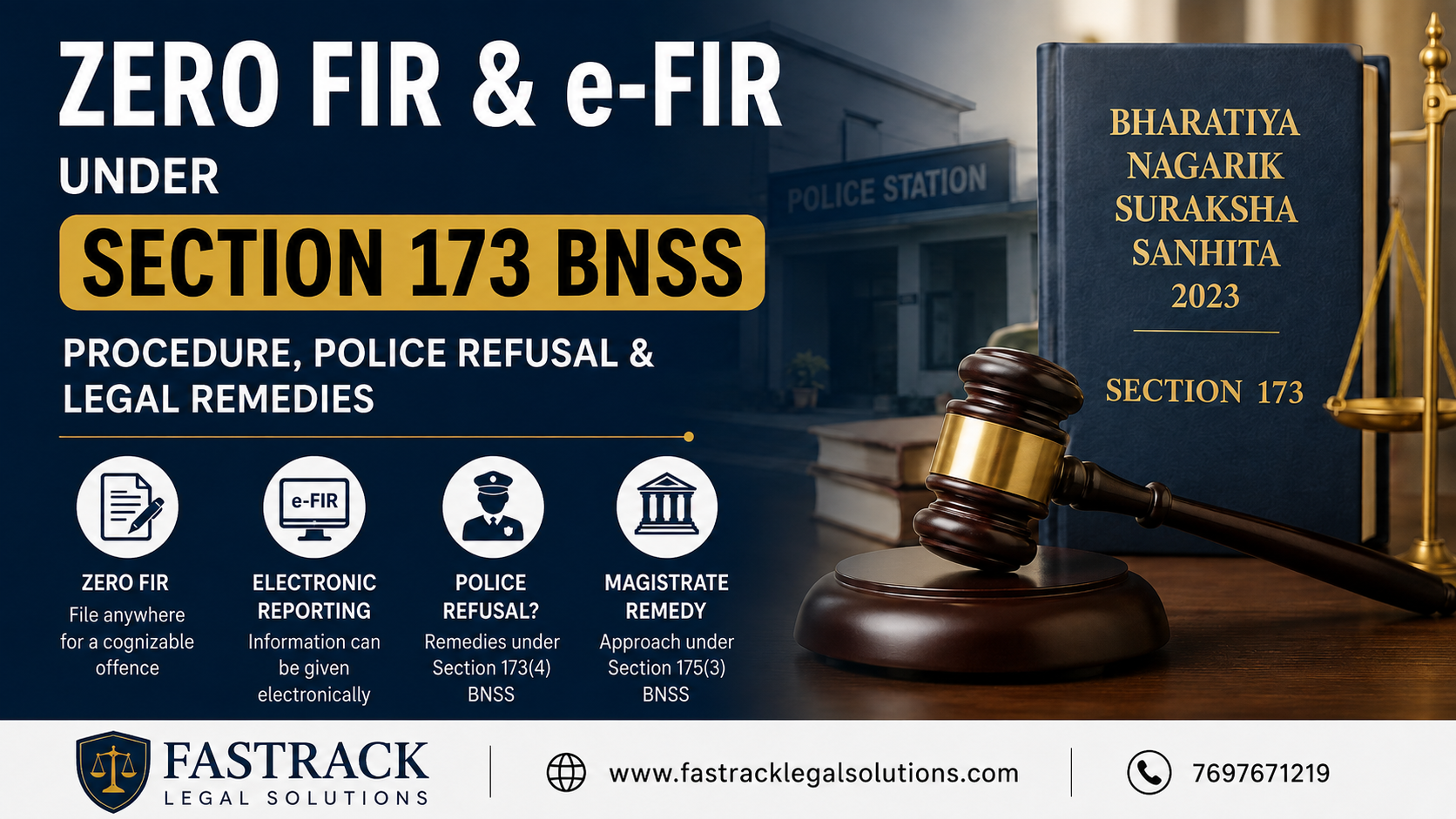
FIR, Zero FIR & e-FIR under BNSS
Section 173 of the Bharatiya Nagarik Suraksha Sanhita, 2023 (BNSS) governs information relating to cognizable offences. It gives statutory recognition to territorial flexibility associated with Zero FIR, permits information by electronic communication, requires a free copy for the informant or victim, creates a defined preliminary-enquiry mechanism for certain offences, and provides a statutory escalation route when police refuse to record the information.
This article is designed as the student-facing FIR hub. It should be read with our complete BNSS 2023 guide, Arrest under BNSS: Sections 35–62, Section 35 notice-before-arrest guide, and anticipatory bail under Section 482 BNSS.
- Section 173(1) allows cognizable-offence information to be given to a police station irrespective of the area where the offence was committed.
- The expression “Zero FIR” is not separately defined, but its territorial principle now has an express statutory foundation.
- Information may be given orally or by electronic communication; electronic information is taken on record upon being signed within three days.
- A copy of the recorded information must be supplied forthwith and free of cost to the informant or victim.
- For specified cognizable offences punishable with three years or more but less than seven years, Section 173(3) permits the statutory preliminary-enquiry route subject to prior DSP-level permission and a fourteen-day limit.
- Outside the Section 173(3) category, if the information on its face discloses a cognizable offence, FIR registration remains mandatory.
- If the SHO refuses to record the information, Section 173(4) provides recourse to the Superintendent of Police.
- Thereafter, Section 175(3) provides a Magistrate-stage remedy subject to its affidavit and procedural requirements.
- In Sujal Vishwas Attavar v. State of Maharashtra, 2026 INSC 442, the Supreme Court reiterated that these sequential statutory remedies should ordinarily be exhausted before seeking FIR registration directly under Article 226.
- Registration of an FIR does not mean automatic arrest; arrest is separately controlled by Section 35 and allied safeguards.
- What is an FIR?
- Zero FIR and territorial jurisdiction
- e-FIR and the three-day signature rule
- Free copy and special safeguards for women
- Mandatory FIR registration and Section 173(3) preliminary enquiry
- Imran Pratapgadhi, 2025 INSC 410
- Police refusal: Section 173(4) SP remedy
- Magistrate remedy under Section 175(3)
- Public-servant complaints and XXX v. State of Kerala, 2026 INSC 88
- Article 226 and Sujal Vishwas Attavar, 2026 INSC 442
- FIR vs arrest, complaint, NCR and investigation
- Cyber-financial fraud and practical reporting
- Exam questions and revision tools
Official Statutory Framework
The authoritative BNSS text is available on India Code. Section 173 is titled “Information in cognizable cases.” It must be read with Section 174 on non-cognizable cases, Section 175 on the police power to investigate cognizable cases and the Magistrate’s investigation jurisdiction, Section 176 on investigation procedure, Section 193 on the police report after investigation, and Section 35 on arrest without warrant.
Part I — FIR, Zero FIR and e-FIR
What Is an FIR?
A First Information Report is the formal recording of information relating to the commission of a cognizable offence in accordance with Section 173. It is not substantive proof of guilt. Its procedural significance lies in formally setting the police investigation machinery in motion in a cognizable case.
The facts alleged must be examined to see whether they disclose a cognizable offence.
Oral information is reduced to writing and read over; electronic communication follows the statutory signing rule.
Once an FIR is registered, investigation proceeds under the BNSS subject to the applicable statutory safeguards.
Zero FIR — Territorial Jurisdiction Is Not a Gatekeeping Barrier
Section 173(1) expressly permits information relating to a cognizable offence to be given irrespective of the area where the offence was committed. This is the statutory foundation for the principle commonly called Zero FIR.
The term “Zero FIR” itself is not separately defined in the BNSS. The legal point is more important than the label: a victim should not ordinarily be turned away merely because another police station may ultimately have territorial jurisdiction. The receiving police station may record the information and the case can subsequently be transferred to the competent police station for further investigation.
e-FIR — Electronic Information under Section 173(1)(ii)
Section 173(1)(ii) expressly permits information relating to a cognizable offence to be given by electronic communication. The information is to be taken on record upon being signed within three days by the person giving it.
| Electronic Complaint | Registered FIR |
|---|---|
| A mode by which information may be sent. | Formal recording of cognizable-offence information in accordance with Section 173. |
| May require completion of the statutory signing process. | Carries an FIR number and sets investigation formally in motion. |
| Every email/web submission should not automatically be assumed to have become an FIR. | The complainant should obtain or verify the formal FIR record/copy. |
Section 173(2) — Free Copy Is a Statutory Right
A copy of the information recorded under Section 173(1) must be given forthwith and free of cost to the informant or victim. This is not a discretionary police courtesy. From an evidentiary and procedural perspective, the copy also enables the informant to verify the material actually recorded.
Special Safeguards for Specified Offences Against Women
Section 173 contains additional safeguards for information concerning specified offences against women under the Bharatiya Nyaya Sanhita. In the situations specified by the statute, the information is to be recorded by a woman police officer or woman officer.
Specified allegations involving a woman attract the statutory woman-officer recording safeguard.
For a temporarily or permanently mentally or physically disabled victim, recording may occur at residence or another convenient place with interpreter/special educator support where needed.
The statutory framework includes videography and follow-up recording before a Magistrate in the applicable cases.
Part II — Mandatory FIR Registration and Preliminary Enquiry
The Core Rule from Lalita Kumari
Lalita Kumari v. Government of Uttar Pradesh, (2014) 2 SCC 1, remains the foundational Constitution Bench authority on FIR registration. Under the earlier CrPC framework, it established that where information clearly discloses commission of a cognizable offence, registration of an FIR is mandatory; truthfulness, credibility and ultimate proof belong ordinarily to investigation rather than the registration stage.
Under the BNSS, that principle must now be read together with the express statutory mechanism in Section 173(3).
Section 173(3) — Statutory Preliminary Enquiry
Where information relates to a cognizable offence punishable with imprisonment for three years or more but less than seven years, the officer in charge may, after obtaining prior permission from an officer not below the rank of Deputy Superintendent of Police and after considering the nature and gravity of the offence:
Conduct a preliminary enquiry to ascertain whether a prima facie case exists for proceeding. The enquiry must fit within the statutory fourteen-day limit.
Where the statutory conditions justify it and a prima facie case exists, proceed with investigation without using preliminary enquiry as a delaying device.
Imran Pratapgadhi v. State of Gujarat, 2025 INSC 410
On 28 March 2025, the Supreme Court directly considered the operation of Section 173(3) BNSS. The Court explained that the provision marks a significant statutory change. It held, in substance, that where information discloses a cognizable offence outside the Section 173(3) category, the police should register the FIR and investigate. For the defined Section 173(3) category, the police may use the preliminary-enquiry mechanism subject to the statute.
The Court further explained that if a Section 173(3) preliminary enquiry reveals a prima facie case, FIR registration and investigation should follow. If the officer concludes that no prima facie case exists for proceeding, the first informant should be informed promptly so the remedy under Section 173(4) can be invoked.
Official judgment: Imran Pratapgadhi v. State of Gujarat, 2025 INSC 410.
Part III — What If the Police Refuse to Register the FIR?
Step 1 — Officer in Charge of Police Station
The complainant should first place the cognizable-offence information before the officer in charge of the police station under Section 173(1). A written, chronological complaint is often preferable in practice because it preserves the exact allegations and allows proof of submission.
Step 2 — Superintendent of Police under Section 173(4)
If the officer in charge refuses to record the information, the aggrieved person may send the substance of the information in writing and by post to the Superintendent of Police concerned. If satisfied that a cognizable offence is disclosed, the Superintendent of Police may investigate personally or direct investigation by a subordinate officer in accordance with the statute.
Step 3 — Magistrate under Section 175(3)
A Magistrate empowered under Section 210 may order investigation under Section 175(3) after following the statutory procedure. The BNSS expressly contemplates an application supported by an affidavit made pursuant to Section 173(4), such inquiry as the Magistrate considers necessary, and consideration of the police officer’s submissions.
| Stage | Authority | Core Function |
|---|---|---|
| 1 | SHO / officer in charge | Section 173(1) receipt/registration process |
| 2 | Superintendent of Police | Section 173(4) statutory escalation after refusal |
| 3 | Jurisdictional Magistrate | Section 175(3) judicial consideration of investigation request |
Complaints Against Public Servants — Section 175(4) and 2026 INSC 88
Where the proposed investigation concerns a public servant in the statutory circumstances covered by Section 175(4), additional procedural safeguards apply. In XXX v. State of Kerala & Others, 2026 INSC 88, the Supreme Court held that Section 175(4) is not a standalone route; it must be read with the Section 175(3) framework. The affidavit-supported application and the statutory procedural structure therefore remain relevant.
This judgment should be used carefully: its principal importance lies in the special procedure concerning allegations against public servants and the relationship between Section 175(3) and Section 175(4), rather than as a substitute for the general Section 173(4) remedy.
Should the Complainant Directly File a Writ Petition?
Ordinarily, not as the first procedural step where the BNSS provides an effective statutory hierarchy. In Sujal Vishwas Attavar v. State of Maharashtra, 2026 INSC 442, decided on 4 May 2026, the Supreme Court stated that the BNSS provides a structured sequential mechanism: first Section 173(1), then Section 173(4) before the jurisdictional Superintendent of Police on refusal, and thereafter Section 175(3) before the Magistrate.
Official judgment: Sujal Vishwas Attavar v. State of Maharashtra, 2026 INSC 442.
Part IV — FIR Compared with Related Criminal-Procedure Concepts
FIR vs Non-Cognizable Information
| Cognizable Case — Section 173 | Non-Cognizable Case — Section 174 |
|---|---|
| Police may investigate under the cognizable-case framework without first obtaining a Magistrate order, subject to the BNSS. | Police ordinarily cannot investigate a non-cognizable case without the Magistrate order required by Section 174. |
| Section 173 governs the information/FIR process. | The substance is entered in the prescribed book and the informant is referred to the Magistrate as the statute directs. |
FIR vs Arrest
FIR registration and arrest are legally distinct. Registration starts investigation; it does not determine guilt and does not automatically authorise or require immediate custody. Arrest without warrant must independently satisfy Section 35 and the safeguards in Sections 35–62.
FIR vs Criminal Complaint Before Magistrate
A police FIR under Section 173 is not the only route by which criminal proceedings can begin. A complainant may, depending on the facts and statutory requirements, invoke the Magistrate’s complaint jurisdiction. Students should therefore distinguish an application seeking a police investigation under Section 175(3) from a complaint proceeding in which the Magistrate takes cognizance and follows the complaint-case procedure.
FIR vs Police Report / Chargesheet
The FIR is the beginning of the police investigation process; the police report under Section 193 comes at the completion of investigation. These documents serve different functions. The FIR records the first information; the final police report contains the investigative conclusion, material collected and the statutory result of investigation.
Part V — Cybercrime, Interstate Offences and Evidence Preservation
Why Zero FIR Matters Most in Multi-State Crime
Cyber fraud, online cheating, interstate abduction, offences committed during travel and financial crimes frequently have facts spread across multiple jurisdictions. A victim may be in one State, the accused in another, the beneficiary bank account in a third and the electronic intermediary elsewhere. Section 173(1)’s territorial wording prevents the victim from being required to solve that jurisdiction puzzle before the criminal process can begin.
Cyber-Financial Fraud Reporting
For cyber-financial fraud, prompt reporting can be critical because funds may move through multiple accounts within minutes. The official National Cyber Crime Reporting Portal should be used where applicable, together with the national cyber-fraud reporting mechanism. A portal complaint, however, should not automatically be confused with formal FIR registration; the complainant should verify the FIR number and police-station record where an FIR is required.
UTR/transaction IDs, beneficiary accounts, statements and payment references.
Screenshots, emails, chats, URLs, social-media handles, device details and phone numbers.
Complaint acknowledgment, FIR copy, officer details, transfer details and subsequent notices.
How to Draft a Strong FIR Complaint
- Who? Identify the accused if known; otherwise provide all available identifiers.
- What? State the acts complained of factually and chronologically.
- When? Mention dates, times and the sequence of events.
- Where? State all relevant locations even if territorial jurisdiction is uncertain.
- How? Explain the means by which the offence occurred.
- What loss/injury? Quantify financial loss, bodily injury, property loss or other harm where possible.
- What evidence? Identify documents, CCTV, screenshots, bank records, chats, emails, medical records and witnesses.
- What happened afterwards? Include subsequent threats, demands, transfers, concealment or communications that are materially relevant.
- What prior complaints? Give dates and acknowledgment details of earlier police/SP approaches.
- Avoid exaggeration or unsupported legal labels; facts should reveal the ingredients.
Leading Cases at a Glance
Foundational Constitution Bench rule on mandatory FIR registration where cognizable offence is disclosed, now read with Section 173(3) BNSS.
Territorial objection should not become a basis for police refusing to act on cognizable-offence information.
2025 INSC 410: leading interpretation of Section 173(3) preliminary enquiry.
2026 INSC 88: Section 175(4) public-servant procedure must be read with Section 175(3).
2026 INSC 442: ordinarily exhaust Section 173(1), 173(4) and 175(3) before seeking FIR registration under Article 226.
How to Solve an FIR Problem Question
- Identify whether the alleged offence is cognizable or non-cognizable.
- If cognizable, apply Section 173(1).
- Ignore territorial objections at the initial reporting stage; explain the Zero FIR principle.
- If information was electronic, apply the three-day signing requirement.
- Check whether Section 173(3)’s punishment range and procedural conditions apply.
- If Section 173(3) applies, analyse preliminary enquiry and the fourteen-day limit using Imran Pratapgadhi.
- If registration was refused, move to Section 173(4) before the SP.
- Then analyse Section 175(3) Magistrate jurisdiction and affidavit requirements.
- If the proposed accused is a public servant in the relevant statutory context, additionally test Section 175(4) and XXX v. State of Kerala.
- If Article 226 is invoked directly, discuss Sujal Vishwas Attavar and the alternative-remedy rule.
- Separate FIR registration from arrest, bail, remand and final police report.
Frequently Asked Examination Questions
- What is an FIR under Section 173 BNSS?
- Explain Zero FIR under the BNSS.
- Is “Zero FIR” expressly defined in Section 173?
- Can police refuse information because the offence occurred in another State?
- Explain e-FIR and the three-day signature requirement.
- Is every email complaint automatically a registered FIR?
- What right does Section 173(2) give to the informant or victim?
- Explain preliminary enquiry under Section 173(3).
- What is the punishment range for the Section 173(3) mechanism?
- Discuss Imran Pratapgadhi v. State of Gujarat.
- What remedy is available if the SHO refuses to register an FIR?
- Explain Section 173(4) BNSS.
- Explain the Magistrate’s power under Section 175(3).
- What is the significance of the affidavit under Section 175(3)?
- Explain XXX v. State of Kerala, 2026 INSC 88.
- Can Article 226 ordinarily be invoked as the first remedy for FIR registration?
- Discuss Sujal Vishwas Attavar v. State of Maharashtra, 2026 INSC 442.
- Does FIR registration automatically require arrest?
- Distinguish FIR from a non-cognizable report.
- Distinguish FIR from the final police report under Section 193.
Exam Answer Toolkit
Define Section 173 FIR, state Zero FIR territorial rule, e-FIR three-day signing rule, free copy and Section 173(4) remedy.
Add Section 173(3) preliminary enquiry, Lalita Kumari, Imran Pratapgadhi, Section 175(3)/(4), 2026 authorities, Article 226 and FIR-vs-arrest distinction.
One-Minute Revision
| Question | Answer |
|---|---|
| Cognizable FIR provision? | Section 173 |
| Territorial bar at reporting stage? | No — Section 173(1) says irrespective of area |
| Electronic information? | Permitted; signed within 3 days |
| Free FIR copy? | Section 173(2) |
| Preliminary enquiry? | Section 173(3) |
| PE punishment range? | 3 years or more but less than 7 years |
| PE time limit? | 14 days |
| Refusal by SHO? | Section 173(4) — Superintendent of Police |
| Magistrate investigation order? | Section 175(3) |
| Public-servant special procedure? | Section 175(4) |
| Leading 173(3) case? | Imran Pratapgadhi, 2025 INSC 410 |
| 2026 sequential-remedies case? | Sujal Vishwas Attavar, 2026 INSC 442 |
Section 173 BNSS combines access, technology and procedural control. It prevents territorial jurisdiction from blocking initial reporting, recognises electronic communication, gives the informant a free copy, permits a carefully defined preliminary enquiry in a specified punishment range and provides a structured remedy when the police refuse to act.
Exam sequence: cognizable offence → Section 173(1) → Zero FIR/e-FIR rules → Section 173(3) if applicable → Section 173(4) SP remedy → Section 175(3) Magistrate → Section 175(4) if public-servant context → Article 226 only with the alternative-remedy principles in mind.
Academic note: This material is intended for legal education and examination preparation. Students should consult the current BNSS text and full judgments before relying on any proposition in professional practice.