
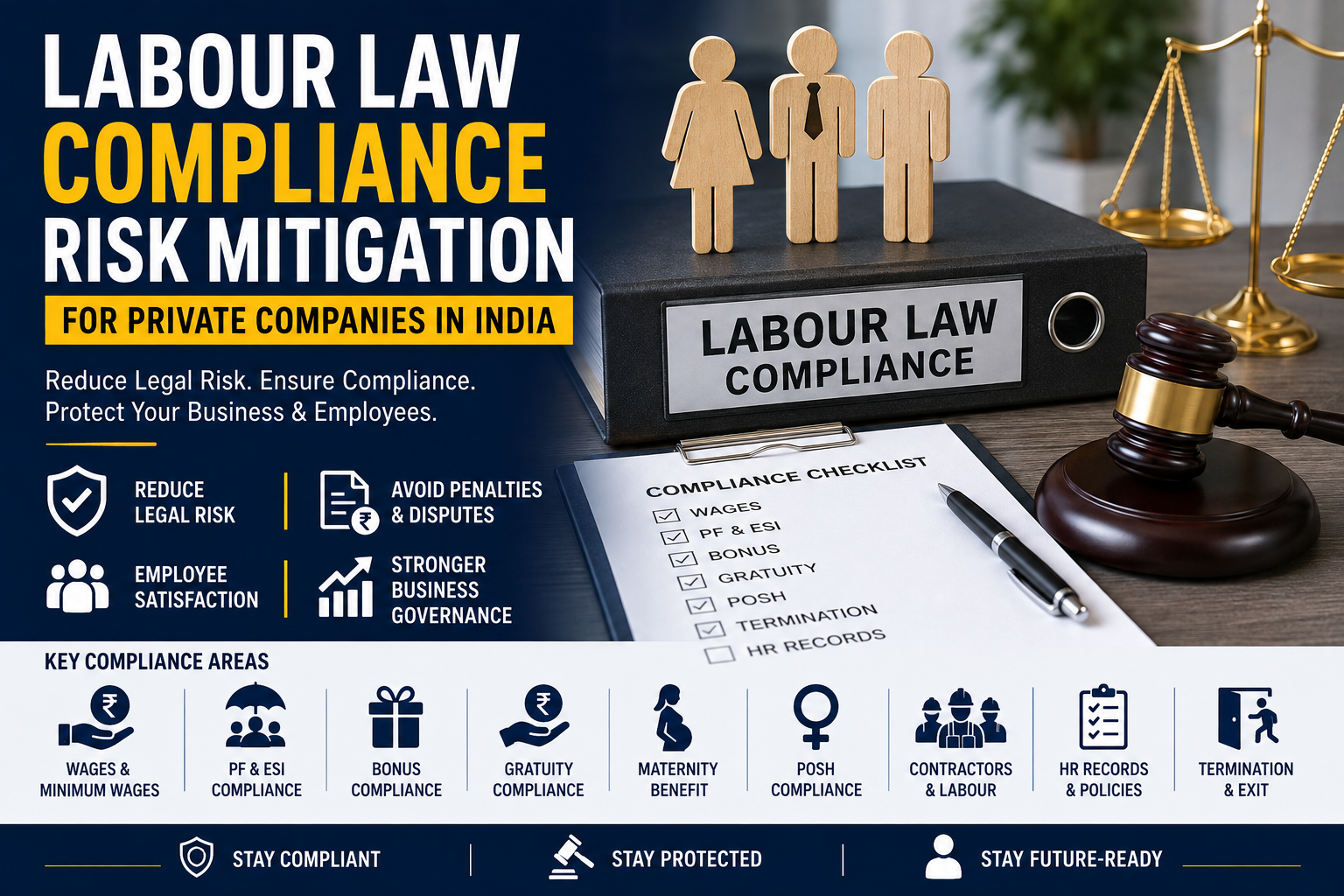
Labour law compliance risk mitigation for private companies in India means creating a structured HR and statutory-compliance system that reduces exposure from unpaid wages, minimum-wage violations, PF/ESI defaults, gratuity disputes, bonus liability, maternity-benefit claims, POSH non-compliance, contractor-labour issues, wrongful termination, overtime disputes, misclassification of employees as consultants, missing appointment letters, defective HR records and inspection-related penalties.
India’s labour law framework has been consolidated into four Labour Codes: the Code on Wages, 2019, the Industrial Relations Code, 2020, the Code on Social Security, 2020, and the Occupational Safety, Health and Working Conditions Code, 2020. The Ministry of Labour and Employment’s employer handbook explains that 29 Central Labour Acts were consolidated into four Labour Codes, reducing multiple returns, forms, registers, registrations and licences into a simplified compliance structure. The Ministry’s 2026 FAQ also records that the definition of “wages” under the Labour Codes has come into effect from 21.11.2025 and that the revised wage definition is relevant for gratuity computation from the date of enforcement.
For private companies, the practical risk-control approach should be: maintain proper appointment letters, classify employees and consultants correctly, pay minimum wages and overtime lawfully, track PF/ESI thresholds, maintain wage and attendance records, comply with POSH, regulate contract labour, document disciplinary action, process termination carefully, maintain statutory registers, and create a monthly labour-compliance calendar.
Non-Solicitation Note
This article is intended for general legal awareness and educational purposes only and may be published by Fastrack Legal Solutions LLP. It does not constitute advertisement, solicitation, invitation or inducement for professional engagement. Labour-law compliance depends on the company’s location, employee strength, wage structure, nature of work, applicable State rules, industry, factory/office status, shops-and-establishments registration, contractor use, employee classification, social-security coverage, standing orders/service rules, pending claims and case-specific documents.
Introduction
Labour-law risk is one of the most underestimated risks in private companies.
Many private companies focus on ROC, GST, contracts and tax compliance, but ignore HR and labour documentation until there is a dispute. The problem usually comes up when an employee is terminated, a salary dispute arises, a consultant claims employee status, a female employee raises a POSH complaint, an ex-employee demands gratuity or bonus, a labour inspector asks for records, or an investor asks for HR compliance during due diligence.
The common mindset is:
“We are a private company, so labour laws are not a major issue.”
That assumption is dangerous.
Even a small or mid-sized private company may face exposure from:
- Unpaid wages.
- Minimum-wage violations.
- Overtime claims.
- PF/ESI non-registration.
- Wrong wage calculation.
- Bonus disputes.
- Gratuity liability.
- Maternity-benefit claims.
- POSH non-compliance.
- Illegal termination allegations.
- Consultant misclassification.
- Contract-labour disputes.
- Missing attendance and wage records.
- No appointment letters.
- No leave policy or HR manual.
- No compliance calendar.
- No record of disciplinary proceedings.
- No settlement or full-and-final documentation.
Labour law compliance is not merely a statutory filing exercise. It is a risk-mitigation system that protects the company, directors, HR department, investors and business continuity.
Also Read How to Conduct a POSH Policy Audit
Why Labour Law Compliance Is a Risk-Mitigation Issue
Labour law creates risk in three ways.
First, it creates statutory risk. This includes non-registration, non-payment, non-filing, non-maintenance of registers, delayed deposits and non-compliance with employee-benefit laws.
Second, it creates litigation risk. This includes employee claims for wrongful termination, unpaid salary, overtime, bonus, gratuity, leave encashment, sexual harassment, discrimination, illegal deduction or forced resignation.
Third, it creates business-risk and due-diligence risk. During funding, acquisition, bank due diligence or vendor onboarding, labour gaps become red flags. A company with weak HR records appears legally immature and operationally risky.
Labour Risk Matrix
| Risk Area | Common Trigger | Business Impact |
|---|---|---|
| Wage compliance | Salary dispute, minimum-wage complaint, overtime demand | Back wages, penalty, employee claims |
| PF/ESI | Inspection, employee complaint, due diligence | Contribution liability, interest, damages |
| Bonus | Annual statutory review, employee demand | Payment liability and records issue |
| Gratuity | Resignation, retirement, death, long-service exit | Statutory liability and dispute |
| Maternity benefit | Pregnancy, termination, leave denial | High legal and reputational risk |
| POSH | Workplace complaint | Inquiry, confidentiality, employer-liability risk |
| Termination | Forced resignation, retrenchment, misconduct | Labour claim, reinstatement/back wages risk |
| Contractors | Principal-employer liability, contractor default | Wage/social-security exposure |
| HR records | Inspection or litigation | Inability to prove compliance |
A private company should treat labour compliance as part of its legal risk register.
Labour Codes and Current Compliance Planning
India’s labour framework has moved toward consolidation under the four Labour Codes. The Ministry of Labour and Employment’s employer handbook states that 29 Central Labour Acts were rationalised into four Labour Codes, with multiple returns replaced by a single electronic return, forms reduced, registers reduced and single registration/licence mechanisms introduced in the Code framework.
The four Codes are:
| Labour Code | Main Risk Area |
| Code on Wages, 2019 | Wages, minimum wages, equal remuneration, overtime, payment timelines |
| Industrial Relations Code, 2020 | Standing orders, trade unions, retrenchment, lay-off, closure, dispute resolution |
| Code on Social Security, 2020 | PF, ESI, gratuity, maternity benefit, social security, gig/platform workers |
| OSHWC Code, 2020 | Working conditions, health, safety, contract labour, inter-State migrant workers |
The Ministry’s 2026 FAQ records that the definition of “wages” came into effect from 21.11.2025 and that gratuity calculation under the revised wage definition applies from the date of implementation of the Codes.
Practical Compliance Note
Private companies should not rely on old HR templates blindly. Every company should review:
- Wage structure.
- Basic salary and allowances.
- PF and ESI coverage.
- Gratuity provisioning.
- Bonus eligibility.
- Leave and overtime records.
- Appointment letters.
- Contractor arrangements.
- Termination process.
- State-specific rules and Shops & Establishments compliance.
The Codes simplify the architecture, but actual compliance still requires careful mapping of Central law, State rules, sector-specific rules and employee records.
Core Labour Law Compliance Risks for Private Companies
1. Employment Documentation Risk
The first labour-law risk is poor documentation.
Many companies allow employees to work without appointment letters, proper role descriptions, salary structure, leave terms, confidentiality clauses, notice-period clauses or termination provisions. This creates major disputes later.
Documents Every Employee File Should Contain
- Appointment letter.
- Identity proof.
- Address proof.
- PAN and bank details.
- Educational/experience documents.
- Role description.
- Salary structure.
- PF/ESI declaration, where applicable.
- Nomination forms, where applicable.
- Leave record.
- Attendance record.
- Appraisal record.
- Warning letters, if any.
- Disciplinary records, if any.
- Resignation/termination records.
- Full-and-final settlement.
- Exit interview or handover record.
Risk Mitigation
| Gap | Risk | Solution |
| No appointment letter | Employee can dispute role, salary, notice period | Issue standard appointment letters |
| No salary structure | PF/ESI/gratuity disputes | Maintain CTC and wage breakup |
| No attendance record | Overtime and absenteeism disputes | Use biometric/HRMS/manual register |
| No leave record | Leave encashment dispute | Maintain leave ledger |
| No misconduct process | Termination challenge | Adopt service rules/disciplinary policy |
| No full-and-final record | Post-exit claims | Use signed settlement and payment proof |
Employee vs Consultant Misclassification Risk
A common private-company mistake is calling a person a “consultant” while treating them like an employee.
The designation used in the agreement is not conclusive. Authorities and courts may examine the real working relationship.
Red Flags of Misclassification
| Factor | Risk Indicator |
| Fixed monthly payment | Looks like salary |
| Fixed working hours | Looks like employment |
| Reporting to manager | Control and supervision |
| Company email/laptop | Integration into business |
| Exclusive service | Employee-like dependency |
| Attendance tracking | Employment control |
| Leave approval | Employee-like terms |
| No GST invoice | Consultant status weakens |
| Long continuous engagement | Employee claim risk |
Risk Mitigation
- Use consultant agreements only where relationship is genuinely independent.
- Define deliverables instead of daily employment control.
- Avoid attendance and leave systems for true consultants.
- Ensure invoices and tax treatment match consultant status.
- Do not use consultants to avoid PF/ESI/statutory benefits where the factual relationship is employment.
- Review long-term consultants periodically.
- Convert consultant to employee where factual control is employee-like.
Misclassification risk can create back wages, social-security exposure, termination claims and tax complications.
Wages, Minimum Wages and Payment Risk
Wage compliance is the foundation of labour-law risk mitigation.
The Code on Wages, 2019 covers wage-related compliance including minimum wages, payment of wages and overtime. India Code lists the Code on Wages as covering payment of minimum rate of wages, floor wage and wages for overtime work. Section 14 of the Code on Wages provides that where an employee whose minimum rate of wages has been fixed works beyond normal hours, overtime must be paid at a rate not less than twice the normal rate of wages.
Wage Compliance Checklist
- Check applicable minimum wages for the State and category of employment.
- Maintain wage register.
- Maintain attendance register.
- Maintain overtime register.
- Ensure salary is paid within prescribed time.
- Avoid unauthorised deductions.
- Maintain payslips.
- Reconcile salary sheet with bank payments.
- Check wage definition under Labour Codes.
- Review fixed and variable components.
- Maintain proof of payment.
- Ensure contractor workers are also paid lawfully through contractors.
Common Wage Risks
| Risk | Example | Mitigation |
| Minimum wage violation | Salary below notified rate | Monthly minimum-wage check |
| Delayed salary | Salary paid after due date | Salary calendar and approval system |
| Unauthorised deduction | Salary cut without legal basis | Deduction policy |
| Overtime unpaid | Extended working hours without OT | Overtime approval and record |
| Wage breakup manipulation | Excess allowances to reduce statutory benefits | Review wage definition and salary structure |
| Cash salary | No proof of payment | Bank transfer only |
Overtime Risk
Overtime disputes are increasing because many companies have extended work hours but poor records.
Risk Areas
- No overtime policy.
- No approval system.
- No record of extra hours.
- Managers informally demand late work.
- Employees claim overtime after resignation.
- Salary structure does not clarify managerial/supervisory status.
- Attendance records contradict company position.
Risk Mitigation
- Define working hours.
- Define weekly off.
- Define overtime approval authority.
- Maintain attendance records.
- Maintain overtime register.
- Pay overtime where legally applicable.
- Distinguish managerial/supervisory roles carefully.
- Avoid forcing overtime without lawful basis and consent where required.
The OSHWC Code also contains provisions concerning overtime payment at twice the rate of wages where a worker works beyond prescribed daily/weekly hours and refers to consent for overtime work.
PF Compliance Risk
Provident fund compliance is a major area of exposure.
The Employees’ Provident Funds and Miscellaneous Provisions Act, 1952 applies, subject to its provisions, to factories engaged in specified industries employing twenty or more persons and to other notified establishments employing twenty or more persons. It also provides that an establishment to which the Act applies continues to be governed by it even if employee strength later falls below twenty.
PF Risk Checklist
| Risk Area | Mitigation |
| Company crossed threshold but not registered | Track headcount monthly |
| Eligible employees not enrolled | Monthly PF eligibility review |
| Incorrect wage calculation | Review wage structure under current regime |
| Delayed deposit | Monthly statutory dues calendar |
| Contractor PF ignored | Obtain contractor challans and ECR proof |
| Ex-employees not marked exit | Update exit records promptly |
| PF notices ignored | Maintain statutory notice tracker |
Documents to Maintain
- PF registration details.
- Employee UAN records.
- Monthly ECR.
- PF challans.
- Wage register.
- Attendance register.
- Contractor PF compliance records.
- Exit records.
- PF inspection/notices file.
PF risk is not only a finance issue. It is also a due-diligence and director-risk issue.
ESI Compliance Risk
ESI compliance arises where the establishment and employees fall within the applicable coverage. The Ministry’s 2026 FAQ records that from 21.11.2025, the definition of wages under the Code on Social Security, 2020 applies and that, at present, ₹21,000 per month wages notified for ESI coverage will apply.
ESI Risk Checklist
- Check whether establishment is covered.
- Track wage threshold.
- Register eligible employees.
- Deposit employer and employee contributions.
- Maintain wage and attendance records.
- Update exits.
- Preserve challans.
- Check contractor-worker ESI compliance.
- Respond to notices promptly.
- Reconcile payroll with ESI records.
Common ESI Mistakes
| Mistake | Risk |
| Not tracking ₹21,000 threshold | Eligible employees may be missed |
| Not registering eligible employees | Contribution and penalty risk |
| Ignoring contractor labour | Principal-employer exposure |
| Salary restructuring without legal review | Contribution dispute |
| No attendance records | Coverage and contribution disputes |
| No medical/accident reporting process | Employee claim risk |
Bonus Compliance Risk
Bonus compliance risk arises when employers fail to identify eligible employees, maintain proper records, compute allocable surplus correctly or document payment/non-payment basis.
Practical Risk Points
- Employee eligibility not reviewed.
- Wage ceiling misunderstood.
- Bonus treated as discretionary performance incentive.
- Statutory bonus and ex-gratia bonus mixed.
- No Form/register maintained.
- No board/management note.
- Bonus not paid within time.
- New company/startup exemption incorrectly assumed.
- Employees resign and later demand bonus.
Risk Mitigation
| Step | Action |
| Identify coverage | Check establishment applicability |
| Identify eligible employees | Review wage threshold and days worked |
| Compute correctly | Separate statutory bonus from incentives |
| Maintain records | Keep registers and payment proof |
| Pay timely | Include in compliance calendar |
| Communicate clearly | Avoid mixing bonus with discretionary payout |
| Preserve calculations | Useful in inspection or employee claim |
Bonus should be reviewed annually with payroll and accounts, not after an employee dispute.
Gratuity Compliance Risk
Gratuity exposure is often ignored until an employee exits after long service.
The Ministry’s 2026 FAQ states that gratuity calculation will apply with effect from 21.11.2025 under the Code on Social Security framework and that fixed-term employees will be eligible for gratuity if they render service under the contract for a period of one year from the start of contract.
Gratuity Risk Areas
- No gratuity provisioning.
- No continuous-service tracker.
- Long-service employees not identified.
- Fixed-term employee gratuity ignored.
- Last drawn wage disputed.
- Notice/resignation date disputed.
- Death/disability cases mishandled.
- Contractor gratuity confusion.
- Delay in payment.
- No nomination records.
Gratuity Risk Mitigation
- Maintain date-of-joining records.
- Maintain continuous-service tracker.
- Maintain gratuity nomination forms.
- Review long-service employees quarterly.
- Provision gratuity liability in accounts.
- Review wage definition.
- Process gratuity promptly on exit.
- Document reasons if gratuity is disputed or withheld.
- Review fixed-term employee contracts.
- Keep signed full-and-final settlement separate from statutory gratuity.
Maternity Benefit Risk
Maternity-benefit non-compliance can create serious legal and reputational exposure.
The Code on Social Security, 2020 includes provisions on right to payment of maternity benefit. India Code lists maternity-benefit rights within the Code on Social Security framework.
Maternity Risk Areas
- Termination during pregnancy.
- Denial of maternity leave.
- Forced resignation.
- Non-payment of maternity benefit.
- Negative appraisal due to pregnancy.
- No creche assessment where applicable.
- No policy communication.
- Contractual or probationary status misunderstood.
- Harassment after return from leave.
- No accommodation for lawful benefits.
Risk Mitigation
- Adopt maternity-benefit policy.
- Train HR and managers.
- Avoid adverse action linked to pregnancy.
- Maintain leave and payment records.
- Track eligibility.
- Communicate return-to-work procedure.
- Preserve medical and leave documents confidentially.
- Review termination decisions carefully where pregnancy or maternity leave is involved.
Maternity matters should be handled with documented sensitivity and legal precision.
POSH Compliance as Labour Risk
POSH compliance is a core HR and labour-governance risk.
Section 19 of the POSH Act requires every employer to provide a safe working environment, display penal consequences and the Internal Committee order, organise workshops and awareness programmes at regular intervals, provide facilities to the committee, assist in securing attendance of respondent and witnesses, assist the aggrieved woman where she chooses to file a criminal complaint, treat sexual harassment as misconduct, and monitor timely submission of committee reports.
POSH Risk Mitigation Checklist
- POSH policy.
- Internal Committee constitution order.
- External member appointment.
- Employee awareness training.
- IC orientation.
- Workplace display.
- Complaint email ID.
- Confidentiality protocol.
- Anti-retaliation protocol.
- Annual report.
- Inquiry templates.
- Complaint register.
- Action taken records.
POSH Red Flags
| Red Flag | Risk |
| No Internal Committee | Statutory and complaint-handling risk |
| No external member | Committee validity and independence issue |
| No training | Preventive duty failure |
| Complaint handled informally | Due process risk |
| Confidentiality breach | Legal and reputational risk |
| Retaliation allegation | Employer liability exposure |
Contract Labour and Vendor Workforce Risk
Private companies often use housekeeping staff, drivers, security guards, loaders, warehouse workers, field staff, payroll contractors, delivery personnel and outsourced support teams.
This creates principal-employer risk if contractor compliance is not monitored.
The OSHWC Code includes special provisions for contract labour and inter-State migrant workers. India Code describes “contract labour” as a worker hired in connection with the work of an establishment by or through a contractor, with or without the knowledge of the principal employer, and includes inter-State migrant workers subject to exclusions.
Contract Labour Risk Areas
- Contractor not licensed/registered where required.
- Contractor not paying minimum wages.
- Contractor not depositing PF/ESI.
- Contractor workers treated like company employees.
- No vendor agreement.
- No indemnity.
- No attendance/wage proof.
- No contractor compliance certificate.
- No accident/incident reporting.
- Contractor workers later claim employment with principal employer.
Risk Mitigation
| Risk | Mitigation |
| Contractor default | Monthly compliance certificate |
| Wage non-payment | Wage sheet and bank proof |
| PF/ESI default | Challan and ECR proof |
| Control by principal employer | Keep contractor supervision structure clear |
| No indemnity | Add labour-law indemnity clause |
| No records | Maintain contractor compliance file |
| Inter-State migrant issue | Verify applicable migrant-worker obligations |
| Accident at site | Incident reporting and insurance documentation |
A private company should never outsource labour and assume statutory risk is fully outsourced.
Termination and Exit Risk
Termination is one of the biggest labour-litigation triggers.
Common Termination Mistakes
- Oral termination.
- Forced resignation.
- No notice or salary in lieu.
- No domestic inquiry for misconduct.
- Termination during protected leave.
- Retrenchment process ignored.
- No performance-improvement record.
- No final settlement.
- No relieving letter or experience letter policy.
- No recovery basis.
- No return of company property record.
- No confidentiality reminder.
Termination Risk Mitigation
| Situation | Safer Process |
| Poor performance | Warning, PIP, appraisal record |
| Misconduct | Charge, inquiry, opportunity to respond |
| Redundancy | Review retrenchment/notice/compensation requirements |
| Resignation | Written resignation and acceptance |
| Absconding | Notices and documented non-reporting |
| Probation exit | Follow appointment letter and fairness |
| Senior employee exit | Confidentiality, non-solicit, handover, devices |
| Full and final | Signed settlement and payment proof |
The Industrial Relations Code covers industrial disputes, standing orders, lay-off, retrenchment and closure. India Code records that the Code consolidates and amends laws relating to trade unions, conditions of employment in industrial establishments, investigation and settlement of industrial disputes and connected matters.
Standing Orders, Service Rules and Employee Handbook Risk
Private companies should not rely only on appointment letters.
They should maintain:
- Employee handbook.
- Leave policy.
- Attendance policy.
- Code of conduct.
- Disciplinary policy.
- POSH policy.
- IT and data policy.
- Confidentiality policy.
- Travel and reimbursement policy.
- Remote-work policy.
- Asset-return policy.
- Whistleblower/vigil mechanism where applicable.
- Social media policy.
- Termination and exit policy.
Why This Matters
Without service rules or handbook, HR decisions become inconsistent. Inconsistent HR action leads to discrimination allegations, unfair labour-practice allegations, wrongful termination claims and internal unrest.
Risk Mitigation
- Adopt written policies.
- Circulate to employees.
- Obtain acknowledgement.
- Apply consistently.
- Review annually.
- Ensure policy does not contradict law or appointment letters.
Leave, Attendance and Working-Hours Risk
Attendance and leave records are the backbone of labour-law compliance.
Records to Maintain
- Daily attendance.
- Weekly off.
- Leave ledger.
- Casual leave.
- Sick leave.
- Earned/privilege leave.
- Maternity leave.
- Compensatory off.
- Overtime.
- Work-from-home attendance.
- Holiday list.
- Shift records, where applicable.
Common Risks
| Risk | Example |
| No attendance record | Company cannot disprove wage/overtime claim |
| No leave ledger | Leave encashment dispute |
| No weekly-off record | Working-hour violation |
| No holiday list | Wage and leave dispute |
| Remote work not tracked | Absenteeism and overtime disputes |
| No overtime approval | Later overtime demand |
Labour Compliance Calendar for Private Companies
A private company should maintain a simple monthly compliance calendar.
Monthly Checklist
| Compliance Area | Monthly Action |
| Salary | Process payroll and payslips |
| Attendance | Close attendance register |
| Leave | Update leave ledger |
| PF | Deposit contribution and preserve challan |
| ESI | Deposit contribution and preserve challan |
| TDS salary | Deduct and deposit where applicable |
| Contractor compliance | Collect wage sheet, PF/ESI proof |
| Overtime | Verify approved overtime |
| New joinees | Issue appointment letter and enroll where applicable |
| Exits | Full-and-final, statutory dues and exit update |
Quarterly Checklist
| Compliance Area | Quarterly Action |
| Wage structure | Review minimum wages and wage definition |
| PF/ESI | Reconcile payroll and filings |
| Contractor audit | Check vendor compliance |
| HR policy | Review gaps and pending acknowledgements |
| POSH | Review IC and training status |
| Litigation | Review labour notices/claims |
| Gratuity | Update long-service employee list |
| Bonus | Review eligibility and provision |
Annual Checklist
| Compliance Area | Annual Action |
| Bonus | Compute and pay statutory bonus where applicable |
| Gratuity | Actuarial/provisioning review |
| POSH | Annual report and training |
| HR policies | Update handbook |
| Minimum wages | Check latest notifications |
| Leave encashment | Review liability |
| Forms/registers | Archive compliance records |
| Director/management report | Present labour-risk status |
Labour Compliance Documents Every Private Company Should Maintain
- Shops and Establishments registration or relevant workplace registration.
- Employee master list.
- Appointment letters.
- Salary structure.
- Wage register.
- Attendance register.
- Leave register.
- Overtime register.
- PF registration and challans.
- ESI registration and challans.
- Bonus calculation sheet.
- Gratuity tracker.
- Maternity-benefit records.
- POSH policy and IC file.
- Contractor agreements.
- Contractor compliance certificates.
- Service rules or employee handbook.
- Disciplinary inquiry records.
- Termination/resignation records.
- Full-and-final settlement records.
- Legal notice and labour case tracker.
- HR compliance calendar.
- Training records.
- Asset handover records.
- Confidentiality and data-policy acknowledgements.
Labour Law Due Diligence Risk
Labour compliance is reviewed during:
- M&A transactions.
- Private equity investment.
- Bank/vendor onboarding.
- Corporate restructuring.
- Statutory audit.
- HR audit.
- Regulatory inspection.
- Litigation preparation.
Due Diligence Red Flags
| Red Flag | Impact |
| No appointment letters | Employee-status and term disputes |
| Salary below minimum wage | Back-wage liability |
| PF/ESI not deposited | Statutory liability |
| No gratuity provision | Financial exposure |
| No POSH compliance | Governance and workplace risk |
| Consultant misclassification | Back benefits and tax risk |
| No contractor records | Principal-employer exposure |
| No termination records | Litigation risk |
| No leave/overtime records | Employee claim exposure |
| No compliance calendar | Systemic governance risk |
A clean labour file improves valuation, investor confidence and management credibility.
30-Day Labour Law Risk Mitigation Plan
Week 1: Identify
- Prepare employee master list.
- Prepare consultant and contractor list.
- Collect all appointment letters.
- Collect payroll records.
- Check PF/ESI status.
- Check minimum-wage applicability.
- Check POSH compliance status.
- List pending employee disputes.
Week 2: Classify
- Identify missing appointment letters.
- Identify consultant misclassification risk.
- Identify PF/ESI gaps.
- Identify wage/overtime gaps.
- Identify long-service gratuity exposure.
- Identify bonus liability.
- Identify contractor-compliance gaps.
- Mark risks as critical/high/medium/low.
Week 3: Correct
- Issue missing appointment letters.
- Update wage structures.
- Register/enroll eligible employees.
- Obtain contractor compliance proof.
- Constitute/update POSH Internal Committee.
- Create leave and attendance records.
- Prepare full-and-final templates.
- Adopt HR policies.
Week 4: Monitor
- Create monthly labour compliance calendar.
- Create PF/ESI tracker.
- Create bonus and gratuity tracker.
- Create contractor compliance tracker.
- Create litigation/legal notice tracker.
- Schedule quarterly HR legal review.
Labour Risk Classification Matrix
| Risk Level | Examples | Response |
| Critical | No PF/ESI despite coverage, no POSH IC, unpaid wages, illegal termination, serious labour notice | Immediate legal and management action |
| High | Missing appointment letters, wage-structure defect, contractor default, maternity-benefit issue, consultant misclassification | Correct within 15–30 days |
| Medium | Weak leave records, no handbook, no training records, incomplete contractor file | Correct within 30–60 days |
| Low | Formatting, old templates, minor policy inconsistencies | Correct during routine HR review |
Common Labour Compliance Mistakes
| Mistake | Consequence |
| Treating HR as informal | Employee claims become harder to defend |
| No appointment letters | Terms of employment disputed |
| Calling employees consultants | Back-benefits and litigation risk |
| Ignoring minimum wages | Back-wage and penalty exposure |
| Not paying overtime | Wage dispute |
| PF/ESI not reviewed after headcount increase | Statutory default |
| No POSH system | Workplace and governance risk |
| No contractor audit | Principal-employer exposure |
| Terminating without documentation | Wrongful termination claim |
| No full-and-final settlement | Post-exit disputes |
| No compliance calendar | Repeated defaults |
Related Risk Mitigation Guides
Readers interested in this subject may also read:
- Legal Risk Mitigation for Private Companies in India
- Director Liability Risk Mitigation for Private Companies
- Contract Risk Mitigation for Private Companies
- POSH Compliance Risk Mitigation for Private Companies
- Data Protection Risk Mitigation for Private Companies
- Vendor Agreement Risk Mitigation Checklist
- Service Rules vs Standing Orders
- M&A Due Diligence Checklist for Private Companies in India
Frequently Asked Questions
1. What is labour law compliance risk mitigation?
Labour law compliance risk mitigation means identifying and reducing legal exposure arising from wages, PF, ESI, bonus, gratuity, maternity benefit, POSH, overtime, contractor labour, employment contracts, HR records, termination and statutory filings.
2. Why do private companies need labour compliance?
Private companies need labour compliance to avoid employee claims, statutory defaults, penalties, inspection issues, director exposure, reputational harm, investor due-diligence red flags and business disruption.
3. What are the main labour-law documents every company should maintain?
A private company should maintain appointment letters, employee master list, salary structure, wage register, attendance register, leave register, PF/ESI challans, bonus records, gratuity tracker, POSH records, contractor compliance records and full-and-final settlement files.
4. Are labour Codes relevant for private companies?
Yes. India’s labour law framework has been consolidated into four Labour Codes dealing with wages, industrial relations, social security and occupational safety/working conditions. The Ministry of Labour and Employment’s employer handbook explains that 29 Central Labour Acts were consolidated into four Labour Codes to simplify compliance.
5. Is PF mandatory for all private companies?
PF applicability depends on employee strength, establishment type and statutory coverage. Under the EPF Act framework, the Act applies to specified factories and notified establishments employing twenty or more persons, subject to statutory provisions, and an establishment once covered continues to remain covered even if employee strength later falls below twenty.
6. What is the present ESI wage threshold?
The Ministry of Labour and Employment’s 2026 FAQ records that, at present, ₹21,000 per month wages notified for ESI coverage will apply, while the definition of wages under the Code on Social Security applies from 21.11.2025.
7. Is POSH compliance part of labour-law risk mitigation?
Yes. POSH compliance is a major workplace and HR risk. Employer duties include providing a safe working environment, displaying penal consequences and Internal Committee details, organising awareness programmes, assisting the committee and treating sexual harassment as misconduct.
8. Can contractor labour create risk for the principal employer?
Yes. If contractor workers are not paid properly, not covered for statutory benefits, or are directly controlled by the principal employer without proper structure, the company may face legal, financial and operational risk. Contractor compliance should be audited monthly.
9. What is the biggest labour-risk area for small private companies?
The biggest risk areas are usually missing appointment letters, wrong employee/consultant classification, PF/ESI non-compliance after crossing thresholds, unpaid overtime, weak termination records, no POSH compliance and no contractor compliance monitoring.
10. How often should labour compliance be reviewed?
A private company should review payroll, PF/ESI, attendance, leave and contractor compliance every month; POSH, wage structure, bonus, gratuity and HR policies should be reviewed quarterly or annually depending on risk level.
Conclusion
Labour law compliance risk mitigation is not merely about avoiding penalties. It is about creating a legally defensible HR system.
A private company should know who its employees are, who its consultants are, who its contractors are, what wages are payable, what social-security obligations apply, what benefits are due, what records must be maintained, how termination should be handled, and how workplace complaints must be addressed.
The strongest labour-risk mitigation system contains:
- Proper appointment letters.
- Correct wage structure.
- Minimum-wage compliance.
- PF and ESI tracker.
- Bonus and gratuity tracker.
- Maternity-benefit process.
- POSH compliance file.
- Contractor compliance audit.
- Attendance and leave records.
- Service rules or employee handbook.
- Termination and full-and-final process.
- Monthly compliance calendar.
Private companies that ignore labour compliance may survive for some time, but the risk surfaces during employee disputes, inspections, funding, acquisition, audits, legal notices and litigation. Labour compliance should therefore be treated as a core risk-mitigation function, not a routine HR formality.
Disclaimer
This article is intended for general legal awareness and educational purposes only and may be published by Fastrack Legal Solutions LLP. It does not constitute advertisement, solicitation, invitation or inducement for professional engagement. Labour-law compliance depends on Central law, State rules, Shops and Establishments law, industry, employee strength, wage structure, role classification, contractor arrangements, applicable notifications, employee records, pending disputes and case-specific documents.