
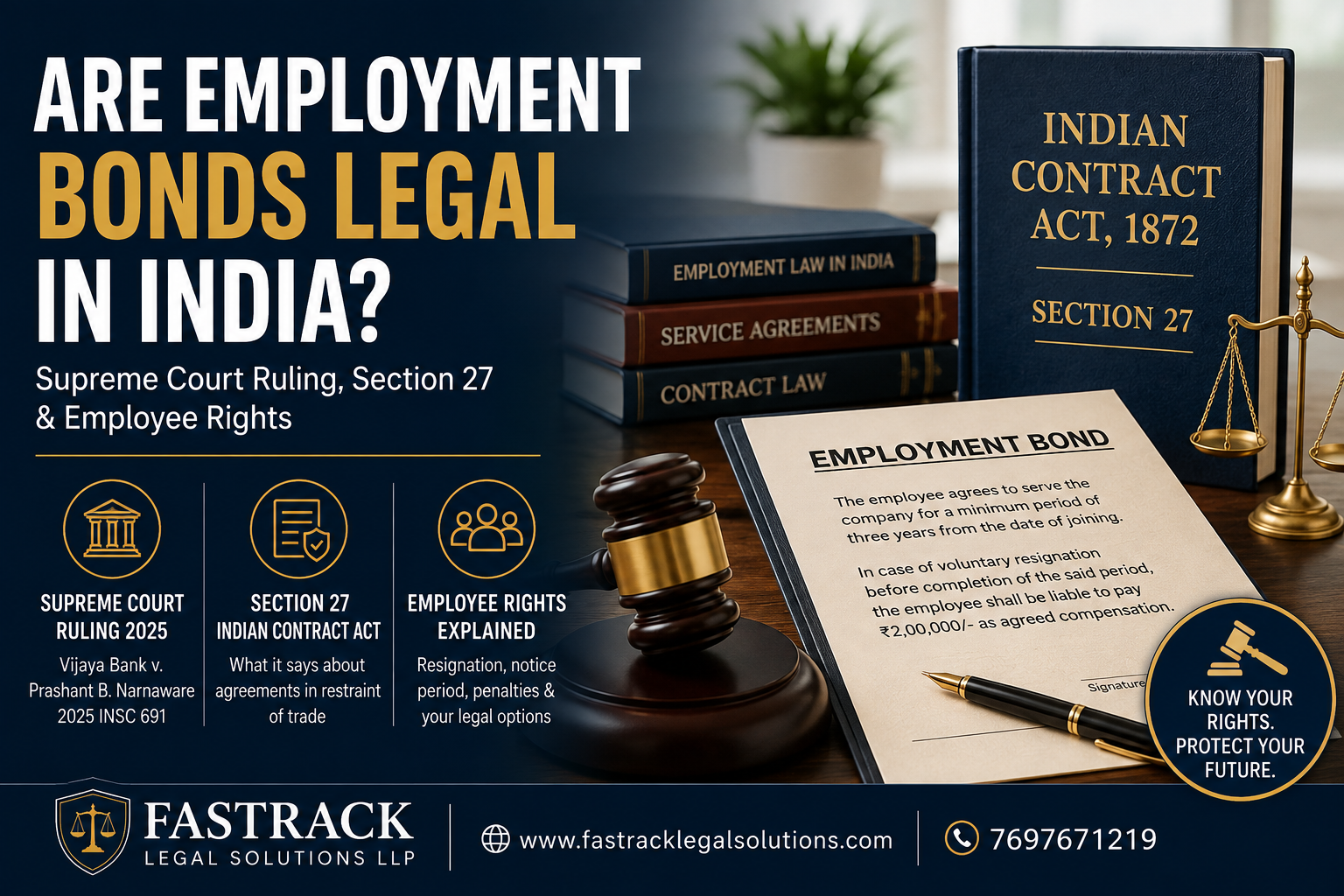
- 7 Essential Legal Rules for Employment Bonds in India
- Employment Bond Law at a Glance
- What Is an Employment Bond?
- What Did the Supreme Court Decide in Vijaya Bank v. Prashant B. Narnaware?
- Why Did the Supreme Court Uphold the Employment Bond?
- Section 27 of the Indian Contract Act and Employment Bonds
- Does the Supreme Court Judgment Mean Every Employment Bond Is Valid?
- Why the Facts of the Vijaya Bank Case Matter
- Does an Employer Have to Prove That the Bond Is Reasonable?
- Can an Employer Recover the Entire Bond Amount Automatically?
- Section 73 and Actual Loss
- Is an Employment Bond Valid Only If the Employer Paid for Training?
- Can an Employer Force an Employee to Continue Working?
- Employment Bond vs Notice Period
- Employment Bond vs Non-Compete Clause
- What Makes an Employment Bond Stronger for an Employer?
- Warning Signs That an Employment Bond May Be Vulnerable
- Can a ₹5 Lakh or ₹10 Lakh Employment Bond Be Enforced?
- Can a Company Recover an Employment Bond From a Fresher?
- What If the Employee Was Forced to Sign the Bond?
- What If the Employer Terminates the Employee?
- What If the Employee Resigns Due to Employer Breach?
- Can an Employer Send a Legal Notice for Bond Recovery?
- Can an Employer File a Civil Suit?
- What If the Employment Agreement Contains an Arbitration Clause?
- Can an Employer Withhold Full-and-Final Settlement Because of the Bond?
- Does an Employment Bond Need to Be on Stamp Paper?
- Does an Employment Bond Need to Be Notarised?
- Employment Bond Drafting Checklist for Employers
- Employment Bond Review Checklist for Employees
- Frequently Asked Questions on Employment Bonds in India
- Are employment bonds legal in India?
- Did the Supreme Court say all employment bonds are valid?
- Can an employer require an employee to work for three years?
- Can a company stop an employee from resigning?
- Can an employer stop an employee from joining another company?
- Can an employer recover the entire bond amount?
- Is an employment bond valid if no training was provided?
- Is a two-year employment bond legal in India?
- Is a five-year employment bond valid?
- Can a fresher challenge an employment bond?
- Can an employer enforce a bond if it terminates the employee?
- Can an employer deduct bond money from salary?
- Can an employment-bond dispute go to arbitration?
- Does signing a bond mean the employee automatically loses the case?
- Supreme Court's Key Takeaway for Employers
- Key Takeaway for Employees
- Important Legal Provisions
- Important Supreme Court Judgment
- Conclusion
7 Essential Legal Rules for Employment Bonds in India
Yes, an employment bond can be legally enforceable in India—but not every employment bond is automatically valid.
The Supreme Court of India significantly clarified the law in Vijaya Bank & Anr. v. Prashant B. Narnaware, 2025 INSC 691, where it upheld a contractual condition requiring an employee to serve for a minimum period of three years or pay ₹2 lakh upon premature resignation.
The Court held that the particular clause did not violate Section 27 of the Indian Contract Act, 1872, because its object was to regulate the employeee’s obligation during the subsistence of employment rather than prevent him from taking up future employment after leaving.
However, the judgment should not be read as declaring every service bond, training bond or minimum-employment clause enforceable.
The validity of an employment bond can still depend on:
- the duration of the minimum-service period;
- the amount demanded on premature resignation;
- the employer’s legitimate business interest;
- recruitment or training expenditure;
- bargaining power between the parties;
- whether the term is oppressive or unconscionable;
- whether it restricts future employment;
- the nature of the employee’s position; and
- whether the amount claimed constitutes reasonable compensation.
The legal position therefore lies between two incorrect extremes:
“All employment bonds are illegal” is incorrect.
And:
“If an employee signed a bond, the employer can recover any amount written in it” is also incorrect.
Employment Bond Law at a Glance
Principal statute: Indian Contract Act, 1872
Key provision: Section 27 – Agreement in restraint of trade
Public-policy provision: Section 23 of the Indian Contract Act
Damages provisions: Sections 73 and 74 of the Indian Contract Act
Leading recent judgment: Vijaya Bank & Anr. v. Prashant B. Narnaware, 2025 INSC 691
Supreme Court decision date: 14 May 2025
Core distinction: A reasonable minimum-service condition operating during employment is legally different from a restraint preventing an employee from working elsewhere after termination.
What Is an Employment Bond?
An employment bond, sometimes called a service bond, is a contractual term under which an employee agrees to remain with an employer for a specified minimum period or face specified contractual consequences for leaving earlier.
Employment bonds are commonly used where employers claim to incur significant expenditure on:
- specialised training;
- technical certification;
- relocation;
- recruitment;
- onboarding;
- foreign assignments;
- professional courses;
- specialised skill development; or
- filling positions involving high replacement costs.
A typical clause may state:
“The employee shall serve the company for a minimum period of two years. If the employee voluntarily resigns before completion of the minimum service period, the employee shall be liable to pay ₹1,50,000 towards agreed compensation.”
Whether such a clause will ultimately be enforceable cannot be answered merely by checking whether the employee signed it.
Its substance, purpose, proportionality and legal effect matter.
What Did the Supreme Court Decide in Vijaya Bank v. Prashant B. Narnaware?
The Supreme Court’s judgment in Vijaya Bank & Anr. v. Prashant B. Narnaware, 2025 INSC 691 is now one of the most important authorities on employment bonds in India.
The employee was subject to a condition requiring him to:
- serve the bank for a minimum period of three years; and
- pay ₹2 lakh if he resigned before completing that period.
He resigned before completing three years and paid the stipulated amount under protest.
The dispute ultimately reached the Supreme Court.
The principal questions were whether the clause:
- amounted to restraint of trade under Section 27 of the Indian Contract Act; and
- was opposed to public policy under Section 23.
The Supreme Court upheld the clause.
Why Did the Supreme Court Uphold the Employment Bond?
1. The Clause Did Not Restrict Future Employment
This was crucial.
The Court distinguished between a restriction that operates during an employment contract and a restriction that prevents a former employee from earning a livelihood after employment has ended.
The clause before the Court required a minimum period of service or payment of the agreed amount upon premature resignation.
It did not prevent the employee from subsequently joining another employer.
The Supreme Court therefore held that the object of the restriction was to further the subsisting employment relationship and not to restrain future employment.
This distinction is fundamental when drafting or challenging employment agreements.
Section 27 of the Indian Contract Act and Employment Bonds
Section 27 of the Indian Contract Act, 1872 declares agreements restraining a person from exercising a lawful profession, trade or business void to that extent, subject to the statutory exception concerning sale of goodwill.
Employment contracts require a more careful analysis.
Indian courts have historically distinguished:
Restrictions During Employment
A condition requiring an employee to work exclusively for an employer during the subsistence of the employment agreement does not necessarily amount to an unlawful restraint of trade.
Restrictions After Employment Ends
A clause that broadly prevents a former employee from joining competitors or carrying on a profession after termination faces much greater difficulty under Section 27.
This distinction was recognised in earlier Supreme Court authorities including:
- Niranjan Shankar Golikari v. Century Spinning & Manufacturing Co. Ltd.
- Superintendence Company of India (P) Ltd. v. Krishan Murgai
The Supreme Court reaffirmed this distinction while deciding the Vijaya Bank case.
Does the Supreme Court Judgment Mean Every Employment Bond Is Valid?
No.
This is perhaps the most important qualification.
The Supreme Court expressly examined the clause in its particular factual setting.
It did not enact a universal rule that every employer may impose any minimum-service period or any monetary penalty.
The judgment itself reiterates that employment covenants may have to be examined for:
- unconscionability;
- unfairness;
- unreasonableness;
- public-policy concerns; and
- restraint of lawful employment.
The Court also observed that judgments must be applied keeping the factual matrix peculiar to each case in mind.
Therefore, an employer cannot safely argue:
“The Supreme Court has declared all employment bonds valid.”
That proposition would be too broad.
Why the Facts of the Vijaya Bank Case Matter
The employer in that case was a public sector bank.
The Supreme Court accepted the bank’s justification that premature resignations could result in substantial institutional consequences because recruitment required:
- open advertisement;
- competitive recruitment;
- administrative expenditure;
- time;
- replacement arrangements; and
- a fresh recruitment process.
The Court also considered the employee’s position and the amount of ₹2 lakh in determining whether the clause was oppressive or made resignation practically impossible.
Therefore, a private employer seeking to rely upon this judgment should still be able to demonstrate why its own bond protects a legitimate and proportionate business interest.
Does an Employer Have to Prove That the Bond Is Reasonable?
The Supreme Court’s analysis places importance on justification for restrictive employment covenants.
Where enforceability is disputed, an employer should be prepared to demonstrate why the clause:
- protects a legitimate interest;
- does not merely punish resignation;
- does not prevent future employment;
- is proportionate to the circumstances;
- is not unconscionable;
- is not unfair or one-sided; and
- is consistent with public policy.
This makes careful drafting essential.
Companies should avoid copying generic employment-bond templates downloaded from the internet without considering the actual role, expenditure and commercial interest being protected.
Our guide on employment law compliance in India explains why appointment letters, employment agreements, disciplinary procedures and separation documentation should form part of a coordinated HR compliance system.
Can an Employer Recover the Entire Bond Amount Automatically?
Not necessarily merely because a number appears in the contract.
Where a contract specifies an amount payable upon breach, Section 74 of the Indian Contract Act becomes relevant.
Section 74 deals with compensation where a sum is named in a contract or a penalty is stipulated.
The enforceability of the amount claimed must therefore be examined in the context of reasonable compensation, the contractual language and the particular facts.
In the Vijaya Bank case, the Supreme Court upheld the ₹2 lakh amount on the facts before it.
That does not necessarily mean that a ₹10 lakh or ₹20 lakh bond imposed on a junior employee earning a modest salary would receive identical treatment.
Proportionality matters.
Section 73 and Actual Loss
Section 73 of the Indian Contract Act deals generally with compensation for loss or damage caused by breach of contract.
An employer seeking contractual damages may rely upon losses such as:
- training expenditure;
- recruitment expenditure;
- certification costs;
- relocation expenses;
- replacement costs; or
- other legally recoverable consequences of premature departure.
However, an employer should avoid artificially inflating the alleged loss.
For risk management, companies should maintain contemporaneous records showing how employment-bond amounts were calculated.
Is an Employment Bond Valid Only If the Employer Paid for Training?
No universal rule says that an employment bond can be valid only where expensive training was provided.
The Vijaya Bank judgment itself demonstrates that legitimate employer interests can extend beyond training costs.
The Court considered institutional recruitment costs and employee retention in the context of the bank.
However, where an employer relies on training expenditure as justification for the bond, the employer’s position is naturally stronger if it can produce evidence of:
- actual training fees;
- trainer costs;
- external certification expenses;
- travel or accommodation expenditure;
- specialised software or programme costs;
- paid courses; and
- other identifiable expenditure attributable to the employee.
A vague assertion that “we spent a lot on training” may be considerably weaker than properly documented expenditure.
Can an Employer Force an Employee to Continue Working?
An employment bond should not be confused with forced continuation of personal service.
The Specific Relief Act places limitations on specific enforcement of contracts that are dependent upon personal qualifications or involve duties that a court cannot appropriately supervise.
See Section 14 of the Specific Relief Act, 1963.
Therefore, the practical remedy for breach of an employment bond is ordinarily analysed through contractual remedies rather than compelling an unwilling employee to continue working indefinitely.
The distinction is important:
An employer’s possible right to claim contractual compensation is not the same thing as a right to compel labour.
Employment Bond vs Notice Period
These are separate contractual obligations.
An employment agreement may contain:
Notice Period Clause
For example:
60 days’ notice or salary in lieu thereof.
Minimum-Service Bond
For example:
Minimum service of 24 months, failing which specified compensation becomes payable.
An employee who resigns early may therefore face questions regarding both provisions.
However, merely because both clauses appear in the same agreement does not mean the employer automatically obtains double recovery.
The wording of the contract, nature of the obligations and actual loss must be examined carefully.
Employment Bond vs Non-Compete Clause
These should not be confused.
Employment Bond
Regulates premature departure during a specified minimum employment period and usually provides a monetary consequence.
Post-Employment Non-Compete
Attempts to restrict an employee from working for another employer or carrying on competing work after the employment relationship ends.
Post-employment restraints face serious scrutiny under Section 27 of the Contract Act.
This is why employers should not draft an otherwise defensible employment bond in language that unnecessarily attempts to prevent the employee from working for competitors after resignation.
For broader commercial drafting principles, see our guide on business contracts in India.
What Makes an Employment Bond Stronger for an Employer?
A professionally drafted bond should ordinarily address the following.
1. Identify the Legitimate Interest
Explain why minimum tenure is required.
For example:
- specialist training;
- lengthy recruitment;
- critical project continuity;
- employer-sponsored certification; or
- specialised role requirements.
2. Use a Reasonable Minimum Period
A 12-month or 24-month commitment may be easier to justify in some circumstances than an excessive period bearing little connection to the employer’s legitimate interest.
There is no universal statutory duration that automatically makes a bond valid.
3. Use a Defensible Compensation Formula
The amount should not look arbitrary.
It may be linked to:
- actual training expenditure;
- recruitment costs;
- relocation expenditure;
- certification costs;
- reasonable replacement costs; or
- another identifiable commercial basis.
4. Avoid Restricting Future Employment
The clause should not unnecessarily prohibit the employee from earning a livelihood after termination.
5. Consider Pro-Rata Reduction
A reducing liability can sometimes produce a more proportionate arrangement.
For example:
Bond amount: ₹1,20,000 for 12 months, reducing proportionately for every completed month.
This often better reflects the diminishing employer interest as the agreed service period is substantially performed.
6. Maintain Documentary Evidence
The company should preserve evidence supporting the calculation.
7. Integrate the Bond With the Employment Agreement
The appointment letter, employment agreement, confidentiality obligations, IP clauses, notice period and bond should not contradict each other.
Companies undertaking broader contract and governance reviews may also refer to our guide on legal risk audits for companies in India.
Warning Signs That an Employment Bond May Be Vulnerable
An employee challenging a bond should examine whether it contains features such as:
- extremely long compulsory tenure;
- disproportionate monetary liability;
- no identifiable employer investment or interest;
- same bond amount regardless of when resignation occurs;
- broad prohibition on future employment;
- restriction covering an entire industry;
- clauses preventing lawful resignation altogether;
- one-sided or oppressive terms;
- inconsistent appointment documents;
- penalties having no apparent commercial basis;
- coercive execution circumstances; or
- contractual terms contrary to statute or public policy.
No single factor automatically determines the dispute, but these issues may materially affect enforceability.
Can a ₹5 Lakh or ₹10 Lakh Employment Bond Be Enforced?
There is no statutory rule that a particular rupee amount is automatically valid or invalid.
The correct question is whether the amount and contractual scheme are legally defensible in the circumstances.
Relevant considerations can include:
- employee salary;
- seniority;
- duration of minimum service;
- employer’s actual investment;
- difficulty and cost of recruitment;
- training expenditure;
- length of service already completed;
- nature of the breach;
- wording of the agreement; and
- whether the amount operates as reasonable compensation or an oppressive deterrent.
The ₹2 lakh amount upheld in the Vijaya Bank judgment should therefore not be converted into a universal benchmark.
Can a Company Recover an Employment Bond From a Fresher?
Potentially, but the employee’s status as a fresher does not by itself answer the legal question.
In fresher recruitment, employers frequently rely on:
- initial training programmes;
- certification;
- technical onboarding;
- campus recruitment expenditure; and
- specialised role preparation.
However, fresh graduates may also possess less bargaining power.
A court examining an unusually harsh standard-form contract may consider whether the terms are unconscionable, unfair or unreasonable.
The Supreme Court’s analysis expressly recognises the importance of fairness and bargaining power when employment contracts are tested against public policy.
What If the Employee Was Forced to Sign the Bond?
Simply saying “I had no option because I needed the job” will not automatically invalidate every employment agreement.
Standard-form contracts are common in employment.
However, Indian contract law does recognise issues concerning:
- free consent;
- coercion;
- undue influence;
- fraud;
- misrepresentation;
- unlawful objects; and
- public policy.
A genuine allegation that the contract was unconscionable or procured through legally relevant pressure requires examination of the actual facts and evidence.
What If the Employer Terminates the Employee?
This is a very important drafting issue.
Many bonds are drafted only around employee resignation.
If the employer itself terminates the employee before completion of the bond period, the employer’s ability to demand the bond amount will depend heavily on:
- the wording of the bond;
- reason for termination;
- misconduct, if any;
- contractual provisions;
- applicable employment law; and
- surrounding facts.
An employer terminating an employee for organisational reasons should not automatically assume that the employee remains liable for the entire minimum-service amount.
What If the Employee Resigns Due to Employer Breach?
An employee may argue that premature resignation resulted from serious employer defaults such as:
- non-payment of salary;
- fundamental change in employment terms;
- unlawful conduct;
- unsafe workplace;
- material contractual breach; or
- other legally relevant circumstances.
Whether such circumstances defeat or reduce a bond claim depends on the facts and the contractual framework.
Employers should therefore treat employment agreements as part of a complete HR compliance system rather than merely as recovery instruments.
Can an Employer Send a Legal Notice for Bond Recovery?
Yes, an employer asserting breach may issue a legal demand setting out:
- employment agreement;
- bond provision;
- joining date;
- minimum-service obligation;
- resignation date;
- alleged breach;
- compensation claimed;
- basis of calculation; and
- payment demand.
The employee may dispute:
- validity of the bond;
- calculation;
- applicability of Section 27;
- public policy;
- proportionality;
- employer’s own breach;
- amount claimed;
- facts surrounding resignation; or
- other contractual defences.
The legal notice should therefore not merely state:
“You signed the bond, therefore pay immediately.”
A well-founded claim should establish the contractual and legal basis for recovery.
Can an Employer File a Civil Suit?
Depending upon the contract, arbitration clause and facts, an employer seeking recovery may pursue the appropriate contractual dispute-resolution remedy.
The correct forum may depend on:
- arbitration agreement;
- territorial jurisdiction clause;
- place of employment;
- cause of action;
- amount claimed;
- applicable court jurisdiction; and
- nature of relief.
The applicable limitation period must also be checked from the date on which the contractual cause of action arose.
What If the Employment Agreement Contains an Arbitration Clause?
Where a valid arbitration agreement covers the dispute, the employer or employee may invoke arbitration in accordance with the Arbitration and Conciliation Act, 1996.
The employment bond should therefore never be read in isolation.
The complete dispute-resolution clause must be reviewed.
Can an Employer Withhold Full-and-Final Settlement Because of the Bond?
An employer should distinguish between:
- earned salary;
- statutory dues;
- contractual set-off;
- notice-pay recovery;
- bond compensation; and
- disputed claims.
A disputed bond claim should not automatically be treated as authority to disregard statutory employment obligations.
The legality of deduction or adjustment depends upon the nature of the dues, applicable employment legislation, contractual authority and facts.
Does an Employment Bond Need to Be on Stamp Paper?
Execution on stamp paper does not by itself make an unlawful clause lawful.
Conversely, contractual enforceability should not be analysed only by asking whether the document was notarised.
Stamp duty is governed by applicable stamp legislation and State-specific requirements.
Depending upon the instrument and jurisdiction, insufficient stamping may create evidentiary or procedural issues.
Employers should therefore obtain proper advice regarding the form and stamp treatment of the particular instrument rather than relying on generic internet templates.
Does an Employment Bond Need to Be Notarised?
Notarisation is not a substitute for the fundamental requirements of a valid contract.
The substantive questions remain:
- Was there a valid agreement?
- Was there free consent?
- Was the object lawful?
- Is the restriction compatible with Section 27?
- Is the provision consistent with public policy?
- Is the monetary consequence legally defensible?
Notarising an otherwise unlawful clause does not cure its illegality.
Employment Bond Drafting Checklist for Employers
Before implementing an employment bond, an employer should ask:
- What legitimate business interest are we protecting?
- Why is minimum service necessary for this particular position?
- What is the actual cost of recruitment or training?
- Is the minimum period proportionate?
- How was the bond amount calculated?
- Does liability reduce as the employee completes service?
- Does the clause improperly restrain future employment?
- Does it conflict with the notice-period clause?
- What happens if the employer terminates employment?
- What happens if employment ends due to illness or incapacity?
- What happens if the company fundamentally breaches the agreement?
- Is there an arbitration clause?
- Is the governing-law clause appropriate?
- Is territorial jurisdiction properly drafted?
- Is the document correctly stamped?
Employment Bond Review Checklist for Employees
Before paying an amount demanded by an employer, check:
- the exact bond clause;
- appointment letter;
- employment agreement;
- minimum-service period;
- date of joining;
- date of resignation;
- amount of service already completed;
- compensation formula;
- training actually provided;
- documents supporting employer expenditure;
- notice-period compliance;
- post-employment restrictions;
- arbitration clause;
- employer’s own contractual compliance; and
- whether the amount demanded matches the agreement.
An employee should not assume either that the demand is automatically enforceable or that the bond can simply be ignored.
Frequently Asked Questions on Employment Bonds in India
Are employment bonds legal in India?
Yes, an employment bond may be enforceable depending on its terms and circumstances. The Supreme Court upheld the particular minimum-service clause considered in Vijaya Bank v. Prashant B. Narnaware, 2025 INSC 691.
Did the Supreme Court say all employment bonds are valid?
No. The Court decided the validity of the clause before it on its particular facts. Unreasonable, unconscionable or unlawful provisions remain open to legal scrutiny.
Can an employer require an employee to work for three years?
A reasonable minimum-service condition is not automatically invalid merely because it requires service for a specified period. Its enforceability depends on the contractual terms and circumstances.
Can a company stop an employee from resigning?
An employment bond may create contractual consequences for premature resignation, but that is different from compelling an employee indefinitely to render personal service.
Can an employer stop an employee from joining another company?
A broad restriction operating after employment has ended faces significant difficulty under Section 27 of the Indian Contract Act.
Can an employer recover the entire bond amount?
Not automatically in every case. The nature and amount of contractual compensation must be tested against the Contract Act and the particular facts.
Is an employment bond valid if no training was provided?
Absence of training does not automatically make every bond invalid. Legitimate employer interests may include recruitment and retention costs, but the justification must be assessed case by case.
Is a two-year employment bond legal in India?
There is no statutory rule that makes a two-year period automatically valid or invalid. Reasonableness depends upon the surrounding circumstances.
Is a five-year employment bond valid?
A longer duration may attract greater scrutiny, particularly where the employer cannot demonstrate a proportionate legitimate interest. There is no universal statutory maximum applicable to all employment bonds.
Can a fresher challenge an employment bond?
Yes. An employee may challenge the enforceability, amount, fairness or application of the bond based on the facts and law.
Can an employer enforce a bond if it terminates the employee?
That depends substantially on the wording of the agreement, reason for termination and applicable law.
Can an employer deduct bond money from salary?
The legality of deduction depends on the nature of the payment, contractual authority, applicable wage/employment legislation and the facts. A disputed contractual claim should not automatically be treated as an unrestricted right of deduction.
Can an employment-bond dispute go to arbitration?
Yes, where the employment contract contains a valid arbitration agreement covering the dispute.
Does signing a bond mean the employee automatically loses the case?
No. Signature proves agreement to the document but does not make an otherwise unlawful, unconscionable or legally unenforceable clause automatically valid.
Supreme Court’s Key Takeaway for Employers
The strongest lesson from Vijaya Bank v. Prashant B. Narnaware is not:
“Employment bonds are now always valid.”
The stronger legal lesson is:
A properly justified minimum-service covenant operating during employment can be enforceable where it protects a legitimate employer interest, does not restrain future employment and is not unconscionable, unfair, unreasonable or contrary to public policy.
Employers should therefore move away from arbitrary penalty clauses and instead adopt evidence-based, proportionate employment-bond structures.
Key Takeaway for Employees
Employees should similarly avoid relying on outdated internet claims that all service bonds are illegal under Section 27.
After the Supreme Court’s 2025 ruling, such an argument may be legally inadequate.
The better analysis is to examine:
- what exactly the bond restricts;
- whether it operates during or after employment;
- why the employer imposed it;
- whether the duration is proportionate;
- whether the amount is reasonable;
- what expenditure or interest the employer can demonstrate;
- whether the terms are unconscionable;
- whether the employer breached the contract; and
- what remedies the agreement actually provides.
Important Legal Provisions
Section 23, Indian Contract Act, 1872
Deals with lawful consideration and object, including agreements opposed to public policy.
Section 27, Indian Contract Act, 1872
Governs agreements in restraint of profession, trade or business.
Section 73, Indian Contract Act, 1872
Provides the general framework for compensation for loss caused by breach of contract.
Section 74, Indian Contract Act, 1872
Deals with compensation where a sum is stipulated or a penalty is provided for breach.
Section 14, Specific Relief Act, 1963
Identifies categories of contracts that cannot be specifically enforced, including contracts dependent upon personal qualifications in the manner specified by the statute.
Important Supreme Court Judgment
Vijaya Bank & Anr. v. Prashant B. Narnaware, 2025 INSC 691
Court: Supreme Court of India
Date: 14 May 2025
Coram: Justice Pamidighantam Sri Narasimha and Justice Joymalya Bagchi
The Supreme Court upheld a clause requiring minimum service of three years or payment of ₹2 lakh upon premature resignation.
The Court held that the particular clause:
- operated during the employment relationship;
- did not restrain future employment;
- did not violate Section 27;
- was not opposed to public policy on the facts; and
- was justified in light of the employer’s recruitment and retention considerations.
Read the official Supreme Court judgment.
Conclusion
Employment bonds are no longer safely analysed through the simplistic statement that “service bonds are illegal in India.”
The Supreme Court’s decision in Vijaya Bank v. Prashant B. Narnaware confirms that a minimum-service obligation can be legally sustainable where the covenant operates during the subsistence of employment, protects a legitimate employer interest and does not unlawfully obstruct future employment.
At the same time, the judgment does not give employers unlimited power.
Every bond must still withstand scrutiny under:
- Section 23 of the Contract Act;
- Section 27;
- the law of contractual damages;
- public policy;
- principles concerning unconscionable contracts; and
- the particular factual circumstances of the employment relationship.
For employers, the correct approach is proportionate drafting supported by evidence.
For employees, the correct approach is clause-specific legal analysis rather than assuming that signature either automatically creates liability or automatically makes the bond unenforceable.
Related Fastrack Legal Solutions Guides
Read our detailed guide on Employment Law Compliance in India for appointment letters, HR policies, wages, PF, ESI, gratuity, POSH, termination and employment documentation.
For commercial drafting principles, see Business Contracts in India: Essential Clauses, Legal Risks and Drafting.
Companies reviewing broader legal and contractual exposure may refer to our guide on Legal Risk Audit for Companies in India.
About Fastrack Legal Solutions LLP
Fastrack Legal Solutions LLP is a New Delhi-based legal practice engaged in litigation, corporate and employment advisory, legal risk mitigation, due diligence, service matters and allied legal work.
Website: www.fastracklegalsolutions.com
Contact: 7697671219
New Delhi, India
Disclaimer
This article is published solely for general legal information and public legal awareness. It does not constitute legal advice, solicitation, advertisement or an invitation to form an advocate-client relationship.
Employment-bond disputes are fact-specific. Enforceability may depend upon the wording of the employment agreement, nature of the employee’s position, applicable State employment laws, contractual consideration, stamp requirements, nature of employer expenditure, quantum of damages, cause of separation, dispute-resolution clause and binding judicial precedent. Case-specific legal advice should be obtained where required.
© 2026 Fastrack Legal Solutions LLP. All Rights Reserved.