
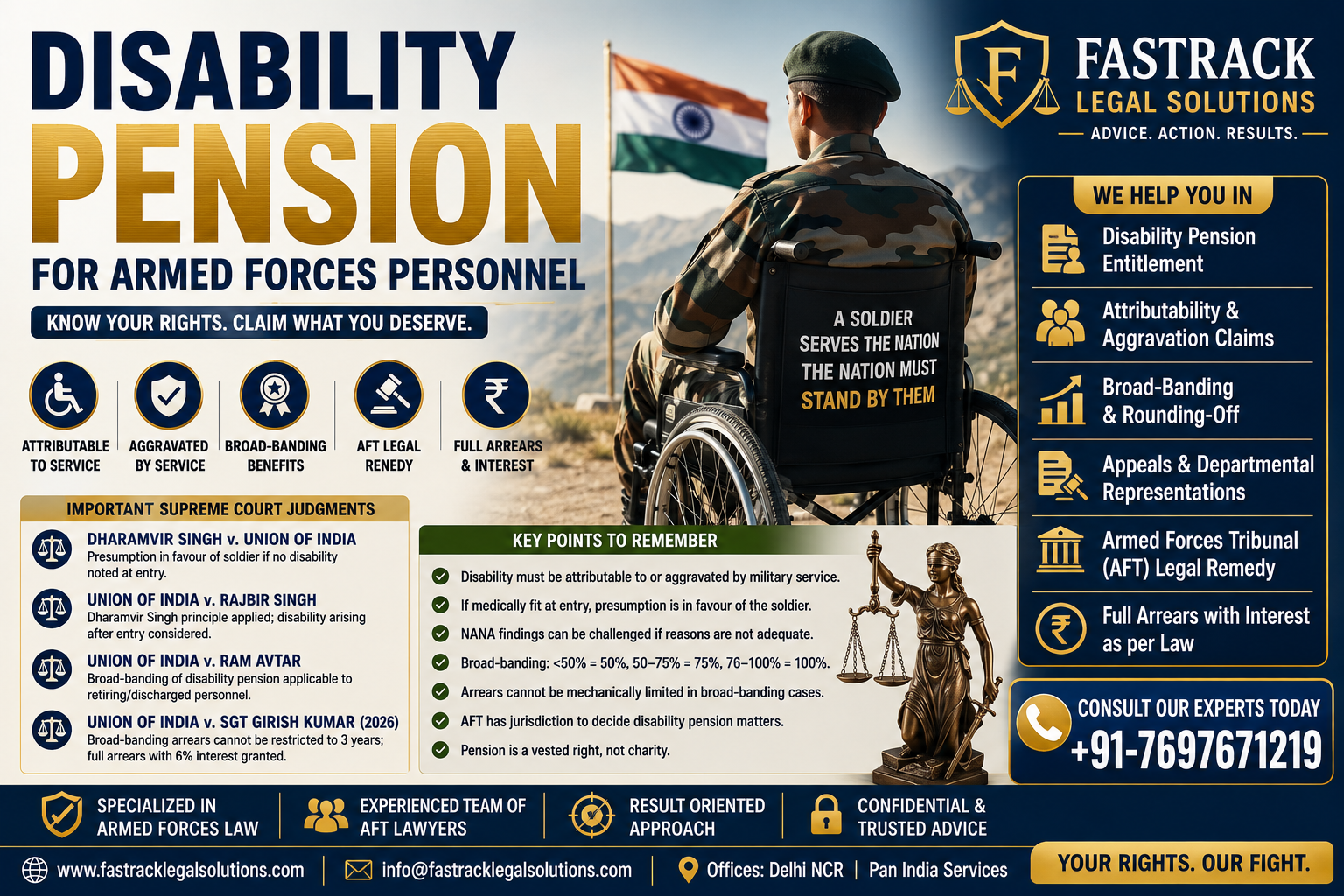
Armed Forces Pension Law · Medical Boards · Broad-Banding · AFT
Disability Pension for Armed Forces: Eligibility, Medical Board, Reassessment, Broad-Banding & AFT Appeal 2026
A practical legal guide to disability-pension entitlement, NANA findings, attributable/aggravated disabilities, reassessment and resurvey medical boards, broad-banding, arrears and Armed Forces Tribunal remedies.
Attributable to or aggravated by service, subject to the governing pension framework.
Diagnosis, percentage, duration, causation and reasons must be examined together.
A disputed percentage or later deterioration may require resurvey/reassessment depending on the applicable rules.
Departmental remedies should be examined before filing an OA under Section 14 of the AFT Act.
What is disability pension in the Armed Forces?
Disability pension is a service-linked pensionary award available under the applicable Armed Forces pension framework where the statutory and medical conditions are satisfied. Historically, disability pension has comprised a service element and a disability element. Under the 2023 framework, different terminology is also used for certain retained-in-service cases, including impairment relief.
The first legal question is therefore not simply, “What percentage disability has been assessed?” It is: Which entitlement framework applies, what did the medical board conclude, what reasons did it give, and how did the individual leave service?
2023 Entitlement Rules: who do they apply to?
The Ministry of Defence stated when issuing the Entitlement Rules for Casualty Pension and Disability Compensation Awards to Armed Forces Personnel, 2023 and the Guide to Medical Officers (Military Pensions), 2023 that death and disability reported or recorded after 21 September 2023 would be governed by ER 2023/GMO 2023. The Government also stated that the revised rules were intended to clarify and consolidate the framework and did not disturb past pensioners already receiving benefits.
That date distinction is crucial. A pension dispute should not mix older entitlement jurisprudence and the 2023 framework without first identifying the date on which the disability was reported/recorded and the manner of exit from service.
Invalided out versus retained in service
| Issue | Invalided from service | Retained despite disability |
|---|---|---|
| Exit | Medical invaliding before normal completion. | Continues in service and later retires/releases normally. |
| Relevant benefit | Disability pension, subject to entitlement. | Impairment-relief framework may apply in eligible post-2023 cases. |
| Core dispute | Attributability/aggravation, invaliding, percentage. | Accepted disability, retention, RIAB/assessment and retirement entitlement. |
Attributable to military service
A disability is attributable to military service where the causal origin is sufficiently connected with military service under the governing entitlement rules. The factual inquiry may involve operational deployment, field/high-altitude service, injury reports, accidents, training, exposure, duty conditions, onset and specialist medical evidence.
Aggravated by military service
Aggravation concerns a condition that may not have originated because of military service but was materially worsened by service conditions. The analysis is usually more nuanced than simply identifying a diagnosis. It may require comparison of onset, progression, service environment, medical categorisation and functional deterioration.
What does NANA mean?
NANA means “neither attributable to nor aggravated by military service.” It is a common basis for rejection of disability-related benefits. A NANA conclusion should be examined for the medical reasoning supporting it, the service conditions actually considered, the date of onset and the governing entitlement rules.
In older-rule cases, Supreme Court decisions such as Dharamvir Singh v. Union of India and Union of India v. Rajbir Singh are frequently relied upon where no disability was noted at entry and the condition arose during service. For post-21 September 2023 cases, those authorities must be read alongside ER 2023/GMO 2023 rather than treated as if the rule framework had remained unchanged.
Medical boards that may become relevant
| Board / process | Why it matters |
|---|---|
| Invaliding Medical Board | Relevant where the member is medically invalided from service. |
| Release Medical Board | Often relevant at normal retirement/release where a disability exists. |
| Resurvey / reassessment process | May become relevant where a disability percentage or duration requires later review under the applicable rules. |
| Appeal / review medical process | May be relevant where causation or percentage is disputed. |
| Retention-cum-Impairment Assessment | Relevant under the current framework for eligible personnel retained despite attributable/aggravated disability. |
Disability percentage and reassessment
Your search data is already showing interest in the disability pension re-evaluation / reassessment process. This is legally distinct from broad-banding.
Three issues must be separated:
- Entitlement: Is the disability attributable to or aggravated by service?
- Assessment: What is the medically assessed percentage and duration?
- Broad-banding: If entitlement exists, is the assessed percentage rounded to a prescribed slab for pension computation?
If the dispute is that the medical percentage itself is too low, the legal focus is on the medical assessment, functional impairment and available reassessment/resurvey route. If entitlement already exists and the dispute is only about rounding-off, the broad-banding authorities become central.
Broad-banding / rounding-off
Broad-banding rounds an eligible assessed disability to a prescribed pension slab. The commonly applied broad-banding structure has historically operated as follows:
| Assessed disability | Broad-banded level |
|---|---|
| Below 50% | 50% |
| 50%–75% | 75% |
| 76%–100% | 100% |
The precise entitlement depends on the applicable policy, category of exit and date. The Supreme Court’s broad-banding jurisprudence, including Union of India v. Ram Avtar, remains important for covered legacy cases.
Supreme Court 2026: Sgt Girish Kumar and arrears
In Union of India through its Secretary & Ors. v. Sgt Girish Kumar & Ors., 2026 INSC 149, decided on 12 February 2026, the Supreme Court dealt with restriction of arrears in broad-banding cases. The judgment is particularly important where disability-pension entitlement already exists and the controversy concerns computation/broad-banding rather than a fresh claim to establish service causation.
The decision should therefore be used precisely. It is a strong authority against mechanical curtailment of arrears in covered broad-banding matters, but it should not be converted into a proposition that every delayed first-time disability-pension entitlement claim automatically carries unlimited arrears.
For the dedicated analysis, see Disability Pension Arrears & Broad-Banding — Sgt Girish Kumar.
When should reassessment be considered?
The assessed percentage appears inconsistent with functional restriction or specialist records.
The disability was assessed for a limited period and later review is contemplated.
The medical condition has materially worsened after the earlier assessment, subject to the governing rules.
The percentage or causation finding conflicts with the underlying medical record.
The exact procedural route varies by date, service and pension category. A reassessment request should therefore identify the medical basis for review, the earlier board findings, the present functional impairment and the rule/circular under which reconsideration is sought.
Documents to collect before appeal or AFT filing
- Entry medical examination / commissioning or enrolment medical record.
- Complete AFMS medical history and specialist opinions.
- Medical-category proceedings.
- Release / Invaliding / Retention-cum-Impairment Board proceedings, as applicable.
- Disability percentage and duration assessment.
- Attributability/aggravation opinion and reasons.
- Service profile and posting history.
- Field, high-altitude and operational posting records where relevant.
- Injury report / Court of Inquiry / accident documentation in injury cases.
- Pension sanction or rejection order.
- First and second appeal papers and decisions, where applicable.
- PPO / corrigendum PPO and pension calculation documents.
Common grounds for challenge
- wrong entitlement framework or effective date applied;
- service conditions not considered;
- NANA conclusion not supported by adequate reasoning;
- medical percentage inconsistent with documented impairment;
- medical-board findings internally inconsistent;
- reassessment/resurvey request not considered under the applicable rules;
- broad-banding policy not applied to an otherwise eligible claimant;
- departmental appeal disposed of without addressing material medical or service evidence;
- retained-in-service case not examined under the correct impairment-relief framework.
Appeal and Armed Forces Tribunal remedy
Disability-pension disputes are service matters within the Armed Forces Tribunal’s jurisdiction under Section 14 of the Armed Forces Tribunal Act, 2007. Section 21 deals with exhaustion of remedies and Section 22 with limitation. The litigation strategy should be built around the actual rejection order and appellate record rather than assuming that recurring pension consequences eliminate all limitation issues.
Related resources include the Army Disability Pension 2026 — ER 2023 & Impairment Relief and the Armed Forces Tribunal guide.
Frequently asked questions
Can a disability pension case be reconsidered if the percentage is too low?
Potentially, yes. The relevant route depends on the original medical-board assessment, whether the percentage was temporary or final, the applicable service rules and whether fresh medical evidence shows a legally relevant basis for reassessment.
Is reassessment the same as broad-banding?
No. Reassessment concerns the underlying medical percentage. Broad-banding concerns pension computation after entitlement and assessment are established.
Can 20% disability be rounded to 50%?
In covered legacy broad-banding cases, 20% may be rounded to 50%, subject to the applicable pension framework and judicial authorities.
What if the medical board says NANA?
The claimant should examine whether the board applied the correct entitlement rules, considered the relevant service conditions and gave a sustainable medical explanation for the causation finding.
Can AFT interfere with a medical-board opinion?
The Tribunal does not simply substitute its medical view, but it can examine whether the opinion is reasoned, legally sustainable, based on relevant material and consistent with the governing rules.
Does the 2023 framework apply to every old pension case?
No. The Government stated that disabilities reported or recorded after 21 September 2023 would be governed by ER 2023/GMO 2023, while past pensioners already receiving disability/death compensation were not affected merely by issuance of the revised framework.
Professional correspondence
For professional correspondence concerning disability pension, medical-board disputes or Armed Forces Tribunal proceedings, the Fastrack Legal Solutions LLP case-information form may be used.
Provided only for professional identification and correspondence. It is not solicitation, advertising, inducement or assurance of outcome.
Primary sources and further reading
- Ministry of Defence / PIB — ER 2023 & GMO 2023 press brief
- Department of Ex-Servicemen Welfare — pension circulars
- Armed Forces Tribunal Act, 2007 — India Code
- Supreme Court — Union of India v. Sgt Girish Kumar, 2026 INSC 149
Disclaimer: This article is for general legal information and education. Disability-pension entitlement depends on the applicable rule set, date, medical record, service conditions, category of discharge/retirement, appeal history and individual facts.