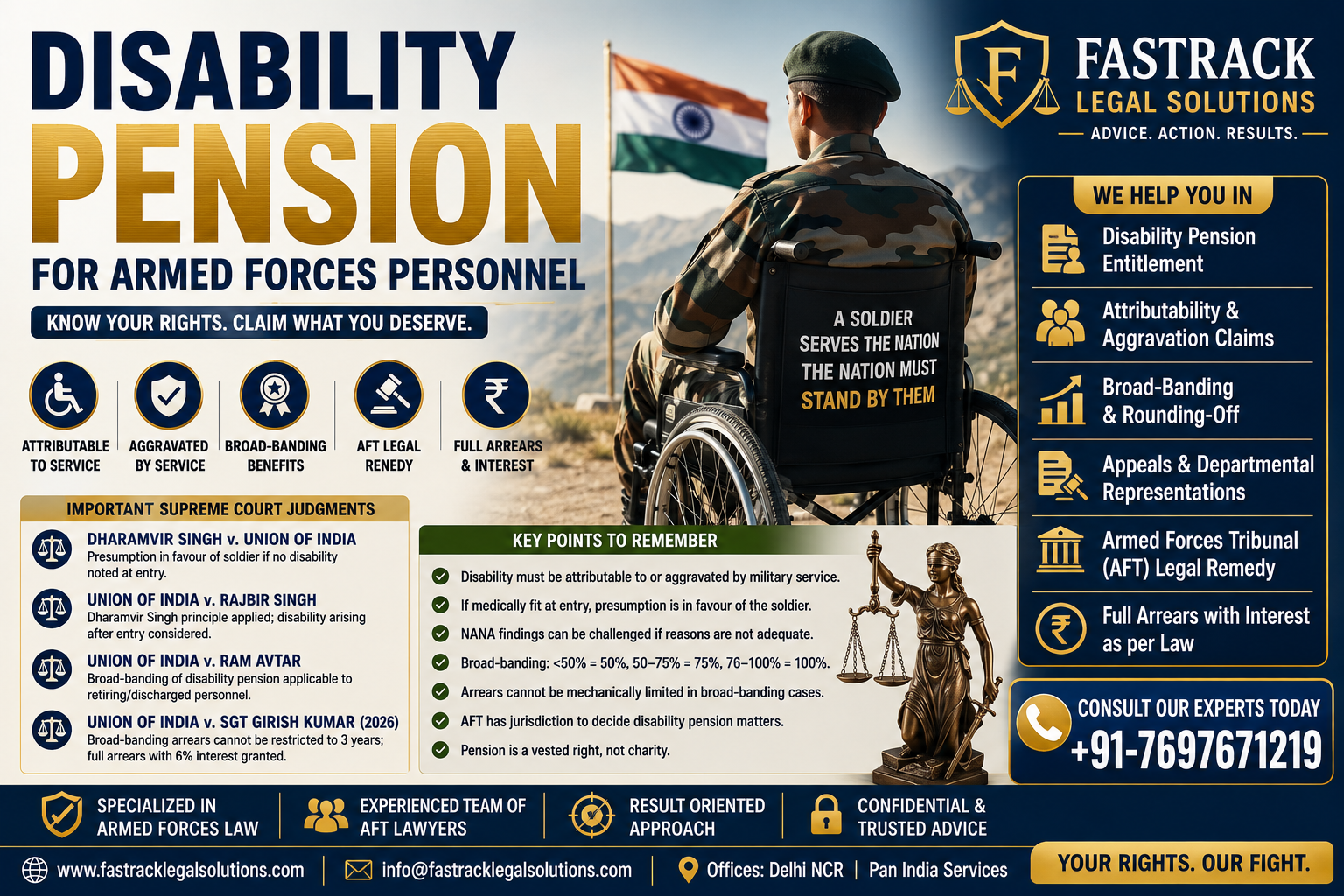
Disability pension for Armed Forces personnel is payable where a disability is attributable to or aggravated by military service and satisfies the applicable pensionary rules. In many cases, if no disease or disability was noted at the time of enrolment/commissioning, and the disability arose during service, courts have applied a presumption in favour of the soldier unless the authorities establish that the condition was neither attributable to nor aggravated by service. The Armed Forces Tribunal has jurisdiction over service matters, including disability pension disputes, under Section 14 of the Armed Forces Tribunal Act, 2007. Broad-banding/rounding-off of disability element is governed by Supreme Court jurisprudence including Ram Avtar and Sgt Girish Kumar, with the latter holding that broad-banding arrears cannot be mechanically restricted to three years in covered cases.
Table of Contents
Introduction
Disability pension is one of the most litigated issues in Armed Forces service law. A soldier may be enrolled in sound medical condition, serve in field areas, high altitude, counter-insurgency zones, operational conditions, stressful appointments or prolonged military environments, and later be invalided out, discharged, released or superannuated with a disability. Yet, at the pension stage, the disability may be declared “neither attributable to nor aggravated by military service” by the medical board or pension sanctioning authority.
That rejection is not final merely because the department says so. Disability pension disputes can be challenged through departmental appeal and, where necessary, before the Armed Forces Tribunal.
This article explains disability pension for Armed Forces personnel in India, including eligibility, medical board findings, attributability, aggravation, broad-banding, arrears, appeal procedure, AFT remedy and important Supreme Court case law.
What is Disability Pension?
Disability pension is a pensionary benefit granted to eligible Armed Forces personnel who suffer from a disability attributable to or aggravated by military service, subject to applicable rules, percentage of disability and service conditions.
It generally has two components:
- Service element — related to qualifying service.
- Disability element — related to the assessed percentage of disability.
Where the person is otherwise entitled, the disability element is calculated based on the disability percentage and applicable pension rules. In appropriate cases, the assessed disability percentage may also be rounded off/broad-banded to the next prescribed slab.
Who Can Claim Disability Pension?
Disability pension claims commonly arise for:
- Officers.
- Junior Commissioned Officers.
- Other Ranks.
- Air Force personnel.
- Naval personnel.
- Territorial Army personnel, subject to applicable rules.
- Personnel invalided out due to disability.
- Personnel discharged/released on completion of tenure with disability.
- Personnel superannuating with disability attributable to or aggravated by service.
- Personnel whose disability pension was rejected by PCDA/Pension Sanctioning Authority.
The exact entitlement depends on service record, medical board opinion, disability percentage, date of discharge, applicable regulations and whether the disability is attributable to or aggravated by military service.
Legal Framework for Disability Pension
The framework may include:
- Pension Regulations for the Army / Navy / Air Force, as applicable.
- Entitlement Rules for Casualty Pensionary Awards / Disability Compensation Awards.
- Guide to Medical Officers.
- Ministry of Defence policy letters.
- Medical Board proceedings.
- Armed Forces Tribunal Act, 2007.
- Supreme Court and AFT judgments.
The Pension Regulations for the Army, Part-I, 2008 regulate pensionary awards for personnel of the Regular Army, Defence Security Corps, Emergency/Short Service Commissioned Officers and Territorial Army.
The 2023 Entitlement Rules were notified to supersede the 2008 Entitlement Rules, as reflected in Government material explaining the new framework. The Ministry of Defence press note records that the Entitlement Rules and Guide to Medical Officers were earlier promulgated in 2008 and that the 2023 framework was introduced after several policy developments in disability/death compensation.
People Also Ask: What Are Attributability and Aggravation?
Attributability
A disability is attributable to military service when it is causally connected with service conditions, injury, disease, stress, exposure, operational duty or other military factors.
Examples may include:
- Injury during duty.
- Injury during authorised movement.
- Disease caused by service conditions.
- Disability linked with field/operational/high-altitude service.
- Trauma or injury in military environment.
- Service-related psychiatric or physical conditions, depending on medical evidence.
Aggravation
A disability is aggravated by military service where the condition may not have originated in service but worsened due to military service conditions.
Examples may include:
- Hypertension worsened by service stress.
- Orthopaedic condition worsened by military duties.
- Psychiatric condition aggravated by operational stress.
- Hearing loss aggravated by military noise exposure.
- Existing condition worsened by harsh service environment.
The key is causal connection. The medical board must give a reasoned opinion, not a mechanical declaration.
Presumption in Favour of Soldier
A major principle in disability pension cases is that if a person was accepted into military service in sound medical condition and no disease/disability was recorded at entry, later deterioration may attract a presumption in favour of the claimant, unless the authorities show that the disability was not connected with service.
The Supreme Court in Dharamvir Singh v. Union of India applied this welfare principle and held that where no note of disease existed at entry, the presumption could operate in favour of the soldier, subject to facts and rules.
The Supreme Court in Union of India v. Rajbir Singh followed the reasoning in Dharamvir Singh and noted that absence of a disability note at entry was significant in assessing entitlement.
Medical Board and Disability Pension
The medical board plays a central role in disability pension matters. Common boards include:
- Release Medical Board.
- Invaliding Medical Board.
- Resurvey Medical Board.
- Appeal Medical Board.
- Review Medical Board.
The medical board usually records:
- Diagnosis.
- Percentage of disability.
- Duration: temporary or life.
- Whether disability is attributable to service.
- Whether disability is aggravated by service.
- Whether disability is neither attributable nor aggravated.
- Reasons for such opinion.
- Service conditions considered.
- Date of onset.
- Category and restrictions.
A medical board opinion must be reasoned. A bald endorsement of “NANA” — neither attributable nor aggravated — without proper reasoning is often vulnerable to challenge.
People Also Ask: What if RMB Says Disability is NANA?
If the Release Medical Board or Invaliding Medical Board says the disability is NANA, the claimant can challenge it if:
- The person was medically fit at entry.
- Disability arose during service.
- Service conditions were not properly considered.
- The board gave no reasons.
- The board ignored field/operational/high-altitude/stress exposure.
- The onset occurred during service.
- The disease is known to be affected by service conditions.
- The pension authority rejected the claim mechanically.
- Appeal was rejected without independent reasoning.
- Applicable Supreme Court principles support entitlement.
AFT pleadings should specifically attack the medical board reasoning, not merely state that the board was wrong.
Minimum Disability Percentage
Traditionally, disability pension entitlement often required disability assessed at 20% or more, subject to applicable rules and facts. However, disability percentage issues must be analysed carefully because courts have considered cases involving lower assessment, reassessment, rounding-off, invaliding, and entitlement under later policy.
Where a disability is assessed at less than 20%, the legal strategy may involve:
- Challenging percentage assessment.
- Seeking resurvey/reassessment.
- Challenging arbitrary medical opinion.
- Invoking broad-banding only where legally available.
- Examining whether invaliding presumption applies.
- Reviewing applicable rules by date of retirement/discharge.
The correct route depends on whether the dispute is about entitlement, percentage, or rounding-off.
Broad-Banding / Rounding-Off of Disability Pension
Broad-banding means rounding off the disability element to a higher slab.
Historically, the broad-banding issue arose because the benefit was granted to personnel invalided out of service but denied to those who retired or were discharged on completion of tenure. The Supreme Court in Union of India v. Ram Avtar affirmed broad-banding benefits for similarly placed Armed Forces personnel, and subsequent cases applied the principle across AFT matters.
The common broad-banding slabs are:
| Assessed Disability | Rounded / Broad-Banded Disability |
|---|---|
| Less than 50% | 50% |
| 50% to 75% | 75% |
| 76% to 100% | 100% |
The exact entitlement depends on rules, date, status and facts.
People Also Ask: Can 20% Disability Be Rounded Off to 50%?
Yes, in covered Armed Forces disability pension cases, 20% disability may be rounded off/broad-banded to 50%, subject to eligibility and applicable legal framework. This is the principle flowing from the broad-banding jurisprudence including Ram Avtar and later judgments.
However, broad-banding is not a substitute for proving entitlement. First, disability pension entitlement must exist. Then, rounding-off/broad-banding may be claimed.
Supreme Court on Full Arrears of Broad-Banding: Sgt Girish Kumar
In Union of India through its Secretary v. Sgt Girish Kumar and Others, 2026 INSC 149, decided on 12 February 2026, the Supreme Court held that arrears arising from broad-banding of disability pension cannot be mechanically restricted to only three years before filing of the OA before the AFT.
The Court held that disability pension is a valuable vested right, pensionary entitlement has the character of property, and the benefit cannot be denied by invoking limitation, delay or laches in covered broad-banding cases. The Court granted eligible ex-servicemen broad-banding arrears from 01.01.1996 or 01.01.2006, as applicable, with 6% interest per annum.
This is a major judgment for ex-servicemen whose broad-banding arrears were restricted.
People Also Ask: Can Disability Pension Arrears Be Restricted to Three Years?
In covered broad-banding cases, the Supreme Court in Sgt Girish Kumar held that arrears of broad-banded disability pension cannot be restricted to only three years prior to filing of the OA. The Court treated disability pension as a vested pensionary right and rejected limitation-based curtailment in the broad-banding context.
Caution: this does not mean every stale disability pension claim automatically gets unlimited arrears. The judgment is strongest where entitlement to disability pension already exists and the dispute concerns broad-banding/re-computation.
Important Supreme Court Judgments on Disability Pension
1. Dharamvir Singh v. Union of India
Proposition: If no disease or disability is noted at entry and the condition arises during service, presumption may operate in favour of the soldier unless the authorities prove otherwise. This judgment is frequently relied upon in cases where the disability arose during service but was later declared NANA.
2. Union of India v. Rajbir Singh
Proposition: The Supreme Court applied the Dharamvir Singh reasoning and emphasised the significance of absence of disability at entry while considering disability pension entitlement.
3. Union of India v. Ram Avtar
Proposition: Armed Forces personnel retiring or discharged on completion of tenure with disability attributable to or aggravated by military service are entitled to broad-banding/rounding-off benefits, subject to applicable facts.
4. Union of India v. Sgt Girish Kumar
Proposition: Broad-banding arrears cannot be mechanically restricted to three years before filing the AFT application in covered cases; disability pension is a valuable vested right with property-right implications.
5. Union of India v. Baljit Singh
Proposition: The earlier strict approach emphasised the need for a causal connection between disability and military service. This judgment is often cited by the Union, but later welfare-oriented judgments such as Dharamvir Singh and Rajbir Singh are crucial where presumption and lack of entry-note issues arise.
Appeal Against Rejection of Disability Pension
If disability pension is rejected, the claimant should normally examine departmental remedies before approaching the AFT.
First Appeal
The first appeal generally challenges:
- Rejection of attributability/aggravation.
- Incorrect medical board findings.
- Non-speaking pension sanctioning authority order.
- Failure to consider service conditions.
- Wrong disability percentage.
- Incorrect denial of disability element.
- Incorrect denial of broad-banding.
- Failure to apply Supreme Court judgments.
Second Appeal
Where first appeal is rejected, a second appeal may lie depending on applicable procedure and service instructions.
AFT Original Application
If departmental remedies fail, the claimant can file an Original Application under Section 14 of the Armed Forces Tribunal Act, 2007, because disability pension is a service matter within the AFT’s jurisdiction. The AFT Act expressly deals with jurisdiction, powers and authority in service matters under Section 14.
Limitation Before Armed Forces Tribunal
Section 22 of the Armed Forces Tribunal Act deals with limitation. The Act also requires exhaustion of remedies under Section 21 before admission, subject to statutory conditions.
In disability pension cases, limitation must be analysed carefully because pension is often treated as a recurring cause, but arrears may still become a disputed issue. After Sgt Girish Kumar, broad-banding arrears in covered cases stand on a stronger footing.
Practical approach:
- File appeal/representation promptly.
- Do not wait for years after rejection.
- If delay exists, plead recurring cause and explain delay.
- For broad-banding arrears, rely on Ram Avtar and Sgt Girish Kumar where applicable.
- For fresh entitlement cases, plead facts carefully and do not assume unlimited arrears.
Documents Required for Disability Pension Claim
A strong disability pension file should include:
- Enrolment/commissioning details.
- Service record extracts.
- Medical category documents.
- Initial medical examination record, if available.
- Injury report, if injury case.
- Medical board proceedings.
- Release Medical Board / Invaliding Medical Board.
- Disability percentage certificate.
- PPO / corrigendum PPO.
- Rejection order from pension sanctioning authority.
- First appeal and rejection order.
- Second appeal and rejection order, if any.
- Posting profile.
- Field/high-altitude/operational service records.
- Hospitalisation records.
- Sick report / treatment record.
- Discharge book.
- Last pay certificate.
- Representation correspondence.
- Relevant Supreme Court/AFT judgments.
The quality of documents often determines the strength of the OA.
Common Reasons for Rejection
Disability pension claims are commonly rejected on grounds such as:
- Disability declared NANA.
- Disability assessed below 20%.
- Disease described as constitutional.
- Disease described as idiopathic.
- Disability said to be lifestyle-related.
- Service conditions not accepted as causal.
- Disability said to be detected close to retirement.
- Injury said to be not on duty.
- Medical board records insufficient.
- Appeal rejected mechanically.
Each ground requires a specific legal response. A generic OA will not be effective.
Grounds for Challenging Rejection Before AFT
A disability pension OA may plead:
- Applicant was medically fit at entry.
- No disability was noted at enrolment/commissioning.
- Disability arose during military service.
- Medical board failed to give proper reasons.
- NANA opinion is mechanical.
- Service conditions were ignored.
- Field/operational/high-altitude/stress exposure was not considered.
- Disease was aggravated by military service.
- Benefit of reasonable doubt must favour the soldier.
- Pension sanctioning authority cannot override medical board without lawful basis.
- Disability pension is welfare-oriented and not charity.
- Broad-banding is payable under Ram Avtar.
- Arrears cannot be restricted in covered broad-banding cases after Sgt Girish Kumar.
The pleadings should connect facts to legal principles. Merely citing judgments without service facts is weak.
Disability Pension for Lifestyle Diseases
Cases involving hypertension, diabetes, coronary artery disease, obesity-related complications, psychiatric conditions, hearing loss, spinal disorders and degenerative diseases require careful factual analysis.
The department often argues that such diseases are constitutional, lifestyle-related or not connected with service. The claimant may counter by showing:
- Normal medical condition at entry.
- Onset during service.
- Stressful service conditions.
- Operational/field/high-altitude exposure.
- Long service duration.
- Military work environment.
- Medical category history.
- Aggravation due to service.
- Absence of proper reasoning in medical board.
- Supporting medical literature, where appropriate.
Not every lifestyle disease automatically qualifies. But not every such disease can be rejected mechanically either.

Disability Pension for Injuries
Injury cases may involve:
- Training injury.
- Battle casualty.
- Physical training injury.
- Sports injury during authorised activity.
- Road accident while on duty.
- Injury while proceeding to or returning from duty.
- Leave-related injury.
- Injury during authorised travel.
- Injury in operational area.
- Injury during military exercise.
The legal issue often becomes whether the injury occurred in the course of duty or was sufficiently connected with military service.
Important documents include:
- Injury report.
- Court of Inquiry, if any.
- Medical board proceedings.
- Duty certificate.
- Movement order.
- Leave certificate.
- Travel documents.
- Witness statements.
- Hospital records.
- Commanding Officer’s remarks.
Disability Pension and Broad-Banding: Practical Examples
Example 1: 20% Disability for Life
If an ex-serviceman is granted 20% disability pension for life but broad-banding is denied, he may seek rounding-off to 50% if covered by the broad-banding jurisprudence.
Example 2: Disability Pension Rejected as NANA
If the disability pension itself is rejected as NANA, first challenge entitlement. Broad-banding becomes relevant only after entitlement is established.
Example 3: Broad-Banding Granted Only Prospectively
If broad-banding is granted from a later date but arrears are restricted, Sgt Girish Kumar may be relevant if the case falls within the covered class.
Example 4: Disability Below 20%
If disability is assessed below 20%, the strategy may involve challenging assessment, seeking reassessment, or examining whether invaliding and applicable rules support entitlement.
People Also Ask: Can AFT Grant Disability Pension?
Yes. The Armed Forces Tribunal can decide service matters, including pension and disability pension disputes, under Section 14 of the Armed Forces Tribunal Act, 2007.
The AFT can examine:
- Rejection of disability pension.
- Wrong NANA finding.
- Denial of broad-banding.
- Arrears restriction.
- Incorrect disability percentage.
- Medical board defects.
- Pension sanctioning authority errors.
- Non-speaking appeal orders.
People Also Ask: Is Disability Pension a Right or Charity?
Disability pension is not charity. In Sgt Girish Kumar, the Supreme Court recognised disability pension as a valuable vested right and rejected the idea that it can be treated as largesse. The Court also treated pensionary entitlement as having property-right character in the context of Article 300A.
This principle is important in pleadings because pensionary benefits should not be denied on hyper-technical grounds when entitlement is otherwise established.
Do’s for Disability Pension Claimants
- Collect complete medical board papers.
- Obtain rejection order.
- File appeal promptly.
- Preserve service posting profile.
- Highlight field/operational/stress exposure.
- Obtain old medical category documents.
- Check whether disability was noted at entry.
- Challenge vague NANA findings.
- Claim broad-banding separately where applicable.
- Seek arrears and interest with proper pleadings.
Don’ts for Disability Pension Claimants
- Do not file OA without medical board records.
- Do not rely only on emotional facts.
- Do not ignore limitation.
- Do not plead broad-banding before proving entitlement.
- Do not conceal earlier rejection/appeal orders.
- Do not assume all diseases automatically qualify.
- Do not ignore service-condition evidence.
- Do not file generic copied grounds.
- Do not miss PPO/corrigendum PPO issues.
- Do not delay after rejection.
Search-Optimised Quick Answers
What is disability pension in Armed Forces?
Disability pension is a pensionary benefit for eligible Armed Forces personnel whose disability is attributable to or aggravated by military service.
What is broad-banding of disability pension?
Broad-banding is rounding off the disability percentage to a higher slab, such as 20% to 50%, 50% to 75%, or 76% to 100%, where legally applicable.
Which court handles disability pension cases?
The Armed Forces Tribunal handles disability pension disputes as service matters under Section 14 of the Armed Forces Tribunal Act, 2007.
Which Supreme Court case helps disability pension claimants?
Important cases include Dharamvir Singh, Rajbir Singh, Ram Avtar and Sgt Girish Kumar.
Can disability pension be denied if medical board says NANA?
It can be challenged if the NANA finding is mechanical, unsupported by reasons, ignores service conditions, or is contrary to the presumption arising from sound medical condition at entry.
Frequently Asked Questions
1. Who is eligible for disability pension in Armed Forces?
A person may be eligible where the disability is attributable to or aggravated by military service and satisfies the applicable pension regulations, entitlement rules and disability percentage requirements.
2. What does attributable to military service mean?
It means the disability has a causal connection with military service, service conditions, injury, exposure, stress, operational duty or other service-related factors.
3. What does aggravated by military service mean?
It means the disability may not have originated due to service but worsened because of military service conditions.
4. What is NANA in disability pension cases?
NANA means “neither attributable to nor aggravated by military service”. A NANA finding often leads to rejection of disability pension but can be challenged if unsupported by reasons or contrary to facts.
5. Can 20% disability be rounded off to 50%?
Yes, in covered cases, 20% disability may be rounded off/broad-banded to 50% under the broad-banding jurisprudence following Ram Avtar, subject to eligibility.
6. Can disability pension arrears be restricted to three years?
In covered broad-banding cases, the Supreme Court in Sgt Girish Kumar held that arrears cannot be mechanically restricted to three years before filing the OA.
7. Can AFT grant disability pension?
Yes. The AFT has jurisdiction over service matters, including disability pension disputes, under Section 14 of the Armed Forces Tribunal Act, 2007.
8. What documents are needed for disability pension OA?
Medical board proceedings, rejection order, appeal papers, PPO, service record, medical category documents, posting profile, hospital records and proof of service conditions are important.
9. Is disability pension a vested right?
Where entitlement is established, disability pension is treated as a valuable right. In Sgt Girish Kumar, the Supreme Court recognised disability pension as a vested pensionary entitlement and not charity.
10. What is the strongest ground in disability pension cases?
The strongest ground usually depends on facts, but common strong grounds include sound medical condition at entry, disability arising during service, lack of reasoned NANA opinion, service-condition aggravation, and application of Supreme Court judgments.
Conclusion
Disability pension for Armed Forces personnel is not a discretionary favour. It is a service-linked pensionary entitlement where disability is attributable to or aggravated by military service. The law has evolved substantially through Supreme Court judgments, especially Dharamvir Singh, Rajbir Singh, Ram Avtar and Sgt Girish Kumar.
For claimants, the strongest legal route is a document-based challenge: establish medical fitness at entry, show onset or aggravation during service, attack mechanical NANA findings, rely on service conditions, and claim broad-banding and arrears where applicable.
A disability pension case is won through service record, medical board analysis, correct statutory framework and precise AFT pleadings.
Disclaimer
This article is intended for general legal awareness and educational purposes only. It does not constitute legal advice, solicitation, advertisement or creation of an advocate-client relationship. Disability pension claims depend on service record, medical board findings, disability percentage, attributability/aggravation, applicable regulations, date of discharge, appeal history, limitation and case-specific facts.