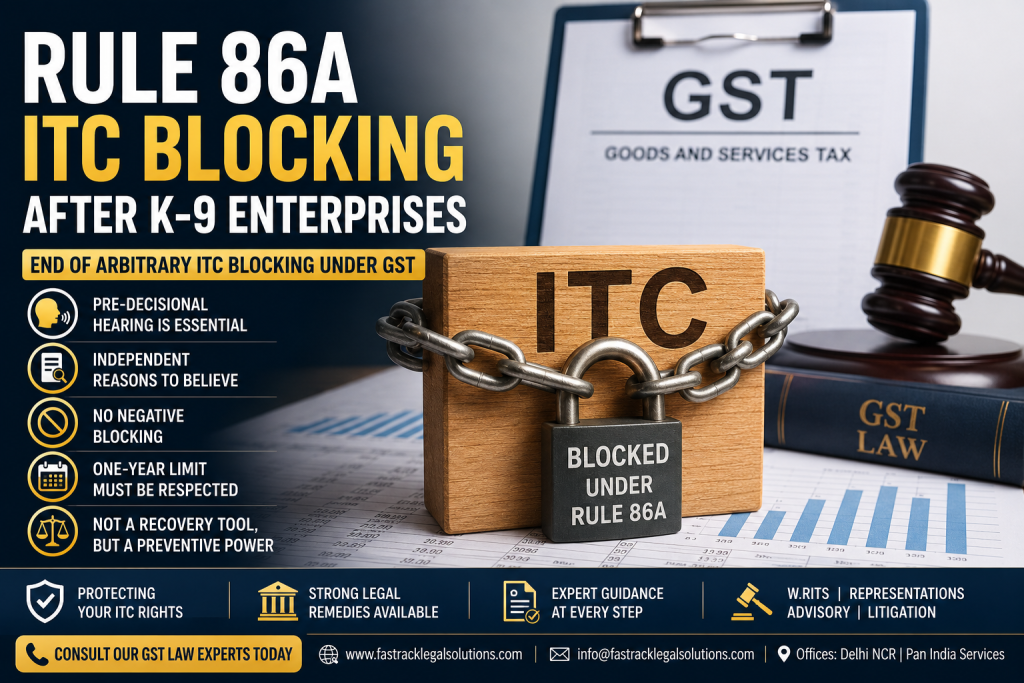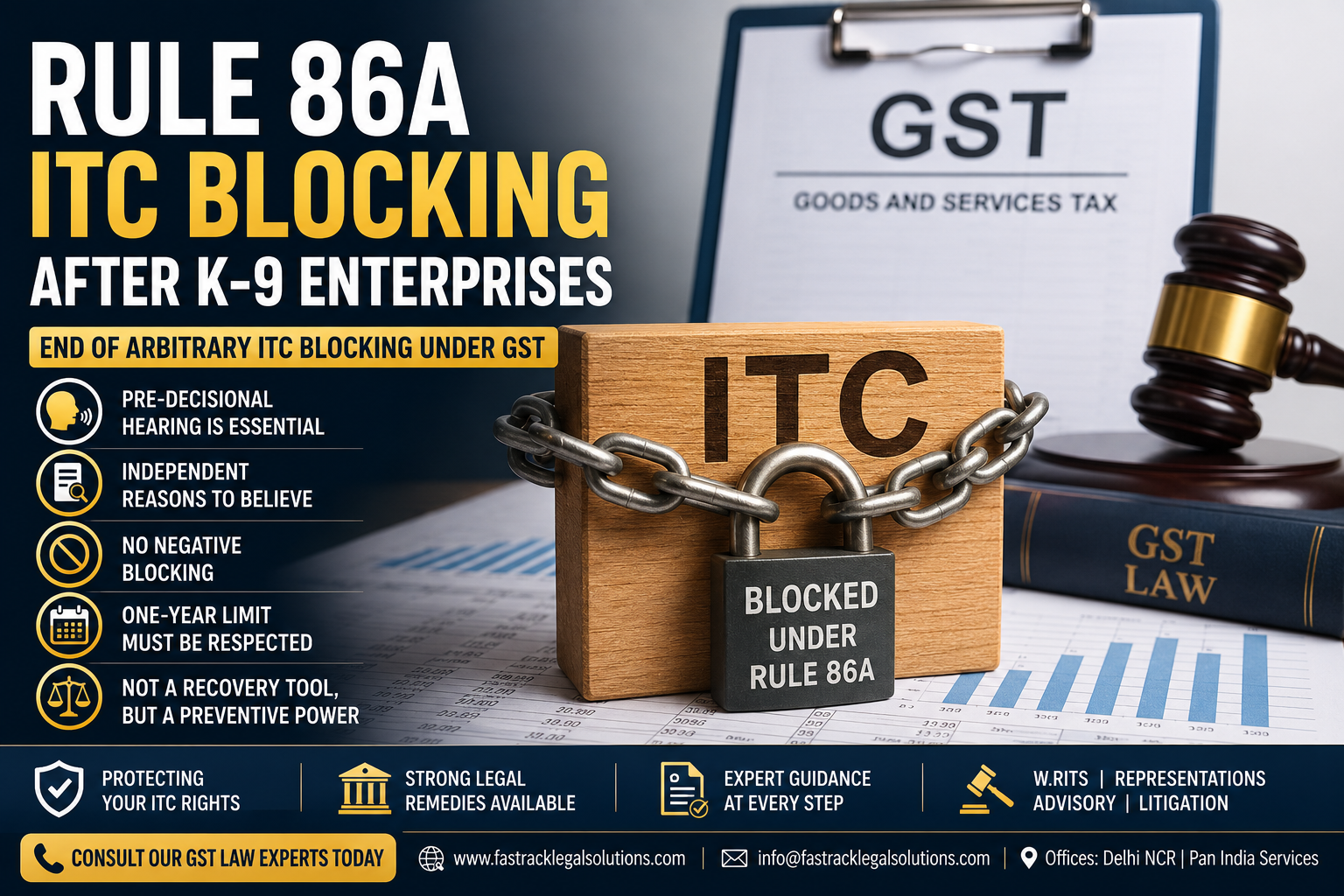
Rule 86A ITC Blocking After the K-9 Enterprises line of cases, GST authorities cannot mechanically block Input Tax Credit under Rule 86A of the CGST Rules. Rule 86A is a drastic preventive power and must be exercised only after the proper officer forms independent “reasons to believe” on the basis of relevant material. Courts have increasingly insisted on procedural safeguards such as pre-decisional hearing, independent application of mind, proportionate blocking, prohibition on negative blocking, and compliance with the one-year statutory sunset. Arbitrary blocking of Electronic Credit Ledger without reasons, without hearing, or beyond available credit is vulnerable to challenge before the High Court under Article 226.
Introduction
Input Tax Credit is the working-capital backbone of the GST system. If a taxpayer’s Electronic Credit Ledger is blocked, the business may be forced to pay tax in cash despite having credit, suppliers and customers may be affected, returns may become commercially difficult, and normal operations may suffer.
Rule 86A of the CGST Rules, 2017 was introduced as an anti-fraud measure to prevent misuse of fake or ineligible ITC. However, in practice, it has often been used as a coercive blocking tool before adjudication. Taxpayers have frequently faced ledger blocking through brief portal messages, internal departmental communications, or system-level restrictions without meaningful notice, reasons or hearing.
The judicial response has now become stronger. The K-9 Enterprises litigation and subsequent decisions have clarified that Rule 86A is not a parallel recovery mechanism. It is a temporary preventive measure and must be exercised strictly within the rule, principles of natural justice and constitutional limits.
This article explains Rule 86A after K-9 Enterprises, the safeguards against arbitrary ITC blocking, remedies available to taxpayers, and the practical legal strategy to challenge illegal blocking of Electronic Credit Ledger.
What is Rule 86A?
Rule 86A of the CGST Rules empowers the Commissioner or an authorised officer to disallow debit from the Electronic Credit Ledger where there are reasons to believe that ITC has been fraudulently availed or is ineligible.
In practical terms, Rule 86A allows the department to temporarily block utilisation of ITC lying in the Electronic Credit Ledger.
It may be invoked where the officer has reasons to believe that credit has been availed:
- On the strength of invoices without actual receipt of goods or services.
- From a supplier found non-existent or not conducting business from the registered place.
- Where tax charged in respect of supply has not been paid to the Government.
- Where the registered person availing ITC is found non-existent.
- Where the recipient is not in possession of tax invoice, debit note or prescribed document.
The power is preventive, not adjudicatory. It does not finally decide tax liability. It merely restricts debit from the Electronic Credit Ledger pending inquiry or proceedings.
Why Rule 86A Became Controversial
Rule 86A became controversial because it directly affects working capital without a full adjudication process.
The normal GST demand route under Sections 73 and 74 of the CGST Act requires:
- Show cause notice.
- Opportunity to reply.
- Personal hearing.
- Reasoned order.
- Appellate remedy.
- Recovery only after lawful determination.
Rule 86A, on the other hand, was often used before any such adjudication. The taxpayer would discover that the Electronic Credit Ledger was blocked, sometimes without a speaking order. This created serious civil consequences.
The core problem was this: a temporary anti-fraud power was being used like a recovery weapon.
K-9 Enterprises: Why the Judgment Matters
K-9 Enterprises is important because it treats Rule 86A as a drastic power requiring procedural discipline. The Karnataka High Court recognised that blocking of Electronic Credit Ledger causes serious civil consequences and cannot be done mechanically.
The case involved blocking of Electronic Credit Ledger under Rule 86A on the basis of alleged issues relating to suppliers. The taxpayer challenged the blocking, arguing that there was no proper pre-decisional hearing, no independent formation of reasons to believe, and that the department had acted on borrowed satisfaction.
The broader legal proposition emerging from K-9 Enterprises is that the officer invoking Rule 86A must independently examine the material and cannot merely reproduce or rely blindly on another officer’s report. Since Rule 86A disables utilisation of credit and affects business operations, the taxpayer must ordinarily be given a fair opportunity before such blocking.
The Three Pillars After K-9 Enterprises
Pillar 1: Pre-Decisional Hearing
A pre-decisional hearing means an opportunity to the taxpayer before the Electronic Credit Ledger is blocked.
Why is this important?
Because blocking ITC affects:
- Working capital.
- Ability to pay tax through credit.
- Business liquidity.
- Vendor payments.
- GST return strategy.
- Credit chain.
- Commercial reputation.
A post-blocking hearing is often inadequate because damage may already be done. If the taxpayer is heard before blocking, the department can avoid unnecessary hardship and distinguish genuine taxpayers from fake-credit operators.
Practical Effect
If ITC is blocked without prior notice or hearing, the taxpayer may challenge the action as violative of natural justice, especially where there is no urgency or risk of immediate misuse.
Pillar 2: Independent “Reasons to Believe”
Rule 86A uses the expression “reasons to believe”. This is not an empty phrase. It requires objective material and independent satisfaction by the competent officer.
The officer must identify:
- Which clause of Rule 86A applies.
- What material shows fraudulent or ineligible ITC.
- Why the taxpayer’s credit is suspicious.
- Whether the credit is actually available in the ledger.
- Why blocking is necessary to protect revenue.
- Whether less drastic action would suffice.
The authority cannot act merely on borrowed satisfaction. A field report, enforcement communication, data analytics flag or intelligence input may be relevant material, but the blocking officer must apply his own mind.
Practical Effect
A blocking order is vulnerable if it only says:
- “As per report of another officer.”
- “Supplier is suspicious.”
- “Credit appears doubtful.”
- “As directed by superior authority.”
- “ITC blocked for verification.”
Such language may show absence of independent reasons to believe.
Pillar 3: No Negative Blocking
Negative blocking means blocking more ITC than is actually available in the Electronic Credit Ledger, thereby creating an artificial negative balance or restricting future credit.
Courts have strongly questioned this practice because Rule 86A permits disallowing debit of credit available in the Electronic Credit Ledger. If no credit is available, or if the department blocks beyond available balance, the action may become recovery in disguise.
Rule 86A is not a recovery provision. If the department wants to recover allegedly wrongly availed credit already utilised, it must follow adjudication under the CGST Act.
Practical Effect
If the ledger balance is ₹2 lakh, the department cannot mechanically create a negative block of ₹50 lakh under Rule 86A. It must proceed through proper demand and recovery provisions.
One-Year Limit Under Rule 86A
Rule 86A contains a statutory time limit. The restriction ceases to have effect after expiry of one year from the date of imposing such restriction.
This means:
- Blocking cannot continue indefinitely.
- The department must complete investigation/adjudication promptly.
- After one year, the restriction should cease by operation of law.
- Continuing the block beyond one year is open to challenge.
The one-year period is not a licence to keep the taxpayer paralysed for a year. It is the outer limit, not the ideal duration.
People Also Ask: Can GST Department Block ITC Without Notice?
After the K-9 Enterprises line of cases, blocking ITC without notice or hearing is legally vulnerable, especially where there is no urgent necessity and the action causes serious civil consequences. Rule 86A may not expressly mention prior hearing, but courts have read principles of natural justice into the provision because ledger blocking directly affects business rights and working capital.
People Also Ask: What Are “Reasons to Believe” Under Rule 86A?
“Reasons to believe” means the officer must have objective material showing that ITC available in the Electronic Credit Ledger has been fraudulently availed or is ineligible. The reasons must be formed independently by the competent officer and should be recorded in writing. Mere suspicion, borrowed satisfaction, generic allegations or mechanical reliance on another officer’s report is not enough.
People Also Ask: Can ITC Be Blocked Beyond Available Ledger Balance?
No. Rule 86A cannot be used to create an artificial negative ITC balance. Blocking beyond the amount actually available in the Electronic Credit Ledger amounts to negative blocking and may be challenged as ultra vires Rule 86A. If the department alleges wrongly availed and utilised ITC, it must proceed through adjudication and recovery provisions.
People Also Ask: Can Rule 86A Be Used for Recovery?
No. Rule 86A is a temporary preventive measure. It is not a recovery provision. If the department wants to recover tax, interest or penalty, it must follow the procedure under the CGST Act, including show cause notice, hearing, adjudication and recovery as per law.
When Can Rule 86A Be Validly Invoked?
Rule 86A may be validly invoked where:
- The taxpayer has ITC available in the Electronic Credit Ledger.
- The authorised officer has objective material.
- The material falls within Rule 86A grounds.
- The officer records reasons to believe in writing.
- The officer independently applies his mind.
- The blocking is proportionate to the suspected ineligible credit.
- The taxpayer is given fair opportunity, unless exceptional urgency exists.
- The restriction is reviewed if conditions no longer exist.
- The restriction does not continue beyond one year.
- The department proceeds with substantive adjudication where required.
When Is Rule 86A Blocking Illegal or Vulnerable?
ITC blocking under Rule 86A may be challenged where:
- No prior notice or hearing was given.
- No reasons were recorded.
- Reasons were not communicated.
- Order is cryptic or non-speaking.
- Officer relied only on another officer’s report.
- There is no independent application of mind.
- ITC was blocked beyond available balance.
- Negative ledger balance was created.
- Blocking continued beyond one year.
- Blocking was used as pressure for recovery.
- No Section 73/74 adjudication was initiated.
- Supplier-level allegations were mechanically used against recipient.
- The taxpayer had invoices, goods receipt and payment proof.
- The action was disproportionate.
- The taxpayer was not allowed to submit evidence.
Documents Required to Challenge ITC Blocking
A taxpayer challenging Rule 86A action should collect:
- Copy of blocking order.
- Portal screenshot of blocked ledger.
- Electronic Credit Ledger statement.
- Details of blocked amount.
- Date of blocking.
- Name/designation of officer.
- Communication received from department.
- Show cause notice, if any.
- Reply filed, if any.
- Purchase invoices.
- E-way bills.
- Goods receipt documents.
- Transport documents.
- Payment proof to supplier.
- GSTR-2B / GSTR-2A records.
- Supplier GST status.
- Ledger accounts.
- Bank statements.
- Stock register.
- Correspondence with supplier.
- Representation seeking unblocking.
- Proof of business hardship.
The challenge should not be only procedural. The taxpayer should also prepare substantive evidence showing genuine availment of ITC.
Legal Remedies Against Rule 86A ITC Blocking
1. Representation Before GST Officer
The first practical step may be to file a detailed representation seeking unblocking.
The representation should state:
- ITC is genuine.
- Invoices are available.
- Goods/services were received.
- Payment was made through banking channels.
- GSTR-2B/2A supports claim.
- No fake invoicing exists.
- Blocking is disproportionate.
- No hearing was granted.
- Reasons to believe were not supplied.
- Business is suffering due to working-capital restriction.
2. Request for Reasons and Hearing
The taxpayer should specifically request:
- Copy of reasons recorded.
- Material relied upon.
- Personal hearing.
- Opportunity to file documents.
- Reconsideration under Rule 86A(2).
- Partial unblocking where only part credit is disputed.
3. Writ Petition Before High Court
Where the blocking is arbitrary, non-speaking, without hearing, based on borrowed satisfaction, beyond available credit or continuing beyond one year, a writ petition under Article 226 may be an effective remedy.
High Court relief may include:
- Quashing of Rule 86A blocking order.
- Direction to unblock Electronic Credit Ledger.
- Direction to provide reasons.
- Direction to grant hearing.
- Direction to restrict block only to eligible amount.
- Direction to decide representation within time.
- Direction against negative blocking.
- Costs or consequential relief in appropriate cases.
Drafting Grounds for Writ Petition
A writ petition challenging Rule 86A blocking may include the following grounds:
Ground 1: Violation of Natural Justice
The taxpayer was not given pre-decisional notice or hearing despite serious civil consequences.
Ground 2: No Independent Reasons to Believe
The blocking officer did not independently form reasons to believe and acted on borrowed satisfaction.
Ground 3: Non-Speaking Order
The order does not disclose material, reasons, clause invoked or nexus between allegation and credit blocked.
Ground 4: Rule 86A Used as Recovery
The department used Rule 86A to recover alleged tax without completing adjudication under Sections 73/74.
Ground 5: Negative Blocking
The department blocked more ITC than was available in the Electronic Credit Ledger.
Ground 6: Disproportionate Action
The entire ledger was blocked despite dispute, if any, being limited to specific transactions.
Ground 7: One-Year Sunset Violated
The block continued beyond the statutory one-year period.
Ground 8: Genuine ITC Evidence Ignored
The taxpayer had invoices, receipt proof, payment proof and GST records, but the department failed to consider them.
Supplier Default and Recipient’s ITC
A major issue in Rule 86A cases is whether the recipient’s ITC can be blocked merely because the supplier is alleged to be non-existent or defaulting.
The taxpayer should prepare evidence showing:
- Supplier was registered when transaction occurred.
- Tax invoice was issued.
- Goods or services were received.
- Payment was made through banking channels.
- E-way bill or transport record exists.
- Transaction is recorded in books.
- Credit appears in GSTR-2B/2A, where applicable.
- There was no collusion or knowledge of fraud.
- Due diligence was done at transaction stage.
- Department should first investigate the supplier chain properly.
This does not guarantee relief in every case, but it strengthens the bona fide purchaser/recipient defence.
Rule 86A and Article 300A
ITC, once validly availed, has been treated by courts as a valuable right. Blocking it without authority of law or without following lawful procedure can raise constitutional concerns, including deprivation of property-like rights under Article 300A.
The argument is not that ITC can never be restricted. The argument is that ITC cannot be restricted arbitrarily, mechanically or without due process.
Also read Online Gaming And new tax regime 2024
Practical Strategy for Taxpayers
Step 1: Identify the Blocking Order
Check whether you received:
- Formal order.
- Portal message.
- SMS/email.
- Officer communication.
- No communication but ledger blocked.
Step 2: Check the Amount
Compare:
- ITC available on date of blocking.
- Amount blocked.
- Alleged ineligible credit.
- Whether negative balance is created.
- Whether future credit is being restricted.
Step 3: Demand Reasons
Ask for reasons recorded and material relied upon.
Step 4: File Representation
Submit invoice-wise, supplier-wise and transaction-wise reply.
Step 5: Seek Hearing
Demand personal hearing and opportunity to produce documents.
Step 6: Approach High Court
If the action is arbitrary, urgent or paralysing the business, file writ petition.
Practical Strategy for GST Department
Even from the department’s perspective, Rule 86A orders should be properly structured to withstand judicial scrutiny.
A valid order should contain:
- Jurisdiction and authority of officer.
- Specific clause of Rule 86A invoked.
- Material relied upon.
- Independent reasons to believe.
- Amount of ITC available.
- Amount proposed to be blocked.
- Nexus with alleged fraudulent/ineligible credit.
- Hearing details.
- Consideration of taxpayer’s reply.
- Reasons for rejecting explanation.
- Period of restriction.
- Review mechanism.
A cryptic block will not survive serious challenge.
Rule 86A Compliance Checklist
For Taxpayers
- Preserve invoices.
- Keep e-way bills.
- Maintain transport proof.
- Keep payment proof.
- Reconcile GSTR-2B/2A.
- Conduct supplier due diligence.
- Maintain stock records.
- Reply promptly to notices.
- Demand reasons for blocking.
- Challenge arbitrary action quickly.
For Officers
- Verify jurisdiction.
- Identify Rule 86A clause.
- Record reasons in writing.
- Avoid borrowed satisfaction.
- Give pre-decisional hearing.
- Block only available credit.
- Avoid negative blocking.
- Review representations.
- Complete adjudication promptly.
- Release block if conditions no longer exist.
People Also Ask: How to Unblock ITC Under Rule 86A?
A taxpayer can seek unblocking by filing a representation before the GST officer with documents proving genuine ITC and by requesting reasons, hearing and reconsideration under Rule 86A(2). If the blocking is arbitrary, without hearing, without independent reasons, negative, disproportionate or beyond one year, the taxpayer may file a writ petition before the High Court.
People Also Ask: How Long Can ITC Be Blocked Under Rule 86A?
Rule 86A provides that the restriction shall cease to have effect after one year from the date of imposing such restriction. Therefore, ITC blocking cannot continue indefinitely under Rule 86A.
People Also Ask: Is ITC Blocking Same as Tax Demand?
No. ITC blocking is not the same as tax demand. Rule 86A only restricts debit from the Electronic Credit Ledger temporarily. Final tax demand requires adjudication under the CGST Act, including show cause notice, hearing and order.
Search-Optimised Quick Answers
What is Rule 86A in GST?
Rule 86A allows the GST department to temporarily restrict debit from Electronic Credit Ledger where the officer has reasons to believe that ITC has been fraudulently availed or is ineligible.
Can GST department block ITC without hearing?
After K-9 Enterprises, ITC blocking without pre-decisional hearing is legally vulnerable because blocking has serious civil consequences.
What is negative blocking under Rule 86A?
Negative blocking means blocking ITC beyond the available balance in the Electronic Credit Ledger. Courts have held such blocking to be impermissible.
Can Rule 86A be used for recovery?
No. Rule 86A is preventive, not a recovery provision. Recovery must follow adjudication under the CGST Act.
What is the remedy against arbitrary ITC blocking?
The taxpayer may file representation before the officer and, in appropriate cases, a writ petition before the High Court seeking unblocking of Electronic Credit Ledger.
Frequently Asked Questions
1. What is Rule 86A ITC blocking?
Rule 86A ITC blocking means restriction on debit from the Electronic Credit Ledger where the GST officer has reasons to believe that ITC has been fraudulently availed or is ineligible.
2. What did K-9 Enterprises decide?
K-9 Enterprises strengthened procedural safeguards around Rule 86A by emphasising that blocking of Electronic Credit Ledger has serious civil consequences and requires natural justice, independent reasons to believe and proper application of mind.
3. Is pre-decisional hearing mandatory before ITC blocking?
Courts have increasingly held that a pre-decisional hearing is necessary because Rule 86A blocking causes serious civil consequences and cannot be done mechanically.
4. What are reasons to believe under Rule 86A?
Reasons to believe mean objective and relevant material leading the authorised officer to independently conclude that ITC is fraudulent or ineligible.
5. Can ITC be blocked based on another officer’s report?
The blocking officer may consider another officer’s report, but cannot act mechanically. The officer must independently apply mind and record reasons.
6. Can GST department create negative ITC balance?
No. Rule 86A cannot be used to create artificial negative balance or block future ITC beyond the available Electronic Credit Ledger balance.
7. How long can ITC remain blocked under Rule 86A?
The restriction under Rule 86A ceases after one year from the date of imposing such restriction.
8. Can I file writ petition against ITC blocking?
Yes. If ITC is blocked without hearing, without reasons, through borrowed satisfaction, beyond available balance, or beyond one year, a writ petition before the High Court may be maintainable.
9. Is Rule 86A a recovery provision?
No. Rule 86A is a preventive measure. Recovery must follow statutory adjudication and demand procedure.
10. What documents are needed to challenge ITC blocking?
Invoices, e-way bills, payment proof, GSTR-2B/2A, ledger statement, stock records, supplier details, portal screenshot, blocking order and correspondence with department are important.
Conclusion
Rule 86A remains an important anti-fraud tool under GST law. But after K-9 Enterprises and the subsequent judicial trend, it can no longer be used as an arbitrary, unilateral or recovery-like weapon.
The emerging legal position is clear: before blocking ITC, the department must follow procedural fairness, form independent reasons to believe, avoid borrowed satisfaction, block only available credit, respect the one-year limit and proceed with substantive adjudication where required.
For taxpayers, the remedy is equally clear. Demand reasons. Demand hearing. Submit evidence. Challenge negative blocking. Challenge borrowed satisfaction. If the business is paralysed by arbitrary action, approach the High Court.
Rule 86A is preventive. It is not punishment. It is not recovery. It is not a shortcut around adjudication.
Disclaimer
This article is intended for general legal awareness and educational purposes only. It does not constitute legal advice, tax advice, solicitation, advertisement or creation of an advocate-client relationship. GST ITC blocking cases depend on the blocking order, ledger balance, reasons recorded, supplier facts, invoices, GSTR records, departmental material, jurisdiction, limitation and case-specific facts.