
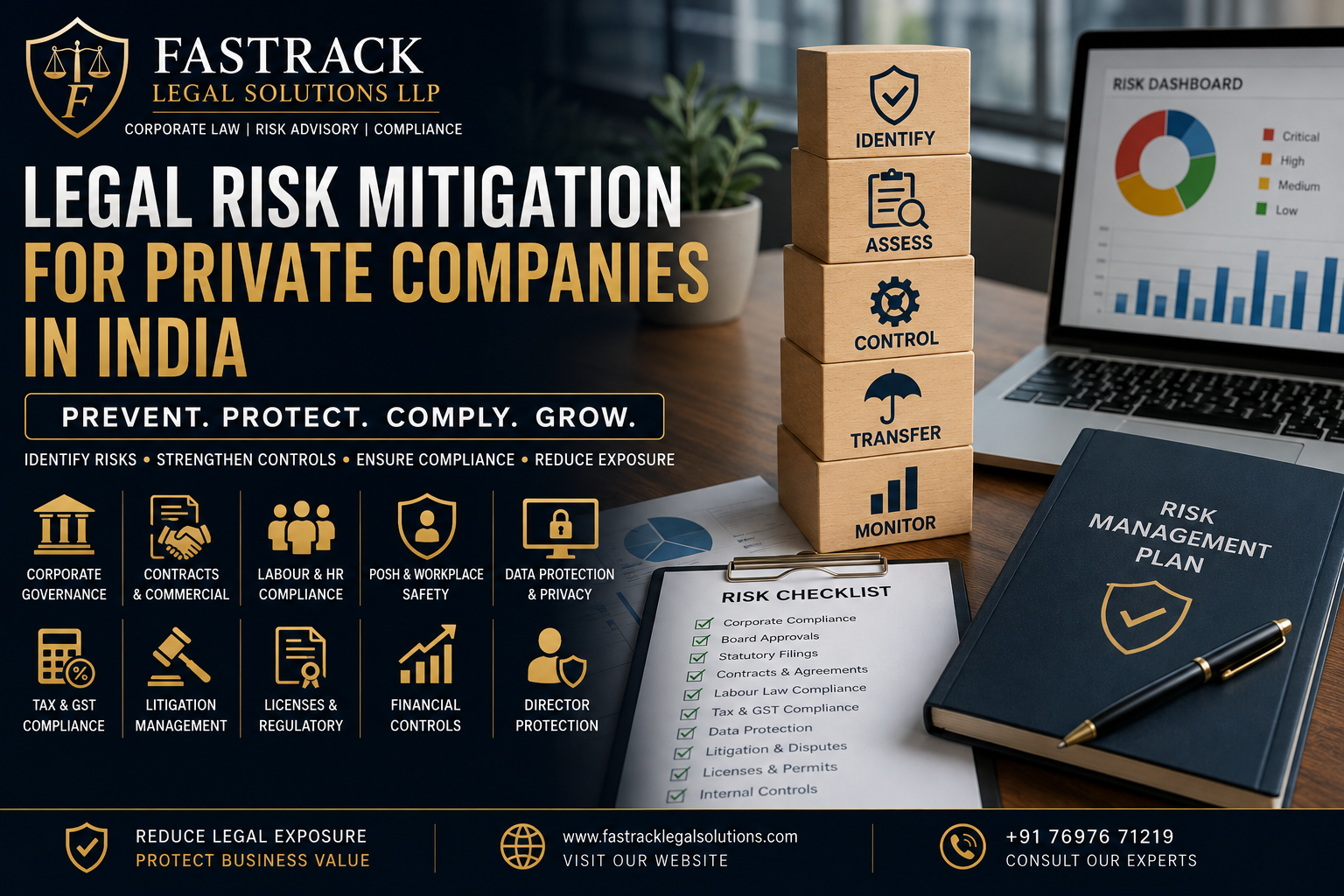
Corporate Risk Mitigation in India: Legal Risk Audit, Fraud Controls, Internal Investigations & Board Protection 2026
A practical framework for promoters, boards, CFOs, HR leaders, compliance teams, lenders and investors dealing with legal, operational, fraud, people, vendor, data and transaction risk.
Corporate risk mitigation is the process of identifying material legal, operational, financial, regulatory and conduct-related exposures before they become litigation, fraud loss, regulatory action, customer disruption, director liability or reputational damage. For a private company, the highest-risk events are often not created by one dramatic breach. They emerge from a chain of weak controls: informal approvals, poor vendor onboarding, uncontrolled data access, undocumented employee exits, unverified claims, weak payment controls, conflict-of-interest gaps, missing evidence and inconsistent management reporting.
A useful risk framework therefore goes beyond a statutory compliance checklist. It asks whether the company can detect a problem early, preserve evidence, quantify exposure, identify responsible processes, protect the board’s decision-making record and implement measurable corrective action.
Who needs a corporate risk-mitigation review?
A structured review becomes particularly valuable when a company is growing quickly, operating across multiple locations, using large vendor or contractor networks, handling significant customer or employee data, relying on incentive-heavy sales teams, preparing for investment or borrowing, facing unusually high claims or expenses, or experiencing management concerns about employee integrity or information leakage.
Typical trigger situations include:
- suspected employee or vendor fraud;
- unexplained revenue leakage, payment leakage or duplicate invoices;
- customer, sales or pricing data appearing with competitors;
- rapid increase in claims, write-offs, shortages or exceptions;
- vendor concentration or undisclosed related-party relationships;
- high-value employee exits involving confidential information;
- repeated labour, POSH or disciplinary issues;
- regulatory notices or licence gaps;
- weak delegation of authority or uncontrolled contract signing;
- fundraising, lender diligence, acquisition or sale of business;
- board concern that management reporting does not reflect operational reality; and
- an incident serious enough to require an internal investigation before legal action is considered.
The 10 principal corporate risk areas
| Risk area | Typical exposure | Control objective |
|---|---|---|
| Governance | Informal decisions, missing approvals, director exposure | Board trail, authority matrix, conflict controls |
| Fraud | False invoices, expense fraud, collusion, misappropriation | Segregation, verification, exception analytics |
| Vendor | Shell vendors, inflated pricing, conflict relationships | KYC, competitive sourcing, ownership checks |
| People | Misconduct, data removal, falsification, conflict of interest | BGV, access controls, investigation protocol |
| Data | Customer-data leakage, uncontrolled exports, personal devices | Access mapping, logging, retention, incident response |
| Contracts | Unlimited liability, weak scope, poor termination rights | Standard clauses, approval workflow, obligation tracking |
| Compliance | ROC, labour, tax, licence, sectoral defaults | Compliance calendar, evidence repository, escalation |
| Claims | False or unsupported claims, duplicate settlements, leakage | Document rules, maker-checker, anomaly review |
| Transactions | Hidden liabilities, related parties, weak title or licences | Legal due diligence, red-flag schedules, conditions precedent |
| Litigation | Missed notices, evidence loss, inconsistent positions | Notice tracker, legal hold, chronology and exposure review |
Fraud-risk assessment: where companies should look first
Fraud risk is rarely confined to the finance department. It may arise through procurement, operations, claims, sales incentives, HR reimbursements, warehouses, transport, vendor onboarding or customer refunds. The starting point is to map where an employee or vendor can create, approve and benefit from the same transaction.
Common red flags include repeated round-value invoices, split purchases just below approval thresholds, dormant vendors suddenly becoming active, the same bank details appearing across multiple vendors, personal email addresses used for vendor communication, unusually high exceptions under one manager, manual overrides, back-dated approvals, invoices without proof of delivery and repeated payments processed outside normal working patterns.
A good assessment does not treat every anomaly as fraud. It creates a hierarchy: data anomaly, control failure, policy breach, conflict indicator, suspected misconduct and evidence-supported fraud concern. This prevents both underreaction and premature accusation.
Internal investigations: evidence before conclusions
Where misconduct is suspected, the investigation should begin with evidence preservation rather than interviews. Email, system logs, access records, approval trails, invoices, expense claims, CCTV where lawfully available, device records, policy acknowledgements and relevant HR documents should be identified before the persons involved are alerted where there is a legitimate risk of evidence destruction.
The investigation plan should define allegations, relevant periods, custodians, evidence sources, interview sequence and reporting responsibility. Interviews should test documents rather than replace them. Findings should distinguish established fact, corroborated inference, unresolved issue and allegation not supported by available evidence.
For the detailed process, see Internal Investigation of Employee Misconduct in India.
Data leakage and insider risk
Data leakage may involve deliberate theft, negligent sharing, uncontrolled access or poor exit management. The risk is particularly acute where employees can export customer databases, quotations, route data, pricing, tender information, sales pipelines or strategic reports without a monitored approval trail.
A practical review should ask: who can access the data; whether access is role-based; whether exports are logged; whether personal email or messaging is used; whether former employees retain access; whether vendors receive more data than necessary; and whether confidentiality obligations are linked to actual technical controls.
The Digital Personal Data Protection Act, 2023 and the Digital Personal Data Protection Rules, 2025 have a staged commencement framework. Companies should therefore distinguish obligations already in force from future obligations on the notified timeline rather than treating the entire regime as simultaneously operational. citeturn729187search27turn729187search0
CERT-In’s directions also require specified entities including body corporates to maintain ICT logs for a rolling period of 180 days within India and provide them when required under the directions. That makes log preservation important not only for cyber security but also for reconstructing certain internal incidents. citeturn729187search29turn729187search4
Vendor and procurement risk
Vendor risk should be reviewed at onboarding, award, performance, invoice and renewal stages. A vendor file should ordinarily permit management to answer who owns the vendor, who introduced it, how pricing was benchmarked, who approved the commercial terms, whether bank details were independently verified, what work was actually performed and whether any employee has a disclosed relationship with the vendor.
Controls can include PAN/GST/CIN verification, bank-account confirmation, beneficial-ownership checks where appropriate, conflict declarations, three-way matching, service-level evidence, price variance reporting and periodic vendor concentration analysis.
Employee integrity and BGV risk
Background verification should not be treated as a one-time HR formality. High-risk roles may justify proportionate verification of identity, previous employment, education, references, conflicts and other job-relevant information, subject to law and privacy requirements. The control should be risk-based: finance, procurement, IT administration, sales data, warehouse, claims and payment roles often require a stronger integrity framework than low-access positions.
Post-joining controls are equally important. Role changes, access changes, repeated policy exceptions and high-risk exits should trigger review. Where an employee leaves for a competitor, the company should promptly close credentials, recover devices and records, preserve relevant logs and remind the employee of lawful confidentiality obligations without making unsupported allegations.
Board and director risk protection
Risk protection for directors is built through evidence of governance. Important controls include defined approval limits, proper board minutes, conflict disclosures, related-party review, escalation of material incidents, documented legal advice where appropriate, compliance reporting and a clear record of remediation decisions.
Under the Companies Act, the risk framework intersects with governance, internal financial controls, vigil mechanisms for applicable companies and auditor reporting obligations. For listed entities, SEBI’s LODR framework imposes a formal Risk Management Committee requirement on the top 1000 listed entities and high-value debt listed entities, with defined responsibilities including risk-plan monitoring and cyber-security coverage. citeturn729187search26
See also Director Liability Risk Mitigation for Private Companies in India.
Transaction and investor risk
A company preparing for investment, acquisition, borrowing or strategic partnership should run a pre-transaction risk review before the external diligence begins. The objective is to find issues while management still has time to fix them.
Typical review areas include corporate records, cap table, related parties, debt and security, licences, material contracts, employment liabilities, litigation, tax disputes, intellectual property, data practices, customer concentration and contingent liabilities. Findings should be classified into issues that can be cured, issues requiring disclosure, issues requiring price protection and issues serious enough to affect the transaction structure.
What should a corporate risk report contain?
A useful report should be decision-ready, not a narrative dump of observations. A practical structure is:
| Field | Purpose |
|---|---|
| Finding | What was identified |
| Evidence | Documents, data or interviews supporting it |
| Risk level | Critical, high, medium or low |
| Potential impact | Financial, legal, operational or reputational consequence |
| Root cause | Control or process failure that enabled the risk |
| Remediation | Specific action required |
| Owner | Responsible department or executive |
| Deadline | Closure date and escalation point |
30-day risk-mitigation framework
Days 1–7: scope and evidence. Identify business units, key processes, material contracts, high-risk employees, vendors, systems, licences, notices and major exceptions. Preserve relevant data before remediation changes the evidence trail.
Days 8–14: testing. Sample transactions, test approvals, compare records, verify vendors, review system access, interview process owners and identify exceptions requiring deeper review.
Days 15–21: classification. Separate control gaps from misconduct indicators. Quantify financial exposure where possible. Identify whether legal notice, disciplinary process, recovery, regulatory response or board escalation may be required.
Days 22–30: remediation. Issue a prioritised action plan, assign owners, revise policies or contracts, close access gaps, initiate lawful disciplinary or recovery action where warranted and establish a repeat review cycle.
Sector-specific risk modules
Logistics and transport: claims, route data, vendor ownership, freight rates, vehicle capacity, proof of delivery, fuel, shortages, trip closure and contractor leakage.
Manufacturing: procurement, scrap, inventory, quality claims, contract labour, EHS/licence exposure, related vendors and plant-level delegations.
Fintech, NBFC and LSP ecosystems: outsourcing, customer data, loan journeys, collections, vendor conduct, regulatory contracts, grievance records and digital-lending controls.
Professional services and technology: client data, employee exits, source-code or confidential information, subcontractors, billing controls and IP ownership.
Multi-location businesses: local licences, branch controls, cash or inventory, HR compliance, local vendor dependence and inconsistent operating procedures.
Frequently asked questions
What is the difference between a compliance audit and a risk-mitigation review?
A compliance audit primarily checks whether obligations are being met. A risk-mitigation review also examines how fraud, people, vendors, data, controls and commercial practices can create loss even where a formal statutory filing is technically complete.
When should a company start an internal investigation?
When a credible allegation, anomaly or incident suggests possible misconduct or material control failure. The scope should be proportionate and evidence should be preserved before conclusions are drawn.
Can risk assessment identify hidden fraud?
It can identify anomalies, control gaps and evidence requiring investigation. A risk assessment should not label an individual fraudulent without evidence supporting that conclusion.
How often should risk reviews be done?
Frequency depends on sector and risk. High-risk processes may require continuous exception monitoring, while a wider legal and operational review may be quarterly, half-yearly or event-driven.
Should the board receive every investigation detail?
Materiality and governance structure matter. Boards generally need enough information to understand significant exposure, management response and remediation without unnecessarily circulating sensitive personal or evidentiary material.
Is a risk report the same as a forensic audit?
No. A risk report can be preventive or diagnostic. A forensic exercise is usually narrower, evidence-intensive and focused on suspected wrongdoing, quantification or litigation/regulatory use.
Related risk resources
See Director Liability Risk Mitigation, Labour Law Compliance Risk Mitigation and Internal Investigation of Employee Misconduct in India.
Authoritative sources
- Companies Act, 2013 — India Code
- Digital Personal Data Protection Rules, 2025 — MeitY
- CERT-In Directions under Section 70B, Information Technology Act
- SEBI LODR Regulations — Risk Management Committee provisions
Author: Adv. Govind Bali, Fastrack Legal Solutions LLP.