
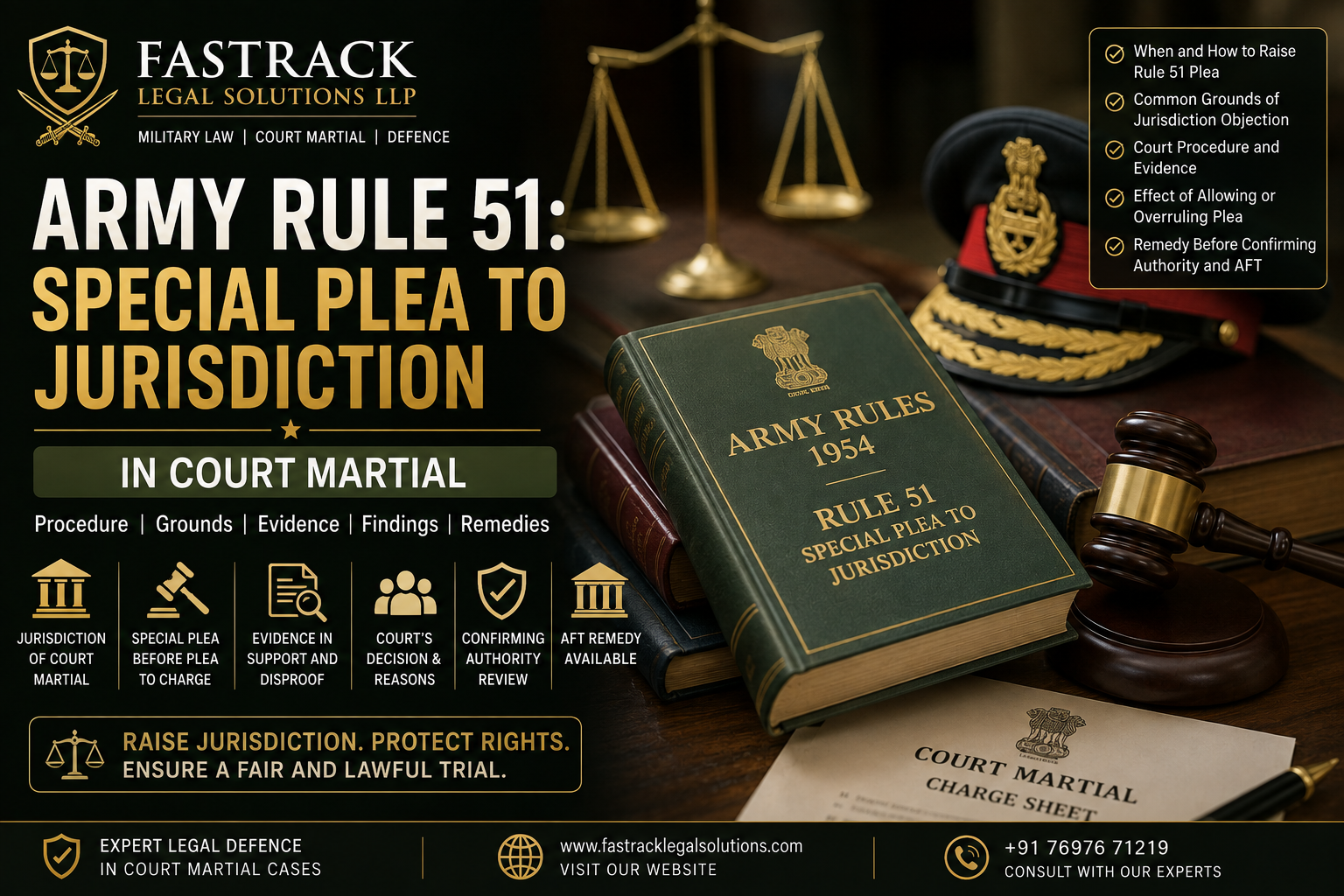
Army Rule 51 allows an accused, before pleading to the charge, to offer a special plea to the general jurisdiction of the Court-Martial. If the Court considers that the plea shows lack of jurisdiction, it must receive evidence in support of the plea, evidence from the prosecution in disproof or qualification, and hear addresses from both sides. If the Court allows the plea, it records its decision and reasons and reports the matter to the confirming authority. If the Court overrules the plea, it proceeds with trial, but the accused may still raise the issue before the confirming authority, and the confirming authority may withhold confirmation if it considers the plea well-founded.
In practical terms, Army Rule 51 is a serious defence safeguard. It is used where the accused says that the Court-Martial itself lacks jurisdiction to try him, the offence, the charge, or the trial in the manner convened.
Non-Solicitation Note
This article is intended for general legal awareness and educational purposes only and may be published by Fastrack Legal Solutions LLP. It does not constitute advertisement, solicitation, invitation or inducement for professional engagement. Court martial jurisdiction depends on the Army Act, Army Rules, status of the accused, nature of offence, place of offence, limitation, convening order, constitution of court, charge-sheet, Summary of Evidence, trial record and case-specific facts.
Introduction
In a Court-Martial, the first major defence issue is often not whether the accused is guilty or not guilty.
The first issue may be:
Does this Court-Martial have jurisdiction to try the case at all?
That is where Army Rule 51 becomes important.
Army Rule 51 provides the procedural route for raising a special plea to jurisdiction. This plea must be raised before the accused pleads to the charge. If properly raised, the Court has to consider whether it has jurisdiction, receive evidence where necessary, hear both sides, and record its decision.
For defence lawyers, accused officers, JCOs, ORs and military law practitioners, Rule 51 is one of the most important early-stage trial safeguards.
Also Read Army Rule 180: Overview and Application in Military Law
What Is a Special Plea to Jurisdiction?
A special plea to jurisdiction is an objection that the Court-Martial lacks legal authority to try the accused or the charge.
It may concern:
- The status of the accused.
- Whether the accused was subject to the Army Act.
- Whether the offence is triable by Court-Martial.
- Whether the Court has been properly convened.
- Whether the Court is properly constituted.
- Whether the offence is barred by limitation.
- Whether the alleged act falls outside military jurisdiction.
- Whether the charge is legally unsustainable before that Court.
- Whether a special statutory bar applies.
Army Rule 51 specifically concerns a plea to the general jurisdiction of the Court. It is not the same as a normal plea of “guilty” or “not guilty”.
Textual Basis of Army Rule 51
Army Rule 51 provides that the accused, before pleading to a charge, may offer a special plea to the general jurisdiction of the Court. If the Court considers that anything stated in the plea shows that the Court has no jurisdiction, the Court shall receive evidence offered in support, evidence offered by the prosecutor in disproof or qualification, and hear the accused and prosecution on that plea.
This means the Court-Martial cannot ignore a jurisdictional plea merely because it is inconvenient. Once the plea raises a jurisdictional issue, the Court must deal with it.
Why Army Rule 51 Matters
Army Rule 51 matters because jurisdiction goes to the root of trial legality.
If a Court lacks jurisdiction, the trial itself may be vulnerable.
A conviction based on a fundamentally defective jurisdictional foundation may be challenged on grounds such as:
- Accused was not subject to the Army Act.
- Court was not competent to try the offence.
- Court was not properly convened.
- Offence was excluded from Court-Martial jurisdiction.
- Limitation had expired.
- Wrong type of Court-Martial was assembled.
- Mandatory procedure affecting jurisdiction was not followed.
- The charge was not triable by that Court.
The purpose of Rule 51 is to ensure that such objections are raised and decided at the threshold.
When Should Army Rule 51 Be Raised?
Army Rule 51 must be raised before pleading to the charge.
This timing is critical.
The accused should raise Rule 51 before entering a plea of:
- Guilty; or
- Not guilty.
If the accused enters a plea first and raises jurisdiction later, the objection may become procedurally weaker, although serious jurisdictional defects may still be raised before the confirming authority or later forums depending on facts.
Therefore, the defence should examine jurisdiction before the plea stage.
Army Rule 51 Procedure: Step-by-Step
| Stage | What Happens |
|---|---|
| Step 1 | Court-Martial assembles |
| Step 2 | Charge is read/explained |
| Step 3 | Before pleading to the charge, accused raises special plea to jurisdiction |
| Step 4 | Court considers whether the plea, if accepted, shows lack of jurisdiction |
| Step 5 | Court receives defence evidence in support |
| Step 6 | Court receives prosecution evidence in disproof or qualification |
| Step 7 | Defence addresses the Court |
| Step 8 | Prosecution replies |
| Step 9 | Court decides the plea |
| Step 10 | If plea succeeds, Court records decision and reasons and reports to confirming authority |
| Step 11 | If plea fails, trial proceeds |
| Step 12 | Accused may still raise the issue before confirming authority |
This procedure is important because it creates a record for later challenge.
Who Is Subject to the Army Act?
A jurisdiction objection may arise if the accused was not subject to the Army Act at the relevant time.
Army Act Section 2 identifies persons subject to the Act, including officers, JCOs, warrant officers of the regular Army, enrolled persons, certain reserve forces, Territorial Army personnel in specified circumstances, and other categories mentioned in the provision. It also provides that persons under specified clauses remain subject to the Act until duly retired, discharged, released, removed, dismissed or cashiered from service.
Therefore, in a Rule 51 plea, the defence should examine:
- Date of alleged offence.
- Service status on that date.
- Date of retirement, release or discharge.
- Whether the accused was still subject to the Act.
- Whether the accused falls within any extended category under Section 2.
- Whether the charge relates to a period when the accused was subject to military law.
Civil Offences and Court-Martial Jurisdiction
Army Act Section 69 provides that, subject to Section 70, any person subject to the Act who commits a civil offence at any place in or beyond India shall be deemed guilty of an offence against the Act and, if charged under Section 69, may be tried by Court-Martial.
However, Section 70 creates an important limitation. It provides that a person subject to the Act who commits murder against a person not subject to military, naval or air force law, culpable homicide not amounting to murder against such person, or rape in relation to such person, shall not be deemed guilty of an offence against the Act and shall not be tried by Court-Martial, unless the offence is committed while on active service, outside India, or at a notified frontier post.
Therefore, if the charge is a civil offence, jurisdiction analysis must consider both Section 69 and Section 70.
Common Grounds for Army Rule 51 Plea
A special plea to jurisdiction may be considered where:
| Ground | Defence Question |
| Accused not subject to Army Act | Was the accused subject to military law on the date of offence and trial? |
| Offence not triable by Court-Martial | Does the Army Act permit Court-Martial trial for this offence? |
| Section 70 bar | Is the case excluded from Court-Martial jurisdiction? |
| Limitation expired | Is trial barred by Army Act Section 122? |
| Wrong Court-Martial type | Can this Court legally try this charge? |
| Improper convening | Was the Court convened by competent authority? |
| Improper constitution | Is the Court composed according to law? |
| Defective jurisdiction over person/place/offence | Does the Court have jurisdiction over accused, location and offence? |
| Prior trial or summary disposal | Has the accused already been tried or dealt with for the same offence? |
| Charge does not disclose Army Act offence | Does the charge legally fall within the Act? |
The plea must be precise. A vague plea will not help.
Rule 51 vs Rule 53: Jurisdiction Plea and Plea in Bar
Army Rule 51 and Army Rule 53 are connected but different.
| Point | Army Rule 51 | Army Rule 53 |
| Nature | Special plea to general jurisdiction of Court | Plea in bar of trial |
| Timing | Before pleading to charge | At plea stage |
| Focus | Whether Court has jurisdiction | Whether trial is barred for specific reasons |
| Examples | Court lacks power; accused not subject to Act; offence not triable by Court-Martial | Previous conviction/acquittal, summary disposal, dismissal under Rule 22, pardon/condonation, limitation |
| Consequence | Court may allow or overrule jurisdiction plea | Court decides whether bar to trial is proved |
Army Rule 53 specifically recognises plea in bar on grounds such as previous conviction or acquittal, summary disposal, dismissal under Rule 22, pardon or condonation, and expiry of limitation under Section 122.
In some cases, the defence may need to consider both Rule 51 and Rule 53.
Limitation and Jurisdiction
Army Act Section 122 is extremely important in Court-Martial defence. It provides that, except as otherwise provided, no trial by Court-Martial of any person subject to the Act for any offence shall commence after expiry of three years, with the period starting from the date of offence, or where the offence was not known to the aggrieved person or competent authority, from the first day on which the offence came to such knowledge, whichever is earlier, or where the offender was unknown, from the date identity became known.
Limitation may be raised as a plea in bar under Army Rule 53, but it also affects the broader legality of trial. Defence should therefore calculate limitation carefully and preserve the objection at the earliest stage.
Rule 51 and Convening Defects
A jurisdiction plea may also arise from defects in convening.
The defence should check:
- Was the Court-Martial convened by competent authority?
- Was the convening order valid?
- Was Army Rule 37 complied with?
- Was the convening authority empowered?
- Was the Court properly constituted?
- Were members eligible and not disqualified?
- Was the Judge Advocate properly appointed?
- Was the charge-sheet properly placed before the Court?
If the Court itself is not properly convened or constituted, Rule 51 may become relevant at the threshold.
Rule 51 and Improper Court Composition
Court-Martial jurisdiction is not only about the offence. It is also about the constitution of the Court.
Defence should examine:
- Number of members.
- Rank and eligibility of members.
- Whether any member is disqualified.
- Whether any member was connected with investigation.
- Whether any member has apparent bias.
- Whether the Presiding Officer is eligible.
- Whether mandatory constitution requirements are satisfied.
- Whether the convening order matches the officers present.
A Court-Martial that is improperly constituted may be vulnerable to jurisdictional challenge.
Rule 51 and Charge Drafting
A jurisdiction objection may arise where the charge is drafted in a way that does not disclose an offence triable by Court-Martial.
The defence should examine:
- Does the charge identify the correct Army Act provision?
- Are the legal ingredients stated?
- Is the alleged act connected to an offence under the Act?
- If charged under Section 69, is the corresponding civil offence properly identified?
- Does Section 70 bar the Court-Martial from trying the matter?
- Is the charge vague or impossible to answer?
- Does the charge relate to a period outside jurisdiction?
A defective charge may sometimes be curable, but where the defect goes to jurisdiction, Rule 51 may be invoked.
Evidence in Support of Rule 51 Plea
Army Rule 51 allows evidence to be received if the plea raises lack of jurisdiction. The defence should therefore be prepared with documents.
Possible Evidence
- Retirement, discharge or release order.
- Service records.
- Posting order.
- Date of offence documents.
- Charge-sheet.
- Convening order.
- Warrant/authority of convening officer.
- Summary of Evidence.
- Prior trial or summary disposal record.
- Rule 22 dismissal order, if applicable.
- Pardon or condonation record.
- Documents showing place of offence.
- Documents showing victim status, where Section 70 applies.
- Limitation calculation chart.
- Correspondence showing date of knowledge of offence.
A Rule 51 plea should be evidence-backed, not merely argumentative.
Draft Structure of a Rule 51 Plea
A proper Rule 51 plea may be structured as follows:
- Title: Special Plea to Jurisdiction under Army Rule 51.
- Brief facts.
- Stage of trial and statement that plea is before pleading to charge.
- Jurisdictional objection.
- Legal basis.
- Factual basis.
- Evidence relied upon.
- Prejudice caused.
- Prayer.
Sample Prayer
It is respectfully submitted that this Hon’ble Court-Martial lacks jurisdiction to try the present charge for the reasons stated hereinabove. The accused therefore offers this special plea to jurisdiction under Army Rule 51 and prays that the Court may receive the evidence in support of the plea, hear the parties, uphold the plea, record its decision with reasons and report the same to the confirming authority in accordance with law.
This draft must be customised to the actual case.
Practical Example: Accused Retired Before Trial
Suppose the alleged offence is said to have occurred during service, but the accused has retired before trial.
The first question is not automatically whether the trial is illegal. The defence must examine:
- Whether the accused continued to be subject to the Army Act.
- Whether the alleged offence occurred while he was subject to the Act.
- Whether the Army Act permits trial after retirement in that factual situation.
- Whether limitation under Section 122 is satisfied.
- Whether the convening order lawfully covers the accused.
- Whether trial by that specific Court-Martial is competent.
A Rule 51 plea should therefore not be generic. It must be based on statutory status, dates and documents.
Practical Example: Civil Offence Under Section 69
Suppose the charge is framed under Army Act Section 69 for a civil offence.
The defence should examine:
- What is the corresponding civil offence?
- Was the accused subject to the Act?
- Does Section 70 bar Court-Martial trial?
- Was the offence committed while on active service, outside India or at a notified frontier post, if Section 70 is attracted?
- Is the charge properly framed?
- Is the Court-Martial the legally competent forum?
This analysis can become central in cases involving serious civil offences.
Practical Example: Limitation
Suppose the alleged offence occurred more than three years before commencement of trial.
The defence should prepare a limitation chart:
| Date / Event | Relevance |
| Date of alleged offence | Starting point under Section 122 |
| Date aggrieved person came to know | Alternative starting point |
| Date competent authority came to know | Critical for limitation |
| Date identity of offender became known | Relevant if offender was initially unknown |
| Date of hearing of charge | Procedural chronology |
| Date of Summary of Evidence | Delay analysis |
| Date Court-Martial commenced | Limitation endpoint |
If Section 122 is attracted, the plea may be raised as a plea in bar under Rule 53 and may also support broader jurisdictional objection.
What Happens If Rule 51 Plea Is Allowed?
If the Court upholds the special plea to jurisdiction, Rule 51 requires it to record its decision and reasons and report the matter to the confirming authority. It must then adjourn and await the confirming authority’s decision. The confirming authority may confirm the decision and dissolve the Court, or withhold confirmation and direct revision of the decision.
This is a significant protection because a successful plea can stop the trial at the threshold.
What Happens If Rule 51 Plea Is Rejected?
If the Court overrules the plea, the trial proceeds.
However, Rule 51 also provides that the accused is not prejudiced from raising the plea before the confirming authority. If the confirming authority considers the plea well-founded, it shall withhold confirmation of the finding and sentence.
This means a rejected Rule 51 plea should still be preserved properly in the trial record.
Defence Strategy for Army Rule 51
A strong Rule 51 strategy should include:
- Raise the plea before pleading to charge.
- Put the plea in writing.
- Identify the specific jurisdictional defect.
- Attach or identify supporting documents.
- Request reception of evidence.
- Request reasoned decision.
- Preserve objections in trial record.
- If rejected, raise the issue before confirming authority.
- Where necessary, raise the issue in post-trial petition or AFT proceedings.
- Avoid vague objections.
Jurisdictional pleas fail when they are drafted casually.
Common Mistakes in Rule 51 Pleas
| Mistake | Why It Weakens the Defence |
| Raising the plea after pleading to charge | Timing objection may arise |
| Making vague jurisdiction allegations | Court may overrule quickly |
| Not citing specific statutory provision | Plea lacks legal foundation |
| Not filing supporting evidence | Plea remains unsupported |
| Confusing Rule 51 with Rule 53 | Wrong procedural route |
| Not calculating limitation properly | Section 122 argument weakens |
| Not checking Section 70 | Civil offence jurisdiction issue missed |
| Not preserving objection before confirming authority | Later challenge becomes harder |
| Not linking defect to prejudice | AFT challenge may weaken |
Rule 51 Checklist for Defence Lawyers
| Question | Document / Action |
| Was the accused subject to Army Act? | Check Section 2 status and service record |
| Is the offence triable by Court-Martial? | Check Army Act charge provision |
| Is it a civil offence? | Check Section 69 and Section 70 |
| Is limitation expired? | Prepare Section 122 chart |
| Was the Court properly convened? | Check Rule 37 and convening order |
| Is Court properly constituted? | Check members and Presiding Officer |
| Is charge legally framed? | Check ingredients and particulars |
| Is plea before charge plea? | Raise Rule 51 before guilty/not guilty plea |
| Is evidence ready? | File documents with plea |
| Is objection preserved? | Record plea and arguments fully |
Rule 51 and AFT Remedy
A Rule 51 issue may later be relevant before the Armed Forces Tribunal where:
- The Court-Martial wrongly rejected jurisdiction plea.
- The confirming authority failed to consider the plea.
- The Court lacked jurisdiction over the accused.
- Trial was barred by limitation.
- Section 70 barred Court-Martial trial.
- Court was improperly convened or constituted.
- Charge did not disclose a triable offence.
- The jurisdictional defect caused prejudice.
The strongest AFT challenge is built from the trial record. Therefore, the Rule 51 plea, supporting evidence, Court decision and reasons must be properly recorded during trial.
Related Military Law Guides
Readers studying Army Rule 51 should also read:
- Army Rule 180: Court of Inquiry Rights and AFT Remedy
- Army Rule 22: Hearing of Charge by Commanding Officer
- Army Rule 23: Summary of Evidence in Court Martial
- Army Rule 24: Remand of Accused and Court Martial Decision
- Army Rule 37: Convening of Court Martial and Application of Mind
- Army Rule 53: Plea in Bar of Trial
- Court Martial Defence in India: Rights of the Accused
- Statutory Complaint Rejected in Indian Army: AFT Remedy
Frequently Asked Questions
1. What is Army Rule 51?
Army Rule 51 allows the accused, before pleading to the charge, to raise a special plea to the general jurisdiction of the Court-Martial.
2. When should Army Rule 51 be raised?
It should be raised before the accused pleads guilty or not guilty to the charge.
3. What is a special plea to jurisdiction?
It is an objection that the Court-Martial does not have legal authority to try the accused, the offence or the charge.
4. Can evidence be given in support of Army Rule 51 plea?
Yes. If the plea raises lack of jurisdiction, the Court may receive evidence from the defence and prosecution before deciding the plea.
5. What happens if the Rule 51 plea is accepted?
The Court records its decision and reasons, reports to the confirming authority, and awaits the confirming authority’s decision.
6. What happens if the Rule 51 plea is rejected?
The trial proceeds, but the accused may still raise the plea before the confirming authority. If the confirming authority finds it well-founded, it may withhold confirmation.
7. Is limitation a Rule 51 issue?
Limitation is specifically recognised as a plea in bar under Army Rule 53 read with Army Act Section 122. Depending on facts, it may also support broader jurisdictional challenge.
8. Can Rule 51 violation be challenged before AFT?
Yes, depending on facts, prejudice and stage of proceedings. If jurisdictional objection was wrongly rejected or ignored, it may become a ground before the Armed Forces Tribunal.
Conclusion
Army Rule 51 is a critical safeguard in Court-Martial proceedings. It allows the accused to challenge the jurisdiction of the Court before entering a plea to the charge. This can include objections based on accused status, Court competence, offence triability, limitation, Section 69/70 civil offence issues, improper convening, improper constitution or charge defects.
A Rule 51 plea must be precise, timely and evidence-backed. It should not be used as a vague objection. The defence should identify the exact jurisdictional defect, produce relevant documents, request a reasoned decision and preserve the issue for the confirming authority and, where necessary, AFT proceedings.
In Court-Martial defence, jurisdiction must be examined before merits. If the Court itself lacks authority, the trial cannot be treated as a routine continuation of disciplinary proceedings.
Disclaimer
This article is intended for general legal awareness and educational purposes only and may be published by Fastrack Legal Solutions LLP. It does not constitute advertisement, solicitation, invitation or inducement for professional engagement. Court-Martial jurisdiction depends on the Army Act, Army Rules, service status, charge, offence, limitation, convening authority, Court composition, trial record and case-specific documents.