
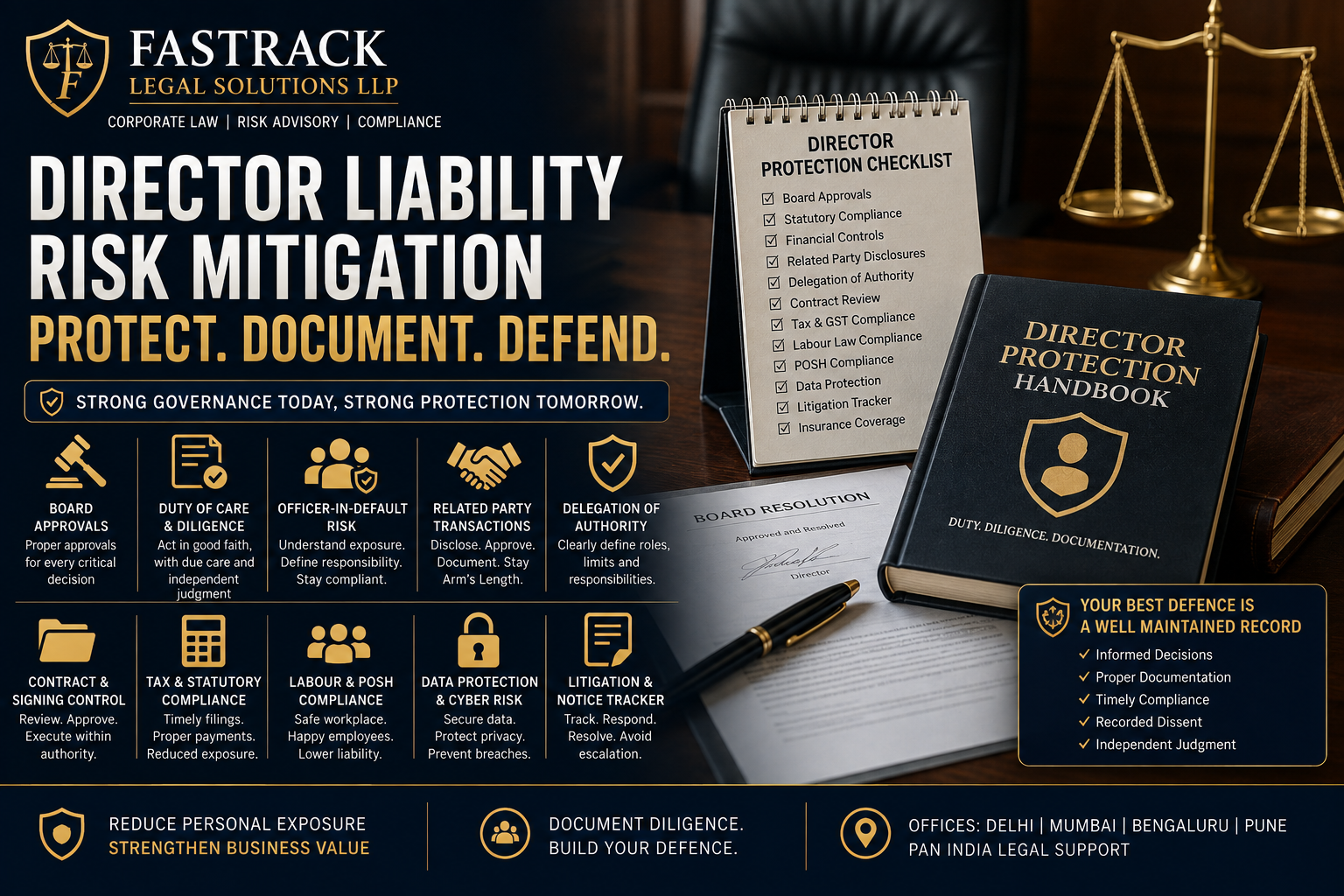
Director liability risk mitigation for private companies in India means creating systems that protect directors from personal exposure arising out of statutory defaults, unauthorised contracts, related-party transactions, tax and GST defaults, labour dues, cheque-bounce matters, data breaches, workplace complaints, regulatory non-compliance and defective board records.
Under the Companies Act, 2013, directors have statutory duties under Section 166, including the duty to act in good faith, exercise due and reasonable care, skill and diligence, and exercise independent judgment. The Act also uses the concept of “officer who is in default”, which may include whole-time directors, KMP, specified directors, persons responsible for records/compliance, and directors who are aware of a contravention through board proceedings or participation and do not object, or where the contravention occurred with their consent or connivance.
The practical protection is not verbal assurance. Directors require proper board approvals, documented dissent where necessary, conflict disclosures, delegation of authority, contract approval controls, statutory compliance trackers, litigation trackers, tax and labour compliance systems, and clear evidence that they exercised due care.
Non-Solicitation Note
This article is intended for general legal awareness and educational purposes only and may be published by Fastrack Legal Solutions LLP. It does not constitute advertisement, solicitation, invitation or inducement for professional engagement. Director liability depends on the company’s structure, director role, board participation, statutory default, knowledge, consent, connivance, diligence, delegated responsibilities, sectoral regulation, documents and case-specific facts.
Introduction
In many private companies, directors sign documents, approve transactions, operate bank accounts, borrow money, deal with employees, execute contracts, issue cheques and handle regulatory matters without a formal risk-protection structure.
This becomes dangerous when something goes wrong.
A company may face:
- ROC default.
- GST demand.
- TDS default.
- Labour claim.
- POSH complaint.
- Vendor dispute.
- Cheque-bounce case.
- Bank recall notice.
- Data breach.
- Related-party dispute.
- Shareholder conflict.
- Contractual claim.
- Criminal complaint arising from a commercial transaction.
When the company is under pressure, the question often becomes:
Which director is personally responsible?
Director risk mitigation is the system that answers this question before a dispute arises.
Also Read Legal Risk Audit for Companies in India | Corporate Legal Risk & Compliance Audit
Why Directors of Private Companies Need Protection
Private company directors often assume that liability is limited because the company is a separate legal entity. That is only partly true.
A company has separate legal personality, but directors may still face exposure where the law imposes responsibility on officers in default, authorised signatories, persons in charge of business, persons who consented to or connived in default, or directors who knowingly failed to prevent a contravention.
This is why a director should never rely only on designation.
The safer approach is:
- Define role clearly.
- Record decisions properly.
- Avoid informal commitments.
- Maintain approvals.
- Disclose conflicts.
- Object in writing where required.
- Delegate properly.
- Track compliance.
- Preserve evidence of diligence.
- Review statutory exposure regularly.
Core Legal Duties of Directors
Section 166 of the Companies Act, 2013 sets out statutory duties of directors. It requires directors to act in accordance with the Articles of the company, act in good faith to promote the objects of the company for the benefit of members as a whole, and act in the best interests of the company, employees, shareholders, community and environment. It also requires directors to exercise due and reasonable care, skill and diligence and independent judgment.
Practical Meaning
| Duty | Practical Risk Mitigation |
|---|---|
| Act according to Articles | Check AOA before share transfer, borrowing, issue of shares or major decisions |
| Act in good faith | Record commercial rationale in board notes |
| Act in company’s interest | Avoid promoter-personal benefit without disclosure and approval |
| Exercise due care | Review documents before approving |
| Exercise independent judgment | Do not blindly sign because promoter/accountant/manager says so |
| Avoid conflict | File disclosure and abstain where required |
| Avoid undue gain | Maintain arm’s-length records for related-party benefits |
The director’s best defence is a clean record showing informed, diligent and documented decision-making.
Officer-in-Default Risk
The Companies Act does not make every director automatically liable for every default. But it does create risk for persons who fall within the definition of “officer who is in default.”
This may include whole-time directors, KMP, specified directors who have consented to such specification, persons responsible for records or filings, persons under whose directions the Board acts, and directors who are aware of contravention through board proceedings or participation without objecting, or where the contravention occurred with their consent or connivance.
Risk Mitigation
| Risk | Protection |
| Director treated as officer in default | Define compliance responsibility in board resolution |
| All directors exposed because no person is specified | Specify responsible officer/director where legally appropriate |
| Director attended meeting but did not object | Record dissent or reservation in minutes |
| Compliance team failed to file forms | Maintain compliance calendar and escalation records |
| Director signed without understanding | Require legal/CS note before signing |
| Default continued after board knowledge | Record corrective action and follow-up |
A director who is aware of a default and remains silent may be in a weaker position than a director who placed objection and corrective action on record.
Non-Executive Director Risk
Section 149(12) provides protection for independent directors and certain non-executive directors not being promoter or KMP, by limiting liability to acts of omission or commission by a company that occurred with their knowledge attributable through board processes and with their consent or connivance, or where they did not act diligently.
This is important for non-executive directors, nominee directors and passive family directors.
However, this protection is not automatic in every factual situation. A non-executive director should still maintain evidence of diligence.
Protection Checklist for Non-Executive Directors
- Obtain agenda papers before board meetings.
- Ask questions on major decisions.
- Record reservations in minutes.
- Avoid signing operational documents unless necessary.
- Avoid acting like an executive director informally.
- Avoid giving oral approvals outside board process.
- Seek compliance certificates from management.
- Ask for quarterly statutory compliance status.
- Record dissent where risk is visible.
- Maintain separate personal records of board papers and objections.
Board Approval Risk
Many director-liability problems arise because decisions are taken informally.
Section 179 of the Companies Act recognises powers of the Board and specifies matters requiring board resolutions at meetings, including borrowing monies, investing funds, granting loans or guarantees or security, approving financial statements and Board’s report, approving amalgamation/merger/reconstruction, and taking over a company or acquiring controlling or substantial stake.
Board Approval Matrix
| Decision | Risk if Informal | Protection |
| Borrowing money | Unauthorised debt / director dispute | Board resolution and lender documentation |
| Granting loan/guarantee/security | Section 186 and contingent liability risk | Board/shareholder approval where required |
| Acquisition/investment | Authority and valuation dispute | Board approval with note and valuation |
| Related-party contract | Voidable contract and indemnity risk | Section 188 approval and disclosure |
| Financial statements | Misstatement risk | Audit review and board approval |
| Bank authority | Unauthorised transactions | Banking resolution and signing matrix |
| Major contract | Liability without authority | Contract approval note and signatory authority |
No significant business decision should happen only on WhatsApp, oral approval or informal family understanding.
Related-Party Transaction Risk for Directors
Related-party transactions are a major source of director exposure.
Section 188 of the Companies Act deals with related-party transactions and defines an arm’s-length transaction as one between related parties conducted as if they were unrelated, so there is no conflict of interest. It also provides that where required approval is not obtained and the transaction is not ratified within the statutory period, the contract may be voidable at the option of the Board or shareholders, and directors concerned may be required to indemnify the company against loss where applicable.
Common Related-Party Risks
- Company paying rent to promoter-owned property.
- Purchase from group entity.
- Sale to sister concern.
- Director loan.
- Promoter advance.
- Management fees to family entity.
- Company asset used personally.
- Company staff used for promoter work.
- Reimbursement without policy.
- Brand or IP owned by promoter but used by company.
Mitigation
| Step | Action |
| Identify related party | Maintain related-party register |
| Disclose interest | File MBP-1 and update board records |
| Check arm’s length | Maintain pricing basis and market comparison |
| Check ordinary course | Record commercial rationale |
| Obtain approval | Board/shareholder approval where required |
| Execute contract | Avoid oral arrangements |
| Track payments | Maintain ledger and reconciliation |
| Disclose in financials | Ensure accountant/auditor disclosure |
Conflict Disclosure Risk
Directors must disclose interests properly.
Section 184 concerns disclosure of interest by directors and is part of the Companies Act framework for conflict management. India Code records Section 184 as the statutory provision on disclosure of interest by director.
Practical Protection
- File MBP-1 at the beginning of the financial year.
- Update disclosure when interest changes.
- Do not participate in conflicted decisions where prohibited.
- Ensure minutes record disclosure.
- Avoid using company opportunity for personal benefit.
- Maintain register of contracts in which directors are interested.
- Ensure related-party transactions are not hidden as ordinary expenses.
A director’s conflict should be disclosed before the transaction, not after a dispute begins.
Delegation of Authority Matrix
A Delegation of Authority Matrix is one of the strongest director-protection tools.
It defines:
- Who can approve purchases.
- Who can sign contracts.
- Who can operate bank accounts.
- Who can approve hiring.
- Who can terminate employees.
- Who can approve legal notices.
- Who can settle disputes.
- Who can borrow money.
- Who can give guarantees.
- Who can approve related-party transactions.
Sample Delegation Matrix
| Activity | Approval Level | Document Required |
| Vendor onboarding | Department Head + Finance | Vendor KYC and contract |
| Contract below ₹5 lakh | Authorised Manager | Approved template |
| Contract above ₹5 lakh | Director / Board authorised signatory | Legal review note |
| Borrowing | Board | Board resolution |
| Related-party transaction | Board/shareholders where required | Disclosure + approval |
| Litigation settlement | Board / authorised committee | Settlement note |
| Bank account operation | Approved signatories | Banking resolution |
| Employee termination | HR + authorised director | Legal/HR review |
Without delegation, every major decision can later be blamed on the Board.
Contract Signing Risk
Directors should avoid signing contracts without internal approval.
Contract Signing Checklist
Before signing, check:
- Is the signatory authorised?
- Is board approval required?
- Is the contract within business objects?
- Is liability capped?
- Is indemnity one-sided?
- Is payment timeline clear?
- Is termination clause workable?
- Is jurisdiction/arbitration clause acceptable?
- Are tax responsibilities clear?
- Are data/confidentiality clauses included?
- Are service levels defined?
- Is there a legal review note?
A director who signs a bad contract without review may not always be personally liable, but the signature can create serious commercial and evidentiary exposure.
Bank Account and Payment Risk
Banking authority is often mishandled in private companies.
Risks
- Old directors remain authorised signatories.
- Resigned employees retain access.
- Single-person payment approval.
- No payment vouchers.
- Director personal expenses paid by company.
- Company money transferred to promoter accounts.
- Loan repayments made without documentation.
- Cheques issued without invoice backing.
- Digital banking access not controlled.
- No bank reconciliation.
Mitigation
- Maintain bank authority resolution.
- Update signatories after director/employee change.
- Use maker-checker control.
- Require invoice and approval for payments.
- Separate personal and company expenses.
- Reconcile bank accounts monthly.
- Maintain payment approval trail.
- Review high-value payments quarterly.
- Restrict admin access to net banking.
- Record director loan transactions properly.
Cheque-Bounce and Authorised Signatory Risk
Cheque-bounce matters can create criminal process risk for the company and signatories.
Director protection requires:
- Clear cheque-signing authority.
- Payment approval trail.
- Contract/invoice backing for cheques.
- Avoidance of blank signed cheques.
- Internal register of issued cheques.
- Immediate legal review of Section 138 notices.
- Documentation showing who was in charge of relevant transaction.
- Proper board-approved financial controls.
A director should never sign blank cheques or security cheques casually.
Tax, GST and TDS Director Risk
Tax defaults can create serious financial and prosecution exposure depending on the statute and facts.
Directors should ensure:
- GST returns are filed.
- TDS is deducted and deposited.
- Income tax notices are tracked.
- GST notices are responded to.
- Input tax credit is reconciled.
- Tax liabilities are not hidden from the Board.
- Finance team gives monthly compliance certificate.
- Major tax disputes are placed before the Board.
Tax Risk Mitigation Table
| Risk | Director Protection |
| GST mismatch | Monthly reconciliation report |
| TDS default | TDS challan tracker |
| Tax notice ignored | Litigation tracker |
| Fake invoice exposure | Vendor KYC and invoice verification |
| Cash transactions | Cash policy and audit trail |
| Demand order passed | Board-level review and appeal decision |
Labour and Employment Director Risk
Directors may face reputational and regulatory exposure if labour laws are ignored.
Risks
- PF/ESI default.
- Non-payment of salary.
- Illegal termination.
- Consultant misclassification.
- No appointment letters.
- Non-payment of gratuity/bonus.
- Contract labour violations.
- Workplace harassment complaint.
- Maternity benefit violation.
- No service rules or HR policy.
Mitigation
- Issue appointment letters.
- Maintain employee registers.
- File PF/ESI returns.
- Maintain wage and attendance records.
- Use proper consultant agreements.
- Track statutory dues.
- Adopt service rules or employee handbook.
- Follow disciplinary inquiry process.
- Document termination decisions.
- Review labour compliance quarterly.
POSH and Workplace Complaint Risk
A workplace sexual harassment complaint can create serious legal, reputational and management exposure.
Director protection requires:
- Proper POSH policy.
- Internal Committee where applicable.
- External member appointment.
- Annual awareness sessions.
- Confidential complaint handling.
- Proper inquiry process.
- Non-retaliation safeguards.
- Action on committee recommendations.
- Annual reporting where applicable.
- Board awareness of serious complaints.
The director’s risk increases where complaints are ignored, suppressed, mishandled or informally settled without due process.
Data Protection and Cyber Risk for Directors
Data breaches and misuse of customer or employee data can create legal and reputational exposure.
Directors should ensure:
- Privacy policy exists.
- Consent and notice mechanism is reviewed.
- Vendor data-processing agreements exist.
- Personal data access is restricted.
- Data breach response plan exists.
- Cybersecurity controls are reviewed.
- Employee devices are controlled.
- Customer data is not stored casually.
- Data retention policy is implemented.
- Management reports breaches promptly.
This becomes especially important for fintech, HR-tech, edtech, healthtech, SaaS, e-commerce and service companies handling personal data.
Litigation and Legal Notice Risk
A company should have a litigation tracker.
Tracker Format
| Matter | Date Received | Forum / Authority | Deadline | Risk Level | Responsible Person | Status |
| Legal notice | High | Legal / Director | ||||
| GST notice | Critical | Tax / Finance | ||||
| Employee claim | Medium | HR / Legal | ||||
| Vendor dispute | Medium | Business / Finance | ||||
| Police complaint | Critical | Legal / Director |
Ignoring legal notices is one of the most common director-level mistakes.
Dissent and Objection as Director Protection
If a director disagrees with a risky decision, the objection must be recorded.
How to Record Dissent
- Ask questions in the board meeting.
- Request documents.
- State specific objection.
- Ask for dissent to be recorded in minutes.
- Send written note after meeting if minutes are inaccurate.
- Avoid participating in conflicted decisions.
- Escalate continuing statutory default.
- Seek professional advice where necessary.
Silence can be dangerous where the director had knowledge of the issue.
Director Protection Documents
Every private company should maintain these documents:
- Board approval matrix.
- Delegation of Authority Matrix.
- Bank authority matrix.
- Contract signing policy.
- Related-party transaction register.
- MBP-1 disclosure file.
- DIR-8 declaration file.
- Statutory compliance calendar.
- Litigation tracker.
- Tax and GST notice tracker.
- Labour compliance tracker.
- POSH compliance file.
- Data protection policy.
- Cyber incident response plan.
- Insurance register.
- D&O insurance policy, where feasible.
- Minutes and agenda archive.
- Legal opinion file for major decisions.
- Risk register.
- Quarterly compliance certificate.
30-Day Director Risk Mitigation Action Plan
Week 1: Identify Exposure
- Review director roles.
- Review bank signatories.
- Review board minutes.
- Review ROC defaults.
- Review pending notices.
- Review tax/GST status.
- Review related-party transactions.
Week 2: Create Controls
- Prepare Delegation of Authority Matrix.
- Update bank authority.
- Create contract approval process.
- Create litigation tracker.
- Create statutory compliance calendar.
- Create related-party register.
Week 3: Fix Documentation
- Update MBP-1 and DIR-8 records.
- Regularise missing approvals where legally possible.
- Execute missing related-party agreements.
- Update employment and consultant contracts.
- Document pending tax/labour notices.
Week 4: Build Monitoring
- Monthly finance compliance certificate.
- Quarterly legal risk report.
- Board-level compliance review.
- Contract renewal tracker.
- POSH and HR compliance review.
- Data protection review.
Director Risk Matrix
| Risk Level | Example | Response |
| Critical | Tax prosecution, serious fraud, data breach, police complaint, major statutory default | Immediate board and legal action |
| High | Related-party non-compliance, unapproved borrowing, labour dues, ignored notices | Rectify within 15–30 days |
| Medium | Missing contracts, weak minutes, outdated registers | Correct within 30–60 days |
| Low | Formatting/document filing gaps | Routine compliance update |
Common Mistakes Directors Make
| Mistake | Consequence |
| Signing without reading | Personal and evidentiary exposure |
| Allowing informal related-party transactions | Conflict and indemnity risk |
| Ignoring ROC/tax notices | Escalation and penalty |
| Not recording dissent | Later deemed knowledge/participation risk |
| Mixing personal and company funds | Tax, governance and fraud concerns |
| Using blank cheques | Cheque-bounce and misuse risk |
| No delegation matrix | All decisions blamed on directors |
| Not checking labour compliance | Employee/statutory claims |
| No POSH system | Workplace liability and reputational risk |
| No data protection controls | Breach and privacy exposure |
Frequently Asked Questions
1. Can directors be personally liable for company defaults?
Yes, in specified situations. Liability may arise where the law treats a director as an officer in default, authorised signatory, person in charge, consenting/conniving person, or where the director failed to act diligently despite knowledge.
2. What is officer-in-default risk?
Officer-in-default risk arises where a person is legally treated as responsible for a company default under the Companies Act. The definition includes certain directors, KMP and persons responsible for records, compliance or defaults in specified circumstances.
3. How can a director reduce personal risk?
A director can reduce risk through proper board approvals, written dissent, conflict disclosures, delegation matrix, statutory compliance trackers, contract controls, tax/labour compliance review and documentation of due care.
4. Are non-executive directors protected?
Non-executive directors who are not promoters or KMP have statutory protection in specified circumstances, but they should still act diligently, review board materials, ask questions and record objections where necessary.
5. Is verbal approval enough for company decisions?
No. Important company decisions should be supported by written approvals, board resolutions, contracts, agenda notes and minutes.
6. Why is a Delegation of Authority Matrix important?
It defines who can approve contracts, payments, hiring, borrowing, litigation, settlements and bank operations. It prevents unauthorised commitments and reduces director-level ambiguity.
7. Can related-party transactions create director liability?
Yes. If required approvals are not obtained and the transaction is not ratified within the statutory period, consequences may follow, including voidability and director indemnity exposure in specified cases.
8. Should directors record dissent?
Yes. If a director disagrees with a risky, illegal or unsupported decision, dissent should be recorded in the minutes or by written communication.
Conclusion
Director liability risk mitigation is not about avoiding responsibility. It is about ensuring that responsibility is properly defined, lawfully exercised and carefully documented.
For private companies in India, director protection requires clean board records, proper approvals, conflict disclosures, related-party controls, delegation of authority, contract review, tax and labour compliance, POSH systems, data protection controls, litigation trackers and evidence of due diligence.
A director who signs casually, remains silent during defaults, allows informal related-party transactions, ignores notices or fails to document objections creates avoidable personal exposure. A director who insists on records, approvals, disclosure, compliance and reasoned decision-making creates a strong protection file.
The safest director is not the director who does nothing. It is the director who acts with documented care, diligence and independent judgment.
Disclaimer
This article is intended for general legal awareness and educational purposes only and may be published by Fastrack Legal Solutions LLP. It does not constitute advertisement, solicitation, invitation or inducement for professional engagement. Director liability depends on the Companies Act, sectoral laws, contracts, tax laws, labour laws, board records, individual role, knowledge, consent, connivance, diligence and case-specific documents.