
Armed Forces Pension Law · Medical Board · NANA · AFT
Attributable or Aggravated by Military Service? NANA Medical Board, Dharamvir Singh & AFT Challenge 2026
A practical guide to the legal difference between attributability, aggravation and NANA; the effect of entry medical fitness; the role of Dharamvir Singh and later cases; the 2023 Entitlement Rules; and how a reason-deficient medical-board opinion may be challenged before the Armed Forces Tribunal.
The disability has a legally sufficient causal connection with military service, duty conditions, service exposure or a service incident.
The condition may have pre-existed or arisen independently, but military service materially worsened its course or severity.
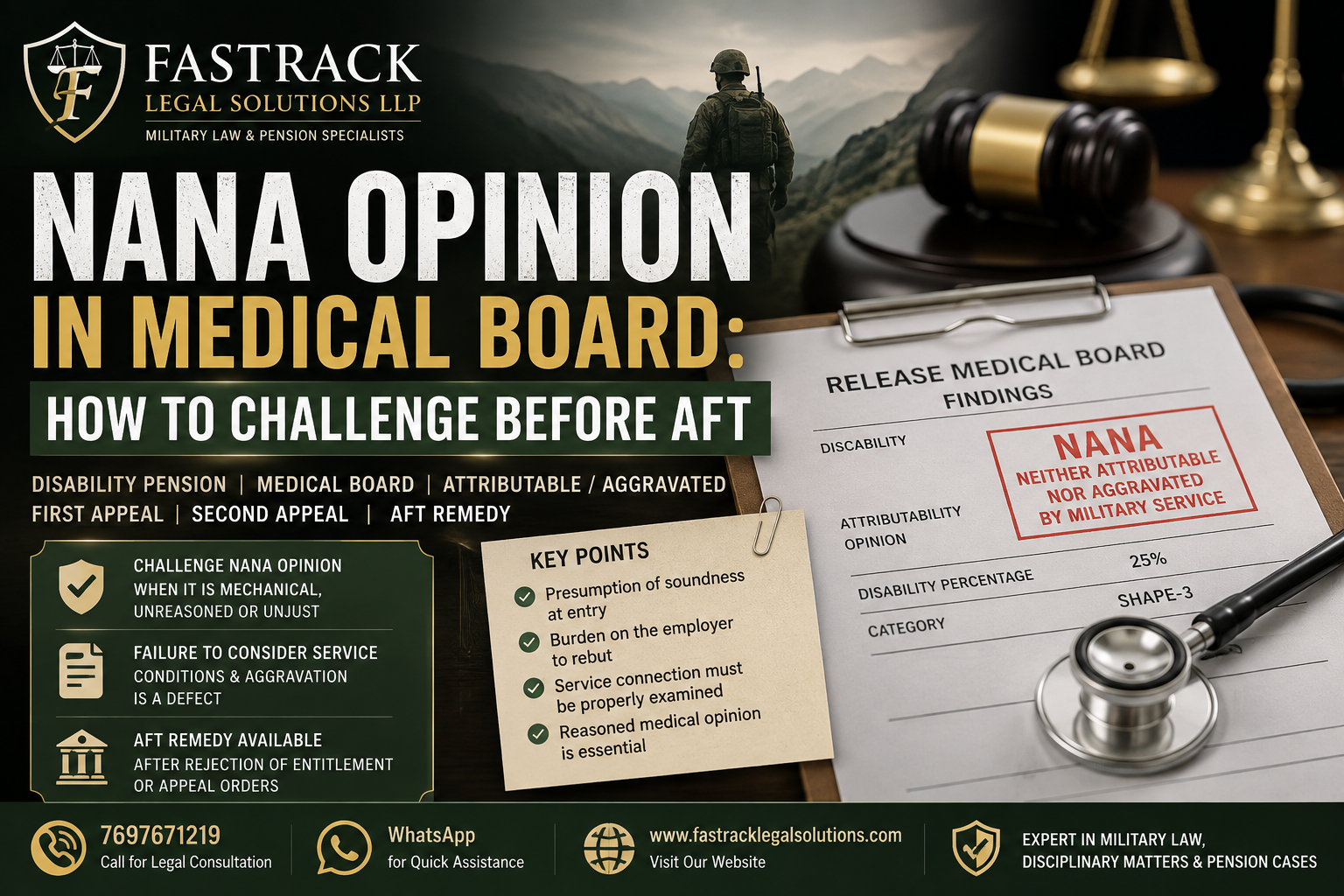
Neither Attributable Nor Aggravated. This is a conclusion, not a substitute for the reasons and evidence required to support it.
1. Why this issue matters
In many Armed Forces disability-pension disputes, the existence of the disability is not disputed. The Medical Board may accept Primary Hypertension at 30%, hearing loss at 20%, a spinal condition at 40% or a psychiatric disability at another assessed percentage. The dispute begins because the Board marks the disability as Neither Attributable Nor Aggravated by Military Service.
That classification can determine whether disability pension, disability element, impairment relief or related benefits are sanctioned. It can also determine whether a later claim for broad-banding, arrears or reassessment has any foundation. For the wider pension framework, see the Armed Forces Disability Pension pillar.
2. Attributability and aggravation are different legal questions
| Issue | Attributability | Aggravation |
|---|---|---|
| Core question | Did service cause or materially contribute to onset? | Did service worsen an existing or independently arising condition? |
| Typical evidence | Injury report, operational exposure, duty conditions, onset chronology. | Medical-category progression, service stressors, worsening after particular duties or postings. |
| Common mistake | Assuming every disease arising in service is automatically attributable. | Ignoring aggravation because direct causation cannot be proved. |
A legally sound challenge should therefore test both routes separately. A case may be weak on direct attributability but strong on aggravation.
3. What does NANA actually mean?
NANA means Neither Attributable Nor Aggravated by military service. In practice, that notation may appear in a Release Medical Board, Invaliding Medical Board, Retention-cum-Impairment Assessment Medical Board, appeal proceedings or pension adjudication.
The important question is not simply whether “NANA” has been written. It is why it has been written. A conclusory label such as “constitutional”, “idiopathic”, “lifestyle disease” or “onset in peace station” must be examined against the governing rules, medical evidence and service profile.
4. Dharamvir Singh: the classic presumption and burden-of-proof case
In Dharamvir Singh v. Union of India, (2013) 7 SCC 316, the Supreme Court examined the earlier entitlement framework and emphasised several important principles. Where no disease or disability was noted at entry, the member was presumed to have entered service in sound physical and mental condition. Under the then-applicable rules, the claimant was not required to prove entitlement in the same manner as an ordinary civil claimant; the employer had to justify disentitlement, and reasonable doubt operated beneficially.
5. Recent courts continue to reject mechanical NANA findings in older-rule cases
The principle is not merely historical. In Union of India v. Ex Nk Amin Chand, decided by the Delhi High Court on 27 March 2025, the Court undertook an extensive review of Dharamvir Singh, Rajbir Singh, Sukhvinder Singh and related disability-pension jurisprudence. The judgment dealt with claims governed by the earlier entitlement structure and stressed the importance of reasoned medical conclusions.
More recently, in Union of India v. Hav. Jawan Singh (Retd.), decided on 20 February 2026, the Delhi High Court considered Primary Hypertension assessed at 30% for life. The RMB had treated the condition as NANA because onset occurred at a peace station. The Court held that onset in a peace station was, by itself, insufficient and reiterated that the Medical Board must identify cogent causative factors rather than rely on a bald NANA conclusion.
This 2026 decision is especially useful because it shows how courts continue to scrutinise reasoning, not just the result recorded by the Board.
6. ER 2023 and GMO 2023: the current framework
The Department of Ex-Servicemen Welfare issued the Entitlement Rules for Casualty Pension and Disability Compensation Awards to Armed Forces Personnel, 2023 and Guide to Medical Officers, 2023 with effect from 21 September 2023.
The current medical guide is significant for NANA disputes because it requires Medical Boards to consider the relevant service circumstances and to record conclusions with reasons. The guide expressly requires opinions on attributability, aggravation and NANA to be supported by cogent reasons, and warns that a bare medical opinion without reasons is of little value to the competent or appellate authority.
| Claim period | Starting point |
|---|---|
| Earlier disability / earlier pension claim | Identify the entitlement rules and pension regulations applicable to the date of disablement, discharge and claim; Dharamvir/Rajbir jurisprudence may be central. |
| Disability reported/recorded after 21 September 2023 | Begin with ER 2023 and GMO 2023, then examine applicable pension regulations, policy circulars and judicial review principles. |
7. A Medical Board must explain the causal reasoning
A reasoned opinion should ordinarily address the material relevant to the diagnosis. Depending on the condition, this can include:
- medical condition at enrolment or commissioning;
- date and circumstances of onset;
- length of service before onset;
- field, high-altitude, operational or afloat service;
- nature of duties and occupational exposure;
- treatment history and medical-category progression;
- family or pre-service history where medically relevant;
- constitutional, hereditary or personal risk factors relied upon;
- whether service hastened onset or worsened the condition;
- why the Board accepts or rejects a causal relationship with military service.
If the Board changes an earlier opinion on attributability or aggravation, the reason for the change becomes particularly important.
8. “Peace station” does not automatically mean “no service connection”
One recurring defence-pension dispute concerns diseases such as Primary Hypertension arising while the member is serving in a peace station. The mere classification of the station as “peace” does not, by itself, answer the causation or aggravation question. Military service in a peace station may still involve long hours, command responsibility, irregular sleep, physical training, administrative stress, occupational exposure or other service factors.
The 2026 Delhi High Court decision in Hav. Jawan Singh is therefore particularly relevant when a NANA conclusion rests almost entirely on the words “peace station”.
9. Common conditions where attributability or aggravation is disputed
| Condition | Typical dispute | Evidence to examine |
|---|---|---|
| Primary Hypertension | Lifestyle/constitutional versus service stress or aggravation | Entry fitness, onset after long service, duty profile, medical-category history. |
| Psychiatric illness | Predisposition versus service stress/trauma | Premorbid history, service events, behaviour records, treatment chronology. |
| Sensorineural Hearing Loss | Age-related versus noise exposure | Weapon/firing exposure, trade, posting profile, audiometry history. |
| Spinal / joint conditions | Degenerative versus aggravated by service | Load-bearing duties, PT, route marches, terrain, injury history. |
| Diabetes Mellitus | Metabolic/personal risk factors versus service aggravation | Medical history, onset, service environment, risk-factor analysis. |
No diagnosis automatically guarantees entitlement. Equally, no diagnostic label automatically proves NANA.
10. How to test a NANA opinion before filing an appeal or OA
Identify the date of disablement, board, discharge and pension adjudication. Do not mix the 1982/2008 and 2023 frameworks.
Check whether the relevant disease or disability was noted at entry and what medical evidence exists from the early service period.
Map postings, duties, field/operational exposure, first symptoms, treatment, category changes and final board.
Identify the exact reasons supporting NANA. A conclusion without a causal analysis should be challenged specifically.
Compare the First and Second Appeal decisions with the grounds actually raised. A non-speaking rejection creates a separate issue.
Separate entitlement, percentage, reassessment, broad-banding and arrears. They are related but legally distinct issues.
11. Documents that usually matter most
- Entry medical examination / enrolment or commissioning medical record.
- Complete service medical history and AFMS forms.
- Posting profile and field/high-altitude/operational record.
- Medical-category proceedings and specialist opinions.
- Release Medical Board / Invaliding Medical Board / RIAB, as applicable.
- Detailed justification page on attributability/aggravation/NANA.
- Pension sanction or rejection communication.
- First Appeal with enclosures and decision.
- Second Appeal with enclosures and decision, where applicable.
- PPO / Corrigendum PPO if some pension component has already been sanctioned.
- Injury Report / Court of Inquiry / duty documents for injury cases.
- Any earlier medical-board opinion inconsistent with the final NANA conclusion.
If the dispute is primarily about the percentage rather than service connection, see the separate guide on disability-pension reassessment and medical re-evaluation.
12. AFT grounds should attack reasons, not merely request sympathy
An effective challenge normally identifies the precise legal and evidentiary defect. Depending on the governing rules and facts, grounds may include:
- NANA recorded without cogent reasons;
- relevant service conditions omitted from the Board’s analysis;
- entry medical fitness or earlier medical records ignored;
- aggravation not considered independently from direct causation;
- peace-station onset treated as conclusive;
- earlier Board opinion reversed without explanation;
- diagnostic label substituted for causal analysis;
- First or Second Appeal rejected without dealing with material grounds;
- wrong entitlement rules applied to the relevant date;
- percentage, duration or functional impairment inconsistent with the underlying medical record.
13. NANA, reassessment and broad-banding are not the same issue
| Dispute | Question |
|---|---|
| Entitlement / NANA | Is the disability attributable to or aggravated by service? |
| Percentage / reassessment | Is the assessed impairment percentage medically correct? |
| Broad-banding | Once entitlement exists, what percentage is reckoned for pension computation? |
| Arrears | From what date is the accepted entitlement or recomputation payable? |
For broad-banding arrears, the 2026 Supreme Court decision in Sgt Girish Kumar is separately analysed in our broad-banding arrears case note.
14. ER 2023 cases require a different drafting discipline
For disabilities governed by ER 2023/GMO 2023, pleadings should be built from the current framework itself. It is not enough to cite Dharamvir Singh as a universal formula. The better approach is to:
- identify the exact ER 2023 provision applicable to the category of claim;
- extract the Medical Board’s detailed justification;
- test whether the Board considered the evidence for and against service connection;
- identify the causal factors relied upon to deny attributability or aggravation;
- show any factual omission, contradiction or absence of cogent reasons;
- connect the challenge to the service record and medical evidence rather than only older case law.
This distinction is essential for keeping AFT pleadings legally current.
15. Frequently asked questions
Does a disease arising during service automatically become attributable?
No. The applicable entitlement rules and evidence must be applied. In older-rule cases, presumptions developed in Dharamvir Singh and related judgments may be important. Under the 2023 framework, the Medical Board must still perform an evidence-based causal analysis and give cogent reasons.
Can a NANA medical-board opinion be challenged?
Yes. Medical expertise carries weight, but a legally deficient, unsupported or non-speaking opinion can be scrutinised by the appellate authorities and the AFT.
Is a peace-station posting enough to deny disability pension?
No. The 2026 Delhi High Court decision in Hav. Jawan Singh rejected peace-station onset as a sufficient reason by itself in a Primary Hypertension case governed by the earlier rules.
What is stronger: attributability or aggravation?
Neither is inherently stronger. The correct route depends on medical causation and service facts. Some cases are much stronger on aggravation than on direct causation.
Can the AFT change a medical-board finding?
The Tribunal does not simply substitute its own medical opinion. It can, however, examine whether the opinion was reasoned, legally sustainable, based on relevant evidence and consistent with the governing rules.
Does broad-banding cure a NANA finding?
No. Broad-banding concerns computation after entitlement exists. A NANA dispute must first be resolved on attributability or aggravation.
Related disability-pension resources
Disability Pension for Armed Forces — Main Guide
Case-information form
For structured professional correspondence concerning a disability-pension record, the relevant medical-board papers, appeal orders and service chronology may be organised before seeking case-specific advice.
Open the Fastrack Legal Solutions case-information form
Provided for professional correspondence and information only; not solicitation, advertising, inducement or assurance of outcome.
Conclusion
The phrase “Neither Attributable Nor Aggravated” is not self-proving. A disability-pension dispute must be analysed through the correct entitlement framework, the entry and service medical record, the chronology of onset, the nature of military duties and the reasons actually recorded by the Medical Board.
For older-rule cases, Dharamvir Singh and subsequent decisions remain central to questions of entry fitness, presumption and burden. For post-21 September 2023 cases, ER 2023 and GMO 2023 require a current, evidence-based analysis and reasoned medical justification. The strongest AFT challenge is therefore not a generic attack on NANA; it is a document-led demonstration of why the recorded causal conclusion cannot stand under the rules applicable to that particular case.