
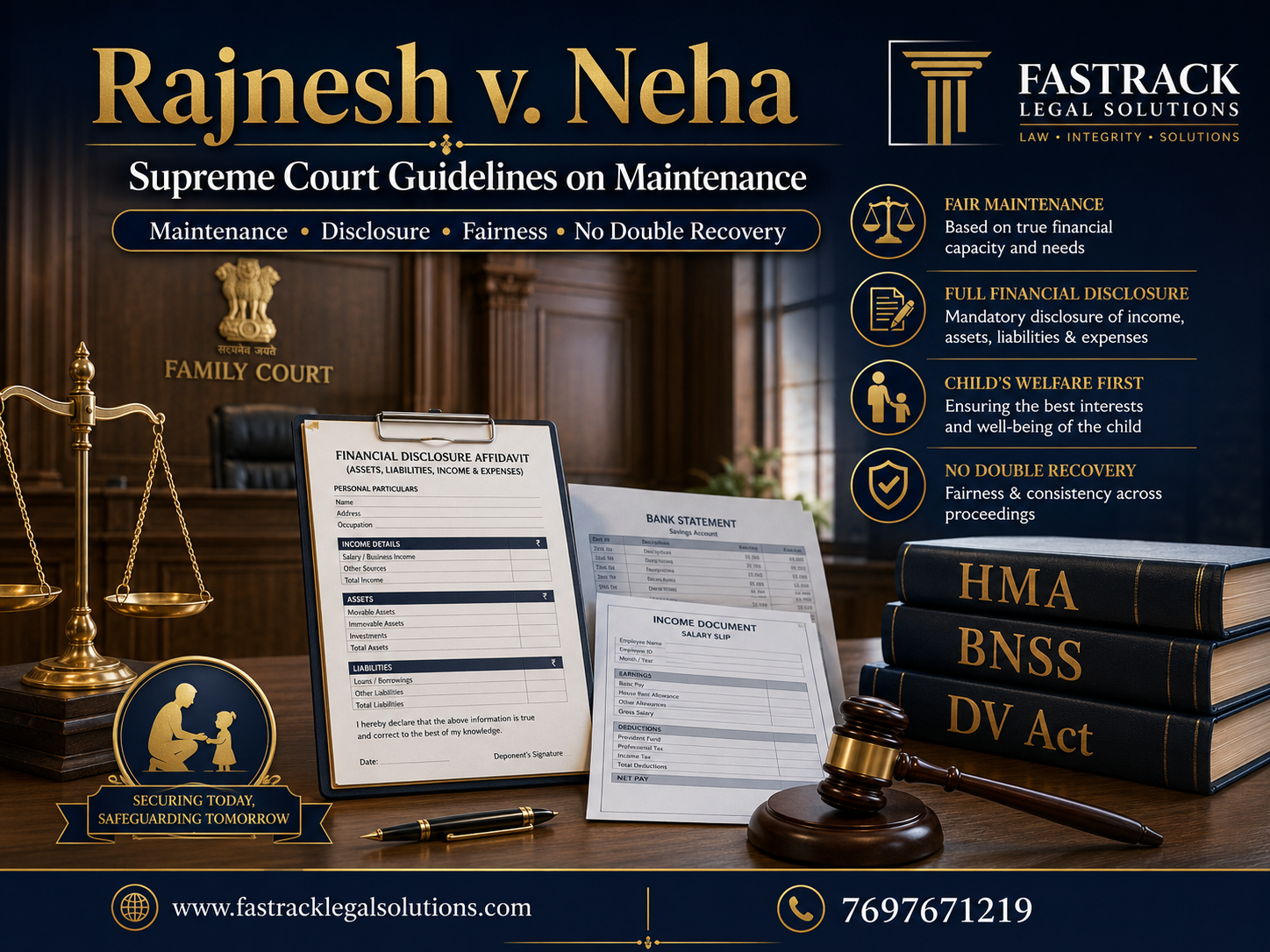
Rajnesh v. Neha, Criminal Appeal No. 730 of 2020, decided by the Supreme Court of India on 4 November 2020 and reported as (2021) 2 SCC 324, is a landmark judgment on maintenance in matrimonial disputes. The Supreme Court framed nationwide guidelines on financial disclosure, overlapping maintenance proceedings, interim maintenance, criteria for determining quantum, date from which maintenance should be awarded, and enforcement of maintenance orders. The judgment made the Affidavit of Disclosure of Assets and Liabilities central to maintenance litigation in India.
1. Introduction
Maintenance litigation in India was, for a long time, marked by delay, concealment, multiplicity of proceedings and inconsistent orders. A wife or child could be waiting for interim maintenance for years, while the respondent could avoid meaningful disclosure of income, assets, standard of living and liabilities. Equally, respondents frequently complained that multiple proceedings under different statutes were being used to claim overlapping amounts without proper disclosure.
The Supreme Court’s decision in Rajnesh v. Neha brought much-needed procedural discipline into this area. The judgment was not limited to one family dispute. It created a national framework for maintenance adjudication across Family Courts, District Courts and Magistrate Courts. The Court specifically framed guidelines on overlapping jurisdiction, interim maintenance, quantum, date of award and enforcement of orders.
For litigants, the case changed the maintenance strategy completely. After Rajnesh v. Neha, maintenance is not meant to be decided merely on emotional allegations such as “he earns very well” or “she is hiding her income.” The court now expects structured financial disclosure, documentary support and clean pleading.
2. Case Background: What Happened in Rajnesh v. Neha?
The matter arose from an application for interim maintenance under Section 125 of the Code of Criminal Procedure, 1973, filed by the wife and minor son. The Supreme Court noted that the interim maintenance proceedings had remained pending for about seven years, which exposed the practical failure of the system in providing speedy relief to dependants.
The Supreme Court therefore used the case to address systemic issues in maintenance litigation. It recognised that maintenance proceedings often suffer from delay, repetitive adjournments, incomplete disclosure, overlapping remedies and difficulty in enforcement. The result was a set of binding guidelines intended to streamline maintenance cases across India.
3. Why Rajnesh v. Neha Is Important
The judgment is important for five reasons.
First, it requires parties to file an Affidavit of Disclosure of Assets and Liabilities in maintenance proceedings. Secondly, it recognises that maintenance may be claimed under different statutes, but double recovery must be avoided. Thirdly, it clarifies that interim maintenance should not remain pending for years. Fourthly, it identifies factors for calculating quantum of maintenance. Fifthly, it strengthens enforcement of maintenance orders.
In practical terms, Rajnesh v. Neha shifted maintenance litigation from vague allegations to financial accountability.
4. Statutory Framework of Maintenance in India
Maintenance in India may arise under different statutes depending on the parties, religion, forum and nature of proceedings. The Supreme Court in Rajnesh v. Neha considered the problem of multiple remedies and overlapping jurisdiction in maintenance cases.
Important provisions include:
- Section 24, Hindu Marriage Act, 1955 — maintenance pendente lite and expenses of proceedings. This provision is gender-neutral and may be invoked by either spouse where there is no independent income sufficient for support and litigation expenses. The proviso requires the application to be disposed of, as far as possible, within sixty days from service of notice.
- Section 25, Hindu Marriage Act, 1955 — permanent alimony and maintenance. The court may grant gross sum, monthly or periodical payment, and may vary, modify or rescind the order on change of circumstances.
- Section 26, Hindu Marriage Act, 1955 — custody, maintenance and education of minor children in proceedings under the Act.
- Section 125, CrPC — the provision under which the original Rajnesh v. Neha dispute arose.
- Section 144, Bharatiya Nagarik Suraksha Sanhita, 2023 — the broadly corresponding current provision for maintenance of wives, children and parents in proceedings under the new criminal procedure framework. India Code records the BNSS enforcement date as 1 July 2024, and Section 144 deals with maintenance of wives, children and parents.
- Section 20, Protection of Women from Domestic Violence Act, 2005 — monetary reliefs in domestic violence proceedings.
A litigation strategy in maintenance cases must therefore identify the correct provision, forum, pending proceedings, prior orders and possibility of set-off.
5. The Problem of Overlapping Maintenance Proceedings
One of the most important aspects of Rajnesh v. Neha is the treatment of overlapping proceedings.
A claimant may have remedies under different statutes. For example, maintenance may be claimed under the Hindu Marriage Act, Domestic Violence Act, CrPC/BNSS or personal law. The Supreme Court recognised that there is no absolute bar on pursuing maintenance under different enactments. However, it also held that it would be inequitable to direct payment of maintenance independently under each proceeding without accounting for amounts already awarded.
The practical rule is this: multiple remedies may exist, but double recovery is impermissible.
The claimant is under a legal obligation to disclose earlier maintenance orders in subsequent proceedings. The later court must take the earlier award into account and grant adjustment or set-off.
6. Mandatory Financial Disclosure: The Real Impact of Rajnesh v. Neha
The most practical contribution of Rajnesh v. Neha is the standardised financial disclosure mechanism.
The Supreme Court directed that the Affidavit of Disclosure of Assets and Liabilities annexed to the judgment shall be filed by parties in all maintenance proceedings, including pending proceedings, before Family Courts, District Courts and Magistrate Courts throughout the country.
The Court further directed that:
- The applicant seeking maintenance should file a concise application along with the disclosure affidavit.
- The respondent must file the reply with the disclosure affidavit within a maximum period of four weeks.
- Courts should not grant more than two opportunities for filing the disclosure affidavit.
- If delay is wilful and contumacious, the court may consider striking off the defence.
- If the respondent fails to file the affidavit, the court may decide the maintenance application on the basis of the applicant’s affidavit and the material on record.
This is the teeth of the judgment. It prevents maintenance cases from becoming endless games of concealment.
7. What Must Be Disclosed in the Maintenance Affidavit?
The disclosure affidavit is meant to give the court a realistic picture of the financial position of the parties. Depending on the format applicable and the facts of the case, relevant disclosures may include income, employment, business interests, assets, bank accounts, investments, liabilities, dependants, living expenses, property holdings, loans, rent, children’s expenses and lifestyle indicators.
The Supreme Court also recognised that India has varied economic realities. It therefore annexed different disclosure formats, including formats suited to urban and rural/agrarian contexts.
This is important because a salaried urban employee, a businessperson, an agricultural landholder and a person in the unorganised sector may require different disclosure treatment.
8. Criteria for Determining Quantum of Maintenance
The Supreme Court made it clear that there is no straitjacket formula for determining maintenance. The purpose of interim or permanent maintenance is to ensure that the dependant spouse is not reduced to destitution or vagrancy because of matrimonial breakdown; it is not meant to punish the other spouse.
The Court identified several relevant factors, including:
- Status of the parties.
- Reasonable needs of the claimant.
- Independent income and property of the claimant.
- Number of persons the respondent is legally obliged to maintain.
- Financial capacity of the respondent.
- Actual income and reasonable expenses of the respondent.
- Liabilities of the respondent.
- Standard of living enjoyed in the matrimonial home.
- Inflation and cost of living.
- Age and employment of the parties.
- Duration of marriage.
- Expenses relating to children.
- Disability, illness or special needs.
- Litigation expenses.
This makes maintenance calculation a factual and equitable exercise, not a mechanical percentage formula.
9. Maintenance Is Not Punishment, but It Is Also Not Charity
The judgment carefully balances both sides.
For the claimant, the law recognises that a financially weaker spouse or child should not be left destitute during matrimonial litigation. For the respondent, the Court recognised that the amount should not be oppressive, unbearable or extravagant. The amount must be reasonable and realistic, ensuring dignified support without creating unjust hardship.
This is why both parties must come to court with clean financial disclosure. A claimant who exaggerates expenses without proof weakens credibility. A respondent who suppresses income or creates artificial liabilities risks adverse orders.
10. Educated Wife or Earning Capacity: Does It Defeat Maintenance?
A frequent defence in maintenance cases is that the wife is educated and therefore capable of earning. Rajnesh v. Neha clarified, while referring to earlier authority, that it is not a complete answer to a maintenance claim that the wife is educated and could support herself. The court must consider the status of parties, actual capacity, income, circumstances and factual realities.
However, this does not mean that educational qualification is irrelevant. A court may examine whether unemployment is genuine, whether there was a career break due to marriage or childcare, whether the claimant has actual income, and whether there is deliberate suppression of earning capacity.
The legal position is balanced: mere qualification does not defeat maintenance; actual financial reality matters.
11. Date From Which Maintenance Should Be Awarded
One persistent issue in maintenance litigation is whether maintenance should be awarded from the date of application or from the date of order.
In Rajnesh v. Neha, the Supreme Court examined competing approaches and framed guidance on the date from which maintenance should be awarded. The Court noted delays in interim maintenance proceedings and the hardship caused when relief is not granted in a timely manner.
As a practical litigation point, the claimant should specifically pray for maintenance from the date of application. The respondent, if opposing such relief, must show legally sustainable reasons why maintenance should not run from that date.
12. Enforcement of Maintenance Orders
Maintenance orders are meaningful only if they are enforceable. The Supreme Court in Rajnesh v. Neha treated enforcement as a separate issue and framed it as part of the national maintenance guidelines.
Where a party wilfully defaults, the available remedies may include execution, recovery proceedings, enforcement under the concerned statute, attachment, warrant processes and other legally permissible measures. The exact remedy depends on the provision under which the order has been passed.
Under the BNSS framework, Section 144 deals with maintenance and Section 147 deals with enforcement of maintenance orders; the official India Code page lists the statutory structure for maintenance, procedure, alteration and enforcement under Sections 144 to 147.
13. Practical Effect on Family Court Litigation
After Rajnesh v. Neha, a maintenance case should be prepared like a financial proceeding. Pleadings must be supported by documents and disclosure affidavits. Courts increasingly expect both parties to disclose their real financial position.
For a claimant, the petition should clearly identify need, standard of living, children’s expenses, medical expenses, household expenses, rent, educational costs and litigation expenses.
For a respondent, the reply should disclose actual income, liabilities, dependants, existing orders, loans, business realities, medical obligations and genuine inability, if any.
The safest legal strategy is transparency. Concealment is usually more damaging than an adverse number.
14. Documents Required After Rajnesh v. Neha
A maintenance case should generally be supported by:
- Income tax returns.
- Salary slips.
- Bank statements.
- Form 16.
- Business income records.
- GST returns, where relevant.
- Company documents, where relevant.
- Rent agreements.
- Property documents.
- Loan statements.
- Credit card statements.
- School fee receipts.
- Medical bills.
- Insurance premium receipts.
- Existing maintenance orders.
- Proof of lifestyle and expenditure.
- Asset-liability affidavit as per Rajnesh v. Neha.
- Documents showing dependants and household expenses.
A vague application is weak. A documented application has weight.
15. Common Mistakes by Claimants
Claimants often weaken their maintenance case by inflating expenses, failing to disclose income, filing multiple proceedings without disclosure, not separating personal expenses from child expenses, relying only on oral allegations about the respondent’s income, and not filing the asset-liability affidavit properly.
After Rajnesh v. Neha, the court expects credibility. A claimant should not merely ask for a high amount; the claimant must show how the amount is justified.
16. Common Mistakes by Respondents
Respondents often damage their defence by suppressing bank accounts, showing artificially low income, transferring assets, claiming unemployment despite lifestyle evidence, filing incomplete disclosure affidavits, ignoring child expenses and not disclosing dependants properly.
The most dangerous defence is false poverty. Courts can examine lifestyle, transactions, assets, family businesses and spending patterns.
17. Stronger Legal Strategy for Claimants
For a claimant, the stronger route is:
- File a concise and structured maintenance application.
- Attach the Rajnesh v. Neha affidavit.
- Disclose all pending and previous maintenance proceedings.
- Provide documentary proof of expenses.
- Separate spouse maintenance from child expenses.
- Seek litigation expenses separately.
- Pray for maintenance from the date of application.
- Avoid exaggerated or unsupported claims.
18. Stronger Legal Strategy for Respondents
For a respondent, the stronger route is:
- File complete financial disclosure within time.
- Disclose genuine liabilities and dependants.
- Produce bank statements, ITRs and income records.
- Seek set-off for existing maintenance orders.
- Challenge inflated expenses with documents.
- Show claimant’s actual income or earning capacity with evidence.
- Avoid concealment.
- Offer reasonable child support where appropriate.
A respondent who appears transparent usually stands on better footing than one who appears evasive.
19. Delhi / NCR Practical Relevance
For litigants in Delhi, Gurugram, Noida and the wider NCR region, Rajnesh v. Neha is especially relevant because maintenance litigation frequently overlaps with divorce, domestic violence, custody, child support and criminal-procedure maintenance proceedings. Family Courts and Magistrate Courts commonly require financial disclosure and consider previous orders before determining fresh maintenance.
20. Conclusion
Rajnesh v. Neha is one of the most important maintenance judgments in Indian matrimonial law. It brings discipline, disclosure and fairness into an area that was previously clouded by delay, concealment and overlapping litigation.
The judgment does not say that every claimant must automatically get the amount claimed. It also does not permit respondents to avoid responsibility by suppressing income. The real message of the judgment is financial transparency.
Maintenance is not charity. It is not punishment. It is financial due process in matrimonial litigation.
For more family law and matrimonial law articles, visit Fastrack Legal Solutions at www.fastracklegalsolutions.com.
FAQs on Rajnesh v. Neha
1. What is Rajnesh v. Neha?
Rajnesh v. Neha, Criminal Appeal No. 730 of 2020, is a Supreme Court judgment dated 4 November 2020 that framed nationwide guidelines for maintenance cases, including financial disclosure, overlapping proceedings, interim maintenance, quantum, date of award and enforcement.
2. What is the main rule in Rajnesh v. Neha?
The main rule is that parties in maintenance proceedings must file proper financial disclosure through an Affidavit of Disclosure of Assets and Liabilities so that courts can determine maintenance fairly and efficiently.
3. Does Rajnesh v. Neha apply only to Section 125 CrPC cases?
No. Although the case arose from Section 125 CrPC proceedings, the Supreme Court framed guidelines applicable to maintenance proceedings before Family Courts, District Courts and Magistrate Courts across India.
4. Can maintenance be claimed under multiple laws?
Yes. A claimant may invoke different statutes where legally maintainable. However, the claimant must disclose previous maintenance orders, and courts must grant adjustment or set-off to avoid double recovery.
5. What factors are considered for deciding maintenance?
Courts consider the status of parties, reasonable needs, income, property, liabilities, dependants, standard of living, duration of marriage, children’s expenses, medical needs, inflation and litigation costs.
6. Is maintenance automatic?
No. Maintenance depends on statutory entitlement, financial need, capacity to pay, disclosure and facts of the case. However, courts do not permit financial concealment to defeat genuine claims.
7. Can an educated wife claim maintenance?
Yes, mere educational qualification does not automatically defeat maintenance. Courts examine actual income, employment status, earning capacity, standard of living, childcare responsibilities and facts of the case.
8. What happens if a party does not file the disclosure affidavit?
The Court in Rajnesh v. Neha stated that where a respondent delays filing the affidavit and seeks repeated adjournments, the court may consider striking off the defence if the conduct is wilful and contumacious; failure to file may also lead the court to decide on the basis of the applicant’s affidavit and record.
Disclaimer
This article is intended solely for general legal awareness and informational purposes. It does not constitute legal advice, legal opinion, solicitation, advertisement or an invitation to create an advocate-client relationship. Maintenance, alimony, child support and matrimonial proceedings are fact-specific and depend upon the applicable statute, personal law, financial disclosures, pleadings, evidence, forum, jurisdiction, existing orders and procedural requirements. Readers should seek independent legal advice before acting on the basis of this article.
