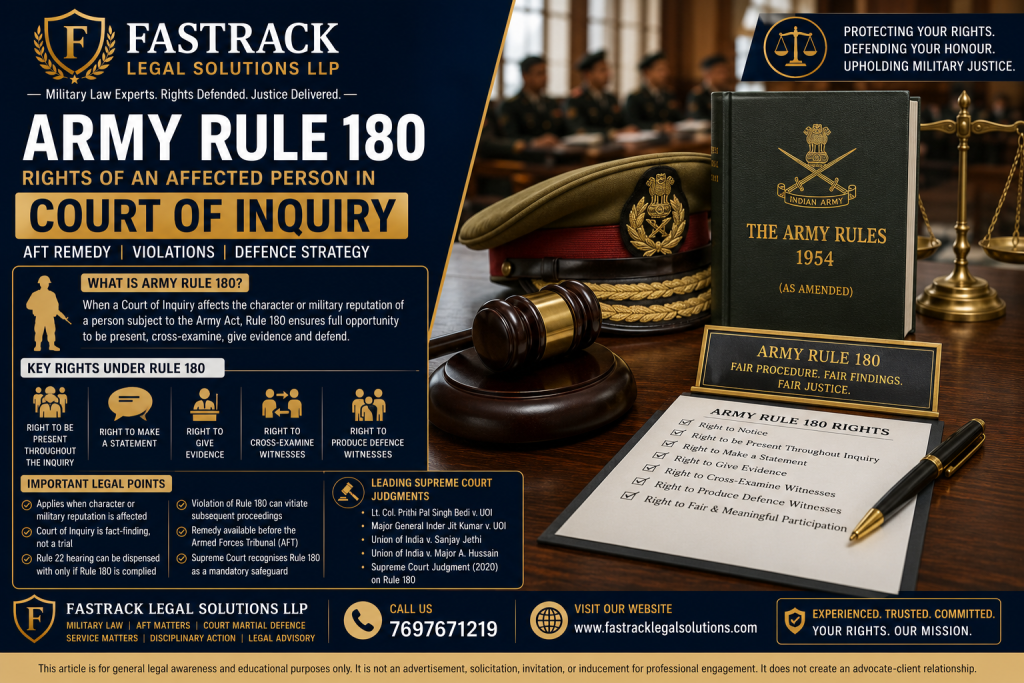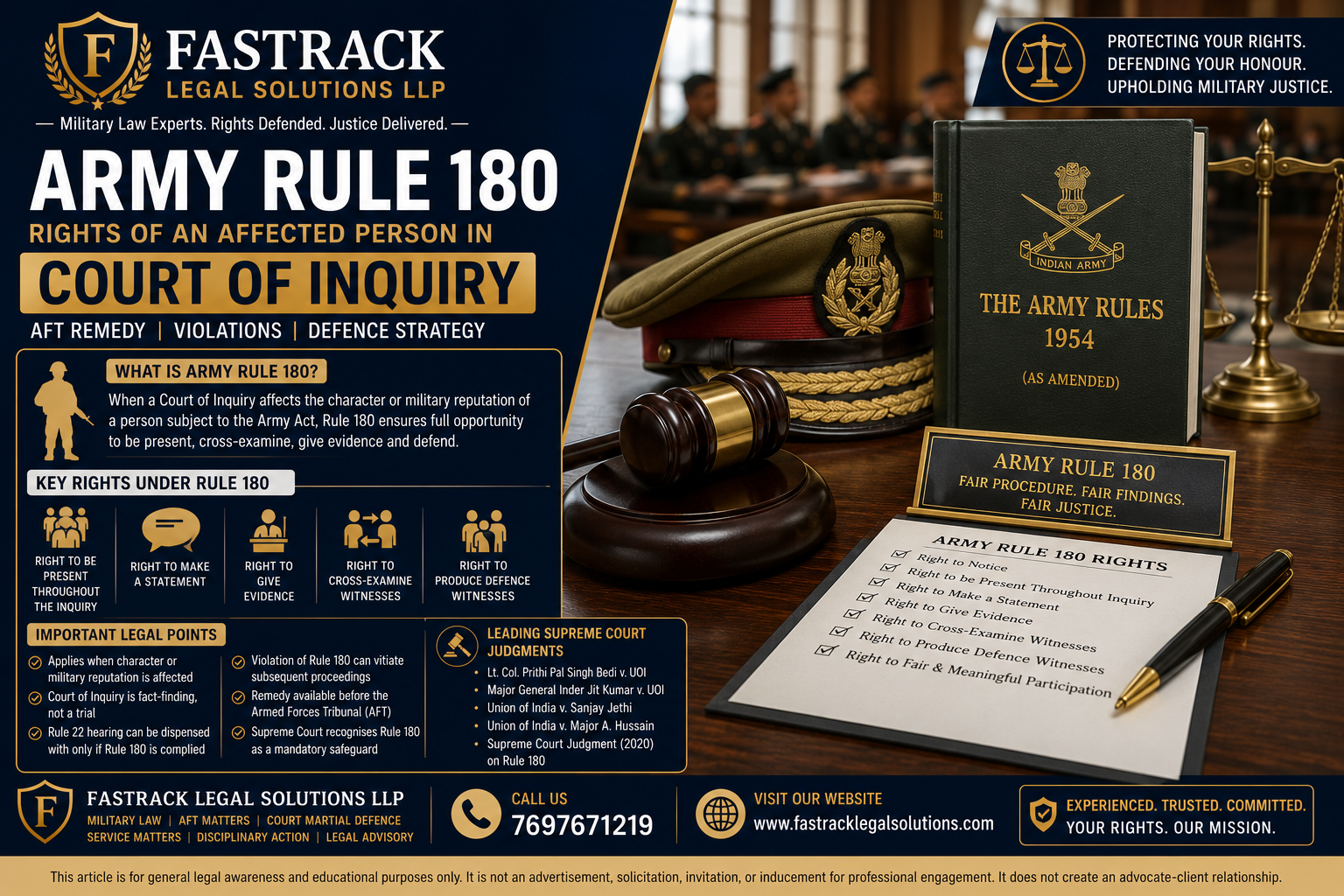
Army Rule 180 protects a person subject to the Army Act when a Court of Inquiry affects his character or military reputation. In such a case, the affected person must be given full opportunity to remain present throughout the inquiry, make a statement, give evidence, cross-examine witnesses whose evidence affects his character or military reputation, and produce witnesses in defence. The Supreme Court has recognised that Rule 180 carries statutory force and provides procedural safeguards in Court of Inquiry proceedings; however, a Court of Inquiry is primarily fact-finding and not a trial by itself. The legal consequence of Rule 180 violation depends on the facts, prejudice caused, later proceedings, and whether the violation affects disciplinary action or court martial.
Disclaimer: This article is for general legal awareness and educational purposes only. It is not an advertisement, solicitation, invitation, or inducement for professional engagement and does not create an advocate-client relationship. Military-law disputes depend on the convening order, Court of Inquiry record, witness statements, Rule 180 compliance, Rule 22 hearing, Summary of Evidence, charge-sheet, court martial record and case-specific facts.
Introduction
Army Rule 180 is one of the most important procedural safeguards in military law. It is often invoked in cases involving Court of Inquiry, disciplinary action, administrative action, censure, severe displeasure, court martial, character assessment, loss of reputation, command responsibility and adverse findings.
A Court of Inquiry is not a trial. It is a fact-finding mechanism. But when the inquiry starts touching the character or military reputation of an officer, JCO, NCO or soldier, Rule 180 becomes crucial. No finding affecting character or military reputation should be recorded behind the back of the affected person.
In practical military litigation, Rule 180 issues arise where:
- Statements are recorded behind the back of the affected person.
- The affected person is not allowed to remain present during witness evidence.
- Cross-examination is denied or mechanically restricted.
- Documents are not shown.
- The affected person is called only after damaging evidence is already recorded.
- Witnesses are not recalled after Rule 180 is belatedly invoked.
- The Court of Inquiry findings later form the foundation for Rule 22 hearing, Summary of Evidence, administrative action or court martial.
This article explains Army Rule 180, its scope, rights, common violations, consequences and AFT remedy.
What is a Court of Inquiry?
Under Rule 177 of the Army Rules, 1954, a Court of Inquiry is an assembly of officers, JCOs, warrant officers or NCOs directed to collect evidence and, if required, report on any matter referred to it. It is essentially a fact-finding body.
A Court of Inquiry may be ordered for matters such as:
- Loss of government property.
- Injury, death or accident.
- Alleged misconduct.
- Operational incident.
- Administrative irregularity.
- Financial irregularity.
- Discipline-related incident.
- Damage to military equipment.
- Conduct of personnel.
- Facts leading to possible disciplinary action.
A Court of Inquiry may collect evidence, record statements and submit findings or recommendations. However, it is not the same as a court martial.
What is Army Rule 180?
Army Rule 180 applies when an inquiry affects the character or military reputation of a person subject to the Army Act.
The Supreme Court reproduced Rule 180 in a 2020 judgment and recorded that where an inquiry affects the character or military reputation of a person subject to the Act, full opportunity must be afforded to such person to be present throughout the inquiry, make any statement, give evidence, cross-examine witnesses whose evidence in his opinion affects his character or military reputation, and produce witnesses in defence. The presiding officer must ensure that the affected person receives notice and fully understands his rights under the rule.
The essence of Rule 180 is simple: nothing affecting a soldier’s character or military reputation should happen behind his back.
When Does Rule 180 Apply?
Rule 180 applies when the Court of Inquiry affects:
- Character.
- Military reputation.
- Professional integrity.
- Conduct as an officer or soldier.
- Command responsibility.
- Alleged misconduct.
- Negligence.
- Dereliction of duty.
- Financial probity.
- Conduct leading to disciplinary or administrative action.
The rule is not triggered merely because a person is mentioned incidentally. It is triggered when the inquiry affects his character or military reputation in a meaningful way.
Is Army Rule 180 Mandatory?
Rule 180 has been treated as a mandatory safeguard where character or military reputation is affected. In Union of India v. Sanjay Jethi, the Supreme Court held that participation of a delinquent officer whose character or military reputation is likely to be affected is a “categorical imperative”, must be meaningful and effective, and Rule 180 has statutory colour and binding effect on Court of Inquiry proceedings.
However, the legal result of violation may still require examination of prejudice, later opportunity, nature of proceedings and whether the mandatory protection was denied in a manner affecting the final action.
Rights Available Under Army Rule 180
1. Right to Notice
The affected person must be notified that his character or military reputation is involved. The presiding officer must ensure that he receives notice and understands his rights under Rule 180.
2. Right to Be Present Throughout the Inquiry
The affected person must be allowed to remain present throughout the inquiry where evidence affecting him is recorded. This is not a symbolic right. It means the evidence should not be recorded behind his back.
3. Right to Make a Statement
The affected person has the right to make a statement in his defence or explanation.
4. Right to Give Evidence
The affected person may give evidence if he wishes to do so.
5. Right to Cross-Examine Witnesses
The affected person may cross-examine any witness whose evidence, in his opinion, affects his character or military reputation. This is one of the strongest protections under Rule 180.
6. Right to Produce Defence Witnesses
The affected person may produce witnesses in defence of his character or military reputation.
7. Right to Meaningful Participation
The participation must be effective, not cosmetic. Calling the affected person after all damaging statements are recorded may not satisfy the real purpose of Rule 180.
Can Witnesses Be Examined Before the Affected Person Is Called?
If the inquiry initially appears general but later starts affecting a person’s character or military reputation, Rule 180 should be invoked immediately. If important evidence has already been recorded behind his back, the safer and fairer course is to recall relevant witnesses for examination in his presence and allow cross-examination.
In AFT litigation, one recurring argument is that merely allowing belated cross-examination after the examination-in-chief was recorded behind the affected person’s back does not always satisfy Rule 180 in letter and spirit, especially where the earlier evidence has already shaped the inquiry.
Rule 180 and Rule 22: Why the Link Matters
Rule 22 of the Army Rules deals with hearing of charge by the Commanding Officer. Rule 22 requires the charge to be heard in the presence of the accused with liberty to cross-examine witnesses and call defence witnesses. Importantly, the proviso to Rule 22 states that where the charge arises from a Court of Inquiry in which Rule 180 has been complied with, the Commanding Officer may dispense with the Rule 22(1) procedure.
This makes Rule 180 strategically important. If the authorities rely on a Court of Inquiry to dispense with or dilute later procedural safeguards, strict compliance with Rule 180 becomes even more critical.
Rule 180 and Rule 182: Admissibility of Court of Inquiry Proceedings
The Supreme Court has noted that under Rule 182, Court of Inquiry proceedings, confessions, statements or answers given in a Court of Inquiry are generally not admissible in evidence, but the proviso permits their use by the prosecution or defence for cross-examining witnesses.
A Court of Inquiry is not evidence at trial in the ordinary sense, but it can still shape disciplinary action, framing of charges, cross-examination strategy and administrative consequences.
Is a Court of Inquiry Always Mandatory Before Disciplinary Action?
No. Rule 180 does not mean that every disciplinary action must necessarily begin with a Court of Inquiry. The Supreme Court has recognised that Rule 180 is an enabling provision to ensure participation when a Court of Inquiry affects character or military reputation; it does not make a prior Court of Inquiry a sine qua non for every disciplinary action.
- If a Court of Inquiry is held and affects character or military reputation, Rule 180 must be followed.
- Disciplinary action does not always require a Court of Inquiry as a mandatory precondition.
- If the authorities choose to hold a Court of Inquiry and then rely on it, procedural safeguards become important.
Does Violation of Rule 180 Automatically Cancel Court Martial?
Not always. The Supreme Court has recognised that Court of Inquiry is fact-finding and not adversarial like trial. In some cases, the effect of pre-trial irregularity may depend on whether prejudice is shown or whether a mandatory provision was violated in a manner causing failure of justice.
However, where Rule 180 violation is serious, foundational and prejudicial, it can become a strong ground to challenge later action, especially if the Court of Inquiry findings formed the basis of disciplinary proceedings, administrative censure or court martial.
Common Violations of Army Rule 180
1. No Notice to Affected Person
The affected person is not informed that his character or military reputation is under inquiry.
2. Evidence Recorded Behind His Back
Witnesses give statements affecting the person while he is not present.
3. Denial of Cross-Examination
The affected person is not allowed to cross-examine witnesses.
4. Restricted Cross-Examination
Questions are arbitrarily disallowed or not recorded.
5. Documents Not Shown
Documents relied upon by witnesses or the Court of Inquiry are not shown to the affected person.
6. Belated Invocation
Rule 180 is invoked only after damaging evidence is already collected.
7. No Recall of Witnesses
Witnesses whose statements were recorded earlier are not recalled for proper cross-examination.
8. No Defence Evidence Allowed
The affected person is denied opportunity to produce defence witnesses or documents.
9. Mechanical Certificate of Compliance
The record contains a certificate that Rule 180 was complied with, but proceedings show otherwise.
10. Findings Beyond Evidence
The Court of Inquiry records findings affecting character or reputation without evidence tested through Rule 180 participation.
Practical Defence Strategy During Court of Inquiry
Step 1: Ask for Written Invocation of Rule 180
Request formal confirmation that Rule 180 has been invoked and that the affected person’s rights will be protected.
Step 2: Seek Convening Order and Terms of Reference
The affected person should know the scope of inquiry.
Step 3: Ask for Access to Relevant Documents
Documents relied upon by witnesses should be shown to enable meaningful cross-examination.
Step 4: Cross-Examine Witnesses Properly
Cross-examination should target facts, contradictions, motive, procedure, documents and reliability.
Step 5: Record Objections
If questions are disallowed or documents are withheld, objections should be recorded.
Step 6: Produce Defence Witnesses
Defence witnesses should be identified early.
Step 7: Submit Written Statement
A precise written statement should be submitted after evidence is tested.
Step 8: Preserve Copies and Record of Requests
Representations, applications, objections and acknowledgments become important later before AFT.
Drafting Points for Rule 180 Objection
A Rule 180 objection should mention:
- Date of Court of Inquiry.
- Convening authority.
- Terms of reference.
- How the applicant’s character or reputation is affected.
- Witnesses examined behind the applicant’s back.
- Documents not supplied or shown.
- Cross-examination denied or restricted.
- Defence evidence not permitted.
- Prejudice caused.
- Prayer for recall of witnesses and full Rule 180 compliance.
The objection should be factual and specific. Vague allegations of “natural justice violation” are weaker.
What Should Be Done If Rule 180 Is Violated?
The affected person should immediately submit a written objection requesting recall of witnesses, opportunity to remain present, cross-examination, access to relevant documents, permission to give evidence and permission to produce defence witnesses. If adverse action is later taken on the basis of the defective Court of Inquiry, the violation may be raised in a statutory complaint or before the Armed Forces Tribunal.
AFT Remedy for Rule 180 Violation
The Armed Forces Tribunal may examine Rule 180 violation where it affects service matters or disciplinary or court martial consequences within its jurisdiction.
Possible reliefs may include:
- Quashing of Court of Inquiry findings.
- Direction for de novo inquiry from Rule 180 stage.
- Setting aside administrative action based on defective inquiry.
- Interference with censure or severe displeasure.
- Interference with disciplinary action where prejudice is shown.
- Relief in court martial challenge where Rule 180 violation vitiates proceedings.
- Direction for supply of records, where legally permissible.
- Direction to consider statutory complaint properly.
The exact relief depends on facts and stage of proceedings.
Important Supreme Court Judgments on Army Rule 180
1. Lt. Col. Prithi Pal Singh Bedi v. Union of India
The Supreme Court recognised the importance of Rule 180 participation where a Court of Inquiry affects character or military reputation, but also clarified that Rule 180 does not make Court of Inquiry mandatory in every disciplinary case.
2. Major General Inder Jit Kumar v. Union of India
This judgment is often cited for the protection provided by Rule 180 at the Court of Inquiry stage. The Supreme Court has referred to it while discussing the nature of Court of Inquiry and Rule 180 protections.
3. Union of India v. Sanjay Jethi
This is one of the strongest authorities on meaningful Rule 180 participation. The Supreme Court held that participation of a delinquent officer whose character or military reputation may be affected is a categorical imperative and must be meaningful and effective.
4. Union of India v. Major A. Hussain
The Supreme Court recognised that Court of Inquiry is fact-finding and not adversarial in the same way as trial. The effect of irregularity may depend on mandatory rule violation and prejudice.
5. Supreme Court 2020 Rule 180 Judgment
In the 2020 decision dealing with Rule 180, the Supreme Court reproduced Rule 180 and discussed its relationship with Court of Inquiry, Rule 182 and Rule 22. The judgment is important because it explains that Rule 180 applies when character or military reputation is involved, while Rule 182 limits admissibility of Court of Inquiry proceedings except for cross-examination purposes.
Rule 180 and Administrative Action
Rule 180 is not relevant only for court martial. It may also matter where Court of Inquiry findings lead to:
- Censure.
- Severe displeasure.
- Adverse remarks.
- Disciplinary action.
- Administrative action.
- Reputational damage.
- Career consequences.
- Promotion impact.
- Attachment or removal from appointment.
- Directions for further proceedings.
Where the Court of Inquiry affects character or military reputation, Rule 180 safeguards should be insisted upon before adverse findings are relied upon.
Rule 180 Checklist for Defence
Before Inquiry
- Obtain convening order.
- Examine terms of reference.
- Identify whether character or reputation is involved.
- Ask for Rule 180 rights in writing.
- Ask for documents necessary for participation.
During Inquiry
- Remain present.
- Cross-examine witnesses.
- Object to denied questions.
- Ask for document inspection.
- Produce defence witnesses.
- Submit statement.
- Ensure proceedings record participation.
After Inquiry
- Ask for permissible copies or extracts.
- Challenge defective findings.
- File statutory complaint if required.
- Preserve proof of objections.
- Raise violation before AFT if adverse action follows.
Quick Answers
What is Army Rule 180?
Army Rule 180 gives procedural rights to a person subject to the Army Act when a Court of Inquiry affects his character or military reputation.
What rights are given under Rule 180?
The affected person has the right to be present throughout the inquiry, make a statement, give evidence, cross-examine witnesses and produce defence witnesses.
Is Rule 180 mandatory?
Yes, where character or military reputation is affected in a Court of Inquiry, Rule 180 safeguards must be followed.
Does Rule 180 apply to every Court of Inquiry?
No. It applies when the inquiry affects the character or military reputation of a person subject to the Army Act.
Can Rule 180 violation be challenged before AFT?
Yes, where the violation affects service rights, administrative action, disciplinary proceedings or court martial consequences.
Frequently Asked Questions
1. What is Army Rule 180?
Army Rule 180 is a procedural safeguard in Court of Inquiry proceedings where the character or military reputation of a person subject to the Army Act is affected.
2. When does Rule 180 apply?
It applies when a Court of Inquiry affects the character or military reputation of a person subject to the Army Act.
3. What are the rights under Army Rule 180?
The affected person has the right to remain present throughout the inquiry, make a statement, give evidence, cross-examine witnesses and produce witnesses in defence.
4. Is Court of Inquiry a trial?
No. A Court of Inquiry is primarily fact-finding. It collects evidence and reports on matters referred to it.
5. Can a person cross-examine witnesses in Court of Inquiry?
Yes, if Rule 180 applies, the affected person may cross-examine witnesses whose evidence affects his character or military reputation.
6. Can Rule 180 be invoked late?
If it becomes clear during inquiry that a person’s character or military reputation is affected, Rule 180 should be invoked immediately. Earlier witnesses may need to be recalled where required for meaningful participation.
7. Does Rule 180 violation automatically vitiate court martial?
Not in every case. The effect depends on prejudice, mandatory-rule violation, later opportunity and how the Court of Inquiry was used. Serious Rule 180 violation can be a strong ground of challenge.
8. Can Rule 22 hearing be dispensed with if Rule 180 was followed?
The proviso to Rule 22 permits the Commanding Officer to dispense with Rule 22(1) procedure where the charge arises from a Court of Inquiry in which Rule 180 was complied with in respect of the accused.
9. Can AFT quash Court of Inquiry findings?
AFT may interfere where Rule 180 violation affects service rights, disciplinary action, administrative action or court martial consequences, depending on facts.
10. What should an affected person do during Rule 180 inquiry?
He should seek written notice, remain present, cross-examine witnesses, demand relevant documents, produce defence evidence, record objections and submit a written statement.
Conclusion
Army Rule 180 is one of the strongest natural-justice protections available in military inquiry proceedings. It ensures that a person whose character or military reputation is at stake is not condemned behind his back.
The rule does not convert a Court of Inquiry into a trial. But it does make participation meaningful where reputation is affected. The affected person must be present, must understand his rights, must be allowed to cross-examine relevant witnesses, and must be allowed to produce defence material.
In military-law litigation, Rule 180 violations should be pleaded with precision. The strongest challenge is not a general allegation of unfairness, but a clear demonstration of what evidence was recorded behind the person’s back, what cross-examination was denied, what documents were withheld, how findings affected reputation, and how prejudice carried forward into administrative action, disciplinary proceedings or court martial.
Rule 180 is not a technicality. It is the military law expression of fair play.
Disclaimer
This article is for general legal awareness and educational purposes only and may be published by Fastrack Legal Solutions LLP. It is not an advertisement, solicitation, invitation, or inducement for professional engagement. It does not create an advocate-client relationship. Army Rule 180 disputes depend on Court of Inquiry record, convening order, terms of reference, witness statements, participation record, objections, Rule 22 proceedings, Summary of Evidence, disciplinary action, administrative action and court martial record.