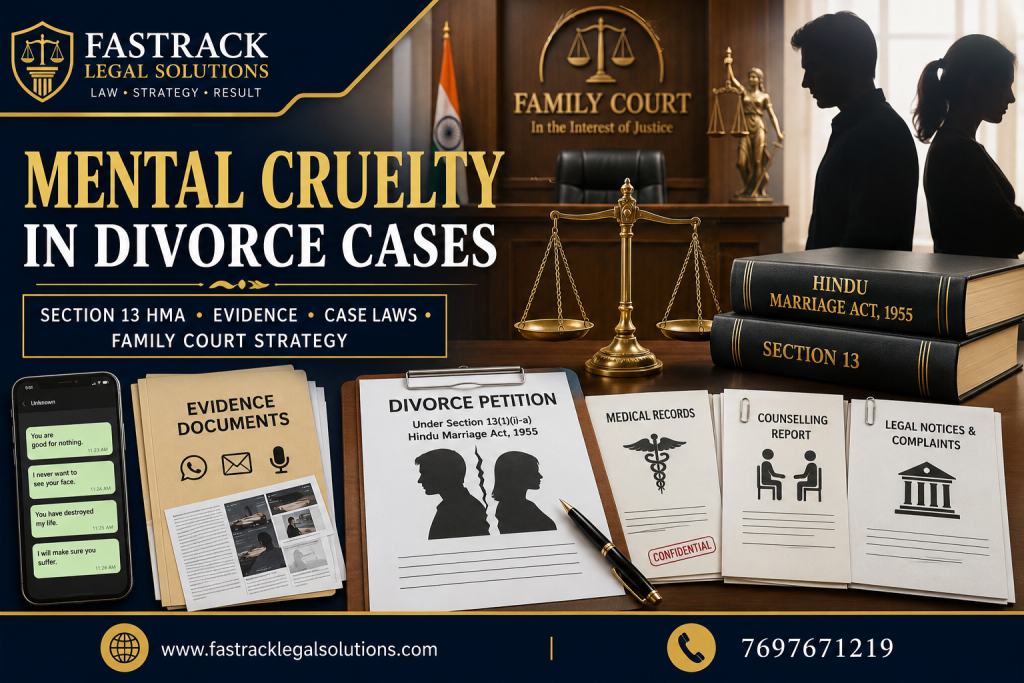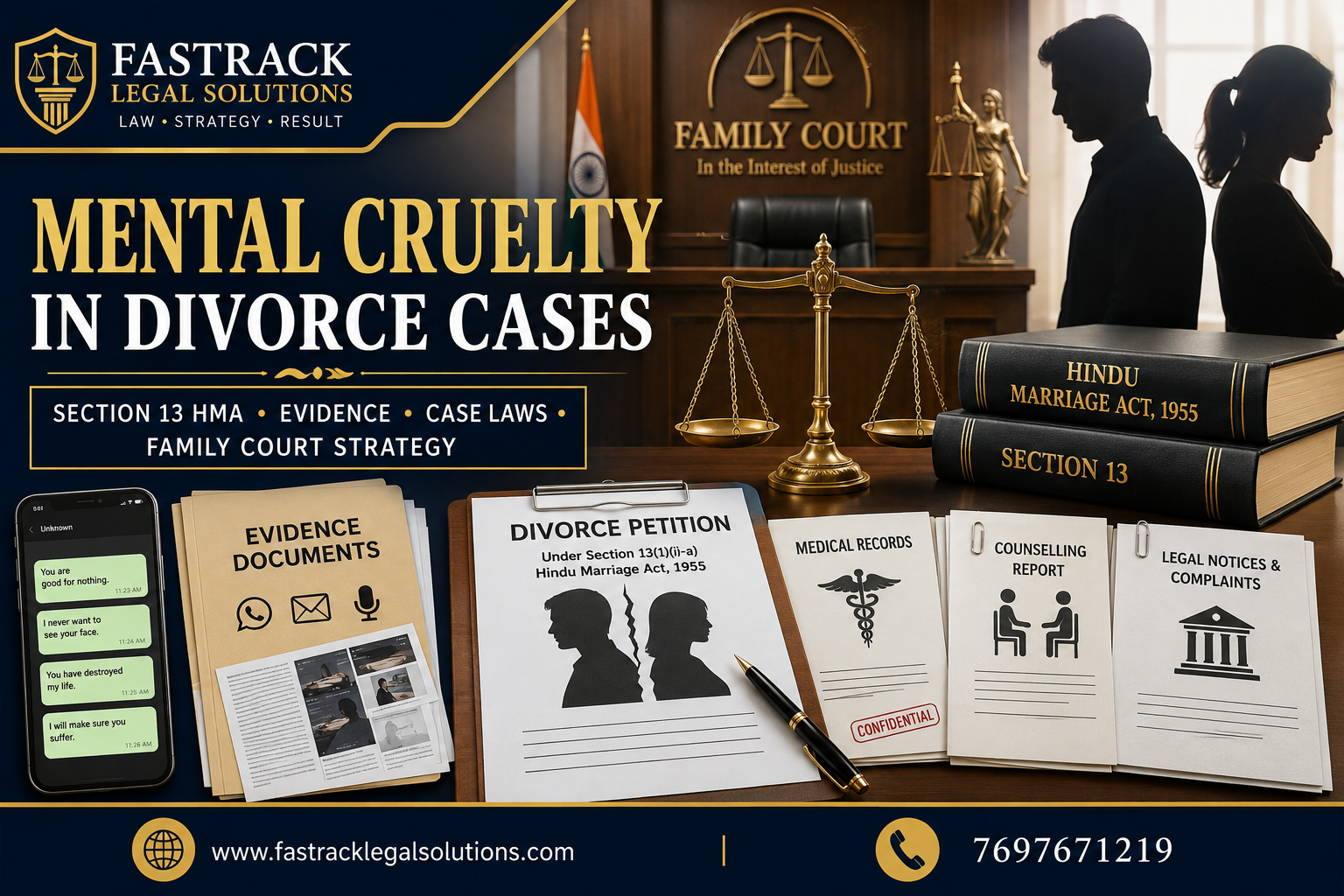
Mental cruelty in divorce cases refers to conduct by one spouse that causes such mental pain, suffering, fear, humiliation, emotional distress or breakdown of trust that the other spouse cannot reasonably be expected to continue the matrimonial relationship. Under Section 13(1)(i-a) of the Hindu Marriage Act, 1955, cruelty is a ground for divorce. Mental cruelty is not confined to physical violence. It may include sustained humiliation, false criminal allegations, denial of marital obligations, abusive conduct, reckless accusations, unilateral decisions affecting marriage, long hostile separation, or conduct that makes matrimonial life unbearable. The Supreme Court in Samar Ghosh v. Jaya Ghosh, (2007) 4 SCC 511, held that there can be no fixed formula for mental cruelty; each case depends on its own facts and cumulative circumstances.
Table of Contents
1. Introduction
Matrimonial litigation often begins with one word: cruelty.
But cruelty in law is not limited to visible injuries. A marriage may break not because of one dramatic event, but because of repeated humiliation, emotional withdrawal, false allegations, calculated silence, denial of dignity, social embarrassment, threats, hostile litigation, or conduct that steadily destroys the foundation of companionship.
Indian courts recognise both physical cruelty and mental cruelty. Physical cruelty may be easier to prove because it can involve medical records, police complaints or visible harm. Mental cruelty is more complex. It must be inferred from conduct, correspondence, circumstances, pleadings, complaints, witnesses, and the total impact of the relationship.
The law does not dissolve a marriage merely because parties are unhappy. But where one spouse’s conduct makes it unreasonable to expect the other to live in the marriage, divorce may be granted on the ground of cruelty.
2. Statutory Basis: Section 13(1)(i-a), Hindu Marriage Act
Section 13(1)(i-a) of the Hindu Marriage Act, 1955 provides that a marriage may be dissolved by a decree of divorce if one spouse has, after solemnisation of marriage, treated the other with cruelty. The statute does not define cruelty exhaustively, which is why judicial interpretation has become central.
This absence of a rigid definition is deliberate in effect. Cruelty is contextual. Conduct that may be tolerable in one marriage may be devastating in another. Courts therefore examine the social background, education, temperament, conduct, duration of marriage, nature of allegations, surrounding circumstances and cumulative impact.
3. Cruelty Need Not Be Physical
In Shobha Rani v. Madhukar Reddi, (1988) 1 SCC 105, the Supreme Court explained that cruelty may be mental or physical, intentional or unintentional, and that the court must examine the nature of conduct and its effect on the complaining spouse. The case is also important because persistent dowry demands were treated as conduct capable of amounting to cruelty.
This judgment remains relevant because many litigants assume cruelty must involve assault. That is incorrect. Mental cruelty may arise from conduct that does not leave physical marks but causes deep psychological injury.
4. Samar Ghosh v. Jaya Ghosh: The Leading Case on Mental Cruelty
The most cited judgment on mental cruelty is Samar Ghosh v. Jaya Ghosh, (2007) 4 SCC 511. The Supreme Court held that mental cruelty cannot be defined by a uniform standard and must be assessed from the facts and circumstances of each case. The Court gave illustrative instances of mental cruelty but clarified that these are not exhaustive.
The judgment is important because it recognises that mental cruelty may arise from:
- Sustained conduct causing mental pain and suffering;
- Conduct making it impossible for the spouse to live with the other;
- Unilateral refusal of cohabitation without justification;
- Long period of separation showing breakdown of matrimonial bond;
- Unilateral decision not to have children in appropriate facts;
- Indifference, humiliation or conduct destroying marital trust;
- Cumulative conduct rather than one isolated incident.
The practical lesson is that mental cruelty must be pleaded as a pattern, not merely as an accusation.
5. False Allegations and Criminal Complaints as Mental Cruelty
False, reckless or defamatory allegations may constitute mental cruelty, particularly where they attack the spouse’s character, morality, professional standing or family reputation.
In K. Srinivas Rao v. D.A. Deepa, (2013) 5 SCC 226, the Supreme Court held that making unfounded indecent defamatory allegations against the spouse or relatives in pleadings, filing false complaints or issuing notices containing defamatory allegations may amount to mental cruelty, depending on the facts. The Court added this category to the illustrative instances discussed in Samar Ghosh.
This does not mean every complaint filed by a spouse is cruelty. A genuine complaint is a legal remedy. The cruelty arises where allegations are found to be false, malicious, reckless, scandalous or intended to destroy reputation.
6. Long Separation and Breakdown of Marital Bond
Long separation by itself is not always an independent statutory ground before a Family Court, unless it fits into a recognised ground such as desertion or cruelty. However, long separation may support a finding of mental cruelty where the relationship has become emotionally dead and continuation of marriage would serve no purpose.
In Samar Ghosh, the Supreme Court considered prolonged separation as one of the relevant circumstances in assessing mental cruelty.
At the same time, litigants must be careful. A party cannot merely say, “We have lived separately for many years, therefore cruelty is proved.” The petition must explain how the separation occurred, who caused it, whether there was refusal of cohabitation, whether the conduct was unjustified, and how it affected the matrimonial relationship.
7. Denial of Cohabitation and Marital Relationship
Unjustified refusal to cohabit or persistent denial of marital relationship may amount to mental cruelty, depending on facts. Courts examine whether the refusal was deliberate, prolonged, unjustified and destructive of matrimonial life.
Recent High Court reporting also shows continuing judicial recognition of repeated refusal to cohabit as a possible form of mental cruelty where facts support such conclusion. For example, the Chhattisgarh High Court reportedly granted divorce where the wife admitted she had no desire to continue the relationship and there had been long separation.
However, this ground must be pleaded with restraint. The court will examine evidence, medical issues, safety concerns, abuse allegations, and whether refusal had legitimate justification.
8. Concealment of Serious Facts Before Marriage
Suppression of material facts before marriage may sometimes amount to cruelty, fraud or grounds for matrimonial relief depending on the nature of concealment and the provision invoked.
Recent High Court reports have treated concealment of serious medical conditions in arranged marriage contexts as legally relevant, including for judicial separation or annulment depending on facts and statutory ground pleaded.
The legal point is not that every illness must become a matrimonial offence. The issue is whether there was deliberate suppression of a material fact that affected marital consent, obligations, trust, or the ability to sustain matrimonial life.
9. Mental Cruelty by Litigation Conduct
Conduct during litigation may also be relevant. Reckless pleadings, scandalous allegations, false criminal complaints, repeated humiliating accusations, social media defamation, complaints to employer, and attempts to destroy professional standing may support a cruelty case.
However, courts distinguish between:
- Bona fide legal action; and
- Malicious use of legal process.
Merely filing a complaint does not amount to cruelty. But filing knowingly false, defamatory or vindictive complaints may amount to mental cruelty if proved.
This distinction is crucial because matrimonial litigation often involves parallel proceedings under the Domestic Violence Act, BNSS/CrPC maintenance provisions, HMA, IPC/BNS offences and child custody law. The legal system allows remedies; it does not protect abuse of remedies.
10. What Does Not Automatically Amount to Mental Cruelty?
Not every marital difficulty is cruelty.
The following may not automatically amount to cruelty unless the facts show serious impact:
- Ordinary wear and tear of marriage;
- Temperamental differences;
- Isolated quarrels;
- Normal disagreements with in-laws;
- Financial stress by itself;
- Refusal to follow unreasonable demands;
- Filing a genuine complaint;
- Living separately for valid reasons;
- Difference in lifestyle;
- Lack of affection unless accompanied by legally relevant conduct.
The court looks at gravity, frequency, intention where relevant, impact, context and whether the conduct makes marital life impossible.
11. Evidence Required to Prove Mental Cruelty
A cruelty petition should be evidence-led. Useful evidence may include:
- WhatsApp chats, emails and messages;
- Audio/video material, subject to admissibility;
- Police complaints and closure reports;
- Medical records;
- Psychiatric or counselling records, where relevant;
- Witness statements;
- Social media posts;
- Employer complaints or defamation material;
- Legal notices and pleadings containing allegations;
- Proof of long separation;
- Attempts at mediation or reconciliation;
- Documents showing false allegations;
- Records of criminal case acquittal, discharge or closure, where relevant;
- Proof of denial of cohabitation or desertion;
- Contemporaneous letters or representations.
A petition based only on general allegations is weak. A petition built on chronology and documents is much stronger.
12. How to Plead Mental Cruelty Properly
A strong divorce petition on mental cruelty should include:
- Date and place of marriage;
- Short matrimonial background;
- Specific incidents of cruelty with dates or approximate periods;
- Conduct showing mental pain, humiliation or fear;
- False allegations or complaints, if any;
- Impact on health, reputation, family life and professional life;
- Attempts at reconciliation;
- Period of separation;
- Why continuation of marriage is unreasonable;
- Prayer for divorce and consequential relief.
Avoid vague phrases such as “the respondent tortured the petitioner mentally.” Courts need particulars.
13. Common Mistakes by Petitioners
Petitioners often weaken cruelty cases by:
- Pleading conclusions instead of facts;
- Not giving dates or chronology;
- Making exaggerated allegations;
- Filing without documentary support;
- Mixing cruelty with irrelevant family disputes;
- Not proving false allegations;
- Treating long separation as automatic divorce;
- Ignoring cross-examination consequences;
- Overusing criminal allegations without proof;
- Not linking conduct to mental suffering.
The court must be shown why the conduct crosses the threshold of matrimonial cruelty.
14. Common Defences to Mental Cruelty Allegations
A respondent may defend a cruelty case by showing:
- Allegations are vague and unsupported;
- Incidents are ordinary marital wear and tear;
- Complaints were bona fide;
- Separation was due to petitioner’s conduct;
- Petitioner suppressed material facts;
- Petitioner is taking advantage of own wrong;
- Alleged cruelty is not grave enough;
- Evidence is fabricated or inadmissible;
- Reconciliation attempts were refused by petitioner;
- Petitioner’s own conduct caused breakdown.
A good defence does not merely deny. It gives an alternative factual narrative supported by documents.
15. Mental Cruelty and Mediation
Mediation is often attempted in matrimonial cases. But mediation is not always suitable where allegations involve severe violence, coercion, unsafe conduct or malicious prosecution.
In cases of mental cruelty, mediation may help where the real dispute is emotional distance, family interference, financial conflict or settlement. It may not help where there is deep hostility, false criminal allegations, repeated humiliation, or complete breakdown of trust.
A practical matrimonial strategy should assess whether the goal is reconciliation, contested divorce, mutual consent divorce, custody settlement, alimony settlement or quashing-linked comprehensive settlement.
16. Delhi / NCR Practical Relevance
In Delhi, Gurugram, Noida and NCR matrimonial litigation, mental cruelty is frequently pleaded along with maintenance, domestic violence, child custody, visitation, permanent alimony and settlement issues. Courts expect specific pleadings and evidence. A cruelty case cannot be treated as a general emotional essay.
Also Read Rajnesh v. Neha: Supreme Court Guidelines on Maintenance
17. Practical Takeaway
Mental cruelty is not about proving that the marriage was unpleasant. It is about proving that the respondent’s conduct made continuation of matrimonial life unreasonable.
The best cruelty case is not the most aggressive one. It is the case that shows a legally relevant pattern through documents, chronology, conduct and consequence.
Indian courts do not reward noise. They reward proof.
18. Conclusion
Mental cruelty has become one of the most important grounds for divorce in India. It reflects the legal recognition that marriage can become unbearable not only through physical violence, but also through sustained emotional harm, humiliation, false allegations, denial of dignity, hostile conduct and destruction of trust.
At the same time, courts are careful. Divorce is not granted merely because parties are incompatible or unhappy. The petitioner must show conduct serious enough to satisfy the legal standard under Section 13(1)(i-a) of the Hindu Marriage Act.
The strongest legal route is therefore clear: plead facts, file documents, prove conduct, show impact, and avoid exaggeration.
For more matrimonial law insights, visit www.fastracklegalsolutions.com.
FAQs on Mental Cruelty in Divorce Cases
1. What is mental cruelty in divorce cases?
Mental cruelty means conduct by one spouse that causes such mental pain, suffering, humiliation or distress that the other spouse cannot reasonably be expected to continue the matrimonial relationship.
2. Is mental cruelty a ground for divorce in India?
Yes. Under Section 13(1)(i-a) of the Hindu Marriage Act, cruelty is a ground for divorce, and judicial decisions recognise both physical and mental cruelty.
3. What is the leading case on mental cruelty?
Samar Ghosh v. Jaya Ghosh, (2007) 4 SCC 511, is the leading Supreme Court judgment on mental cruelty. It gives illustrative instances but clarifies that there is no fixed formula.
4. Can false allegations amount to mental cruelty?
Yes. False, defamatory or malicious allegations against a spouse or relatives may amount to mental cruelty, depending on facts. K. Srinivas Rao v. D.A. Deepa, (2013) 5 SCC 226, is an important authority on this issue.
5. Does long separation amount to mental cruelty?
Long separation may be a relevant factor, especially where it shows breakdown of matrimonial bond, but it is not automatically cruelty in every case. It must be pleaded with supporting facts.
6. What evidence is needed to prove mental cruelty?
Useful evidence includes messages, emails, complaints, medical records, witness testimony, pleadings containing false allegations, legal notices, proof of separation, counselling records and contemporaneous documents.
7. Can denial of cohabitation amount to mental cruelty?
Unjustified and prolonged denial of cohabitation or marital relationship may amount to mental cruelty depending on facts, duration, context and evidence.
8. Are ordinary fights cruelty?
Ordinary wear and tear of marriage, occasional quarrels or temperamental differences do not automatically amount to cruelty unless the conduct is grave, repeated or destructive enough to make continuation of marriage unreasonable.
This article is intended solely for general legal awareness and informational purposes. It does not constitute legal advice, legal opinion, solicitation, advertisement, or an invitation to create an advocate-client relationship. Divorce and cruelty cases are fact-specific and depend upon pleadings, evidence, applicable personal law, jurisdiction, limitation, prior proceedings, conduct of parties and forum-specific procedure. Readers should seek independent legal advice before acting on the basis of this article.