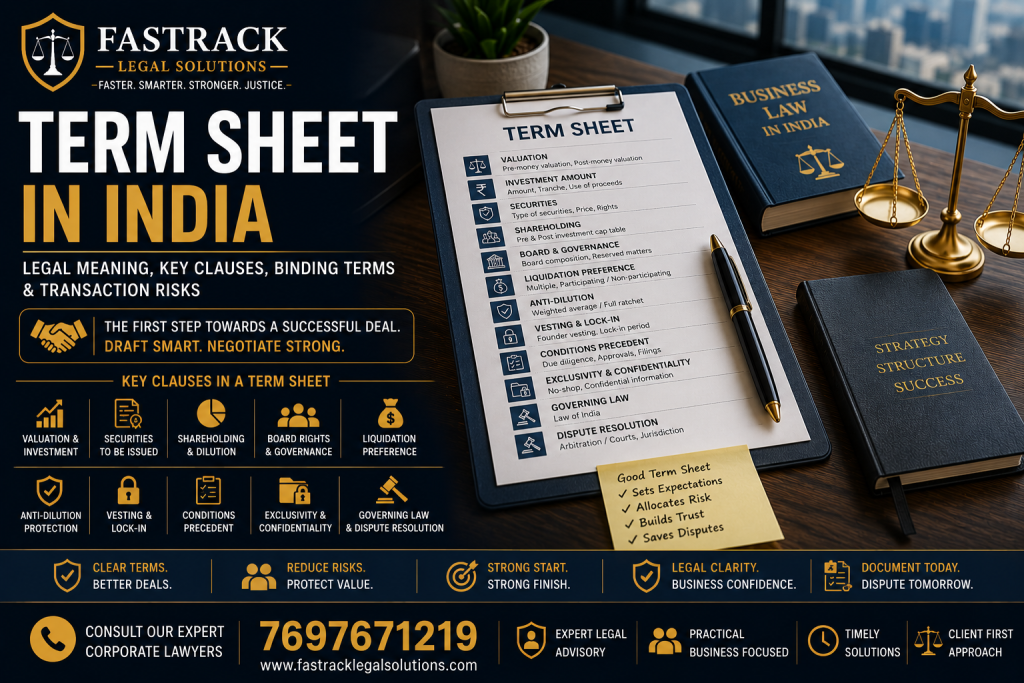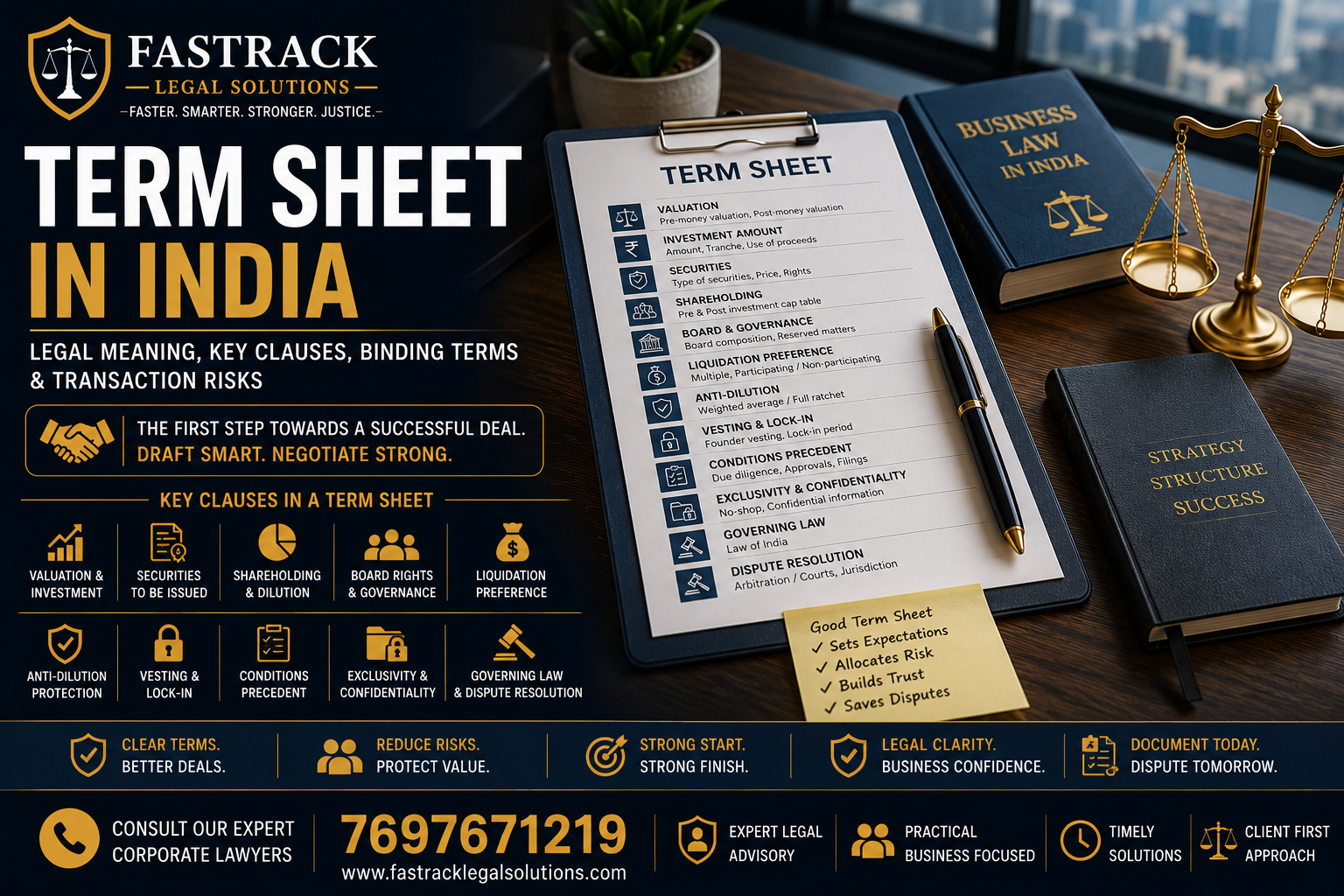
A term sheet in India is a preliminary transaction document that records the principal commercial and legal terms of a proposed investment, acquisition, merger, joint venture, loan or strategic transaction. It may be wholly non-binding, partly binding, or binding, depending on its language. Commercial terms such as valuation and proposed investment are usually made non-binding, while confidentiality, exclusivity, governing law, costs and dispute-resolution clauses are often expressly binding. A term sheet should be drafted carefully because Indian contract law recognises enforceability where parties have free consent, lawful object, lawful consideration and clear intention to create legal obligations.
Introduction
A term sheet is often the first serious document in a business transaction. It is signed before the final definitive agreements, but after the parties have broadly agreed on commercial intent. In startup funding, it may come before a Share Subscription Agreement and Shareholders Agreement. In an acquisition, it may come before a Share Purchase Agreement, Business Transfer Agreement or Asset Purchase Agreement. In a joint venture, it may precede a Joint Venture Agreement and amended constitutional documents.
The mistake many founders, promoters and investors make is treating a term sheet as a harmless summary. That is not always correct. A term sheet may create binding obligations, restrict negotiations with third parties, impose confidentiality duties, fix exclusivity periods, allocate costs, set due-diligence obligations and influence final transaction documents.
A well-drafted term sheet creates clarity. A poorly drafted term sheet creates dispute.
What is a Term Sheet?
A term sheet is a document that summarises the key terms of a proposed transaction.
It usually covers:
- Transaction structure.
- Valuation.
- Investment amount or purchase price.
- Securities to be issued or transferred.
- Conditions precedent.
- Due diligence.
- Founder obligations.
- Investor rights.
- Exclusivity.
- Confidentiality.
- Timeline.
- Costs.
- Governing law.
- Dispute resolution.
- Binding and non-binding status.
In practical terms, a term sheet is the bridge between commercial negotiation and final legal documentation.
Is a Term Sheet Legally Binding in India?
A term sheet may be binding or non-binding depending on its wording, intention of parties and nature of clauses.
Under Section 10 of the Indian Contract Act, 1872, agreements become contracts if made by free consent of competent parties, for lawful consideration and lawful object, and if not expressly declared void. Therefore, if a term sheet is drafted with clear obligations and intention to bind, it may be enforceable.
The safer drafting approach is to clearly divide the term sheet into:
- Non-binding commercial terms; and
- Binding legal terms.
A vague statement that “this term sheet is non-binding” may not be enough if the document elsewhere imposes mandatory obligations.
Binding and Non-Binding Clauses
A transaction term sheet commonly has both binding and non-binding clauses.
| Clause Type | Usually Binding or Non-Binding |
|---|---|
| Valuation | Usually non-binding until definitive documents |
| Investment amount | Usually non-binding until closing |
| Proposed shareholding | Usually non-binding |
| Commercial intent | Usually non-binding |
| Conditions precedent | Usually non-binding until final documents, unless expressly binding |
| Confidentiality | Binding |
| Exclusivity / no-shop | Binding |
| Costs and expenses | Binding |
| Governing law | Binding |
| Dispute resolution | Binding |
| Public announcement restrictions | Binding |
| Return of documents | Binding |
| Break fee | Binding if clearly drafted and legally enforceable |
The term sheet should expressly state which clauses survive termination or expiry.
Term Sheet vs Letter of Intent vs Memorandum of Understanding
| Document | Common Use | Legal Nature |
|---|---|---|
| Term Sheet | Investments, startups, M&A, joint ventures | Can be non-binding or partly binding |
| Letter of Intent | Commercial intent before final contract | Usually non-binding, but can contain binding clauses |
| Memorandum of Understanding | Broad understanding between parties | Can be binding or non-binding depending on language |
| Definitive Agreement | Final transaction agreement | Binding contract |
Names are not decisive. A document titled “Term Sheet” may be binding. A document titled “MOU” may be non-binding. Courts examine wording, intention, obligations and conduct.
Common Transactions Where Term Sheets Are Used
Term sheets are commonly used in:
- Startup seed funding.
- Angel investment.
- Venture capital investment.
- Private equity investment.
- Share acquisition.
- Asset acquisition.
- Business transfer.
- Joint venture.
- Strategic partnership.
- Founder buyout.
- Loan and structured finance.
- Convertible note or debenture transaction.
- Franchise expansion.
- Technology licensing.
- Real estate development transaction.
Each transaction requires different term-sheet architecture.
Key Clauses in a Term Sheet
1. Parties
The term sheet should correctly identify the parties.
It should mention:
- Legal name of investor / buyer / acquirer.
- Legal name of company / seller / promoter.
- CIN / LLPIN, where applicable.
- Registered office.
- Founder or promoter parties.
- Whether affiliates or nominees may participate.
- Whether the company is already incorporated.
Incorrect party description can create confusion in final documentation.
2. Transaction Structure
The term sheet must clearly describe the proposed transaction.
Examples:
- Primary investment into company.
- Secondary purchase from existing shareholders.
- Combination of primary and secondary investment.
- Share purchase.
- Asset purchase.
- Business transfer as going concern.
- Merger or amalgamation.
- Joint venture formation.
- Convertible instrument issuance.
- Strategic licensing arrangement.
Structure affects tax, stamp duty, regulatory approvals, due diligence, definitive documents and closing mechanics.
3. Valuation
Valuation is usually the most negotiated commercial term.
The term sheet should specify:
- Pre-money valuation.
- Post-money valuation.
- Fully diluted basis.
- ESOP pool treatment.
- Whether valuation is subject to due diligence.
- Whether valuation may be adjusted.
- Whether debt, working capital or liabilities affect valuation.
For startups, valuation must be read with dilution. A founder should not focus only on headline valuation. The founder should check liquidation preference, anti-dilution, ESOP expansion and investor rights.
4. Investment Amount / Purchase Price
The term sheet should state:
- Amount to be invested or paid.
- Currency.
- Tranche structure.
- Whether investment is primary or secondary.
- Whether payment is conditional.
- Closing date.
- Escrow or holdback, if any.
- Deferred consideration, if any.
If the investment is in tranches, the milestone and consequence of non-achievement must be clear.
5. Securities to Be Issued
A startup term sheet should identify the instrument.
Common instruments include:
- Equity shares.
- Compulsorily convertible preference shares.
- Compulsorily convertible debentures.
- Convertible notes.
- Warrants.
- Optionally convertible instruments, where legally permissible.
- SAFE-like instruments, subject to Indian law structuring.
Further issue of share capital is governed by Section 62 of the Companies Act, 2013, and private placement is governed by Section 42 where applicable. Therefore, the final issuance structure must comply with company law, valuation, filings and corporate approvals.
6. Shareholding and Dilution
The term sheet should specify investor shareholding after closing.
It should clarify:
- Percentage on fully diluted basis.
- ESOP pool inclusion.
- Treatment of convertible instruments.
- Founder dilution.
- Post-money cap table.
- Rights of existing investors.
- Anti-dilution consequences.
A cap table should be attached as a schedule where possible.
7. ESOP Pool
Investors often require creation or expansion of an ESOP pool before investment.
The term sheet should state:
- Size of ESOP pool.
- Whether created before or after investment.
- Whether ESOP pool dilutes founders only or all shareholders.
- Approval process.
- Vesting schedule.
- Exercise price principles.
- Treatment of unallocated ESOPs.
Founders must carefully check whether headline valuation is effectively reduced by pre-investment ESOP expansion.
8. Conditions Precedent
Conditions precedent are actions that must be completed before closing.
Common conditions precedent include:
- Completion of legal due diligence.
- Satisfactory financial and tax due diligence.
- Board approval.
- Shareholder approval.
- Amendment of Articles of Association.
- Execution of definitive agreements.
- Regulatory approvals.
- Consent from lenders.
- Waiver of existing shareholder rights.
- IP assignment from founders.
- Employment agreements with key founders.
- Settlement of identified disputes.
- Correction of ROC filings.
- FEMA compliance, where foreign investment exists.
A term sheet should distinguish between commercial conditions and mandatory legal conditions.
9. Conditions Subsequent
Conditions subsequent are obligations to be fulfilled after closing.
Examples include:
- Filing corporate forms.
- Updating statutory registers.
- Completing minor licences.
- Implementing DPDP compliance.
- Executing employee contracts.
- Registering trademarks.
- Completing internal policy updates.
- Post-closing reporting.
Critical issues should not be left as conditions subsequent unless the risk is acceptable and indemnified.
10. Due Diligence
The term sheet should provide a due diligence framework.
It should cover:
- Scope of due diligence.
- Legal, financial, tax and technical diligence.
- Data room access.
- Timeline.
- Confidentiality obligations.
- Management cooperation.
- Right to withdraw if due diligence is unsatisfactory.
- Treatment of due diligence findings.
Due diligence findings should feed into final valuation, warranties, indemnities and conditions precedent.
11. Exclusivity / No-Shop
An exclusivity clause prevents the company or promoters from negotiating with other investors or buyers for a defined period.
A good exclusivity clause should specify:
- Duration.
- Restricted transactions.
- Restricted parties.
- Exceptions.
- Consequences of breach.
- Whether break fee applies.
- Whether exclusivity ends automatically if investor delays.
From a founder’s perspective, exclusivity should not be open-ended. From an investor’s perspective, exclusivity protects transaction cost and diligence effort.
12. Confidentiality
Confidentiality is usually binding.
It should protect:
- Business data.
- Financial information.
- Cap table.
- Customer information.
- Technology and IP.
- Investor terms.
- Due diligence materials.
- Negotiation status.
- Transaction documents.
The term sheet may either include a confidentiality clause or refer to a separate NDA.
13. Founder Lock-In
Investors often require founders to remain committed.
A founder lock-in clause may include:
- Restriction on founder share transfer.
- Minimum employment or service period.
- Vesting obligations.
- Good leaver / bad leaver consequences.
- Restrictions on competing business.
- Mandatory board or executive role.
Founder lock-in should align with the founder agreement, SHA and employment agreements.
14. Founder Vesting
Founder vesting is a critical startup term.
The term sheet should mention:
- Vesting period.
- Cliff period.
- Reverse vesting, if shares already issued.
- Treatment of vested and unvested shares.
- Good leaver and bad leaver consequences.
- Buyback or transfer mechanics.
Vesting prevents an early-exit founder from retaining excessive ownership.
15. Board Rights
The term sheet should specify investor governance rights.
These may include:
- Investor nominee director.
- Board observer.
- Founder director rights.
- Board size.
- Quorum requirements.
- Committee participation.
- Information rights.
- Consent rights.
Board rights must later be reflected in the SHA and Articles, where required.
16. Reserved Matters
Reserved matters are decisions requiring investor or special shareholder approval.
Common reserved matters include:
- Issue of new securities.
- Borrowing above threshold.
- Sale of material assets.
- Change in business.
- Related-party transactions.
- Appointment or removal of key executives.
- Annual budget approval.
- Litigation above threshold.
- Acquisition or merger.
- Amendment of constitutional documents.
- IP transfer.
- Winding up.
Reserved matters should be balanced. Excessive veto rights can paralyse the company.
17. Information Rights
Investors often require regular reporting.
The term sheet may provide:
- Monthly MIS.
- Quarterly financial statements.
- Annual audited financials.
- Budget and business plan.
- Cap table updates.
- Litigation and regulatory notices.
- Major contract reporting.
- Compliance certificates.
Information rights help investors monitor risk without managing daily operations.
18. Pre-Emptive Rights
Pre-emptive rights allow investors or shareholders to participate in future share issues to maintain ownership.
Section 62 of the Companies Act governs further issue of share capital and contains the statutory framework for rights issue, ESOP-related issue and preferential issue subject to requirements. In private investment documents, pre-emptive rights may be drafted more specifically than the statutory baseline.
19. Anti-Dilution
Anti-dilution protects investors if shares are issued in the future at a lower valuation.
Common forms include:
- Full ratchet.
- Broad-based weighted average.
- Narrow-based weighted average.
- Pay-to-play.
- Exclusions for ESOPs and approved strategic issuances.
Founders should be cautious of full-ratchet anti-dilution because it may cause severe dilution.
Also Read Business Contracts in India: Essential Clauses, Legal Risks and Drafting Strategy for Companies
20. Liquidation Preference
Liquidation preference determines payout priority in sale, liquidation or deemed liquidation events.
The term sheet should specify:
- Multiple of investment.
- Participating or non-participating.
- Seniority over other investors.
- Pari passu treatment.
- Deemed liquidation events.
- Distribution waterfall.
A 1x non-participating liquidation preference is common in balanced startup investments. Participating preference can materially reduce founder proceeds.
21. Transfer Restrictions
The term sheet may include transfer restrictions such as:
- ROFR.
- ROFO.
- Tag-along.
- Drag-along.
- Founder lock-in.
- Permitted transfers.
- Prohibition on transfer to competitors.
Since private company share-transfer restrictions should be reflected in Articles, these provisions must later be built into the SHA and Articles.
22. Exit Rights
Investor exit rights may include:
- Strategic sale.
- IPO.
- Secondary sale.
- Drag-along.
- Buyback, subject to law.
- Put option, subject to enforceability.
- Redemption of preference shares, subject to company law.
Where foreign investors are involved, exit clauses must be checked under FEMA and RBI pricing norms. RBI materials on foreign investment recognise optionality clauses subject to conditions, including exit without assured return.
23. Non-Compete and Non-Solicitation
Indian law is strict on restraint of trade. Section 27 of the Indian Contract Act provides that agreements in restraint of lawful profession, trade or business are void to that extent, subject to the statutory exception for sale of goodwill.
Therefore, term sheets should be careful with non-compete language. Better protective tools include:
- Confidentiality.
- Founder exclusivity during engagement.
- IP assignment.
- Non-solicitation of employees.
- Non-solicitation of customers.
- Non-circumvention.
- Conflict-of-interest restrictions.
A broad post-exit non-compete may look strong but may be legally vulnerable.
24. Expenses and Costs
The term sheet should specify who bears transaction costs.
Common approaches:
- Each party bears own costs.
- Company reimburses investor legal and diligence costs up to a cap.
- Costs reimbursed only on closing.
- Costs reimbursed even if transaction fails due to company breach.
- Break fee if exclusivity is breached.
Founders should insist on a cost cap.
25. Break Fee
A break fee may be payable if one party walks away in breach of agreed conditions, especially after exclusivity or due diligence costs.
A break-fee clause should specify:
- Trigger event.
- Amount.
- Whether it is reimbursement or liquidated damages.
- Exclusions.
- Payment timeline.
- Interaction with confidentiality and exclusivity breach.
The clause should not operate as an unreasonable penalty.
26. Public Announcements
The term sheet should restrict public announcements without consent.
This is important because premature disclosure may affect:
- Employee morale.
- Customer confidence.
- Investor negotiations.
- Valuation.
- Regulatory position.
- Competitor behaviour.
The clause may permit disclosure required by law.
27. Governing Law and Jurisdiction
The term sheet should state governing law and dispute forum.
For Indian transactions, Indian law is commonly used. The clause should also identify courts having jurisdiction or arbitration mechanism.
If arbitration is chosen, the term sheet should specify:
- Seat.
- Venue.
- Number of arbitrators.
- Language.
- Institutional or ad hoc arbitration.
- Interim relief rights.
A vague dispute clause can create procedural disputes before the main transaction dispute is even addressed.
28. Timeline and Long Stop Date
The term sheet should include transaction milestones.
Examples:
- Due diligence start date.
- Due diligence completion date.
- Definitive document signing date.
- Conditions precedent completion date.
- Closing date.
- Long stop date.
A long stop date prevents the transaction from remaining indefinitely open.
29. Definitive Agreements
The term sheet should identify the definitive documents to be executed.
Depending on the transaction, these may include:
- Share Subscription Agreement.
- Shareholders Agreement.
- Share Purchase Agreement.
- Business Transfer Agreement.
- Asset Purchase Agreement.
- Joint Venture Agreement.
- Employment Agreements.
- IP Assignment Deeds.
- Amended Articles of Association.
- Disclosure Letter.
- Escrow Agreement.
The term sheet should state that final rights and obligations will be governed by definitive agreements.
Startup Investment Term Sheet Checklist
A startup investment term sheet should usually cover:
- Investor identity.
- Company identity.
- Founders.
- Investment amount.
- Valuation.
- Securities.
- Pre-money and post-money cap table.
- ESOP pool.
- Conditions precedent.
- Due diligence.
- Founder vesting.
- Founder lock-in.
- Board rights.
- Reserved matters.
- Information rights.
- Pre-emptive rights.
- Anti-dilution.
- Liquidation preference.
- Transfer restrictions.
- Exit rights.
- Exclusivity.
- Confidentiality.
- Expenses.
- Governing law.
- Binding and non-binding clauses.
M&A Term Sheet Checklist
An M&A term sheet should usually cover:
- Buyer and seller.
- Target company or assets.
- Transaction structure.
- Purchase price.
- Valuation basis.
- Debt-free cash-free basis, where applicable.
- Working capital adjustment.
- Earn-out, if any.
- Escrow or holdback.
- Conditions precedent.
- Due diligence.
- Regulatory approvals.
- Representations and warranties.
- Indemnity principles.
- Non-compete and non-solicit, legally reviewed.
- Employee transfer.
- IP transfer.
- Closing mechanics.
- Exclusivity.
- Confidentiality.
- Definitive agreements.
- Long stop date.
Common Mistakes in Term Sheets
Common mistakes include:
- Not stating whether the term sheet is binding or non-binding.
- Treating all clauses as non-binding despite including mandatory obligations.
- No exclusivity end date.
- No cost cap.
- No due diligence withdrawal right.
- Vague valuation language.
- No ESOP pool treatment.
- No distinction between primary and secondary investment.
- No founder vesting.
- No conditions precedent.
- No long stop date.
- Overbroad non-compete clause.
- No FEMA review for foreign investors.
- No Articles alignment.
- No dispute-resolution clause for binding provisions.
The biggest mistake is signing a term sheet casually because “final agreements will come later.” A bad term sheet often becomes the source of bad definitive documents.
Practical Legal Strategy for Founders
Founders should negotiate a term sheet carefully before signing.
Key founder protections include:
- Clear non-binding status for commercial terms.
- Limited exclusivity period.
- Cost reimbursement cap.
- Balanced liquidation preference.
- Weighted-average anti-dilution instead of full ratchet.
- Reasonable reserved matters.
- Founder vesting aligned with business reality.
- Clarity on ESOP dilution.
- No harsh founder exit provisions.
- No assured-return structure for foreign investors.
Founders should not accept a term sheet only because valuation looks attractive. Control rights, dilution and exit waterfall may matter more than headline valuation.
Practical Legal Strategy for Investors
Investors should ensure that the term sheet protects transaction effort and investment risk.
Key investor protections include:
- Due diligence right.
- Exclusivity.
- Confidentiality.
- Conditions precedent.
- Clear instrument structure.
- Investor consent rights.
- Information rights.
- Founder lock-in.
- Founder vesting.
- IP assignment condition.
- Warranties and indemnity framework.
- Right to withdraw for adverse diligence findings.
Investors should avoid overloading the term sheet with full definitive-document drafting, but key economic and governance terms must be clear.
Important Legal Points
1. Contractual Enforceability
A term sheet may become enforceable if it satisfies contract-law requirements and shows intention to bind. Section 10 of the Indian Contract Act is the starting point for contract enforceability.
2. Restraint of Trade
Non-compete clauses require caution because Section 27 of the Indian Contract Act treats agreements in restraint of trade as void to that extent, subject to the statutory exception.
3. Share Issuance
Investment term sheets involving issuance of shares or convertible instruments must align with Sections 42 and 62 of the Companies Act, 2013, and applicable rules.
4. Foreign Investment
Where a foreign investor is involved, FEMA, pricing guidelines, sectoral caps and RBI reporting must be reviewed. RBI materials recognise optionality clauses subject to conditions and without assured returns.
Frequently Asked Questions
1. What is a term sheet in India?
A term sheet is a preliminary document that records the principal commercial and legal terms of a proposed transaction, such as investment, acquisition, joint venture, loan or strategic partnership.
2. Is a term sheet legally binding in India?
It depends on the wording. A term sheet may be non-binding, partly binding or fully binding. Clauses like confidentiality, exclusivity, costs, governing law and dispute resolution are often expressly binding.
3. What clauses are usually binding in a term sheet?
Confidentiality, exclusivity, costs, governing law, dispute resolution, public announcement restrictions and return of documents are commonly made binding.
4. What clauses are usually non-binding in a term sheet?
Valuation, investment amount, proposed shareholding, commercial intent and transaction structure are usually non-binding until definitive agreements are executed, unless expressly made binding.
5. What is exclusivity in a term sheet?
Exclusivity, also called no-shop, prevents the company or seller from negotiating with other investors or buyers for a specified period.
6. Why is valuation not enough in a startup term sheet?
Founders must also review dilution, ESOP pool, liquidation preference, anti-dilution, reserved matters, board rights, founder vesting and exit rights. A high valuation may still carry harsh control or economic terms.
7. What documents follow a term sheet?
Depending on the transaction, the next documents may include Share Subscription Agreement, Shareholders Agreement, Share Purchase Agreement, Business Transfer Agreement, Joint Venture Agreement, IP Assignment Deed, amended Articles and disclosure letter.
8. Can a term sheet contain non-compete clauses?
Yes, but non-compete clauses must be drafted cautiously in India because broad restraints on trade may be vulnerable under Section 27 of the Indian Contract Act.
9. Is FEMA review needed for investment term sheets?
Yes, if a foreign investor, non-resident shareholder, offshore entity or cross-border transfer is involved, FEMA compliance, pricing guidelines, sectoral caps and reporting requirements must be reviewed.
10. What is the biggest mistake in signing a term sheet?
The biggest mistake is signing without clearly identifying which clauses are binding, how long exclusivity lasts, who bears costs, what valuation assumes, how ESOP dilution works and what rights will be carried into definitive agreements.
Conclusion
A term sheet is not the final transaction document, but it often determines the direction of the entire transaction. It sets the commercial architecture, legal expectations, negotiation boundaries and closing conditions.
For founders, a term sheet must be reviewed beyond valuation. For investors, it must preserve diligence rights and key protections. For buyers and sellers, it must identify transaction structure, price mechanics, conditions precedent and risk allocation.
The strongest term sheets are clear, balanced and disciplined. They identify what is binding, what is not binding, what must happen before closing, what happens if the transaction fails, and what must be captured in definitive agreements.
Disclaimer
This article is intended for general legal awareness and educational purposes only. It does not constitute legal advice, solicitation, advertisement or creation of an advocate-client relationship. Term sheets depend on transaction structure, parties, valuation, instrument, foreign investment status, tax position, company documents, applicable law, regulatory approvals and final definitive agreements.