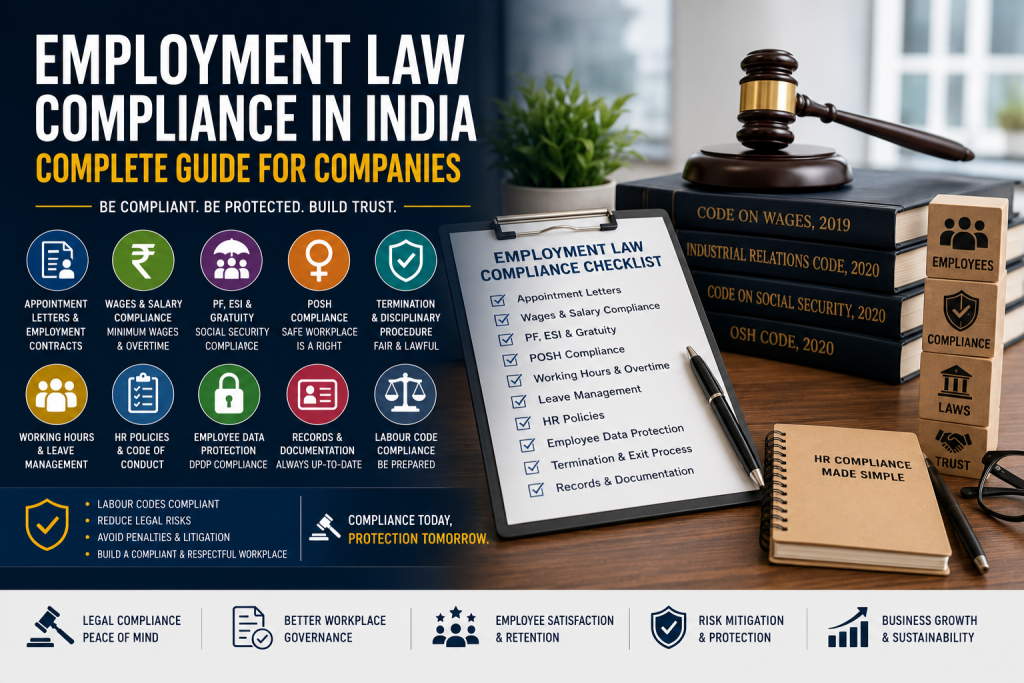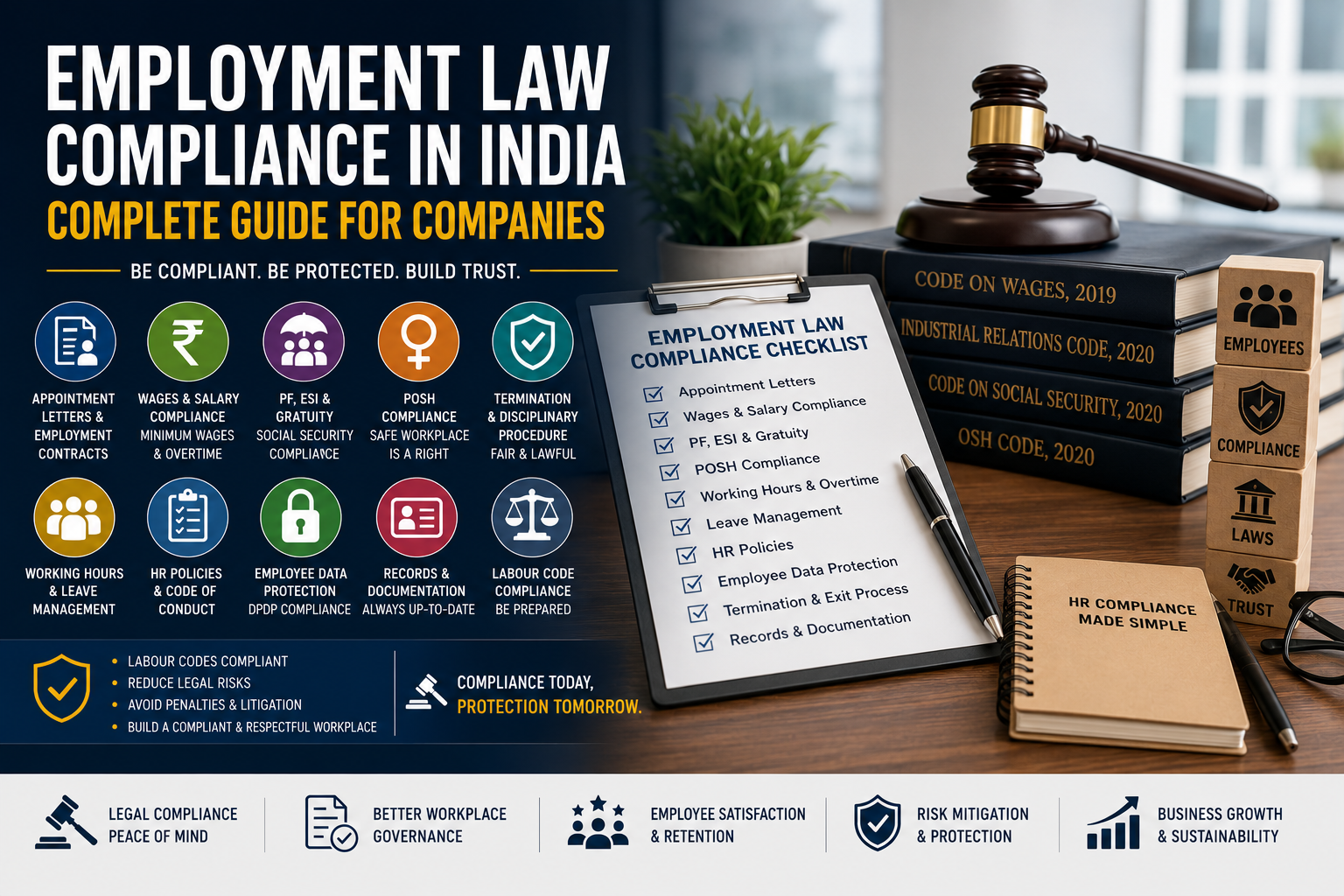
Employment law compliance in India requires employers to maintain lawful employment documentation, issue appointment letters, pay wages within statutory timelines, comply with minimum wage and overtime rules, maintain payroll and attendance records, follow PF/ESI/gratuity obligations where applicable, implement POSH compliance, regulate working conditions, protect employee data, and follow lawful procedures for termination, resignation and full-and-final settlement. India’s four Labour Codes—the Code on Wages, 2019; Industrial Relations Code, 2020; Code on Social Security, 2020; and OSH Code, 2020—were made effective from 21 November 2025, consolidating 29 labour laws.
Introduction
Employment law compliance is no longer a clerical HR function. It is a core legal-risk area for every company, startup, factory, office, consultancy, platform business, manpower agency and multi-location employer in India.
Most employment disputes begin from preventable gaps: no appointment letter, vague salary structure, delayed wages, unpaid statutory contributions, misclassified consultants, no POSH policy, no disciplinary record, no exit documentation, no full-and-final timeline, no confidentiality or IP clause, or no proper data protection practice.
For companies, employment compliance protects against labour claims, inspector proceedings, criminal complaints, statutory penalties, director exposure, reputational risk, investor due-diligence objections and employee litigation. For directors and founders, the safest employment system is not informal goodwill. It is documented compliance.
This article provides a complete employer-side guide to employment law compliance in India, especially after the labour-code transition.
Current Labour Law Framework in India
India has moved towards a consolidated labour-code framework. The Government announced that the four Labour Codes were made effective from 21 November 2025, rationalising 29 earlier labour laws. The four codes are:
- Code on Wages, 2019
- Industrial Relations Code, 2020
- Code on Social Security, 2020
- Occupational Safety, Health and Working Conditions Code, 2020
The Central Rules were also notified in 2026 as an administrative step to operationalise the framework.
For employers, the practical message is clear: employment documents, wage structures, payroll systems, HR policies, attendance records, social-security coverage and workplace policies must be reviewed against the new labour-code architecture.
Also Read Combat How to Send Legal Notice to Tenant to Vacate the Premises in 2023
Why Employment Law Compliance Matters
Employment compliance matters because every employee relationship creates legal obligations. These obligations may arise from:
- Employment contract.
- Appointment letter.
- Company HR policies.
- Wage law.
- Social-security law.
- Shops and Establishments law.
- POSH law.
- Occupational safety law.
- Industrial relations law.
- Data protection law.
- Tax and payroll law.
- Court and tribunal jurisprudence.
Non-compliance can result in:
- Wage claims.
- PF and ESI demands.
- Gratuity claims.
- Labour-inspector proceedings.
- Wrongful termination disputes.
- POSH complaints.
- Criminal complaints in serious cases.
- Director and officer exposure.
- Due-diligence red flags.
- Reputational damage.
A company may scale fast with informal HR systems, but it cannot defend itself with informal records.
1. Appointment Letters and Employment Contracts
The starting point of employment compliance is documentation. The OSH Code expressly requires an employer to issue a letter of appointment to every employee on appointment, in the form and with information prescribed by the appropriate Government.
Every employer should maintain:
- Offer letter.
- Appointment letter.
- Employment agreement.
- Job description.
- Salary annexure.
- Confidentiality clause.
- Intellectual property clause.
- Data protection clause.
- POSH undertaking.
- Code of conduct acknowledgement.
- Policy acceptance record.
- Identity and address proof.
- Educational and experience documents.
- Background verification consent, where applicable.
An appointment letter should not be a vague one-page document. It should clearly record designation, department, reporting manager, wages/salary, probation, working hours, leave, notice period, termination terms, confidentiality, company policies and statutory deductions.
2. Employee Classification
Correct classification is crucial. Employers should classify personnel as:
- Permanent employee.
- Probationer.
- Fixed-term employee.
- Temporary employee.
- Apprentice.
- Trainee.
- Consultant / independent contractor.
- Intern.
- Contract labour.
- Gig or platform worker, where applicable.
The Industrial Relations Code recognises classification of workers, including permanent, temporary, apprentices, probationers, badlis and fixed-term employment as matters to be provided in standing orders.
The most common HR mistake is misclassifying employees as consultants. If a person works full-time under company supervision, uses company systems, follows company attendance, receives fixed monthly remuneration and performs regular operational work, calling him a consultant will not automatically avoid employment-law obligations.
3. Wage Compliance
Wage compliance must be reviewed carefully after the Code on Wages, 2019.
The Code on Wages consolidates wage-related laws and is central to minimum wages, timely payment, wage definition and overtime. The Government’s implementation announcement stated that under the Code on Wages, all workers receive a statutory right to minimum wage payment.
Employers should review:
- Minimum wage applicability.
- Wage structure.
- Basic wage.
- Dearness allowance, where applicable.
- HRA and allowances.
- Retaining allowance, where applicable.
- Bonus and incentives.
- Overtime.
- Deductions.
- Wage period.
- Payroll records.
- Salary slips.
- Bank transfer records.
A company should not design salary structures only for tax or take-home optimisation. Wage structure also affects PF, gratuity, bonus, leave encashment, overtime and statutory benefit calculations.
4. Minimum Wages
Minimum wage compliance is foundational. Employers must ensure that no employee or worker falling under the applicable wage framework is paid below the statutory minimum wage.
Practical employer checklist:
- Identify applicable State and Central wage notifications.
- Identify employee category.
- Identify skill category: unskilled, semi-skilled, skilled, highly skilled, as applicable.
- Identify zone / area classification, where applicable.
- Verify basic wage and allowances.
- Maintain wage register.
- Review contractor wage compliance.
- Keep records for inspection.
Minimum wage default is not merely an accounting issue. It can become a statutory violation and employee-claim risk.
5. Overtime Compliance
Overtime must be handled carefully. The Code on Wages provides that where an employee whose minimum rate of wages is fixed works beyond normal working hours, the employer must pay overtime for every extra hour at a rate not less than twice the normal wage rate.
The Labour Ministry’s employer handbook also records overtime at least twice the normal wage where applicable.
Employers should maintain:
- Attendance records.
- Working-hour records.
- Overtime approvals.
- Overtime calculation sheet.
- Payment proof.
- Manager approval trail.
- Exemption category analysis.
Startups and corporate offices often assume that overtime is irrelevant for white-collar employees. That is unsafe. Applicability depends on role, wage category, State law, establishment type and statutory framework.
6. Working Hours and Leave
Employers must maintain a lawful working-hours and leave framework. This includes:
- Daily working hours.
- Weekly working hours.
- Weekly off.
- Rest intervals.
- Overtime approval.
- Casual leave.
- Sick leave.
- Earned / privileged leave.
- Maternity leave.
- National and festival holidays.
- Leave encashment, where applicable.
- Remote-work attendance, where applicable.
The Labour Ministry’s additional FAQs on Labour Codes clarify that where State law gives a more favourable benefit, the employee may be entitled to that more favourable benefit even in the context of labour-code transition.
Therefore, employers must not only read Central labour codes. They must also check applicable State rules and local Shops and Establishments law.
7. PF Compliance
Provident Fund compliance applies depending on employee strength, wage threshold, coverage, voluntary coverage and establishment status.
An employer should maintain:
- PF registration.
- UAN records.
- Employee KYC.
- Wage calculation sheet.
- Employee contribution.
- Employer contribution.
- ECR filing.
- Challan payment.
- Contractor PF verification.
- Exit date updates.
- Inspection records.
- PF notices and replies.
EPFO materials record that employers must remit EPF contributions with the prescribed return and identify the 15th of the month as the last date.
For companies using manpower vendors, the principal employer must not ignore contractor PF compliance. Contractor default can create downstream exposure.
8. ESI Compliance
ESI applies depending on employee wage threshold, establishment coverage and notified area. Employers should review ESI applicability at the hiring and payroll stage.
An ESI compliance file should contain:
- ESIC registration.
- Employee insurance numbers.
- Wage records.
- Monthly contribution records.
- Challans.
- Employee declarations.
- Accident reports, where applicable.
- Contractor ESI compliance.
- Inspection records.
- Notices and replies.
ESIC materials state that contribution must be paid within 15 days from the last day of the calendar month in which the contribution falls due.
9. Gratuity Compliance
Gratuity is a major employment-cost and exit-liability area. Under the Code on Social Security, 2020, gratuity provisions also address fixed-term employees; the text records pro-rata gratuity for fixed-term employees.
Employers should track:
- Employee joining date.
- Continuous service.
- Fixed-term employment status.
- Last drawn wages.
- Gratuity liability.
- Resignation / termination dates.
- Gratuity nomination.
- Payment records.
- Gratuity provisioning.
- Dispute records.
For fixed-term employment, gratuity can no longer be ignored merely because the engagement is contract-based or time-bound.
10. Bonus and Incentive Compliance
Employers should distinguish between:
- Statutory bonus.
- Performance bonus.
- Retention bonus.
- Joining bonus.
- Sales incentive.
- Discretionary incentive.
- ESOP or equity-linked incentive.
- Ex-gratia payment.
Every incentive plan should define eligibility, performance metrics, payout timeline, forfeiture conditions, resignation treatment and tax treatment. Vague incentive promises are a common source of employee disputes.
11. Fixed-Term Employment
Fixed-term employment can be commercially useful, but it must be documented with precision.
The Industrial Relations Code framework recognises fixed-term employment, and Government FAQs state that fixed-term employees are eligible for benefits such as EPF, ESI, flexible working hours, timely wages and minimum wages equal to permanent employees; they are also entitled to gratuity if they render service under a contract for one year.
A fixed-term contract should include:
- Start date.
- End date.
- Project or role.
- Salary.
- Statutory benefits.
- Leave.
- Confidentiality.
- IP ownership.
- Termination rights.
- Renewal or non-renewal clause.
- Gratuity treatment.
- Exit formalities.
Fixed-term employment should not be used as a device to deny statutory benefits.
12. Consultant and Contractor Compliance
Companies must carefully distinguish employees from consultants.
A genuine consultant agreement should include:
- Independent contractor status.
- Scope of services.
- Fees and GST, where applicable.
- TDS treatment.
- No employment relationship.
- No authority to bind the company.
- Own tools and resources, where applicable.
- Deliverables.
- Confidentiality.
- IP assignment.
- Data protection.
- Indemnity.
- Termination.
- Non-solicitation.
If the consultant is treated operationally like an employee, the label will not save the company from employment claims.
13. Contract Labour Compliance
Where a company uses manpower contractors, it should verify:
- Contractor licence or registration, where applicable.
- Work order / service agreement.
- Wage payment proof.
- PF compliance.
- ESI compliance.
- Attendance records.
- Identity documents.
- Statutory registers.
- Indemnity from contractor.
- Principal-employer monitoring.
Contract labour compliance is particularly important for logistics, manufacturing, facility management, security, housekeeping, warehousing, construction, BPO, staffing and multi-location operations.
14. POSH Compliance
Every workplace must take the POSH framework seriously. The POSH Act requires employer-side prevention, prohibition and redressal systems for sexual harassment at the workplace.
The Act requires the employer to include in its annual report the number of cases filed and their disposal, or where no annual report is required, intimate such number to the District Officer.
A compliant POSH framework should include:
- POSH policy.
- Internal Committee, where applicable.
- External Member.
- Employee awareness.
- Complaint mechanism.
- Inquiry procedure.
- Confidentiality safeguards.
- Anti-retaliation protection.
- Annual report.
- Management training.
POSH compliance is not a paper policy. It requires institutional readiness.
15. Disciplinary Action and Misconduct
Every company should have a misconduct and disciplinary framework.
Misconduct may include:
- Fraud.
- Theft.
- Harassment.
- Sexual harassment.
- Data theft.
- Unauthorised absence.
- Misuse of company property.
- Conflict of interest.
- Bribery or kickbacks.
- Violence or intimidation.
- Gross negligence.
- Breach of confidentiality.
- Working for a competitor.
- Tampering with company records.
Disciplinary action should be procedurally fair. In serious cases, the employer should issue a show-cause notice, conduct inquiry where required, maintain evidence and record reasons.
16. Termination, Resignation and Full-and-Final Settlement
Termination is one of the most sensitive areas of employment law. Employers must distinguish between:
- Resignation.
- Termination during probation.
- Termination for poor performance.
- Termination for misconduct.
- Retrenchment.
- Fixed-term expiry.
- Abandonment of employment.
- Mutual separation.
- Redundancy.
- Closure or restructuring.
A safe termination process should include:
- Contract review.
- Notice-period calculation.
- Statutory-benefit calculation.
- Leave encashment.
- Gratuity, where applicable.
- Pending salary.
- Bonus / incentive treatment.
- Asset return.
- Confidentiality reminder.
- Data-access revocation.
- Full-and-final statement.
- Experience / relieving letter, where applicable.
Termination should never be executed only by email without legal review in sensitive cases.
17. Employment Records and Registers
Employment law compliance depends heavily on records. Employers should maintain:
- Employee master data.
- Appointment letters.
- Employment agreements.
- Attendance records.
- Leave records.
- Wage register.
- Overtime records.
- Salary slips.
- PF records.
- ESI records.
- Bonus records.
- Gratuity records.
- Contractor records.
- POSH records.
- Disciplinary records.
- Exit records.
- Full-and-final records.
Records are the company’s first defence in employment litigation.
18. HR Policies Required for Companies
A company should maintain a structured HR policy pack. At minimum, this should include:
- Code of conduct.
- Leave policy.
- Attendance policy.
- Work-from-home policy.
- IT and device-use policy.
- Data protection policy.
- POSH policy.
- Disciplinary policy.
- Whistleblower policy, where appropriate.
- Expense reimbursement policy.
- Travel policy.
- Social media policy.
- Conflict-of-interest policy.
- Anti-bribery policy.
- Exit policy.
For investor-ready companies, HR policies should be signed, version-controlled and acknowledged by employees.
19. DPDP and Employee Data Protection
Employers process employee personal data throughout the employment lifecycle: recruitment, payroll, attendance, performance, health records, background verification, PF/ESI, insurance, travel, access control, CCTV and exit.
The Digital Personal Data Protection Act, 2023 contains a dedicated chapter on obligations of Data Fiduciaries and rights and duties of Data Principals.
Employers should implement:
- Employee privacy notice.
- Lawful purpose mapping.
- Data minimisation.
- Access controls.
- HR-data retention policy.
- Vendor data-processing clauses.
- Background verification consent.
- Payroll processor contracts.
- Data breach response process.
- Exit deletion / retention protocol.
HR teams should not treat employee data as informal internal material. It is regulated personal data.
20. Remote Work and Hybrid Work Compliance
Remote and hybrid work should be documented. A remote-work policy should cover:
- Work location.
- Attendance.
- Working hours.
- Data security.
- Device usage.
- Internet reimbursement.
- Confidentiality.
- Client data access.
- Cybersecurity.
- Productivity tracking.
- Return-to-office rights.
- Injury or incident reporting.
Remote work increases data and confidentiality risk. A company should link remote-work approval with IT and data-protection controls.
21. Employment Compliance for Startups
Startups should not delay HR compliance until funding. Investor due diligence routinely checks employment records, consultant agreements, IP assignment, ESOP promises, PF/ESI applicability, POSH policy and employee disputes.
Startup employment compliance should include:
- Founder employment / consultancy documentation.
- Employee appointment letters.
- Consultant agreements.
- Internship agreements.
- IP assignment.
- Confidentiality.
- Payroll compliance.
- PF/ESI review.
- POSH policy.
- DPDP/privacy policy.
- Exit checklist.
- ESOP documentation.
An employment compliance gap may directly affect valuation or funding closure.
22. Employment Compliance Checklist for Employers
A. Hiring Stage
- Offer letter.
- Appointment letter.
- Employment agreement.
- Background verification consent.
- Identity proof.
- Address proof.
- Educational documents.
- Previous employment documents.
- PF/UAN details.
- Bank details.
- Tax declaration.
- Policy acknowledgement.
B. During Employment
- Attendance records.
- Leave records.
- Payroll records.
- Wage register.
- Salary slips.
- PF and ESI records.
- Performance records.
- Training records.
- POSH training.
- Data-access controls.
- Disciplinary records.
- Policy updates.
C. Exit Stage
- Resignation or termination letter.
- Notice-period calculation.
- Asset return.
- Data-access revocation.
- Confidentiality reminder.
- Full-and-final settlement.
- Gratuity calculation, if applicable.
- Experience / relieving letter.
- Exit interview.
- No-dues clearance.
23. Common Employment Compliance Mistakes
Common mistakes include:
- No appointment letter.
- Vague offer letter.
- Misclassification of employees as consultants.
- No IP assignment.
- No confidentiality clause.
- No POSH policy.
- No overtime records.
- Delayed salary payment.
- PF/ESI default.
- No contractor compliance monitoring.
- No termination record.
- No full-and-final statement.
- No data protection policy.
- No leave and attendance records.
- No disciplinary process.
The biggest mistake is assuming that HR informality is cheaper. In litigation, informality is expensive.
Practical Legal Strategy for Companies
A company should build employment compliance in three layers.
Layer 1: Documentation
Prepare appointment letters, employment agreements, consultant agreements, policies, POSH documents, confidentiality clauses, IP assignment and exit templates.
Layer 2: Statutory Payroll
Track wages, minimum wages, overtime, PF, ESI, gratuity, bonus, TDS and contractor compliance.
Layer 3: Governance and Defence
Maintain registers, board-level compliance reports, POSH annual records, disciplinary files, full-and-final records, data protection logs and legal notices.
A legally strong employer is not one that never has disputes. It is one that can defend its decisions with records.
Frequently Asked Questions
1. What is employment law compliance in India?
Employment law compliance means following legal obligations relating to appointment letters, wages, working hours, leave, PF, ESI, gratuity, bonus, POSH, safety, termination, records, payroll, employee data and HR policies.
2. Which labour laws apply to employers after the labour codes?
The principal framework is now built around the Code on Wages, 2019; Industrial Relations Code, 2020; Code on Social Security, 2020; and OSH Code, 2020, effective from 21 November 2025.
3. Is an appointment letter mandatory?
Yes. The OSH Code requires employers to issue a letter of appointment to every employee on appointment in the establishment, in the prescribed form and with prescribed information.
4. What are the key HR documents every company should maintain?
Companies should maintain offer letters, appointment letters, employment agreements, salary annexures, attendance records, leave records, wage registers, PF/ESI records, POSH policy, disciplinary files, consultant agreements and exit documents.
5. Is POSH compliance required for companies?
Yes. Employers must maintain a POSH prevention and redressal framework. The POSH Act also requires reporting of complaints and disposal in the employer’s annual report or intimation to the District Officer where no annual report is prepared.
6. What is the overtime rule under the Code on Wages?
The Code on Wages provides that where applicable, an employee working beyond normal working hours must be paid overtime at a rate not less than twice the normal rate of wages.
7. Are fixed-term employees entitled to statutory benefits?
Yes. Government FAQs state that fixed-term employees are eligible for benefits equal to permanent employees, including EPF, ESI, timely wages and minimum wages, and gratuity where they complete the relevant fixed-term service threshold.
8. Can a company classify employees as consultants?
Only where the relationship is genuinely independent. If the person works like an employee under company control, the consultant label may be challenged.
9. Do companies need employee data protection policies?
Yes. Employers process employee personal data and should maintain privacy notices, access controls, retention policies, vendor clauses and breach-response mechanisms under the DPDP framework.
10. What is the biggest employment compliance risk?
The biggest risk is absence of documentation. Without appointment letters, salary records, attendance, PF/ESI proof, POSH records, policy acknowledgements and exit documents, the employer’s defence becomes weak.
Conclusion
Employment law compliance in India is now a board-level and founder-level risk issue. After the labour-code transition, employers must review wages, appointment letters, fixed-term employment, social-security coverage, working conditions, overtime, records, POSH compliance and HR documentation.
A legally compliant company should be able to show who was hired, on what terms, how wages were paid, whether statutory benefits were provided, how complaints were handled, how termination was processed and whether employee data was protected.
Employment compliance is not paperwork. It is the legal architecture of workforce management.
Disclaimer
This article is intended for general legal awareness and educational purposes only. It does not constitute legal advice, solicitation, advertisement or creation of an advocate-client relationship. Employment law compliance depends on the nature of establishment, employee strength, wage structure, State law, sector, contractual arrangements, PF/ESI coverage, labour-code rules, notifications and facts of each case.