
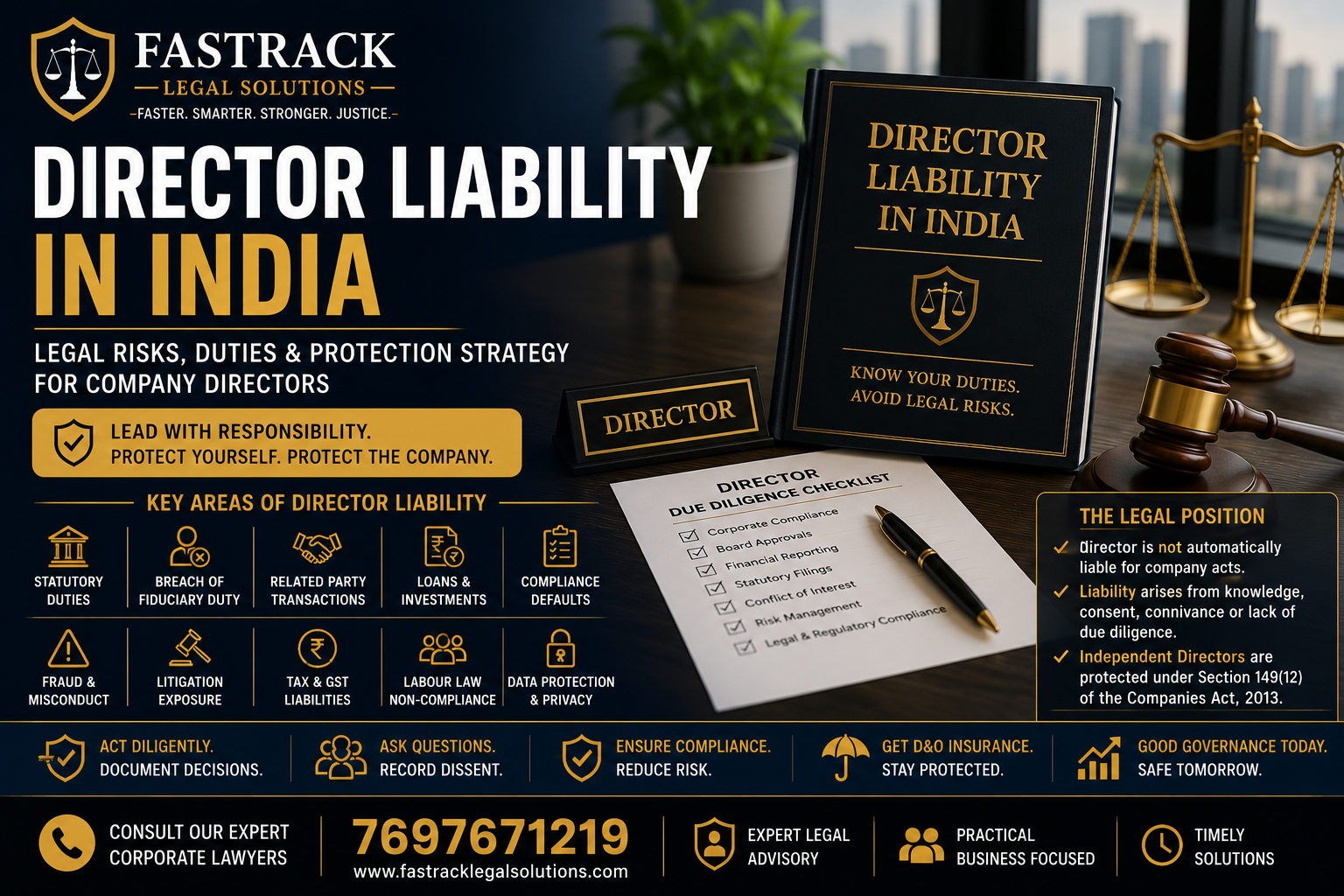
Director liability in India arises when a company director breaches statutory duties, participates in default, fails to exercise due diligence, authorises unlawful transactions, makes false statements, commits fraud, or is treated as an “officer who is in default” under the Companies Act, 2013. However, a director is not automatically criminally liable merely because he holds office. Criminal liability generally requires statutory deeming provisions, active role, consent, connivance, negligence, or specific allegations showing involvement. The Companies Act also gives limited protection to independent and non-executive directors where the default did not occur with their knowledge, consent, connivance, or lack of diligence.
Introduction
A company acts through its board, officers and authorised representatives. Directors make strategic decisions, approve transactions, supervise management, sign documents, certify statutory filings and represent the company before stakeholders. With that authority comes legal responsibility.
In India, director liability may arise under multiple statutes, including the Companies Act, 2013, tax laws, labour laws, environmental laws, insolvency law, data protection law, foreign exchange law, securities law, the Negotiable Instruments Act, and criminal law. The real risk is not theoretical. Directors may face penalties, prosecution, disqualification, civil liability, compensation claims, regulatory notices, summons, arrest risk in certain criminal matters, and reputational damage.
At the same time, Indian law does not support a blanket proposition that every director is liable for every act of the company. Liability depends on the nature of default, role of the director, statutory provision invoked, board records, authorisation, knowledge, consent, connivance and diligence.
Who is a Director?
Under the Companies Act, 2013, a “director” means a director appointed to the Board of a company. The Board of Directors is the collective body of directors of the company.
Directors may broadly include:
- Executive director.
- Whole-time director.
- Managing director.
- Non-executive director.
- Independent director.
- Nominee director.
- Additional director.
- Alternate director.
- Woman director, where applicable.
- Small shareholder director, where applicable.
Liability differs according to role. A managing director or whole-time director usually carries higher operational exposure than a passive non-executive director. An independent director has statutory protection, but that protection is not absolute.
Core Duties of Directors Under Section 166 Companies Act
Section 166 of the Companies Act, 2013 codifies the duties of directors. It requires a director to act in accordance with the Articles of Association, act in good faith to promote the objects of the company for the benefit of members as a whole, and act in the best interests of the company, employees, shareholders, community and environment. The director must exercise duties with due and reasonable care, skill and diligence, and exercise independent judgment.
Section 166 also prohibits a director from involving himself in a situation of direct or indirect conflict with the interest of the company and from achieving or attempting to achieve undue gain or advantage for himself, relatives, partners or associates. A contravention attracts fine under Section 166(7).
In practical terms, a director must not behave like a ceremonial name on the board. The director must act with diligence, review board papers, ask questions, record dissent where necessary and ensure that decisions are legally compliant.
Meaning of “Officer Who Is in Default”
A major source of director liability is the concept of “officer who is in default” under Section 2(60) of the Companies Act, 2013.
The definition includes, among others, whole-time directors and key managerial personnel. This concept is important because many provisions of the Companies Act impose penalties or punishment on the company and every officer who is in default.
This does not mean every director is automatically liable in every case. The statute identifies categories of officers who may be fastened with responsibility. Where a company has properly designated responsibility and maintained board records, the exposure of uninvolved directors may be reduced.
Independent Director and Non-Executive Director Liability
Section 149(12) of the Companies Act gives important protection to independent directors and certain non-executive directors.
It provides that an independent director and a non-executive director, not being a promoter or key managerial personnel, shall be held liable only for acts of omission or commission by the company which occurred with his knowledge attributable through board processes, and with his consent or connivance, or where he had not acted diligently.
This is a significant statutory safeguard. However, it is not immunity. If board papers disclosed a red flag and the director ignored it, or if the director consented to a wrongful transaction, or if the director failed to act diligently, liability may still arise.
Civil, Regulatory and Criminal Liability: The Distinction
Director liability may be divided into three broad categories.
1. Civil Liability
Civil liability may arise from breach of fiduciary duty, breach of contract, negligence, shareholder claims, oppression and mismanagement, wrongful gain, indemnity claims or recovery by the company.
2. Regulatory Liability
Regulatory liability may arise from ROC defaults, SEBI violations, FEMA non-compliance, GST defaults, labour law violations, environmental breaches, data protection failures or sector-specific regulatory contraventions.
3. Criminal Liability
Criminal liability may arise where a statute creates vicarious liability, where the director personally participated in the offence, where there is fraud, false statement, cheating, breach of trust, conspiracy, money laundering, tax prosecution, or where the director was in charge of and responsible for the conduct of business under the relevant statute.
The strongest defence for a director is a clean board record showing absence of involvement, absence of knowledge, proper diligence, recorded objection or formal dissent.
Director Liability Is Not Automatic
The Supreme Court has repeatedly clarified that a director is not criminally liable merely because he holds office.
In Sunil Bharti Mittal v. Central Bureau of Investigation, (2015) 4 SCC 609, the Supreme Court explained that the principle of alter ego may make a company liable for acts of persons controlling it, but it cannot be mechanically applied in reverse to make directors liable for offences committed by the company.
In Shiv Kumar Jatia v. State of NCT of Delhi, Criminal Appeal No. 1263 of 2019, the Supreme Court quashed criminal proceedings against a managing director where the allegations did not justify continuation of prosecution against him merely on the basis of his position.
The legal position is clear: designation is not enough. A complaint or prosecution must show the director’s role, knowledge, consent, connivance, negligence or statutory responsibility.
Common Areas of Director Liability in India
1. Failure to File Statutory Returns
Companies must file annual returns, financial statements and other event-based forms. Non-filing may expose the company and officers in default to penalties.
Directors should ensure that ROC filings such as annual returns, financial statements, director changes, share allotments, charges and beneficial ownership declarations are filed within time. The Companies Act contains multiple provisions where default leads to penalty on the company and officers in default.
2. Breach of Fiduciary Duty
Directors owe fiduciary duties to the company. They must act in good faith, avoid conflict, avoid undue gain and exercise reasonable care, skill and diligence. These duties are codified in Section 166.
Examples of breach include:
- Diverting company opportunity.
- Approving transactions for personal benefit.
- Misusing confidential information.
- Failing to disclose conflict.
- Approving sham transactions.
- Ignoring obvious financial irregularities.
- Allowing related-party misuse.
3. Conflict of Interest
Section 184 requires directors to disclose their concern or interest in companies, bodies corporate, firms or other associations. It also requires disclosure where a director is directly or indirectly concerned or interested in a contract or arrangement. A concerned or interested director must disclose the interest and must not participate in the board meeting discussing that contract or arrangement.
Failure to disclose interest may make the contract voidable at the option of the company and may expose the director to penalty.
4. Related-Party Transactions
Section 188 regulates related-party transactions such as sale or purchase of goods, disposal or purchase of property, leasing, services, appointment of agents, office or place of profit and underwriting of securities. It requires board consent and, in prescribed cases, shareholder approval.
If a related-party transaction is entered without required approval and is not ratified within the statutory period, it may be voidable at the option of the board or shareholders. Directors concerned may also have to indemnify the company for loss.
5. Loans to Directors
Section 185 restricts loans, guarantees and securities in connection with loans involving directors and specified connected persons. It contains specific prohibitions and conditional permissions depending on the recipient and transaction structure.
A casual loan to a director, promoter-related entity or director-interested company can become a serious compliance issue.
6. Loans, Guarantees and Investments by Company
Section 186 regulates loans, guarantees, securities and investments by companies. Contravention may expose the company to fine and every officer in default to punishment, including imprisonment and fine, as provided in the section.
Board approvals, shareholder approvals, registers and disclosure requirements should therefore be handled carefully.
7. Borrowing Beyond Powers
Section 180 restricts the board’s powers in important matters such as sale, lease or disposal of the whole or substantially whole undertaking, and borrowing beyond prescribed limits without special resolution.
Directors approving major borrowing, asset disposal or restructuring should verify whether shareholder approval is required.
8. Fraud and False Statements
Section 447 of the Companies Act deals with punishment for fraud. It covers fraud involving at least ₹10 lakh or 1% of turnover, whichever is lower, and prescribes imprisonment and fine. Where fraud involves public interest, the minimum imprisonment is higher. The explanation to Section 447 defines fraud broadly to include act, omission, concealment of fact or abuse of position with intent to deceive, gain undue advantage or injure interests of the company, shareholders, creditors or any other person.
Section 448 also provides that false statements in returns, reports, certificates, financial statements, prospectus or other documents required under the Act may attract liability under Section 447.
Directors should never sign filings, financial statements or declarations without review.
9. Disqualification of Directors
Section 164 of the Companies Act provides disqualifications for appointment as director, including certain convictions, orders of disqualification, unpaid calls, conviction relating to related-party transactions, and defaults by companies in filing financial statements or annual returns or repayment of deposits, debentures or interest in specified circumstances.
Director disqualification can have serious consequences across companies and future appointments.
10. Personal Liability in Investigation and Fraud Cases
Where investigation reveals fraud, concealment, asset diversion or abuse of position, directors, KMPs and officers may face personal exposure. The Companies Act framework includes investigation, SFIO proceedings, prosecution, disgorgement and personal liability in serious cases.
Director Liability Under Negotiable Instruments Act
In cheque bounce cases involving companies, directors may be prosecuted under Section 141 of the Negotiable Instruments Act if they were in charge of and responsible for the conduct of the company’s business at the time of offence. However, mere designation as director is not enough.
The Supreme Court has repeatedly held in Section 141 jurisprudence that complaints must contain necessary averments showing how the director was responsible for conduct of business. Managing directors and signatories stand on a stronger prosecution footing, but non-executive directors require specific allegations.
For board-level protection, directors should ensure that cheque issuance authority, finance approval matrix, bank signatory powers and board delegations are properly recorded.
Director Liability in Tax, GST and Labour Matters
Directors may face exposure under tax and labour laws where statutes specifically fasten liability on persons in charge, principal officers, employers, occupiers or responsible officers.
Common risk areas include:
- TDS default.
- GST evasion or false invoicing.
- PF and ESI non-deposit.
- Gratuity or wage disputes.
- Shops and establishments violations.
- Contract labour non-compliance.
- Professional tax non-compliance.
- Labour Code transition risks.
The safer route is to maintain statutory payment calendars, compliance dashboards, board reporting and written delegation to finance, HR and compliance officers.
Director Liability in Data Protection and Cyber Risk
With the Digital Personal Data Protection Act, 2023, data governance is now a board-level issue for digital businesses. Directors of data-heavy companies should ensure that the company has privacy notices, consent architecture, vendor controls, breach response processes, retention rules and internal access controls.
For directors, the risk is not merely penalty. A major data breach may create regulatory, contractual, reputational and investor-facing exposure.
Independent Directors: Practical Protection Strategy
Independent directors should not rely only on statutory protection. They should actively build a due-diligence record.
An independent director should:
- Seek timely board papers.
- Read financial statements.
- Ask questions on related-party transactions.
- Demand compliance certificates.
- Record dissent where necessary.
- Ensure conflict disclosures are made.
- Ask for legal opinions in high-risk transactions.
- Verify whether statutory filings are updated.
- Review audit qualifications.
- Avoid signing documents casually.
Section 149(12) protects independent and certain non-executive directors only where liability cannot be attributed through knowledge, consent, connivance or lack of diligence.
Non-Executive Directors: Risk Position
A non-executive director is not involved in day-to-day operations, but may still face risk if:
- He is a promoter.
- He is part of key decision-making.
- He attends and approves wrongful board resolutions.
- Board papers show knowledge of the default.
- He fails to object despite red flags.
- He gives consent or connives in the default.
- He signs filings or financial statements.
The strongest protection is not mere non-executive status. It is documentary evidence of diligence.
Nominee Directors
Nominee directors are appointed by investors, lenders, financial institutions or strategic shareholders. They face a dual expectation: protect the nominating entity’s interest while fulfilling duties to the company.
A nominee director should remember that duties under Section 166 are owed to the company. Acting only as the agent of the nominator may create conflict.
Practical safeguards include:
- Clear nomination documents.
- Conflict disclosure.
- Limited authority letter.
- Recusal where necessary.
- Board minutes recording position.
- Avoiding operational involvement unless intended.
- D&O insurance.
Managing Director and Whole-Time Director
Managing directors and whole-time directors carry higher exposure because they are usually involved in management and execution.
They may be treated as officers in default under Section 2(60), and their operational role may make it easier for regulators or complainants to attribute knowledge and responsibility.
They should maintain:
- Proper delegation matrix.
- Compliance reporting system.
- Audit trail of approvals.
- Legal review of contracts.
- Finance controls.
- HR and labour compliance calendar.
- Statutory payment tracker.
- Board reporting of material risks.
Board Minutes and Dissent: The Director’s Shield
Board minutes are one of the strongest evidentiary tools in director liability defence.
Minutes should properly record:
- Documents placed before the board.
- Disclosures made by interested directors.
- Questions raised.
- Clarifications given.
- Legal opinions considered.
- Financial implications.
- Dissent or abstention.
- Approval thresholds.
- Delegation of responsibility.
- Conditions attached to approval.
A director who disagrees with a transaction should insist that dissent be recorded. Silence in board minutes may later be read as consent.
D&O Insurance
Directors and Officers Insurance is an important risk management tool. It may cover defence costs, claims, investigations and certain liabilities depending on policy terms.
However, D&O insurance does not protect against every exposure. Fraud, wilful misconduct, illegal personal gain and deliberate violations may be excluded.
Directors should review:
- Policy coverage.
- Insured persons.
- Defence cost coverage.
- Investigation coverage.
- Exclusions.
- Retention / deductible.
- Claim notification timeline.
- Prior acts coverage.
- Entity coverage.
- Regulatory proceedings coverage.
Director Liability Risk Checklist
Directors should regularly ask:
- Are ROC filings up to date?
- Are board minutes properly maintained?
- Are statutory registers updated?
- Are related-party transactions approved properly?
- Are interest disclosures current?
- Are tax, GST, PF and ESI dues paid?
- Are loans and guarantees legally approved?
- Are financial statements accurate?
- Are there pending legal notices or proceedings?
- Are data protection controls in place?
- Are labour records compliant?
- Are contracts reviewed before signing?
- Are bank signing powers documented?
- Are high-value transactions supported by board approval?
- Is D&O insurance in force?
Practical Protection Strategy for Directors
A director can reduce risk by creating a defensible governance record.
The practical strategy should include:
- Clear appointment documents.
- Role clarity.
- Updated DIR and ROC filings.
- Conflict-of-interest disclosures.
- Written delegation matrix.
- Regular compliance certificates.
- Board packs circulated in advance.
- Legal review of high-risk transactions.
- Audit committee oversight, where applicable.
- Proper minutes.
- Recorded dissent.
- Statutory payment tracker.
- Whistleblower mechanism.
- D&O insurance.
- Resignation filing and exit record, where leaving the board.
For passive directors, the most dangerous sentence is: “I was only a name on paper.” Courts and regulators may ask why the director accepted office without diligence.
Common Mistakes by Directors
Common mistakes include:
- Signing board resolutions without reading.
- Allowing others to use DSC without supervision.
- Ignoring ROC notices.
- Not checking financial statements.
- Approving related-party transactions casually.
- Not disclosing interest.
- Not recording dissent.
- Not verifying statutory dues.
- Acting beyond authority.
- Treating nominee role as superior to company duty.
- Continuing as director after loss of trust.
- Resigning without ensuring ROC filing.
- Ignoring criminal notices.
- Assuming non-executive status is complete immunity.
- Allowing management to run without board oversight.
Important Case Law
1. Sunil Bharti Mittal v. Central Bureau of Investigation, (2015) 4 SCC 609
The Supreme Court clarified that the alter ego principle cannot be mechanically applied in reverse to make directors liable for offences of the company. Director criminal liability requires statutory basis or specific role and involvement.
2. Shiv Kumar Jatia v. State of NCT of Delhi, Criminal Appeal No. 1263 of 2019
The Supreme Court quashed proceedings against a managing director where the prosecution sought to proceed against him essentially because of his position, without adequate material showing individual criminal liability.
3. Standard Chartered Bank v. Directorate of Enforcement, (2005) 4 SCC 530
This judgment is important for corporate criminal liability. It recognises that a company can be prosecuted and punished for criminal offences, even though application of director liability requires separate statutory or factual foundation. The principle is discussed in Sunil Bharti Mittal.
Also Read Legal Risk Mitigation for Directors in India | Director Liability & Boardroom Compliance
Frequently Asked Questions
1. Are directors personally liable for company debts?
Ordinarily, directors are not personally liable for company debts merely because they are directors. Personal liability may arise where there is fraud, personal guarantee, statutory default, wrongful conduct, breach of duty or specific statutory provision.
2. Can a director be criminally liable for company offences?
Yes, but not automatically. Criminal liability usually requires statutory deeming provision, specific role, consent, connivance, negligence, active participation or clear allegations showing responsibility.
3. What is an officer who is in default?
Under Section 2(60) of the Companies Act, “officer who is in default” includes specified officers such as whole-time directors and key managerial personnel for provisions imposing liability on defaulting officers.
4. Are independent directors protected from liability?
Independent directors and certain non-executive directors are protected under Section 149(12), but only where the act did not occur with their knowledge attributable through board processes, consent, connivance or lack of diligence.
5. What are the statutory duties of directors?
Section 166 requires directors to act according to the Articles, act in good faith, promote company objects, act in the interests of the company and stakeholders, exercise due care, skill and diligence, avoid conflict and avoid undue gain.
6. Can directors be liable for related-party transactions?
Yes. Section 188 requires board consent and, in prescribed cases, shareholder approval for related-party transactions. Unapproved transactions may be voidable and directors concerned may have to indemnify the company for loss.
7. What is the liability for fraud under the Companies Act?
Section 447 provides punishment for fraud and defines fraud broadly to include acts, omissions, concealment or abuse of position with intent to deceive, gain undue advantage or injure company, shareholders, creditors or others.
8. How can directors reduce legal risk?
Directors can reduce risk by maintaining board records, ensuring statutory compliance, disclosing conflicts, seeking legal opinions, recording dissent, reviewing financials, monitoring statutory dues, using delegation matrices and maintaining D&O insurance.
9. Can a director be disqualified?
Yes. Section 164 sets out disqualifications, including certain convictions, disqualification orders, non-payment of calls, related-party transaction convictions and certain company filing or repayment defaults.
10. Is designation as managing director enough for prosecution?
No. As clarified by the Supreme Court, designation alone is not sufficient for criminal prosecution unless the statute creates liability or the complaint shows specific role, knowledge, consent, connivance or participation.
Conclusion
Director liability in India is a serious governance issue. A director is not merely a name on the MCA portal or a signatory on documents. The position carries statutory duties, fiduciary obligations, regulatory exposure and, in appropriate cases, criminal consequences.
The law is balanced. It does not make every director liable for every company default. But it does expect directors to act with care, diligence, good faith, independent judgment and integrity. The safest director is not the silent director; it is the documented, diligent and legally aware director.
Board discipline, proper minutes, conflict disclosures, compliance dashboards, D&O insurance, legal opinions and recorded dissent are not bureaucratic rituals. They are the director’s legal armour.
Disclaimer
This article is intended for general legal awareness and educational purposes only. It does not constitute legal advice, solicitation, advertisement or creation of an advocate-client relationship. Director liability depends on the company structure, director role, statutory provision, board records, knowledge, consent, connivance, diligence, transaction documents, regulatory framework and facts of each case.