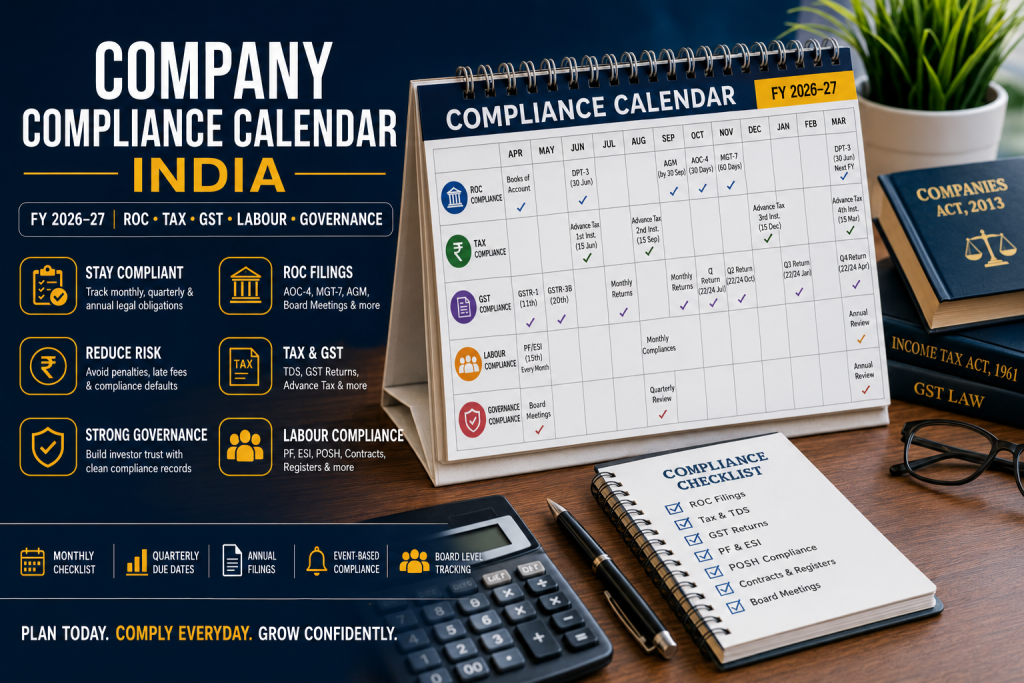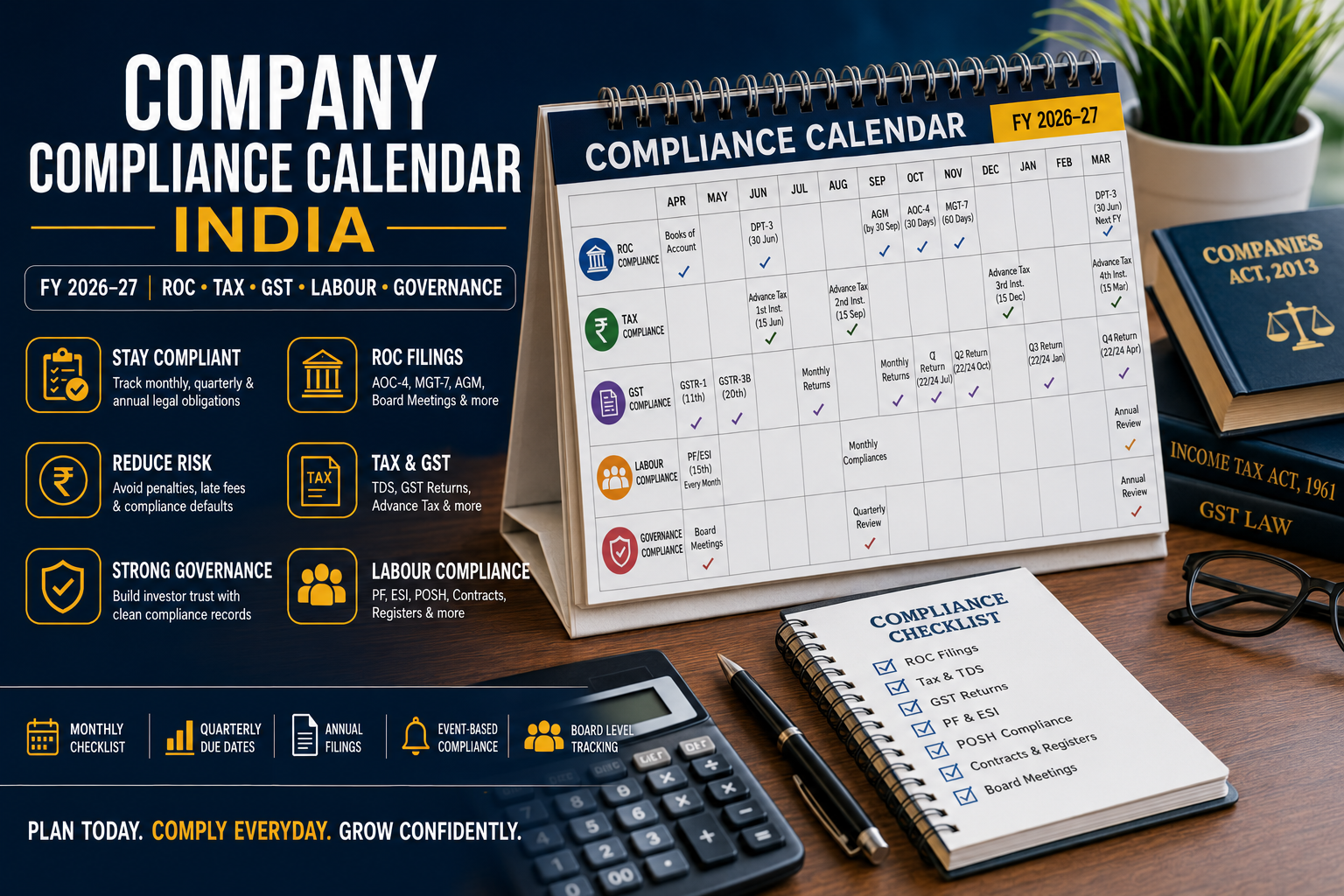
A company compliance calendar in India is a structured yearly, quarterly and monthly tracker of statutory obligations applicable to a company. For a private limited company or startup, it generally covers ROC filings, board meetings, annual general meeting, financial statements, annual return, GST returns, TDS, PF, ESI, labour records, POSH compliance, data protection review, contract renewals, licences and board-level governance reporting.
Introduction
A company does not become legally compliant merely because it has been incorporated. Incorporation is only the beginning. Once a company starts operations, it becomes subject to recurring statutory, tax, labour, corporate, contractual and governance obligations.
For founders, directors, CFOs and compliance teams, a company compliance calendar is not a clerical document. It is a legal risk-control system. It helps prevent ROC defaults, late fees, tax notices, GST mismatches, labour claims, director liability, investor due-diligence objections and avoidable regulatory exposure.
This article provides a practical FY 2026–27 company compliance calendar for Indian private limited companies and startups, covering monthly, quarterly, annual and event-based compliances.
Scope of This Compliance Calendar
This compliance calendar is prepared for a standard Indian private limited company or startup following the financial year:
1 April 2026 to 31 March 2027
The exact applicability of each compliance depends on:
- Nature of entity.
- Turnover.
- Paid-up share capital.
- GST registration status.
- Employee strength.
- PF / ESI coverage.
- Foreign investment.
- Sector-specific licences.
- State-specific labour laws.
- Government notifications and due-date extensions.
Before actual filing, the company should verify due dates from the MCA, GST, Income Tax, EPFO and ESIC portals.
Why Every Company Needs a Compliance Calendar
A compliance calendar helps a company track legal obligations in advance instead of reacting after default. It serves five important purposes:
- It fixes internal responsibility.
- It prevents missed statutory deadlines.
- It reduces penalties, late fees and prosecution risk.
- It creates a clean due-diligence record.
- It protects directors by creating a documented governance trail.
A company that maintains proper books, statutory registers, board minutes, annual filings, tax records, labour documents and contract repositories is far better placed during investment, acquisition, bank financing, regulatory inspection or litigation.
Fixed Monthly Compliance Calendar
The following monthly calendar should be maintained by every company, subject to applicability.
| Due Date | Compliance | Applicability | Practical Action |
|---|---|---|---|
| 7th of every month | TDS deposit for previous month | Companies deducting TDS | Deposit TDS deducted in the preceding month. |
| 10th of every month | Internal finance closure | Recommended for all companies | Close previous month books, reconcile bank, invoices, GST, TDS, payroll and vendor dues. |
| 11th of every month | GSTR-1 | Monthly GST filers | File outward supply details for the previous month. |
| 13th of every month | IFF under QRMP | QRMP taxpayers, first two months of quarter | Furnish B2B invoice details, where applicable. |
| 15th of every month | PF contribution | EPF-covered establishments | Deposit employee and employer PF contribution for previous month. |
| 15th of every month | ESI contribution | ESI-covered establishments | Deposit ESI contribution for previous month. |
| 20th of every month | GSTR-3B | Monthly GST filers | File summary GST return and pay GST. |
| End of every month | Payroll, contracts, registers, legal notices | Recommended for all companies | Update payroll, leave, consultant records, statutory registers, contract tracker and litigation tracker. |
Quarterly Compliance Calendar
Q1: April–June 2026
| Due Date | Compliance | Practical Action |
|---|---|---|
| 15 June 2026 | Advance Tax – First Instalment | Pay first instalment, if applicable. |
| 13 July 2026 | Quarterly GSTR-1 | For QRMP taxpayers covering April–June 2026. |
| 22 / 24 July 2026 | Quarterly GSTR-3B | For QRMP taxpayers, depending on State / UT. |
Q2: July–September 2026
| Due Date | Compliance | Practical Action |
|---|---|---|
| 15 September 2026 | Advance Tax – Second Instalment | Pay cumulative advance tax, if applicable. |
| 13 October 2026 | Quarterly GSTR-1 | For QRMP taxpayers covering July–September 2026. |
| 22 / 24 October 2026 | Quarterly GSTR-3B | For QRMP taxpayers, depending on State / UT. |
Q3: October–December 2026
| Due Date | Compliance | Practical Action |
|---|---|---|
| 15 December 2026 | Advance Tax – Third Instalment | Pay cumulative advance tax, if applicable. |
| 13 January 2027 | Quarterly GSTR-1 | For QRMP taxpayers covering October–December 2026. |
| 22 / 24 January 2027 | Quarterly GSTR-3B | For QRMP taxpayers, depending on State / UT. |
Q4: January–March 2027
| Due Date | Compliance | Practical Action |
|---|---|---|
| 15 March 2027 | Advance Tax – Fourth Instalment | Pay full applicable advance tax. |
| 13 April 2027 | Quarterly GSTR-1 | For QRMP taxpayers covering January–March 2027. |
| 22 / 24 April 2027 | Quarterly GSTR-3B | For QRMP taxpayers, depending on State / UT. |
Companies Act and MCA Compliance Calendar
| Timeline / Due Date | Compliance | Applicability | Practical Action |
|---|---|---|---|
| Within 30 days of incorporation | First Board Meeting | Newly incorporated company | Hold first Board Meeting and record minutes. |
| Throughout year | Board Meetings | Most companies | Hold Board Meetings as per statutory requirement and company needs. |
| Throughout year | Books of Account | All companies | Maintain proper books, vouchers, ledgers, invoices and supporting records. |
| 30 April 2026 | MSME Form I | Companies with reportable MSME dues | File half-yearly return for October 2025–March 2026, if applicable. |
| 30 June 2026 | DPT-3 | Applicable companies | File return of deposits / exempted deposits, if applicable. |
| 30 June 2026 onward | DIR-3 KYC / event-based director KYC updates | DIN holders, as applicable | Verify director KYC position and update changes, where required. |
| 31 October 2026 | MSME Form I | Companies with reportable MSME dues | File half-yearly return for April–September 2026, if applicable. |
| 30 April 2027 | MSME Form I | Companies with reportable MSME dues | File half-yearly return for October 2026–March 2027, if applicable. |
| 30 June 2027 | DPT-3 | Applicable companies | File DPT-3 for FY 2026–27, if applicable. |
| 30 September 2027 | AGM | Companies other than OPC | Hold AGM for FY 2026–27, unless extension or different statutory position applies. |
| 30 days from AGM | AOC-4 | All applicable companies | File financial statements with ROC. |
| 60 days from AGM | MGT-7 / MGT-7A | All applicable companies | File annual return with ROC. |
Month-Wise Compliance Calendar for FY 2026–27
April 2026
April should be used to close the previous financial year and prepare the audit file.
| Date | Compliance |
|---|---|
| 7 April | TDS deposit for March, subject to applicable year-end rules |
| 11 April | GSTR-1 for March, if monthly GST filer |
| 13 April | Quarterly GSTR-1 for January–March 2026, if QRMP |
| 15 April | PF / ESI for March |
| 20 April | GSTR-3B for March, if monthly filer |
| 22 / 24 April | Quarterly GSTR-3B for January–March 2026, if QRMP |
| 30 April | MSME Form I for October 2025–March 2026, if applicable |
Internal action items:
Close FY 2025–26 books, reconcile GST, TDS, PF, ESI, vendor ledgers, receivables and statutory dues.
May 2026
May should focus on audit preparation and internal reconciliation.
| Date | Compliance |
|---|---|
| 7 May | TDS deposit for April |
| 11 May | GSTR-1 for April |
| 13 May | IFF for April, if QRMP |
| 15 May | PF / ESI for April |
| 20 May | GSTR-3B for April |
Internal action items:
Prepare trial balance, audit schedules, fixed asset register, related-party ledger, statutory dues reconciliation and contract renewal tracker.
June 2026
June should be used for tax planning, audit progress and MCA filings.
| Date | Compliance |
|---|---|
| 7 June | TDS deposit for May |
| 11 June | GSTR-1 for May |
| 13 June | IFF for May, if QRMP |
| 15 June | PF / ESI for May and first advance tax instalment |
| 20 June | GSTR-3B for May |
| 30 June | DPT-3 for FY 2025–26, if applicable |
Internal action items:
Review Board Meeting calendar, director KYC status, audit progress, pending ROC event filings and compliance dashboard.
July 2026
July should focus on quarterly GST, audit records and statutory registers.
| Date | Compliance |
|---|---|
| 7 July | TDS deposit for June |
| 11 July | GSTR-1 for June |
| 13 July | Quarterly GSTR-1 for April–June, if QRMP |
| 15 July | PF / ESI for June |
| 20 July | GSTR-3B for June |
| 22 / 24 July | Quarterly GSTR-3B for April–June, if QRMP |
Internal action items:
Finalise audit queries, update statutory registers, review director disclosures, check shareholding records and verify related-party entries.
August 2026
August should be used for financial statement preparation and AGM planning.
| Date | Compliance |
|---|---|
| 7 August | TDS deposit for July |
| 11 August | GSTR-1 for July |
| 13 August | IFF for July, if QRMP |
| 15 August | PF / ESI for July |
| 20 August | GSTR-3B for July |
Internal action items:
Draft financial statements, prepare Board Report, plan AGM agenda, review auditor report status and update shareholder records.
September 2026
September is a key month for annual corporate governance.
| Date | Compliance |
|---|---|
| 7 September | TDS deposit for August |
| 11 September | GSTR-1 for August |
| 13 September | IFF for August, if QRMP |
| 15 September | PF / ESI for August and second advance tax instalment |
| 20 September | GSTR-3B for August |
| 30 September | AGM deadline for FY 2025–26, if applicable |
Internal action items:
Hold AGM, approve financial statements, record shareholder resolutions, finalise minutes and prepare ROC filing documents.
October 2026
October is important for post-AGM filings and quarterly GST.
| Date | Compliance |
|---|---|
| 7 October | TDS deposit for September |
| 11 October | GSTR-1 for September |
| 13 October | Quarterly GSTR-1 for July–September, if QRMP |
| 15 October | PF / ESI for September |
| 20 October | GSTR-3B for September |
| 22 / 24 October | Quarterly GSTR-3B for July–September, if QRMP |
| 30 October | AOC-4 for FY 2025–26, if AGM was held on 30 September 2026 |
| 31 October | MSME Form I for April–September 2026, if applicable |
Internal action items:
Complete post-AGM filings, check tax audit / ITR status, prepare director compliance certificate and review pending legal notices.
November 2026
November should focus on annual return filing, HR documentation and policy review.
| Date | Compliance |
|---|---|
| 7 November | TDS deposit for October |
| 11 November | GSTR-1 for October |
| 13 November | IFF for October, if QRMP |
| 15 November | PF / ESI for October |
| 20 November | GSTR-3B for October |
| 29 November | MGT-7 / MGT-7A for FY 2025–26, if AGM was held on 30 September 2026 |
Internal action items:
Review employment contracts, consultant agreements, POSH framework, DPDP / data protection compliance and contract repository.
December 2026
December should be used for mid-year risk review.
| Date | Compliance |
|---|---|
| 7 December | TDS deposit for November |
| 11 December | GSTR-1 for November |
| 13 December | IFF for November, if QRMP |
| 15 December | PF / ESI for November and third advance tax instalment |
| 20 December | GSTR-3B for November |
Internal action items:
Conduct year-end legal health check, review licences, contracts, insurance policies, pending disputes and statutory dues.
January 2027
January should focus on final-quarter preparation.
| Date | Compliance |
|---|---|
| 7 January | TDS deposit for December |
| 11 January | GSTR-1 for December |
| 13 January | Quarterly GSTR-1 for October–December, if QRMP |
| 15 January | PF / ESI for December |
| 20 January | GSTR-3B for December |
| 22 / 24 January | Quarterly GSTR-3B for October–December, if QRMP |
Internal action items:
Review annual tax planning, payroll records, pending contracts, statutory dues, compliance dashboard and Board Meeting requirements.
February 2027
February should be used to regularise pending filings before year-end.
| Date | Compliance |
|---|---|
| 7 February | TDS deposit for January |
| 11 February | GSTR-1 for January |
| 13 February | IFF for January, if QRMP |
| 15 February | PF / ESI for January |
| 20 February | GSTR-3B for January |
Internal action items:
Regularise pending ROC/event filings, related-party approvals, share capital records, charge filings, vendor agreements and employee records.
March 2027
March is the financial year closing month.
| Date | Compliance |
|---|---|
| 7 March | TDS deposit for February |
| 11 March | GSTR-1 for February |
| 13 March | IFF for February, if QRMP |
| 15 March | PF / ESI for February and fourth advance tax instalment |
| 20 March | GSTR-3B for February |
| 31 March | Financial year close |
Internal action items:
Close books, reconcile GST, TDS, PF, ESI, stock, assets, receivables, payables, advances, loans, related-party transactions and prepare year-end Board note.
Event-Based Compliance Calendar
Apart from recurring monthly and annual compliances, companies must track event-based filings.
| Event | Compliance / Form | General Timeline |
|---|---|---|
| Company incorporated | First Board Meeting | Within 30 days of incorporation |
| Change in director | DIR-12 | Generally within 30 days |
| Share allotment | PAS-3 | Generally within 15 days of allotment |
| Specified resolutions | MGT-14 | Generally within 30 days, where applicable |
| Creation / modification of charge | CHG-1 / CHG-9 | Within statutory charge-registration timeline |
| Change in registered office | INC-22 / other applicable form | Depends on nature of change |
| Increase in authorised capital | SH-7 | After shareholder approval |
| Related-party transaction | Board / shareholder approval | Before entering transaction, where applicable |
| Change in director mobile/email/address | DIR-3 KYC Web / applicable update | Event-based update, where applicable |
Board-Level Compliance Dashboard
Every company should place a compliance dashboard before management or the Board at least quarterly.
| Area | Status | Owner | Red Flag |
|---|---|---|---|
| ROC filings | Pending / Clear | CS / Compliance | Pending annual or event-based filing |
| GST | Pending / Clear | Accounts | GSTR mismatch or ITC issue |
| TDS | Pending / Clear | Accounts | Deducted but not deposited |
| PF / ESI | Pending / Clear | HR / Accounts | Delayed statutory deposit |
| Contracts | Pending / Clear | Legal | Expired, unsigned or high-risk contracts |
| Labour records | Pending / Clear | HR | Missing offer letters or consultant agreements |
| POSH | Pending / Clear | HR / Legal | No IC, no training or no annual reporting |
| DPDP / Data | Pending / Clear | Legal / IT | No privacy notice or breach protocol |
| Litigation | Pending / Clear | Legal | Notice, summons or adverse order |
| Licences | Pending / Clear | Operations | Expired or wrong-category licence |
Compliance Calendar for Startups
Startups should keep the compliance structure simple but disciplined.
Early-Stage Startup Checklist
- Certificate of Incorporation.
- PAN and TAN.
- First Board Meeting.
- Auditor appointment.
- Share certificates.
- Founder agreement.
- Books of account.
- GST registration, where applicable.
- Employment / consultant agreements.
- IP assignment documents.
- Privacy policy and website terms.
Fundraising-Ready Startup Checklist
- Clean cap table.
- Updated statutory registers.
- ROC filings.
- Founder vesting documents.
- ESOP documentation, where applicable.
- IP ownership records.
- Customer contracts.
- Vendor contracts.
- Tax filings.
- Due diligence data room.
Scale-Stage Startup Checklist
- Board governance calendar.
- Investor information rights compliance.
- Related-party transaction review.
- Labour compliance framework.
- POSH implementation.
- DPDP compliance review.
- Contract repository.
- Litigation tracker.
- Internal audit.
- Risk register.
Common Compliance Mistakes by Companies
The most common compliance failures are:
- ROC forms filed late.
- Board Meetings not properly held.
- AGM deadlines missed.
- No statutory registers.
- Unsigned or defective minutes.
- Books maintained only at year-end.
- GST mismatch ignored.
- TDS deducted but not deposited.
- PF / ESI delayed.
- No POSH policy.
- No privacy policy.
- No employment agreements.
- No IP assignment.
- No contract repository.
- No Board-level compliance reporting.
The most dangerous assumption is that a small company has no compliance burden. A smaller company may have fewer compliances, but it does not have zero compliances.
Practical Compliance Strategy
A strong compliance calendar should have:
- Annual calendar.
- Monthly checklist.
- Responsible person for each compliance.
- Escalation matrix.
- Board reporting.
- Document repository.
- Renewal tracker.
- Litigation tracker.
- Contract tracker.
- Compliance certificate.
The compliance calendar should be reviewed monthly by management and at least quarterly by the Board or designated compliance officer.
Frequently Asked Questions
1. What is a company compliance calendar in India?
A company compliance calendar is a structured tracker of statutory, tax, GST, labour, ROC, HR, POSH, data protection, licence and governance obligations applicable to a company throughout the year.
2. Is a compliance calendar mandatory?
The calendar itself is not a statutory form, but the compliances tracked in it are mandatory where applicable. The calendar is a governance tool to ensure deadlines are not missed.
3. What are the main ROC filings for a private limited company?
The main ROC filings usually include financial statement filing through AOC-4, annual return filing through MGT-7 or MGT-7A, and event-based filings such as DIR-12, PAS-3, MGT-14, CHG-1 and INC-22, where applicable.
4. What is the usual AGM deadline?
For a company following the April–March financial year, the AGM is generally held by 30 September, subject to applicable law and extensions.
5. What are the monthly GST compliances?
Monthly GST compliances generally include GSTR-1 by the 11th and GSTR-3B by the 20th for monthly filers. QRMP taxpayers follow quarterly return timelines with IFF for specified months.
6. What are monthly payroll-related compliances?
Monthly payroll-related compliances may include salary processing, TDS deduction, PF deposit, ESI deposit, attendance records, leave records and payroll register updates.
7. Why is this calendar important for directors?
A compliance calendar protects directors by creating a documented record of statutory tracking, compliance review and governance oversight. It also reduces the risk of officer-in-default exposure.
8. Do startups need a compliance calendar?
Yes. Startups need a compliance calendar to avoid ROC defaults, tax notices, investor due-diligence issues, labour disputes, IP documentation gaps and founder/director liability.
9. Should compliance be reported to the Board?
Yes. A quarterly compliance dashboard should ideally be placed before the Board or senior management, especially in companies with investors, employees, GST registration, borrowings or regulatory exposure.
10. Can due dates change?
Yes. Due dates may change due to Government notifications, portal extensions, statutory amendments, State-specific requirements or sectoral rules. Companies should verify final dates before filing.
Conclusion
A company compliance calendar is not merely an administrative checklist. It is a corporate governance tool that protects the company, directors, shareholders, investors and management.
For FY 2026–27, companies should track monthly GST, TDS, PF and ESI obligations; quarterly GST and advance tax timelines; annual ROC filings; AGM and financial statement approvals; labour records; POSH compliance; DPDP/data protection obligations; contract renewals; licences and event-based filings.
A legally disciplined company is easier to fund, easier to acquire, easier to defend and easier to scale. Compliance is not paperwork. It is legal armour.
Disclaimer
This article is intended for general legal awareness and educational purposes only. It does not constitute legal advice, solicitation, advertisement or creation of an advocate-client relationship. Company compliance depends on entity type, turnover, paid-up capital, number of employees, State laws, GST status, foreign investment, sectoral licences, tax position, labour coverage and applicable statutory notifications.