
Director liability in India arises when a company director breaches statutory duties, participates in default, fails to exercise due diligence, authorises unlawful transactions, makes false statements, commits fraud, or is treated as an “officer who is in default” under the Companies Act, 2013. However, a director is not automatically criminally liable merely because he holds...
Read More
Legal due diligence in India is a structured legal review of a company before an investment, acquisition, merger, loan, joint venture or strategic transaction. It examines corporate records, shareholding, statutory filings, contracts, litigation, employment compliance, tax exposure, intellectual property, data protection, licences, regulatory approvals, debt, related-party transactions and title to assets. The objective is to...
Read More
A shareholders agreement in India is a private contract between shareholders, and often the company, that regulates shareholding rights, transfer restrictions, management control, investor protection, exit rights, reserved matters, board representation and dispute resolution. The agreement should be consistent with the Companies Act, 2013 and the Articles of Association. The Supreme Court has recognised that...
Read More
A founder agreement in India is a legally binding contract between startup founders that records equity ownership, founder roles, vesting, intellectual property assignment, decision-making rights, founder exit, confidentiality, dispute resolution and consequences of misconduct or abandonment. It is generally governed by the Indian Contract Act, 1872, the Companies Act, 2013, the company’s Articles of Association...
Read More
Startup legal compliance in India begins with choosing the correct business structure, completing incorporation, maintaining statutory registers, executing founder and shareholder agreements, protecting intellectual property, complying with tax and GST law, following labour and HR requirements, and ensuring data protection compliance. Startups seeking government recognition must also examine the DPIIT recognition framework, which was revised...
Read More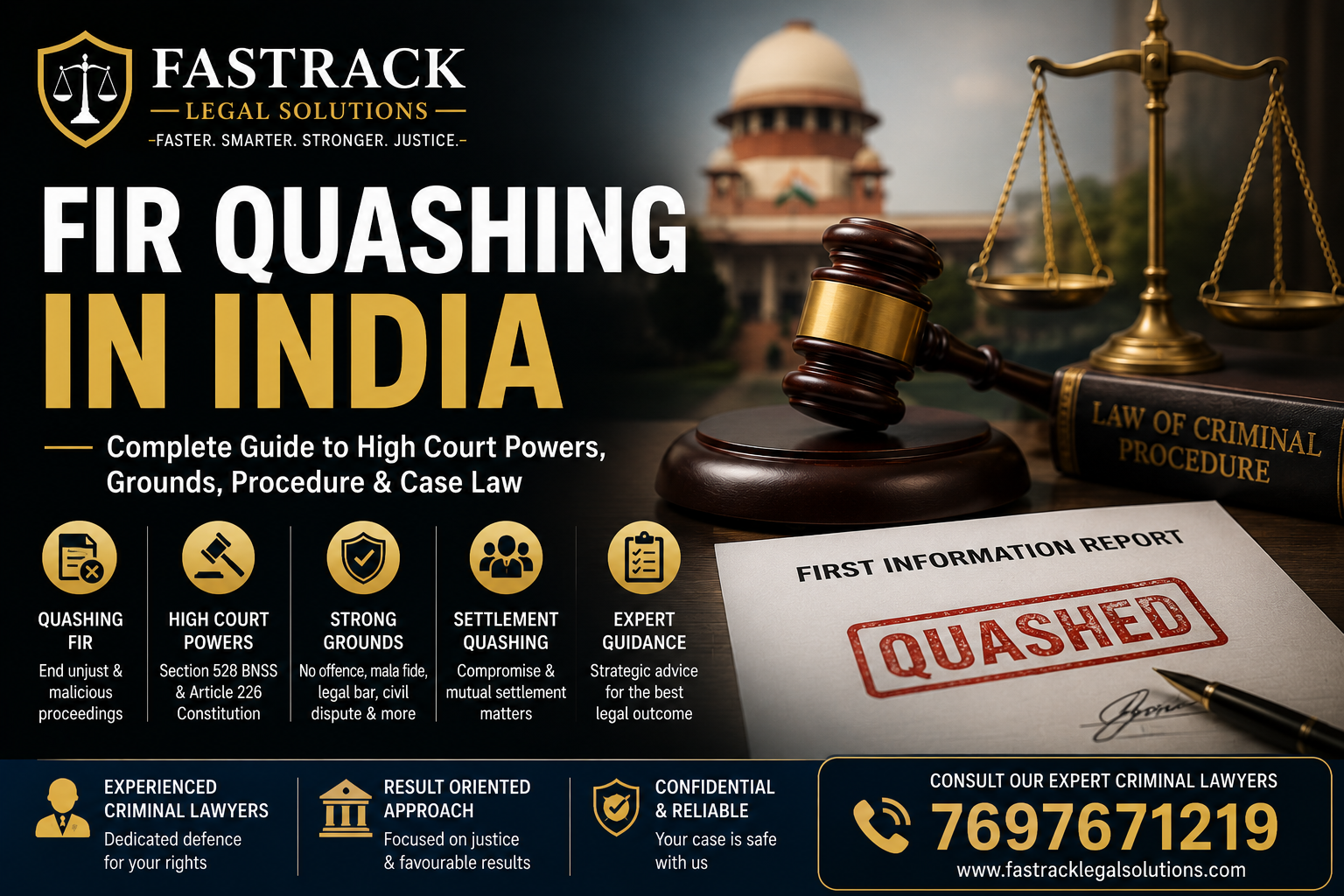
FIR quashing in India is the legal remedy by which the High Court may terminate a criminal case at the threshold where the FIR or criminal proceeding is an abuse of process, does not disclose any cognizable offence, is legally barred, is manifestly mala fide, or where continuation of prosecution would defeat the ends of...
Read More
Regular bail is a remedy sought by an accused person after arrest and while in custody. Under the Bharatiya Nagarik Suraksha Sanhita, 2023, regular bail in non-bailable offences is principally governed by Section 480 BNSS before courts other than the High Court and Court of Session, and by Section 483 BNSS before the High Court...
Read More
Anticipatory bail, now governed by Section 482 of the Bharatiya Nagarik Suraksha Sanhita, 2023, is a pre-arrest legal remedy available to a person who has reason to believe that he or she may be arrested for a non-bailable offence. The application lies before the Court of Session or the High Court. The court may grant...
Read More
Use up and down arrow keys to resize the meta box pane. Bail law in India protects personal liberty by allowing an accused person to be released from custody during investigation, inquiry or trial, subject to conditions imposed by the court. After the new criminal laws came into force on 1 July 2024, the principal...
Read More
Disability pension for Armed Forces personnel is payable where a disability is attributable to or aggravated by military service and is accepted in accordance with the applicable Pension Regulations and Entitlement Rules. It ordinarily consists of two components: service element and disability element. The Supreme Court has repeatedly held that, where no disease or disability...
Read More