
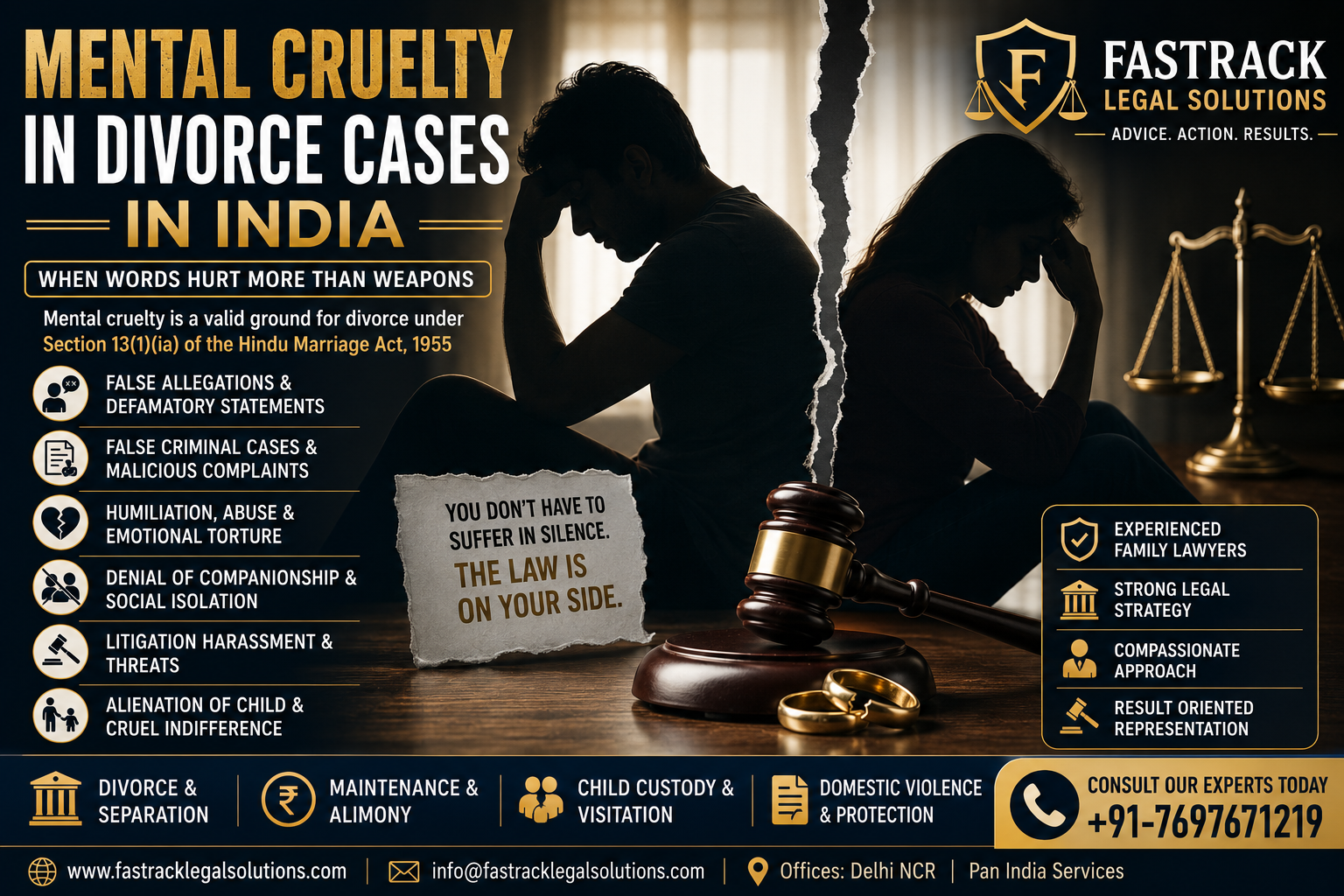
Mental cruelty in divorce cases means conduct by one spouse that causes such mental pain, humiliation, emotional suffering or psychological injury that the other spouse cannot reasonably be expected to continue the marriage. Under Section 13(1)(ia) of the Hindu Marriage Act, 1955, cruelty is a ground for divorce. Mental cruelty may include false criminal complaints, scandalous allegations, sustained humiliation, threats, denial of normal marital relationship, character assassination, abusive conduct, repeated litigation harassment, or conduct that destroys the foundation of matrimonial life.
Introduction
Cruelty is one of the most commonly pleaded grounds for divorce in India. However, cruelty is also one of the most misunderstood grounds. Many litigants assume that cruelty means only physical violence. That is not correct. Indian matrimonial law recognises both physical cruelty and mental cruelty.
Mental cruelty is often more difficult to prove because it may not leave visible injuries. It may arise from repeated insults, false allegations, humiliating conduct, abusive messages, threats, emotional neglect, deliberate alienation, false police complaints, or sustained conduct making matrimonial life impossible.
A divorce petition based on mental cruelty must be carefully drafted. General allegations are not enough. The petition should show specific incidents, conduct, dates, documents, witnesses, impact on the petitioner and the cumulative effect of the respondent’s behaviour.
This article explains the meaning of mental cruelty in divorce cases, examples of mental cruelty, evidence required, important Supreme Court judgments, Family Court strategy and common drafting mistakes.
What is Mental Cruelty in Divorce Law?
Mental cruelty is conduct that causes serious mental suffering or emotional injury to a spouse. It is not limited to physical assault. The court examines whether the conduct is so grave that the petitioner cannot reasonably be expected to live with the respondent.
Mental cruelty may be caused by:
- Repeated humiliation.
- False criminal complaints.
- False allegations of adultery or immoral character.
- Sustained abusive behaviour.
- Threats of suicide or false implication.
- Public insult before family, friends or colleagues.
- Deliberate denial of companionship.
- Unjustified refusal of marital relationship.
- Repeated police complaints without basis.
- Defamatory allegations in pleadings or public forums.
- Alienation of child from the other parent.
- Persistent harassment through litigation.
- Financial intimidation or coercive conduct.
- Conduct destroying trust and dignity in marriage.
Mental cruelty is assessed from the complete matrimonial relationship. One isolated incident may or may not be enough. The cumulative effect of conduct is often more important.
Legal Provision: Section 13(1)(ia), Hindu Marriage Act
Under the Hindu Marriage Act, 1955, a marriage may be dissolved by a decree of divorce if, after solemnisation of marriage, one spouse has treated the other with cruelty.
Cruelty under Section 13(1)(ia) is not exhaustively defined. Therefore, courts have developed the law through judgments. The meaning of cruelty depends on facts, social background, conduct of parties, duration of marriage, nature of allegations, and the effect of conduct on the petitioner.
People Also Ask: Is Mental Cruelty a Ground for Divorce in India?
Yes. Mental cruelty is a recognised ground for divorce in India. A spouse may seek divorce if the other spouse’s conduct causes serious mental suffering, humiliation or emotional harm, making it unreasonable to continue the marriage.
Mental Cruelty vs Physical Cruelty
| Point | Physical Cruelty | Mental Cruelty |
|---|---|---|
| Nature | Physical violence or bodily harm | Emotional, psychological or mental suffering |
| Evidence | Medical records, injury photos, witnesses | Messages, complaints, conduct, allegations, circumstances |
| Visibility | Usually visible | Often invisible but legally serious |
| Examples | Assault, beating, physical abuse | False cases, humiliation, threats, character assassination |
| Proof | Direct evidence may exist | Often proved by cumulative circumstances |
Both forms of cruelty can justify divorce if proved.
Examples of Mental Cruelty in Divorce Cases
1. False Criminal Complaints
False criminal complaints against a spouse or in-laws may amount to mental cruelty if they are malicious, reckless, defamatory or unsupported by evidence.
Examples include:
- False allegations of dowry harassment.
- False allegations of physical abuse.
- False allegations against aged parents.
- Multiple police complaints filed to harass.
- Complaints used as settlement pressure.
- Allegations later found baseless by court or investigation.
However, every dismissed complaint does not automatically become cruelty. The petitioner must show falsity, malice, harassment or serious impact.
2. False Allegations of Adultery or Immoral Character
Alleging that a spouse has an illicit relationship is a serious allegation. If made without proof, it can destroy reputation, dignity and mental peace.
Such allegations may appear in:
- Written statements.
- Complaints.
- Legal notices.
- Social media posts.
- Messages to relatives.
- Public statements.
- Workplace communications.
Unfounded allegations of adultery, prostitution, womanising, immoral conduct or illicit relationship may amount to mental cruelty.
3. Repeated Humiliation and Insult
Continuous insult or humiliation can amount to mental cruelty if it affects dignity and mental peace.
Examples include:
- Insulting spouse before family.
- Mocking income, job or appearance.
- Abusing spouse’s parents.
- Publicly humiliating spouse at workplace or social gatherings.
- Constant taunts about status, infertility, financial condition or family background.
Trivial quarrels are not enough. The conduct must cross the threshold of ordinary matrimonial wear and tear.
4. Threats of Suicide or False Implication
Repeated threats of suicide, self-harm or false criminal implication can create fear, anxiety and mental trauma.
Such threats may include:
- “I will commit suicide and blame you.”
- “I will send you and your family to jail.”
- “I will ruin your career.”
- “I will file false cases.”
- “I will make sure you never see the child.”
If proved, such threats may support a cruelty claim.
5. Denial of Marital Relationship
Persistent and unjustified refusal of normal marital relationship may amount to mental cruelty depending on facts. Courts examine whether refusal is deliberate, prolonged, unjustified and destructive of matrimonial life.
However, this ground must be pleaded sensitively. Health, trauma, pregnancy, medical issues, abuse, coercion or genuine reasons may affect the court’s view.
6. Refusal to Live Together Without Reasonable Cause
If one spouse deliberately refuses to live with the other without reasonable cause and uses separation as emotional pressure, it may support cruelty or desertion, depending on facts.
The petitioner should show:
- Efforts to bring the spouse back.
- Messages or notices requesting cohabitation.
- Respondent’s refusal.
- Absence of reasonable cause.
- Impact on matrimonial life.
7. Litigation Used as Harassment
Matrimonial litigation itself is a legal right. But litigation may become cruelty where it is demonstrably false, malicious, repeated or designed to harass.
Examples include:
- Multiple complaints in different forums.
- False allegations against relatives.
- Complaints filed after settlement talks fail.
- Cases filed only to pressurise for money.
- Defamatory pleadings with no basis.
- Repeated non-cooperation after initiating proceedings.
The court examines whether the litigation was bona fide or abusive.
8. Alienation of Child from Other Parent
Deliberately turning a child against the other parent may amount to serious mental cruelty in appropriate cases. It may also affect custody and visitation proceedings.
Examples include:
- Blocking communication with child.
- Telling child false facts about other parent.
- Preventing visitation despite orders.
- Creating fear or hatred in child.
- Using child as bargaining tool.
Courts treat child welfare as paramount. Parental alienation can damage both matrimonial and custody cases.
People Also Ask: Can False 498A Case Be Ground for Divorce?
Yes, a false and malicious criminal case may amount to mental cruelty if proved. However, the mere filing of a complaint is not automatically cruelty. The spouse seeking divorce must show that the allegations were false, reckless, malicious, defamatory, or filed to harass.
What is Not Mental Cruelty?
Not every matrimonial dispute becomes mental cruelty. Courts usually do not treat the following as cruelty by themselves:
- Ordinary quarrels.
- Minor disagreements.
- Normal adjustment issues.
- Isolated angry words.
- Temporary separation with valid reason.
- Mere incompatibility.
- Difference in lifestyle.
- General dissatisfaction.
- Unproved allegations.
- Small domestic arguments.
The law does not dissolve marriages for trivial irritations. The conduct must be serious enough to make continuation of marriage unreasonable.
Standard of Proof in Mental Cruelty Cases
Mental cruelty in matrimonial cases is generally proved on the civil standard of preponderance of probabilities. The petitioner does not have to prove cruelty beyond reasonable doubt as in a criminal trial.
This is important because many matrimonial facts happen inside the home and may not have direct witnesses. The court can consider conduct, circumstances, documents, probabilities and cumulative impact.
Important Supreme Court Judgments on Mental Cruelty
1. N.G. Dastane v. S. Dastane
This is a foundational judgment on matrimonial cruelty. The Supreme Court clarified that matrimonial cruelty is proved on preponderance of probabilities, not beyond reasonable doubt. The case is important for understanding how courts assess conduct in matrimonial relationships.
2. Samar Ghosh v. Jaya Ghosh
This is the leading judgment on mental cruelty. The Supreme Court explained that mental cruelty cannot be put in a fixed formula. The Court gave illustrative categories of conduct that may amount to mental cruelty and emphasised the cumulative effect of matrimonial conduct.
3. K. Srinivas Rao v. D.A. Deepa
The Supreme Court recognised that false criminal complaints and defamatory allegations may amount to mental cruelty. This judgment is frequently relied upon where one spouse alleges that the other used criminal complaints and reckless allegations to harass.
4. Vishwanath Agrawal v. Sarla Vishwanath Agrawal
The Supreme Court considered reckless allegations against the character of a spouse and held that such conduct may amount to cruelty depending on facts.
5. Naveen Kohli v. Neelu Kohli
The Supreme Court recognised that repeated litigation, bitterness, long separation and complete breakdown of matrimonial relationship may be relevant while assessing cruelty and the viability of continuing the marriage.
Also Read Rajnesh v. Neha: Supreme Court Guidelines on Maintenance in India
Evidence Required to Prove Mental Cruelty
A mental cruelty petition should be evidence-driven.
Documentary Evidence
- WhatsApp chats.
- Emails.
- SMS messages.
- Social media posts.
- Police complaints.
- Legal notices.
- Medical records.
- Court orders.
- Mediation records, where legally usable.
- Written admissions.
- Call recordings, subject to admissibility.
- Photographs or videos, where relevant.
- FIR closure report or acquittal order, where applicable.
- Complaint copies filed before authorities.
Oral Evidence
- Petitioner’s testimony.
- Family members.
- Neighbours.
- Friends.
- Colleagues.
- Doctors or counsellors, where relevant.
- Persons before whom humiliation occurred.
Circumstantial Evidence
- Sudden separation.
- Repeated threats.
- Pattern of complaints.
- Refusal to cohabit.
- Conduct during litigation.
- Messages showing intention to harass.
- Public allegations.
- Child alienation conduct.
Evidence should be legally obtained and properly presented.
How to Draft a Divorce Petition on Mental Cruelty
A strong petition should not read like a general emotional complaint. It should be structured around legal ingredients.
Essential Pleading Points
- Date and place of marriage.
- Jurisdiction of the Family Court.
- Details of cohabitation.
- Children, if any.
- Specific incidents of cruelty.
- Dates or approximate dates.
- Exact words or conduct where possible.
- Documents supporting incidents.
- Impact on petitioner.
- Attempts at reconciliation.
- Reason why continuation of marriage is impossible.
- Cause of action.
- Reliefs sought.
Drafting Style
Use clear paragraphs. Avoid exaggerated language. Avoid unsupported scandalous allegations. Courts prefer precise facts over emotional adjectives.
People Also Ask: What Documents Are Needed for Divorce on Cruelty?
Documents may include marriage proof, identity/address proof, chats, emails, police complaints, medical records, legal notices, photographs, court orders, witness details, income documents for maintenance issues, and evidence showing the pattern and impact of cruelty.
Mental Cruelty by Wife Against Husband
A husband may seek divorce on mental cruelty if he proves legally relevant conduct by the wife. Examples may include:
- False criminal complaints.
- False allegations against husband and family.
- Public humiliation.
- Threats of suicide or false implication.
- Denial of child access without reason.
- Defamatory allegations.
- Persistent refusal to cohabit without cause.
- Abusive conduct towards husband and family.
The husband must prove facts through evidence. Courts do not grant divorce merely because the relationship is strained.
Mental Cruelty by Husband Against Wife
A wife may seek divorce on mental cruelty where the husband’s conduct causes serious mental suffering. Examples may include:
- Verbal abuse.
- Dowry-related harassment.
- Threats and intimidation.
- Character assassination.
- Alcohol-related abusive conduct.
- Humiliation before family.
- Forced isolation.
- Financial control.
- Emotional neglect.
- Cruel conduct by husband or his family, where legally attributable.
The wife may also pursue connected remedies such as maintenance, residence, domestic violence reliefs and criminal action depending on facts.
Mental Cruelty and Domestic Violence
Mental cruelty and domestic violence may overlap, but they are not the same proceeding.
A spouse may file:
- Divorce petition on ground of cruelty.
- Domestic violence complaint for protection, residence, maintenance or compensation.
- Maintenance proceedings.
- Criminal complaint, where offences are made out.
The litigation strategy must consider how one proceeding affects the other.
Mental Cruelty and Maintenance
A party accused of cruelty may still claim maintenance if legally entitled. Divorce and maintenance are separate issues. However, conduct, income, dependency, standard of living and facts may be relevant depending on the provision invoked.
Maintenance proceedings commonly require financial disclosure. Parties should keep salary slips, ITRs, bank statements, business records, rent documents, loan documents and expense records ready.
Mental Cruelty and Child Custody
Where mental cruelty allegations involve children, the court may separately assess custody and visitation. The guiding principle in custody cases is the welfare of the child.
A parent should avoid using child custody as revenge. Courts examine whether the child is being manipulated, neglected, alienated or used as a tool in litigation.
False Allegations in Pleadings as Cruelty
Sometimes cruelty arises not only before filing but also during litigation. False and scandalous allegations made in pleadings, affidavits or complaints may be relied upon as mental cruelty if they are serious and unsupported.
Examples include:
- Allegations of adultery.
- Allegations of prostitution.
- Allegations of impotency without basis.
- Allegations of criminality without proof.
- Allegations against parents and siblings without material.
- Publicly damaging reputation.
Such allegations must be handled carefully in pleadings and cross-examination.
Defence Against False Allegation of Mental Cruelty
A respondent can defend a cruelty petition by showing:
- Allegations are vague.
- Incidents are not proved.
- Alleged conduct is ordinary wear and tear.
- Petitioner has suppressed material facts.
- Petitioner was the wrongdoer.
- Complaints were bona fide.
- Separation had reasonable cause.
- Evidence is manipulated or incomplete.
- There was condonation or reconciliation.
- Petition is filed as counterblast.
The reply should be specific and document-based.
Do’s in Mental Cruelty Divorce Cases
- Preserve messages and documents.
- Prepare a date-wise chronology.
- Keep complaint copies and orders.
- Avoid exaggerated allegations.
- Mention specific incidents.
- Explain cumulative impact.
- Use relevant Supreme Court judgments.
- Keep financial records ready.
- Address child-related issues separately.
- Consider mediation if settlement is possible.
Don’ts in Mental Cruelty Divorce Cases
- Do not file vague allegations.
- Do not make false adultery allegations.
- Do not create evidence.
- Do not delete chats or records.
- Do not post matrimonial details on social media.
- Do not ignore maintenance or custody issues.
- Do not use children as pressure tools.
- Do not assume every quarrel is cruelty.
- Do not rely only on oral allegations.
- Do not file without jurisdiction check.
Search-Optimised Quick Answers
What is mental cruelty in divorce?
Mental cruelty means conduct causing serious mental pain, humiliation or emotional injury, making it unreasonable for the spouse to continue the marriage.
Is mental cruelty a ground for divorce?
Yes. Cruelty under Section 13(1)(ia) of the Hindu Marriage Act includes mental cruelty.
Can false cases amount to mental cruelty?
Yes, false and malicious complaints may amount to mental cruelty if proved through facts and evidence.
Can allegations of adultery amount to cruelty?
Yes, reckless and unproved allegations of adultery or immoral conduct may amount to mental cruelty.
Is normal quarrel mental cruelty?
No. Ordinary quarrels and normal wear and tear of marriage usually do not amount to mental cruelty.
Frequently Asked Questions
1. What is mental cruelty under Hindu Marriage Act?
Mental cruelty is conduct that causes serious mental suffering, humiliation or emotional trauma to a spouse, making continued matrimonial life unreasonable.
2. Can I get divorce for mental cruelty?
Yes, if mental cruelty is specifically pleaded and proved before the Family Court.
3. What evidence is required for mental cruelty?
Evidence may include chats, emails, complaints, legal notices, medical records, witnesses, social media posts, court orders and conduct showing a pattern of cruelty.
4. Can false 498A case be cruelty?
A false and malicious 498A complaint may amount to mental cruelty if the spouse proves falsity, malice and serious impact.
5. Can refusal of physical relationship be mental cruelty?
Persistent and unjustified refusal of marital relationship may amount to mental cruelty depending on facts and evidence.
6. Are false allegations in court pleadings cruelty?
Serious, reckless and unproved allegations in pleadings may constitute mental cruelty depending on their nature and impact.
7. What is the standard of proof in mental cruelty cases?
The standard is preponderance of probabilities, not proof beyond reasonable doubt.
8. Can husband file divorce for mental cruelty?
Yes. Either husband or wife can seek divorce on the ground of mental cruelty.
9. Can wife file divorce for mental cruelty?
Yes. A wife can seek divorce on mental cruelty and may also pursue maintenance, domestic violence or other remedies depending on facts.
10. Is long separation mental cruelty?
Long separation may support a cruelty argument in appropriate cases, especially where the marriage is completely broken and continuation causes further mental suffering. But the Family Court generally requires proof of a statutory ground.
Conclusion
Mental cruelty is a powerful but fact-sensitive ground for divorce in India. It covers conduct that destroys the dignity, peace, trust and emotional foundation of marriage. False cases, defamatory allegations, threats, humiliation, denial of companionship and sustained abusive conduct may amount to mental cruelty if properly proved.
The strongest mental cruelty cases are built on chronology, evidence and cumulative impact. The weakest cases are those based on vague allegations and emotional narration.
A well-drafted divorce petition must connect facts with law, plead specific incidents, support them with evidence and rely on the correct Supreme Court judgments.
Disclaimer
This article is intended for general legal awareness and educational purposes only. It does not constitute legal advice, solicitation, advertisement or creation of an advocate-client relationship. Mental cruelty cases depend on facts, evidence, pleadings, personal law, jurisdiction, conduct of parties, maintenance issues, child custody and Family Court practice.
The legal basis is Section 13 of the Hindu Marriage Act, 1955, which includes cruelty as a divorce ground; Samar Ghosh v. Jaya Ghosh remains the leading Supreme Court authority on mental cruelty; K. Srinivas Rao v. D.A. Deepa addresses false complaints/defamatory conduct as mental cruelty; and N.G. Dastane v. S. Dastane is foundational on the civil standard of proof in matrimonial cruelty cases.